Last updated: August 10, 2026
Executive summary: Sulindac is a mature, off-patent NSAID with low commercial growth prospects and limited financial visibility. The branded product Clinoril has been discontinued in the United States, while generic sulindac tablets remain available through multiple manufacturers. No active U.S. patent or regulatory exclusivity appears to block generic competition. Market value is driven by low-cost maintenance demand, legacy prescribing, and clinical niches such as osteoarthritis, rheumatoid arthritis, and acute gout, but constrained by broad NSAID competition and gastrointestinal, renal, cardiovascular, and hepatic safety risks. Product-specific revenue is not publicly disclosed, so the financial trajectory is best assessed through generic market structure, prescription persistence, pricing, and regulatory risk rather than branded sales forecasts.
Sulindac Market Dynamics, Patent Status, Financial Trajectory, and Generic Competition
What is sulindac and how is it used?
Sulindac is an oral nonsteroidal anti-inflammatory drug, or NSAID, marketed historically in the United States under the brand name Clinoril. It is a prodrug converted in vivo to an active sulfide metabolite that inhibits prostaglandin synthesis through cyclooxygenase inhibition.
U.S. labeling identifies sulindac for the treatment of osteoarthritis, rheumatoid arthritis, ankylosing spondylitis, acute painful shoulder, acute gouty arthritis, and acute painful musculoskeletal conditions. The product is available primarily as 150 mg and 200 mg tablets. Sulindac is generally administered twice daily, although dosing depends on the indication and patient risk profile (DailyMed, 2024).
The drug competes with:
- Ibuprofen and naproxen
- Diclofenac
- Meloxicam
- Celecoxib
- Indomethacin
- Etodolac
- Ketorolac for short-term use
- Generic aspirin and other nonprescription NSAIDs
Sulindac has no meaningful biologic, biosimilar, or specialty-pharmacy component. Its commercial position is that of a prescription generic with established clinical familiarity.
When did sulindac lose patent and market exclusivity?
Sulindac lost its principal U.S. compound and product exclusivity decades ago. Merck commercialized Clinoril during the 1970s, and the product became subject to generic competition after expiration of the relevant patent and regulatory exclusivity periods.
The original U.S. regulatory approval predates the modern Hatch-Waxman framework. The FDA approved Clinoril in 1978, and the brand product is no longer the primary commercial source of sulindac in the United States (FDA, Drugs@FDA, 2024).
| Item |
Status |
| Active ingredient |
Sulindac |
| Historical U.S. brand |
Clinoril |
| Original sponsor |
Merck |
| U.S. approval era |
1970s |
| Current U.S. commercial model |
Generic prescription tablets |
| Compound patent protection |
Expired |
| Regulatory exclusivity |
Expired |
| Biosimilar exposure |
None |
| Branded growth opportunity |
Minimal |
The remaining intellectual-property risk is limited to later patents covering formulations, manufacturing processes, combinations, or specific methods of use. Such patents have not created a meaningful U.S. barrier to ordinary sulindac tablets.
What is the Orange Book status of sulindac?
Public FDA Orange Book data does not indicate an active patent or exclusivity barrier that prevents approval of conventional generic sulindac tablets. The product is positioned as an established generic drug rather than a protected branded product (FDA, Orange Book, 2025).
The practical Orange Book assessment is:
| Orange Book issue |
Sulindac assessment |
| Listed innovator product |
Historical Clinoril product |
| Active listed patent blocking generic tablets |
None identified in current public listings |
| New chemical entity exclusivity |
Expired |
| Pediatric exclusivity |
None relevant to current market access |
| Paragraph IV pathway |
Commercially immaterial for a decades-old product |
| Generic approval route |
ANDA pathway |
| 180-day first-filer value |
Low or absent because multiple generics already compete |
The absence of an active listed patent does not eliminate all litigation risk. A manufacturer could assert a non-Orange Book patent involving a particular formulation or manufacturing process, but that risk is materially lower than for a branded drug with active composition-of-matter or method-of-use patents.
How many patents cover sulindac today?
No active U.S. patent estate appears to provide meaningful market exclusivity for standard sulindac tablets. Historical patents covering the molecule and early formulations have expired. Patent families may still appear in international databases because of expired national rights, abandoned applications, or patents directed to research uses.
The relevant distinction is between historical patent coverage and commercially enforceable protection:
| Patent category |
Current commercial relevance |
| Original sulindac compound patents |
Expired |
| Basic tablet formulation patents |
Expired or no longer commercially blocking |
| Salt or polymorph patents |
Limited relevance unless tied to a marketed product |
| Manufacturing-process patents |
Potentially relevant to a specific supplier, not the entire market |
| Combination patents |
Narrow, indication-specific exposure |
| New formulation patents |
Possible but no major U.S. product has established a protected market |
| Method-of-use patents |
Potentially narrow and vulnerable to design-around |
A patent search based only on the word "sulindac" can overstate protection by counting expired documents and patents covering noncommercial research applications. The actionable conclusion is that sulindac has no broadly enforceable U.S. patent moat around conventional oral tablets.
What generic entry risks exist for sulindac?
Generic entry risk is already realized rather than prospective. Sulindac has been generic for many years, and competition has compressed pricing and reduced the commercial value of individual abbreviated new drug applications.
The principal generic risks are:
- Price erosion from multiple suppliers.
- Low reimbursement rates and pharmacy substitution.
- Manufacturing interruptions or raw-material shortages.
- FDA quality actions affecting a supplier.
- Prescriber migration to newer or better-known NSAIDs.
- Safety-related restrictions that reduce chronic use.
- Low prescription volume that makes the product unattractive to manufacturers.
For generic manufacturers, the product may still generate recurring revenue because it is inexpensive to manufacture and has an established prescribing base. The limitation is scale. A supplier normally cannot support premium pricing unless it has temporary capacity constraints, a differentiated packaging arrangement, or a specialized distribution position.
What formulations are protected by sulindac patents?
The commercially established U.S. dosage form is the immediate-release tablet. No widely used extended-release, transdermal, injectable, or long-acting sulindac formulation has displaced standard tablets.
Potential formulation opportunities include:
- Modified-release tablets
- Gastroprotective combinations
- Lower-dose geriatric formulations
- Fixed-dose combinations with proton-pump inhibitors
- Topical delivery systems
- Abuse-deterrent or specialty-release designs
These concepts face economic barriers. Sulindac is inexpensive, and a new formulation would need to justify development, manufacturing, and regulatory costs despite competition from widely available NSAIDs. A reformulated product could receive patent protection, but its commercial value would depend on demonstrating a clinically meaningful improvement in tolerability, adherence, or efficacy.
The FDA label warns of serious gastrointestinal bleeding, ulceration, renal toxicity, cardiovascular thrombotic events, hypersensitivity reactions, and hepatic effects. Those risks make a differentiated formulation commercially attractive in theory, but they also increase the evidentiary burden for a new product (DailyMed, 2024).
What method-of-use patents or licensing deals affect sulindac?
No major current U.S. licensing transaction appears to control access to conventional sulindac tablets. Merck’s historical ownership of Clinoril is commercially important as background but does not create an active licensing toll on the generic market.
Sulindac has generated research interest in areas such as colorectal neoplasia, familial adenomatous polyposis, chemoprevention, and inflammatory signaling. Research use does not establish a commercially enforceable market position. A method-of-use patent directed to a narrowly defined cancer-prevention regimen could protect a specific indication, but it would not block generic sulindac prescriptions for arthritis or gout.
The commercial value of any new method-of-use claim would depend on:
- A defined patient population
- A clinically accepted endpoint
- A dosing regimen that is difficult to avoid
- FDA approval or credible off-label adoption
- A tolerability profile that supports chronic administration
No such method has created a major commercial sulindac franchise in the United States.
What is the FDA regulatory status of sulindac?
Sulindac remains an FDA-approved active ingredient, but Clinoril is not the relevant growth platform. Generic manufacturers can market sulindac tablets through ANDAs if they demonstrate pharmaceutical equivalence and bioequivalence to the reference product.
The regulatory profile has several commercial implications:
- Approval is based on an established reference product.
- Clinical development risk is lower than for a new molecular entity.
- Generic manufacturers remain subject to current good manufacturing practice requirements.
- Labeling retains class-wide NSAID warnings.
- FDA safety communications can affect the entire category, not only sulindac.
- A manufacturer with a quality failure can lose supply without eliminating market demand.
Sulindac is not a biologic and does not face biosimilar interchangeability rules. It also does not benefit from orphan-drug exclusivity, new chemical entity exclusivity, or other current innovation incentives.
How strong is the sulindac patent estate?
The sulindac patent estate is weak from a market-exclusivity perspective and moderate only as a historical documentation asset.
| Strength factor |
Assessment |
| Composition-of-matter protection |
None currently effective |
| Formulation protection |
Limited and nonblocking for standard tablets |
| Method-of-use protection |
Narrow, indication-dependent |
| Manufacturing protection |
Supplier-specific and potentially designable around |
| Regulatory exclusivity |
None |
| Litigation leverage |
Low |
| Generic substitution resistance |
Low |
| Ability to support premium pricing |
Low |
The drug’s commercial defensibility comes from manufacturing reliability, distributor relationships, regulatory compliance, and supply continuity rather than patents.
Which companies are challenging sulindac, and who supplies it?
Sulindac is not facing a conventional branded-generic patent challenge because the market already consists primarily of generic suppliers. Public drug databases identify multiple manufacturers and labelers over time, including contract manufacturers and distributors that may change with product availability.
The competitive structure is fragmented. Manufacturers compete on:
- Wholesale acquisition price
- Supply reliability
- Contract terms with wholesalers
- FDA inspection history
- Packaging and bottle sizes
- Ability to maintain low-volume products
- Geographic distribution
The major competitive threat is substitution by other generic NSAIDs, not a single rival sulindac product. Naproxen, ibuprofen, meloxicam, diclofenac, and celecoxib have broader commercial recognition and, in some cases, stronger formulary positions.
What is the financial trajectory for sulindac?
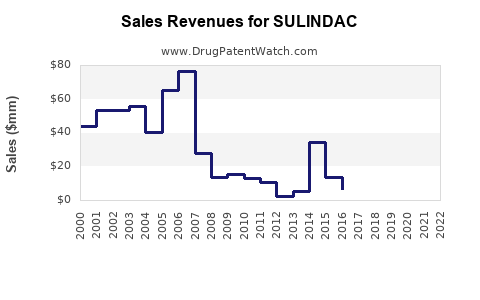
Sulindac has a stable-to-declining financial profile as a standalone product. Public companies generally do not disclose sulindac revenue separately because sales are immaterial within diversified generic portfolios. Public prescription and market datasets may track units and spending, but they do not provide a universally accepted audited global sulindac market figure.
The financial trajectory is therefore characterized as follows:
| Financial driver |
Direction |
| Unit demand |
Stable to modestly declining |
| Net price |
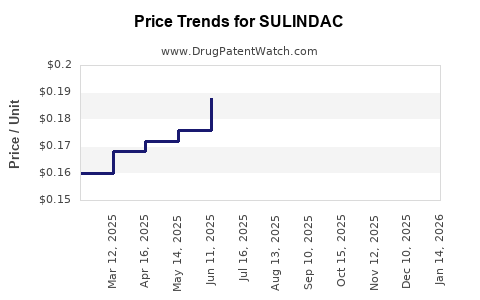
Downward over the long term |
| Gross margin |
Low to moderate, supplier-dependent |
| Brand revenue |
Effectively absent in the U.S. |
| Generic revenue |
Recurring but limited |
| Market concentration |
Variable, with periodic supplier exits |
| Growth from innovation |
Low |
| Revenue volatility |
Linked to shortages and contracts |
| Long-term value |
Maintenance cash flow rather than expansion |
Demand persists because sulindac is inexpensive, familiar, and included in historical treatment patterns. It does not have the growth characteristics of a specialty drug, a biologic, or a protected chronic therapy.
Revenue can temporarily improve when one or more suppliers exit the market, when a wholesaler experiences a shortage, or when contract changes reduce availability. Those effects are usually temporary and invite new supply rather than creating durable pricing power.
What patent litigation and settlement agreements affect sulindac?
No major current U.S. patent litigation or Paragraph IV settlement appears to materially affect the conventional sulindac market. The timing of generic entry is historical, and the product is not in the commercial phase where an innovator typically negotiates a high-value launch settlement.
Any litigation involving sulindac today would more likely concern:
- Product liability
- Manufacturing defects
- Labeling adequacy
- Distribution contracts
- Regulatory compliance
- A narrow reformulation or combination product
Those disputes would affect a particular manufacturer or product configuration rather than the entire active ingredient market.
What geographic coverage does sulindac have?
Sulindac has broad historical international availability, but commercial status varies by country. Market access depends on national approvals, local generic manufacturers, reimbursement rules, and whether the historical brand remains registered.
The United States is a mature generic market. Europe and other developed markets also have established NSAID competition, often with stronger use of naproxen, diclofenac, ibuprofen, and selective COX-2 inhibitors. Emerging markets may retain demand for low-cost oral NSAIDs, but local production and pricing controls can limit margin.
Geographic expansion would not normally require patent licensing. The main barriers are local registration, pharmacovigilance, manufacturing certification, tender pricing, and distribution.
How does sulindac compare with competing NSAIDs?
| Drug |
Commercial position |
Patent status |
Main competitive issue |
| Sulindac |
Mature prescription generic |
Expired |
Low price and declining differentiation |
| Naproxen |
Large generic and OTC market |
Expired |
Strong physician and consumer recognition |
| Ibuprofen |
Large OTC and prescription market |
Expired |
Broad availability and very low cost |
| Diclofenac |
Large international generic market |
Expired |
Strong global use but cardiovascular concerns |
| Meloxicam |
Established prescription generic |
Expired |
Once-daily dosing and formulary use |
| Celecoxib |
Generic, with historical brand value |
Core patents expired |
COX-2 positioning and cardiovascular debate |
| Indomethacin |
Mature prescription generic |
Expired |
Efficacy in selected gout and inflammatory uses |
Sulindac’s potential advantage is clinical familiarity and a historical perception of lower renal impact than some NSAIDs, although it remains subject to significant renal and gastrointestinal warnings. Its disadvantage is the absence of a strong current differentiation claim.
What manufacturing and intellectual-property barriers remain?
Manufacturing is the primary practical barrier. Generic sulindac production requires validated synthesis, impurity control, stable tablet formulation, bioequivalence, and compliance with FDA quality standards. Active pharmaceutical ingredient sourcing can affect margins, especially for a low-volume product.
The principal barriers are operational:
- API supplier qualification
- Impurity and degradation-product control
- Batch consistency
- Packaging stability
- FDA inspection readiness
- Low-volume economic viability
- Wholesaler and pharmacy contracting
These barriers can create short-term supply advantages but do not create durable intellectual-property exclusivity. A manufacturer with a reliable, compliant supply chain may capture share even without patent protection.
What are the main investment implications for sulindac?
Sulindac is unlikely to support a standalone growth investment thesis. Its value is more relevant in three situations:
- A generic manufacturer uses it to fill portfolio gaps and maintain customer relationships.
- A supplier benefits from temporary market shortages or competitor exits.
- A reformulation company develops a clinically differentiated product with new patent protection.
The downside case includes continued price compression, discontinuation by low-volume suppliers, increased NSAID safety scrutiny, and substitution by once-daily or OTC alternatives. The upside case is narrow and depends on a new formulation, a validated chemopreventive indication, or a temporary supply disruption.
Key Takeaways
- Sulindac is a mature, off-patent prescription NSAID.
- Clinoril is a historical brand; U.S. commercial activity is primarily generic.
- No active Orange Book patent or regulatory exclusivity appears to block conventional generic tablets.
- Paragraph IV litigation and settlement risk is not commercially significant.
- Formulation and method-of-use patents could protect new products but do not protect the standard tablet market.
- Product-specific revenue is not publicly disclosed and is likely immaterial within diversified generic portfolios.
- Financial performance is driven by low-cost recurring demand, supplier count, shortages, and price erosion.
- The main competitive threat is substitution by naproxen, ibuprofen, meloxicam, diclofenac, and celecoxib.
- Manufacturing reliability and FDA compliance are more important than patent ownership.
- The base-case outlook is stable-to-declining revenue with limited potential for durable margin expansion.
FAQs about sulindac market exclusivity and commercial outlook
Does sulindac still have a branded product in the United States?
Clinoril was the historical branded product. Current U.S. access is primarily through generic sulindac tablets rather than an actively promoted branded franchise.
Can a company obtain a new patent on sulindac?
A company could seek patents on a new formulation, combination, manufacturing process, or narrowly defined method of use. It could not recreate broad composition-of-matter exclusivity for the old molecule.
Is sulindac a good candidate for an authorized generic strategy?
It may fit a portfolio strategy where manufacturing capacity already exists, but low pricing, mature competition, and limited market size reduce the attractiveness of a standalone launch.
Does sulindac have biosimilar competition?
No. Sulindac is a small-molecule drug, so its competitive pathway is generic substitution rather than biosimilar development.
Could sulindac revenue rise materially from cancer-prevention research?
A meaningful increase would require regulatory validation, an approved indication, a tolerable chronic-use profile, and evidence that generic supply could support the new market. Research interest alone does not create a commercial franchise.
References
-
DailyMed. (2024). Sulindac tablet prescribing information. U.S. National Library of Medicine. https://dailymed.nlm.nih.gov/
-
U.S. Food and Drug Administration. (2024). Drugs@FDA: FDA-approved drugs database. https://www.accessdata.fda.gov/scripts/cder/daf/
-
U.S. Food and Drug Administration. (2025). Approved drug products with therapeutic equivalence evaluations, Orange Book. https://www.fda.gov/drugs/drug-approvals-and-databases/approved-drug-products-therapeutic-equivalence-evaluations-orange-book
-
U.S. Food and Drug Administration. (2024). Abbreviated new drug application process. https://www.fda.gov/drugs/generic-drugs/abbreviated-new-drug-application-anda
-
U.S. Food and Drug Administration. (2020). Non-steroidal anti-inflammatory drugs: Drug safety communication. https://www.fda.gov/drugs/postmarket-drug-safety-information-patients-and-providers/non-steroidal-anti-inflammatory-drugs-nsaids