STIVARGA Drug Patent Profile
✉ Email this page to a colleague
When do Stivarga patents expire, and when can generic versions of Stivarga launch?
Stivarga is a drug marketed by Bayer Hlthcare and is included in one NDA. There are four patents protecting this drug and one Paragraph IV challenge.
The generic ingredient in STIVARGA is regorafenib. There is one drug master file entry for this compound. One supplier is listed for this compound. Additional details are available on the regorafenib profile page.
DrugPatentWatch® Generic Entry Outlook for Stivarga
Stivarga was eligible for patent challenges on September 27, 2016.
By analyzing the patents and regulatory protections it appears that the earliest date
for generic entry will be April 8, 2031. This may change due to patent challenges or generic licensing.
There have been eight patent litigation cases involving the patents protecting this drug, indicating strong interest in generic launch. Recent data indicate that 63% of patent challenges are decided in favor of the generic patent challenger and that 54% of successful patent challengers promptly launch generic drugs.
Indicators of Generic Entry
AI Deep Research
Questions you can ask:
- What is the 5 year forecast for STIVARGA?
- What are the global sales for STIVARGA?
- What is Average Wholesale Price for STIVARGA?
Summary for STIVARGA
| US Patents: | 4 |
| Applicants: | 1 |
| NDAs: | 1 |
| Finished Product Suppliers / Packagers: | 1 |
| Raw Ingredient (Bulk) Api Vendors: | 98 |
| Clinical Trials: | 84 |
| Patent Applications: | 6,422 |
| Drug Prices: | Drug price information for STIVARGA |
| Patent Litigation and PTAB cases: | See patent lawsuits and PTAB cases for STIVARGA |
| What excipients (inactive ingredients) are in STIVARGA? | STIVARGA excipients list |
| DailyMed Link: | STIVARGA at DailyMed |
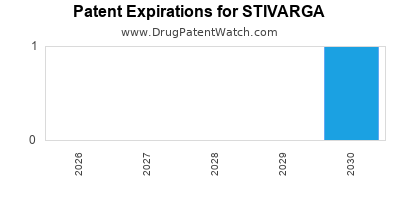

DrugPatentWatch® Estimated Loss of Exclusivity (LOE) Date for STIVARGA
Generic Entry Date for STIVARGA*:
Constraining patent/regulatory exclusivity:
NDA:
Dosage:
TABLET;ORAL |
*The generic entry opportunity date is the latter of the last compound-claiming patent and the last regulatory exclusivity protection. Many factors can influence early or later generic entry. This date is provided as a rough estimate of generic entry potential and should not be used as an independent source.
Recent Clinical Trials for STIVARGA
Identify potential brand extensions & 505(b)(2) entrants
| Sponsor | Phase |
|---|---|
| Asan Medical Center | PHASE1 |
| Mirror Biologics, Inc. | PHASE2 |
| Great Novel Therapeutics Biotech & Medicals Corporation | Phase 1/Phase 2 |
Pharmacology for STIVARGA
Paragraph IV (Patent) Challenges for STIVARGA
| Tradename | Dosage | Ingredient | Strength | NDA | ANDAs Submitted | Submissiondate |
|---|---|---|---|---|---|---|
| STIVARGA | Tablets | regorafenib | 40 mg | 203085 | 2 | 2016-09-27 |
US Patents and Regulatory Information for STIVARGA
STIVARGA is protected by four US patents.
Based on analysis by DrugPatentWatch, the earliest date for a generic version of STIVARGA is ⤷ Start Trial.
This potential generic entry date is based on patent ⤷ Start Trial.
Generics may enter earlier, or later, based on new patent filings, patent extensions, patent invalidation, early generic licensing, generic entry preferences, and other factors.
| Applicant | Tradename | Generic Name | Dosage | NDA | Approval Date | TE | Type | RLD | RS | Patent No. | Patent Expiration | Product | Substance | Delist Req. | Exclusivity Expiration |
|---|---|---|---|---|---|---|---|---|---|---|---|---|---|---|---|
| Bayer Hlthcare | STIVARGA | regorafenib | TABLET;ORAL | 203085-001 | Sep 27, 2012 | RX | Yes | Yes | ⤷ Start Trial | ⤷ Start Trial | ⤷ Start Trial | ||||
| Bayer Hlthcare | STIVARGA | regorafenib | TABLET;ORAL | 203085-001 | Sep 27, 2012 | RX | Yes | Yes | ⤷ Start Trial | ⤷ Start Trial | Y | Y | ⤷ Start Trial | ||
| Bayer Hlthcare | STIVARGA | regorafenib | TABLET;ORAL | 203085-001 | Sep 27, 2012 | RX | Yes | Yes | ⤷ Start Trial | ⤷ Start Trial | Y | ⤷ Start Trial | |||
| Bayer Hlthcare | STIVARGA | regorafenib | TABLET;ORAL | 203085-001 | Sep 27, 2012 | RX | Yes | Yes | ⤷ Start Trial | ⤷ Start Trial | Y | ⤷ Start Trial | |||
| >Applicant | >Tradename | >Generic Name | >Dosage | >NDA | >Approval Date | >TE | >Type | >RLD | >RS | >Patent No. | >Patent Expiration | >Product | >Substance | >Delist Req. | >Exclusivity Expiration |
Expired US Patents for STIVARGA
| Applicant | Tradename | Generic Name | Dosage | NDA | Approval Date | Patent No. | Patent Expiration |
|---|---|---|---|---|---|---|---|
| Bayer Hlthcare | STIVARGA | regorafenib | TABLET;ORAL | 203085-001 | Sep 27, 2012 | ⤷ Start Trial | ⤷ Start Trial |
| >Applicant | >Tradename | >Generic Name | >Dosage | >NDA | >Approval Date | >Patent No. | >Patent Expiration |
EU/EMA Drug Approvals for STIVARGA
| Company | Drugname | Inn | Product Number / Indication | Status | Generic | Biosimilar | Orphan | Marketing Authorisation | Marketing Refusal |
|---|---|---|---|---|---|---|---|---|---|
| Bayer Pharma AG | Stivarga | regorafenib | EMEA/H/C/002573Stivarga is indicated as monotherapy for the treatment of adult patients with:metastatic colorectal cancer (CRC) who have been previously treated with, or are not considered candidates for, available therapies - these include fluoropyrimidine-based chemotherapy, an anti-VEGF therapy and an anti-EGFR therapy;unresectable or metastatic gastrointestinal stromal tumors (GIST) who progressed on or are intolerant to prior treatment with imatinib and sunitinib;hepatocellular carcinoma (HCC) who have been previously treated with sorafenib. | Authorised | no | no | no | 2013-08-26 | |
| >Company | >Drugname | >Inn | >Product Number / Indication | >Status | >Generic | >Biosimilar | >Orphan | >Marketing Authorisation | >Marketing Refusal |
International Patents for STIVARGA
When does loss-of-exclusivity occur for STIVARGA?
Based on analysis by DrugPatentWatch, the following patents block generic entry in the countries listed below:
Argentina
Patent: 1060
Estimated Expiration: ⤷ Start Trial
Patent: 6395
Estimated Expiration: ⤷ Start Trial
Australia
Patent: 11240113
Estimated Expiration: ⤷ Start Trial
Brazil
Patent: 2012026117
Estimated Expiration: ⤷ Start Trial
Canada
Patent: 96238
Estimated Expiration: ⤷ Start Trial
Chile
Patent: 12002840
Estimated Expiration: ⤷ Start Trial
China
Patent: 2947271
Estimated Expiration: ⤷ Start Trial
Patent: 3980191
Estimated Expiration: ⤷ Start Trial
Colombia
Patent: 30136
Estimated Expiration: ⤷ Start Trial
Costa Rica
Patent: 120526
Estimated Expiration: ⤷ Start Trial
Croatia
Patent: 0150885
Estimated Expiration: ⤷ Start Trial
Cuba
Patent: 123
Estimated Expiration: ⤷ Start Trial
Patent: 120147
Estimated Expiration: ⤷ Start Trial
Patent: 140060
Estimated Expiration: ⤷ Start Trial
Denmark
Patent: 58448
Estimated Expiration: ⤷ Start Trial
Dominican Republic
Patent: 012000268
Estimated Expiration: ⤷ Start Trial
Patent: 016000285
Estimated Expiration: ⤷ Start Trial
Ecuador
Patent: 12012234
Estimated Expiration: ⤷ Start Trial
European Patent Office
Patent: 58448
Estimated Expiration: ⤷ Start Trial
Guatemala
Patent: 1200280
Estimated Expiration: ⤷ Start Trial
Hong Kong
Patent: 00831
Estimated Expiration: ⤷ Start Trial
Hungary
Patent: 26821
Estimated Expiration: ⤷ Start Trial
Israel
Patent: 2348
Estimated Expiration: ⤷ Start Trial
Patent: 3119
Estimated Expiration: ⤷ Start Trial
Japan
Patent: 34182
Estimated Expiration: ⤷ Start Trial
Patent: 13523851
Estimated Expiration: ⤷ Start Trial
Jordan
Patent: 58
Estimated Expiration: ⤷ Start Trial
Malaysia
Patent: 2359
Estimated Expiration: ⤷ Start Trial
Patent: 7066
Estimated Expiration: ⤷ Start Trial
Mexico
Patent: 12011734
Estimated Expiration: ⤷ Start Trial
Morocco
Patent: 156
Estimated Expiration: ⤷ Start Trial
New Zealand
Patent: 2997
Patent: Process for the preparation of 4- { 4-[({ [4 -chloro-3 -(trifluoromethyl)-phenyl]amino} carbonyl)amino]-3-fluorophenoxy} -n-methylpyridine-2-carboxamide, its salts and monohydrate
Estimated Expiration: ⤷ Start Trial
Peru
Patent: 130181
Patent: PROCEDIMIENTO PARA LA PREPARACION DE 4-{4-[({[4-CLORO-3-(TRIFLUOROMETIL)FENIL]AMINO}CARBONIL)AMINO]-3-FLUOROFENOXI}-N-METILPIRIDINA-2-CARBOXAMIDA, SUS SALES Y SU MONOHIDRATO
Estimated Expiration: ⤷ Start Trial
Patent: 160838
Patent: PROCEDIMIENTO PARA LA PREPARACION DE 4-{4-[({[4-CLORO-3-(TRIFLUOROMETIL)FENIL]AMINO}CARBONIL)AMINO]-3-FLUOROFENOXI}-N-METILPIRIDINA-2-CARBOXAMIDA, SUS SALES Y SU MONOHIDRATO
Estimated Expiration: ⤷ Start Trial
Philippines
Patent: 012502060
Patent: PROCESS FOR THE PREPARATION OF 4- {4-[({[4-CHLORO-3-(TRIFLUOROMETHYL)-PHENYL]AMINO}CARBONYL)AMINO]-3-FLUROPHENOXY}-N-METHYLPYRIDINE-2-CARBOXAMIDE, ITS SALTS AND MONOHYDRATE
Estimated Expiration: ⤷ Start Trial
Poland
Patent: 58448
Estimated Expiration: ⤷ Start Trial
Portugal
Patent: 58448
Estimated Expiration: ⤷ Start Trial
Russian Federation
Patent: 81585
Patent: СПОСОБ ПОЛУЧЕНИЯ 4-{4-[({[4-ХЛОР-3-(ТРИФТОРМЕТИЛ) ФЕНИЛ] АМИНО}-КАРБОНИЛ) АМИНО]-3-ФТОРФЕНОКСИ}-N-МЕТИЛПИРИДИН-2-КАРБОКСАМИДА, ЕГО СОЛЕЙ И МОНОГИДРАТА (METHOD OF PRODUCING 4-{4-[({[4-CHLORO-3-(TRIFLUOROMETHYL) PHENYL] AMINO} -CARBONYL) AMINO]-3-FLUOROPHENOXY}-N-METHYLPYRIDINE-2-CARBOXAMIDE, SALTS AND MONOHYDRATE THEREOF)
Estimated Expiration: ⤷ Start Trial
Patent: 12148386
Patent: СПОСОБ ПОЛУЧЕНИЯ 4-{4-[({[4-ХЛОР-3-(ТРИФТОРМЕТИЛ) ФЕНИЛ] АМИНО}-КАРБОНИЛ) АМИНО]-3-ФТОРФЕНОКСИ}-N-МЕТИЛПИРИДИН-2-КАРБОКСАМИДА, ЕГО СОЛЕЙ И МОНОГИДРАТА (METHOD OF PRODUCING 4-{4-[({[4-CHLORO-3-(TRIFLUOROMETHYL) PHENYL] AMINO} -CARBONYL) AMINO]-3-FLUOROPHENOXY}-N-METHYLPYRIDINE-2-CARBOXAMIDE, SALTS AND MONOHYDRATE THEREOF)
Estimated Expiration: ⤷ Start Trial
Serbia
Patent: 219
Patent: PROCES ZA PRIPREMU 4-{4-[({[4-HLORO-3-(TRIFLUOROMETIL)-FENIL]AMINO}KARBONIL)AMINO]-3-FLUOROFENOKSI}-N-METILPIRIDIN-2-KARBOKSAMIDA, NJEGOVIH SOLI I NJEGOVOG MONOHIDRATA (PROCESS FOR THE PREPARATION OF 4-{4-[({[4-CHLORO-3-(TRIFLUOROMETHYL)-PHENYL]AMINO}CARBONYL)AMINO]-3-FLUOROPHENOXY}-N-METHYLPYRIDINE-2-CARBOXAMIDE, ITS SALTS AND MONOHYDRATE)
Estimated Expiration: ⤷ Start Trial
Singapore
Patent: 201501221U
Patent: PROCESS FOR THE PREPARATION OF 4- {4-[({[4 -CHLORO-3 -(TRIFLUOROMETHYL)-PHENYL]AMINO}CARBONYL)AMINO]-3-FLUOROPHENOXY}-N-METHYLPYRIDINE-2-CARBOXAMIDE, ITS SALTS AND MONOHYDRATE
Estimated Expiration: ⤷ Start Trial
Patent: 4172
Patent: PROCESS FOR THE PREPARATION OF 4- {4-[({[4 -CHLORO-3 -(TRIFLUOROMETHYL)-PHENYL]AMINO}CARBONYL)AMINO]-3-FLUOROPHENOXY}-N-METHYLPYRIDINE-2-CARBOXAMIDE, ITS SALTS AND MONOHYDRATE
Estimated Expiration: ⤷ Start Trial
Slovenia
Patent: 58448
Estimated Expiration: ⤷ Start Trial
South Korea
Patent: 1800041
Estimated Expiration: ⤷ Start Trial
Patent: 130061670
Estimated Expiration: ⤷ Start Trial
Patent: 170129276
Estimated Expiration: ⤷ Start Trial
Spain
Patent: 42610
Estimated Expiration: ⤷ Start Trial
Taiwan
Patent: 1204356
Patent: Process
Estimated Expiration: ⤷ Start Trial
Patent: 1509415
Patent: Process for the preparation of 4-{4-[({[4-chloro-3-(trifluoromethyl)-phenyl]amino}carbonyl)amino]-3-fluorophenoxy}-N-methylpyridine-2-carboxamide, its salts and monohydrate
Estimated Expiration: ⤷ Start Trial
Patent: 75992
Estimated Expiration: ⤷ Start Trial
Patent: 39951
Estimated Expiration: ⤷ Start Trial
Tunisia
Patent: 12000492
Patent: PROCESS FOR THE PREPARATION OF 4- {4-[({[4 -CHLORO-3 -(TRIFLUOROMETHYL)-PHENYL]AMINO}CARBONYL)AMINO]-3-FLUOROPHENOXY}-N-METHYLPYRIDINE-2-CARBOXAMIDE, ITS SALTS AND MONOHYDRATE
Estimated Expiration: ⤷ Start Trial
Ukraine
Patent: 0613
Patent: СПОСІБ ОДЕРЖАННЯ 4-{4-[({[4-ХЛОР-3-(ТРИФТОРМЕТИЛ)ФЕНІЛ]АМІНО}КАРБОНІЛ)АМІНО]-3-ФТОРФЕНОКСИ}-N-МЕТИЛПІРИДИН-2-КАРБОКСАМІДУ, ЙОГО СОЛЕЙ І МОНОГІДРАТУ (PROCESS FOR PREPARING 4-{4-[({[4-CHLORO-3-(TRIFLUOROMETHYL)-PHENYL]AMINO}CARBONYL)AMINO]-3-FLUOROPHENOXY}-N-METHYLPYRIDINE-2-CARBOXARNIDE, ITS SALTS AND MONOHYDRATE)
Estimated Expiration: ⤷ Start Trial
Uruguay
Patent: 290
Patent: PROCEDIMIENTO PARA PREPARAR 4-{4-[({[4-CLORO-3-(TRIFLUOROMETIL)FENIL]AMINO}CARBONIL)AMINO]-3-FLUOROFENOXI}N-METILPIRIDIN-2-CARBOXAMIDA, SUS SALES Y MONOHIDRATO
Estimated Expiration: ⤷ Start Trial
Patent: 590
Patent: PROCEDIMIENTO PARA PREPARAR 4-{4-[({[4-CLORO-3- (TRIFLUOROMETIL)FENIL]AMINO}CARBONIL)AMINO]-3-FLUOROFENOXI}N- METILPIRIDIN-2-CARBOXAMIDA, MONOHIDRATO Y COMPOSICIONES QUE LO COMPRENDEN
Estimated Expiration: ⤷ Start Trial
Generics may enter earlier, or later, based on new patent filings, patent extensions, patent invalidation, early generic licensing, generic entry preferences, and other factors.
See the table below for additional patents covering STIVARGA around the world.
| Country | Patent Number | Title | Estimated Expiration |
|---|---|---|---|
| Argentina | 035310 | DIFENILUREAS SUBSTITUIDAS CON OMEGA CARBOXIARILO COMO INHIBIDORES DE RAF QUINASA; SUS COMPOSICIONES FARMACEUTICAS Y UN METODO PARA EL TRATAMIENTO DEL CRECIMIENTO DE CELULAS CANCEROSAS | ⤷ Start Trial |
| Argentina | 077485 | DIFENILUREAS SUBSTITUIDAS CON CARBOXIARILO COMO INHIBIDORES DE RAF QUINASA | ⤷ Start Trial |
| Austria | 321027 | ⤷ Start Trial | |
| Austria | 460398 | ⤷ Start Trial | |
| Austria | 520663 | ⤷ Start Trial | |
| Austria | 538794 | ⤷ Start Trial | |
| Austria | 556713 | ⤷ Start Trial | |
| >Country | >Patent Number | >Title | >Estimated Expiration |
Supplementary Protection Certificates for STIVARGA
| Patent Number | Supplementary Protection Certificate | SPC Country | SPC Expiration | SPC Description |
|---|---|---|---|---|
| 1140840 | 91280 | Luxembourg | ⤷ Start Trial | 91280, EXPIRES: 20210720 |
| 1140840 | PA2006008 | Lithuania | ⤷ Start Trial | PRODUCT NAME: SORAFENIBAS IR FARMACINIU POZIURIU PRIIMTINOS JO DRUSKOS; REGISTRATION NO/DATE: EU/1/06/342/001 20060719 |
| 1140840 | 300242 | Netherlands | ⤷ Start Trial | |
| 1140840 | 06C0034 | France | ⤷ Start Trial | PRODUCT NAME: SORAFENIB TOSYLATE, ET AUTRES SELS PHARMACEUTIQUEMENT ACCEPTABLES DE SORAFENIB; REGISTRATION NO/DATE IN FRANCE: EU/1/06/342/001 DU 20060719; REGISTRATION NO/DATE AT EEC: EU/1/06/342/001 DU 20060719 |
| 1140840 | CA 2007 00002 | Denmark | ⤷ Start Trial | PRODUCT NAME: SORAFENIB TOSYLAT |
| 1140840 | SPC 031/2006 | Ireland | ⤷ Start Trial | SPC 031/2006: 20070528, EXPIRES: 20210718 |
| 1140840 | PA2006008,C1140840 | Lithuania | ⤷ Start Trial | PRODUCT NAME: SORAFENIBAS IR FARMACINIU POZIURIU PRIIMTINOS JO DRUSKOS; REGISTRATION NO/DATE: EU/1/06/342/001 20060719 |
| >Patent Number | >Supplementary Protection Certificate | >SPC Country | >SPC Expiration | >SPC Description |
Stivarga (Regorafenib) Market Dynamics, Patent Exclusivity, and Financial Trajectory
More… ↓
Make Better Decisions: Try a trial or see plans & pricing
Drugs may be covered by multiple patents or regulatory protections. All trademarks and applicant names are the property of their respective owners or licensors. Although great care is taken in the proper and correct provision of this service, thinkBiotech LLC does not accept any responsibility for possible consequences of errors or omissions in the provided data. The data presented herein is for information purposes only. There is no warranty that the data contained herein is error free. We do not provide individual investment advice. This service is not registered with any financial regulatory agency. The information we publish is educational only and based on our opinions plus our models. By using DrugPatentWatch you acknowledge that we do not provide personalized recommendations or advice. thinkBiotech performs no independent verification of facts as provided by public sources nor are attempts made to provide legal or investing advice. Any reliance on data provided herein is done solely at the discretion of the user. Users of this service are advised to seek professional advice and independent confirmation before considering acting on any of the provided information. thinkBiotech LLC reserves the right to amend, extend or withdraw any part or all of the offered service without notice.
ISSN: 2162-2639

Privacy and Cookies
Terms & Conditions
Site Map
DrugPatentWatch Alternatives
LOE / Major Patent Expirations 2026 - 2027
NCE-1 Patent Challenge Dates 2026 - 2027
Friedman, Yali. "DrugPatentWatch" DrugPatentWatch, thinkBiotech, 2026, www.DrugPatentWatch.com.
See Primary Research Papers Citing DrugPatentWatch