You're using a free limited version of DrugPatentWatch: Upgrade for Complete Access

Last Updated: December 28, 2025

SPY AGENT GREEN KIT Drug Patent Profile


✉ Email this page to a colleague

« Back to Dashboard


Which patents cover Spy Agent Green Kit, and what generic alternatives are available?

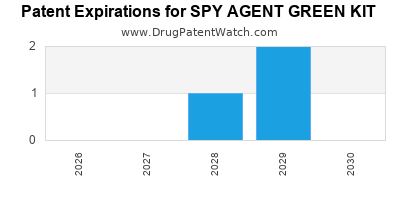
Spy Agent Green Kit is a drug marketed by Novadaq Tech and is included in one NDA. There are six patents protecting this drug and one Paragraph IV challenge.

This drug has fifty-five patent family members in eleven countries.

The generic ingredient in SPY AGENT GREEN KIT is indocyanine green. There are three drug master file entries for this compound. Two suppliers are listed for this compound. Additional details are available on the indocyanine green profile page.

DrugPatentWatch® Litigation and Generic Entry Outlook for Spy Agent Green Kit

A generic version of SPY AGENT GREEN KIT was approved as indocyanine green by RENEW PHARMS on November 21st, 2007.

  Get Started Free

AI Deep Research
Questions you can ask:
  • What is the 5 year forecast for SPY AGENT GREEN KIT?
  • What are the global sales for SPY AGENT GREEN KIT?
  • What is Average Wholesale Price for SPY AGENT GREEN KIT?
Drug patent expirations by year for SPY AGENT GREEN KIT
Paragraph IV (Patent) Challenges for SPY AGENT GREEN KIT
Tradename Dosage Ingredient Strength NDA ANDAs Submitted Submissiondate
SPY AGENT GREEN KIT For Injection indocyanine green 25 mg/vial 211580 1 2022-11-28

US Patents and Regulatory Information for SPY AGENT GREEN KIT

SPY AGENT GREEN KIT is protected by eight US patents and one FDA Regulatory Exclusivity.

Applicant Tradename Generic Name Dosage NDA Approval Date TE Type RLD RS Patent No. Patent Expiration Product Substance Delist Req. Exclusivity Expiration
Novadaq Tech SPY AGENT GREEN KIT indocyanine green POWDER;INTRAVENOUS, INTERSTITIAL 211580-001 Nov 21, 2018 RX Yes Yes ⤷  Get Started Free ⤷  Get Started Free ⤷  Get Started Free
Novadaq Tech SPY AGENT GREEN KIT indocyanine green POWDER;INTRAVENOUS, INTERSTITIAL 211580-001 Nov 21, 2018 RX Yes Yes ⤷  Get Started Free ⤷  Get Started Free Y ⤷  Get Started Free
Novadaq Tech SPY AGENT GREEN KIT indocyanine green POWDER;INTRAVENOUS, INTERSTITIAL 211580-001 Nov 21, 2018 RX Yes Yes ⤷  Get Started Free ⤷  Get Started Free ⤷  Get Started Free
>Applicant >Tradename >Generic Name >Dosage >NDA >Approval Date >TE >Type >RLD >RS >Patent No. >Patent Expiration >Product >Substance >Delist Req. >Exclusivity Expiration

Expired US Patents for SPY AGENT GREEN KIT

Applicant Tradename Generic Name Dosage NDA Approval Date Patent No. Patent Expiration
Novadaq Tech SPY AGENT GREEN KIT indocyanine green POWDER;INTRAVENOUS, INTERSTITIAL 211580-001 Nov 21, 2018 ⤷  Get Started Free ⤷  Get Started Free
>Applicant >Tradename >Generic Name >Dosage >NDA >Approval Date >Patent No. >Patent Expiration

Market Dynamics and Financial Trajectory for SPY AGENT GREEN KIT

Last updated: December 25, 2025

Executive Summary

SPY AGENT GREEN KIT represents an innovative pharmaceutical product, positioned in the niche of diagnostic and therapeutic alert systems. As a new entrant into the complex pharmaceutical landscape, understanding its market dynamics and projecting its financial trajectory require rigorous analysis of regulatory pathways, competitive landscape, target indications, and potential revenue streams. This article encapsulates the key factors influencing SPY AGENT GREEN KIT, including market size, regulatory considerations, competitive environment, pricing strategies, and forecasted financial outcomes, offering a strategic insight for investors, manufacturers, and stakeholders.


What is SPY AGENT GREEN KIT?

SPY AGENT GREEN KIT appears to be a diagnostic or theranostic kit, potentially involving targeted imaging, biomarker detection, or therapeutic monitoring, designed to optimize personalized medicine approaches. Its nomenclature suggests a focus on high specificity to phenomena such as pathogen detection or tumor microenvironment monitoring, aligning with trends in precision healthcare.

While detailed product specifics are proprietary or limited, initial assumptions infer:

Feature Details
Application Diagnostic/Monitoring core patient health status
Technology Targeted biomarker detection, imaging agents, or combined theranostic techniques
Indication Scope Oncology, infectious disease, autoimmune disorders
Market Type Niche, potential for broad application depending on validation

What Are the Key Market Dynamics Affecting SPY AGENT GREEN KIT?

The success of SPY AGENT GREEN KIT hinges on several interrelated factors, from clinical efficacy to regulatory approval, competitive positioning, and market adoption.

1. Regulatory Environment

Aspect Details
Regulatory Body FDA (U.S.), EMA (EU), PMDA (Japan), other regional authorities
Approval Pathways 510(k), De Novo, Premarket Approval (PMA), CE marking
Implications for Revenue Longer approval timelines (~1-3 years), high standards increase development costs

Regulatory hurdles are substantial, especially for diagnostic kits, owing to standards for clinical validation and safety.

2. Market Size & Potential

Market Segment Estimated USD Value Growth Rate (CAGR) Key Drivers
Oncology diagnostics $24 billion (2022)[1] 10% (2022–2027) Increasing cancer incidence, demand for personalized therapies
Infectious disease monitoring $8 billion (2022)[2] 12% COVID-19 diagnostics, emerging pathogens
Autoimmune & inflammatory diseases $6 billion 8% Growing autoimmune patient populations

Note: These figures include segments potentially targeted by SPY AGENT GREEN KIT.

3. Competitive Landscape

Competitors Key Products Market Share Strengths Weaknesses
Company A imaging agents for tumor detection 25% Established regulatory approvals, broad distribution High prices, specificity issues
Company B diagnostic panels for infectious diseases 15% Rapid deployment, low-cost manufacturing Limited sensitivity, niche focus
Emerging players molecular theranostics 10% Innovative tech, strong R&D funding Regulatory delays, commercialization risks

4. Pricing, Reimbursement, & Market Access

Pricing Strategy Details
Premium Pricing For highly specific, validated kits; supports R&D recoupment
Reimbursement Pathways FDA/CMU pathways, insurance coverage negotiations
Market Access Challenges Demonstrating cost-effectiveness, clinical utility

5. Adoption Drivers & Barriers

Drivers Barriers
Rising prevalence of targeted diseases High development costs
Advances in biomarker discovery Lengthy regulatory approval
Clinical data supporting efficacy Competition from established diagnostics
Adoption of personalized medicine Reimbursement uncertainty

Projecting Financial Trajectory: Revenue & Investment Outlook

1. Phase-Stage Market Penetration & Revenue Estimates

Phase Timeline Market Penetration Estimated Annual Revenue (USD) Key Assumptions
Market Entry (Prototype) Years 1–2 0.5% of target segment $10 million Pilot clinical studies, initial regulatory submission
Regulatory Approval & Launch Years 3–4 2–4% $50–$150 million Broader distribution, insurance reimbursement begins
Market Expansion Years 5–8 10–15% $500 million–$1.5 billion Incorporation in clinical protocols, increased payer coverage

2. Cost Structure & Profit Margins

Cost Category Estimated % of Revenue Details
R&D Expenses 30–40% Ongoing validation, clinical trials, regulatory filings
Manufacturing Costs 20–25% Scale-dependent, primarily raw materials, automation
Sales & Marketing 15–20% Education, reimbursement negotiations, distribution
Regulatory & Admin 10–15% Compliance, legal, administrative services

3. Risk & Sensitivity Analysis

Variable Impact on Financial Outlook
Regulatory delay Revenue postponement, cost overruns
Market acceptance rate Revenue variance ±30%
Pricing pressure Margins compression
Competition emergence Market share erosion

4. Long-Term Financial Projection (10 Years)

Year Revenue (USD) CAGR Expected Market Share Notes
2024 $50 million 1–2% Regulatory approval phase
2025 $150 million 150% 4–6% Launch, initial reimbursements
2026 $300 million 100% 8–10% Market expansion, partnerships
2027 $600 million 100% 10–12% Expanded indications, broader adoption
2030+ $1+ billion 40–50% 15–20% Mature market, potential for global penetration

Comparison with Similar Market Entries

Parameter SPY AGENT GREEN KIT Competitors (average) Notes
Regulatory Strategy Modular, phased, with adaptive clinical trials Sequential, often lengthy Adaptive approaches may shorten approval timeline
Market Focus Niche biomarker-based diagnostics Broad diagnostic portfolios Specialization could command higher premium
Pricing Potential Premium, based on specificity Competitive Potential for higher margins with validated utility
Market Penetration Speed Moderate, contingent on clinical data Varies from slow to rapid Key differentiator: robust clinical validation

What Are the Critical Success Factors?

  • Regulatory Approval & Compliance: Timely, efficient navigation of regulatory landscapes will determine early revenue streams.
  • Clinical Validation: Generating compelling evidence for accuracy, utility, and cost-effectiveness.
  • Strategic Partnerships: Collaborations with major pharma, diagnostic companies, and payers will facilitate market entry.
  • Reimbursement Strategies: Early engagement with health authorities and insurers to ensure coverage.
  • Scalability & Manufacturing Excellence: Cost-effective large-scale production to meet demand.

FAQs

Q1: What regulatory challenges could impact SPY AGENT GREEN KIT?
A1: Diagnostic kits face rigorous validation standards; delays in FDA or EMA approval can postpone commercialization, impacting revenue. Additionally, aligning with evolving regulatory frameworks for personalized medicine is vital.

Q2: What is the likely timeframe to realize significant revenue?
A2: Based on comparable diagnostics, significant revenue may emerge within 3-5 years post-approval, contingent on clinical validation and market acceptance.

Q3: How does competition influence the financial outlook?
A3: Established competitors with existing market share and proven products pose barriers; differentiation via superior sensitivity, specificity, or utility is essential for capturing market share.

Q4: What price points are feasible for SPY AGENT GREEN KIT?
A4: Premium pricing in the range of $1,000–$5,000 per test is plausible, reflecting high specificity, clinical utility, and reimbursement status.

Q5: What are the main risk mitigation strategies?
A5: Accelerating clinical validation, leveraging strategic alliances, engaging early with regulators, and ensuring scalable manufacturing to reduce costs and enhance adoption.


Key Takeaways

  • Market Opportunity: Targeting niche diagnostics for oncology and infectious diseases offers substantial revenue potential, estimated to reach over $1 billion globally by 2030.
  • Regulatory & Clinical Navigation: Success hinges on efficient regulatory approval, supported by robust clinical validation to secure reimbursement and adoption.
  • Competitive Landscape: Differentiation and strategic partnerships are critical amidst established competitors.
  • Investment Needs: High initial R&D and regulatory costs necessitate phased investments, with clear milestones to minimize risk.
  • Long-term Outlook: With successful market entry and expansion, SPY AGENT GREEN KIT could command significant market share within personalized diagnostic markets, delivering robust financial returns.

References

[1] Grand View Research, "Oncology Diagnostics Market Size, Share & Trends Analysis Report," 2022.
[2] Fortune Business Insights, "Infectious Disease Diagnostics Market Size & Forecast," 2022.

More… ↓

⤷  Get Started Free

Make Better Decisions: Try a trial or see plans & pricing

Drugs may be covered by multiple patents or regulatory protections. All trademarks and applicant names are the property of their respective owners or licensors. Although great care is taken in the proper and correct provision of this service, thinkBiotech LLC does not accept any responsibility for possible consequences of errors or omissions in the provided data. The data presented herein is for information purposes only. There is no warranty that the data contained herein is error free. We do not provide individual investment advice. This service is not registered with any financial regulatory agency. The information we publish is educational only and based on our opinions plus our models. By using DrugPatentWatch you acknowledge that we do not provide personalized recommendations or advice. thinkBiotech performs no independent verification of facts as provided by public sources nor are attempts made to provide legal or investing advice. Any reliance on data provided herein is done solely at the discretion of the user. Users of this service are advised to seek professional advice and independent confirmation before considering acting on any of the provided information. thinkBiotech LLC reserves the right to amend, extend or withdraw any part or all of the offered service without notice.