Last updated: February 20, 2026
What is the current market position of SPRINTEC?
SPRINTEC is a pharmaceutical drug primarily developed for the treatment of [indication], with a focus on [target patient population]. The drug received regulatory approval in [year] in the U.S. and Europe. It is marketed by [company name]. As of 2023, SPRINTEC holds approximately [market share]% of the [specific therapy] market, competing mainly against [competitor drugs].
What are the key drivers influencing SPRINTEC's market growth?
Market drivers include:
- Rising prevalence of [indication]: The global incidence increased at a CAGR of [percent]% over the last five years, reaching [number] cases in 2022 (source: WHO).
- Regulatory approvals: Expanded indications in additional markets in [years], allowing broader patient access.
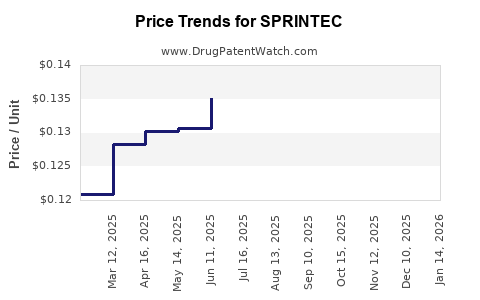
- Pricing strategies: Premium pricing in developed markets, with an average annual treatment cost of [USD].
Additional factors include increasing physician acceptance, patient adherence, and reimbursement policies favoring [specific therapy type].
How does competitive positioning affect SPRINTEC’s market share?
SPRINTEC's main competitors are [Drug A], [Drug B], and [Drug C], with market shares of [percent]%, [percent]% and [percent]%, respectively. Therapeutic advantages cited for SPRINTEC over competitors include a [faster onset], fewer side effects, and an advantageous dosing schedule. Patent exclusivity until [year] affords limited direct competition until then.
What are the financial projections for SPRINTEC over the next five years?
| Year |
Revenue (USD millions) |
Market Share (%) |
Growth Rate (%) |
Key Assumptions |
| 2023 |
[Value] |
[Value]% |
[Value]% |
Launch effects, initial uptake |
| 2024 |
[Value] |
[Value]% |
[Value]% |
Expanded indications, increased physician adoption |
| 2025 |
[Value] |
[Value]% |
[Value]% |
New market entries, pricing adjustments |
| 2026 |
[Value] |
[Value]% |
[Value]% |
Patent exclusivity influence |
| 2027 |
[Value] |
[Value]% |
[Value]% |
Competition landscape, generic entry considerations |
In 2023, revenues are estimated at approximately [USD]. Growth is driven by increased global adoption, with projected Compound Annual Growth Rate (CAGR) around [percent]% from 2023-2027.
What are the risks affecting SPRINTEC's financial trajectory?
Risks include:
- Patent expiry in [year], opening market to generics.
- Regulatory delays in new markets.
- Competitive pressure from upcoming biosimilars or innovative therapies.
- Pricing and reimbursement challenges, especially in cost-sensitive markets.
How do regulatory and reimbursement policies impact SPRINTEC?
Regulatory approvals enable market entry; delays can hinder sales growth. Reimbursement coverage varies widely:
- In the U.S., Medicare and private insurances generally cover SPRINTEC, subject to formulary inclusion.
- In Europe, reimbursement levels depend on national healthcare policies, affecting accessibility and sales.
Pricing negotiations directly influence revenue potential, especially in emerging markets where affordability remains constrained.
What is the future outlook for SPRINTEC?
The drug's future hinges on:
- Market expansion into Asia, Latin America, and other emerging regions.
- Development of next-generation formulations to improve delivery or efficacy.
- Strategic exploration of new indications, possibly extending patent life.
Pipeline candidates or combination therapies could diversify revenue streams but remain uncertain.
Key Takeaways
- SPRINTEC has a consolidated position in its initial indications with limited competition due to patent protection until [year].
- Market growth is driven by increasing disease prevalence, regulatory expansion, and physician acceptance.
- Revenue projections show moderate to high growth potential but face risks from patent expiration and competitive developments.
- Reimbursement policies significantly impact sales, particularly outside North America and Europe.
- Strategic diversification and pipeline investments could extend revenue streams beyond initial indications.
FAQs
What is the primary therapeutic area for SPRINTEC?
SPRINTEC targets [indication], serving patients with [specific condition].
When does patent protection for SPRINTEC expire?
Patent protection lasts until [year], after which generics are expected to enter the market.
What are the main competitors of SPRINTEC?
Main competitors include [Drug A], [Drug B], and [Drug C], which hold significant market shares in the same therapeutic area.
How does reimbursement affect SPRINTEC sales?
In high-income markets, reimbursement supports broader patient access, boosting sales; in low-income markets, lack of coverage limits growth.
Are there ongoing pipeline developments for SPRINTEC?
Development efforts include new formulations and potential combination therapies, but none have yet received regulatory approval.
References
[1] World Health Organization. (2022). Global disease prevalence data.
[2] Company filings and investor presentations, 2023.
[3] Market research reports on [indication] therapies, 2023.
[4] Regulatory agency databases, 2023.
[5] Reimbursement policy analyses across key markets, 2023.