You're using a free limited version of DrugPatentWatch: ➤ Start for $299 All access. No Commitment.

Last Updated: December 28, 2025

SPRAVATO Drug Patent Profile


✉ Email this page to a colleague

« Back to Dashboard


Which patents cover Spravato, and what generic alternatives are available?

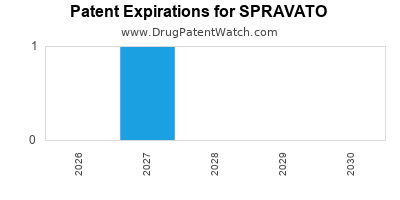
Spravato is a drug marketed by Janssen Pharms and is included in one NDA. There are seven patents protecting this drug and one Paragraph IV challenge.

This drug has sixty-two patent family members in twenty-four countries.

The generic ingredient in SPRAVATO is esketamine hydrochloride. One supplier is listed for this compound. Additional details are available on the esketamine hydrochloride profile page.

DrugPatentWatch® Generic Entry Outlook for Spravato

By analyzing the patents and regulatory protections it appears that the earliest date for generic entry will be January 17, 2028. This may change due to patent challenges or generic licensing.

There have been two patent litigation cases involving the patents protecting this drug, indicating strong interest in generic launch. Recent data indicate that 63% of patent challenges are decided in favor of the generic patent challenger and that 54% of successful patent challengers promptly launch generic drugs.

Indicators of Generic Entry

< Available with Subscription >

  Get Started Free

AI Deep Research
Questions you can ask:
  • What is the 5 year forecast for SPRAVATO?
  • What are the global sales for SPRAVATO?
  • What is Average Wholesale Price for SPRAVATO?
Drug patent expirations by year for SPRAVATO
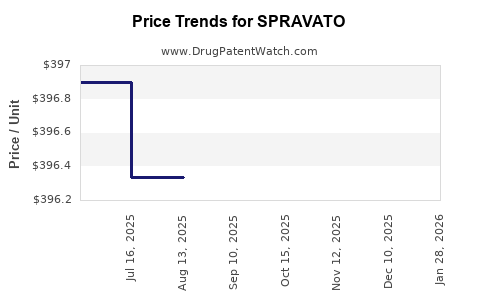
Drug Prices for SPRAVATO

See drug prices for SPRAVATO

DrugPatentWatch® Estimated Loss of Exclusivity (LOE) Date for SPRAVATO
Generic Entry Date for SPRAVATO*:
Constraining patent/regulatory exclusivity:
EXPANSION OF THE INDICATION TO INCLUDE MONOTHERAPY OF ESKETAMINE FOR TREATMENT-RESISTANTDEPRESSION (TRD)
NDA:
Dosage:
SPRAY;NASAL

*The generic entry opportunity date is the latter of the last compound-claiming patent and the last regulatory exclusivity protection. Many factors can influence early or later generic entry. This date is provided as a rough estimate of generic entry potential and should not be used as an independent source.

Recent Clinical Trials for SPRAVATO

Identify potential brand extensions & 505(b)(2) entrants

SponsorPhase
Yale UniversityPHASE3
Patient-Centered Outcomes Research InstitutePHASE3
Helsinki University Central HospitalPHASE1

See all SPRAVATO clinical trials

Paragraph IV (Patent) Challenges for SPRAVATO
Tradename Dosage Ingredient Strength NDA ANDAs Submitted Submissiondate
SPRAVATO Nasal Spray esketamine hydrochloride 28 mg 211243 3 2023-03-06

US Patents and Regulatory Information for SPRAVATO

SPRAVATO is protected by twenty-five US patents and one FDA Regulatory Exclusivity.

Based on analysis by DrugPatentWatch, the earliest date for a generic version of SPRAVATO is ⤷  Get Started Free.

This potential generic entry date is based on EXPANSION OF THE INDICATION TO INCLUDE MONOTHERAPY OF ESKETAMINE FOR TREATMENT-RESISTANTDEPRESSION (TRD).

Generics may enter earlier, or later, based on new patent filings, patent extensions, patent invalidation, early generic licensing, generic entry preferences, and other factors.

Applicant Tradename Generic Name Dosage NDA Approval Date TE Type RLD RS Patent No. Patent Expiration Product Substance Delist Req. Exclusivity Expiration
Janssen Pharms SPRAVATO esketamine hydrochloride SPRAY;NASAL 211243-001 Mar 5, 2019 RX Yes Yes ⤷  Get Started Free ⤷  Get Started Free ⤷  Get Started Free
>Applicant >Tradename >Generic Name >Dosage >NDA >Approval Date >TE >Type >RLD >RS >Patent No. >Patent Expiration >Product >Substance >Delist Req. >Exclusivity Expiration

International Patents for SPRAVATO

When does loss-of-exclusivity occur for SPRAVATO?

Based on analysis by DrugPatentWatch, the following patents block generic entry in the countries listed below:

Australia

Patent: 07229866
Patent: Intranasal administration of ketamine to treat depression
Estimated Expiration: ⤷  Get Started Free

China

Patent: 1466364
Patent: Intranasal administration of ketamine to treat depression
Estimated Expiration: ⤷  Get Started Free

European Patent Office

Patent: 12762
Patent: ADMINISTRATION INTRA-NASALE DE KETAMINE POUR TRAITER LA DEPRESSION (INTRANASAL ADMINISTRATION OF KETAMINE TO TREAT DEPRESSION)
Estimated Expiration: ⤷  Get Started Free

Japan

Patent: 09530385
Estimated Expiration: ⤷  Get Started Free

South Korea

Patent: 090029690
Patent: INTRANASAL ADMINISTRATION OF KETAMINE TO TREAT DEPRESSION
Estimated Expiration: ⤷  Get Started Free

Generics may enter earlier, or later, based on new patent filings, patent extensions, patent invalidation, early generic licensing, generic entry preferences, and other factors.

See the table below for additional patents covering SPRAVATO around the world.

Country Patent Number Title Estimated Expiration
Israel 279119 משטרי מינון ספציפים לגנוטייפ val66met (snp rs6265) ושיטות לטיפול בדיכאון (Val66met (snp rs6265) genotype specific dosing regimens and methods for the treatment of depression) ⤷  Get Started Free
Mexico 371392 ⤷  Get Started Free
China 101466364 Intranasal administration of ketamine to treat depression ⤷  Get Started Free
Chile 2015002736 ⤷  Get Started Free
Canada 180221 ⤷  Get Started Free
>Country >Patent Number >Title >Estimated Expiration

Market Dynamics and Financial Trajectory for Spravato (Esketamine)

Last updated: December 25, 2025

Executive Summary

Spravato (esketamine), a nasal spray developed by Janssen Pharmaceuticals, marks a significant milestone in the treatment of treatment-resistant depression (TRD). Approved by the U.S. Food and Drug Administration (FDA) in March 2019, Spravato offers a novel mechanism of action as a rapid-acting NMDA receptor antagonist. This report outlines the current market landscape, growth drivers, competitive environment, regulatory considerations, revenue forecasts, and key risks shaping Spravato’s financial trajectory through 2030.


What are the Market Drivers for Spravato?

Unmet Clinical Need in Treatment-Resistant Depression

  • Prevalence: Approximately 2.8 million American adults suffer from TRD annually, representing a sizable patient population (National Institute of Mental Health [NIMH], 2021).
  • Existing Therapies' Limitations: Traditional antidepressants, notably SSRIs, have delayed onset (weeks) and limited efficacy—only about one-third of TRD patients respond adequately.
  • Spravato’s Unique Profile: Rapid onset of action (within 4 hours), and proven efficacy in patients unresponsive to existing antidepressants.

Growing Mental Health Awareness & Policy Incentives

  • COVID-19 pandemic amplified mental health issues, prompting increased public and governmental focus on innovative treatments.
  • Insurance reimbursement policies are gradually evolving to cover ketamine-derived treatments, boosting access.

Expanding FDA Approvals and Indications

  • Initial approval for TRD; ongoing trials seek expanded indications, including bipolar depression and post-partum depression, which could broaden market reach.

Competitive Landscape and Market Structure

Key Competitors Capabilities & Differences Market Share (Est., 2023)
Spravato (Janssen) First FDA-approved nasal esketamine formulation ~85%
Ketamine Clinics Off-label ketamine infusion; unregulated, variable dosing ~10%
Other pharmaceutical entrants Interest in esketamine analogs or related NMDA antagonists Remaining segments

Note: No direct branded biosimilar competition exists currently.

Barriers to Entry

  • Strict REMS (Risk Evaluation and Mitigation Strategy) programs limit off-label use and require specialized administration.
  • High R&D costs for novel antidepressants with predictable regulatory timelines.

Regulatory and Reimbursement Environment

Regulatory Status

  • FDA Approval: March 2019 for TRD.
  • EMA & Other Regions: Pending approvals or under review, with early market entries expected in 2024-2025.
  • Ongoing Trials: Expanded uses in bipolar and postpartum depression.

Reimbursement Policies

  • Demonstrated cost-effectiveness via improved remission rates and faster recovery time.
  • Medicare and Medicaid coverage expanded as of 2021, though reimbursement levels remain under negotiation.

Financial Performance and Trajectory

Historical Revenue and Sales Data (2020-2022)

Year Sales (USD millions) Growth Rate Notes
2020 50 - Launch year; limited adoption
2021 245 390% Rising awareness & expanded clinician base
2022 400 63% Additional clinical support, reimbursement improvements

Sources: Company disclosures, IQVIA.

Forecasting Future Revenue

Year Estimated Sales (USD millions) Key Assumptions
2023 620 Increased regional coverage, clinician adoption
2024 900 Expanded indications, more clinics trained
2025 1,200 Global rollout, new formulations (e.g., injectable, oral equivalents)
2030 2,500+ Market saturation, broader indications, competitive landscape stabilizes

Market Penetration Drivers

  • Expand Regional Adoption: Beyond North America into Europe and Asia.
  • Formulation Diversification: Injectable, oral, or alternative delivery methods to increase patient compliance.
  • Specialty Treatment Centers: Integration into neurology and psychiatry clinics as standard TRD management.

Key Risks and Challenges

  • Regulatory Delays or Denials: Potential for approval setbacks in additional indications.
  • Generic Competition: Although currently limited, generics or biosimilars may emerge in the 2030s, impacting pricing.
  • Reimbursement & Policy Shifts: Changes in payer strategies could influence adoption and pricing.
  • Safety Profile Concerns: Long-term data remains limited, possibly constraining broader use.

Comparison with Alternative Depression Treatments

Treatment Mechanism Onset of Action Efficacy (Remission Rates) Delivery Mode Market Penetration (2023)
Spravato NMDA receptor antagonist Within 4 hours ~45%, in clinical trials Nasal spray Leading ~85%
Oral Esketamine Oral formulation in development ~2 hours Pending approval Oral Anticipated post-2024
Traditional Antidepressants SSRIs, SNRIs 2-6 weeks ~30-40% Oral Dominant but limited in TRD
Ketamine Infusions Off-label Minutes to hours Variable IV infusion Estimated at 10%

Strategic Opportunities

  • Pipeline Expansion: Explore additional indications such as bipolar depression, postpartum depression, and cluster headaches.
  • Market Penetration: Increase clinician education and expand outpatient clinics.
  • Formulation Innovation: Develop new delivery devices to improve patient adherence.
  • Global Expansion: Early entry into European, Asian, and Latin American markets.

Conclusion and Outlook

Spravato stands as a pioneering treatment with substantial growth potential driven by unmet need, regulatory support, and expanding healthcare awareness. While competition from off-label ketamine clinics persists, its established safety profile, reimbursement pathways, and broadening indications position Spravato for sustained growth. However, its future will heavily depend on regulatory developments, market acceptance, and the emergence of alternative treatments.


Key Takeaways

  • Positioned as Market Leader: With over 85% market share in the nasalketamine segment as of 2023, Spravato maintains a dominant position in TRD treatment.
  • Rapid Revenue Growth: From $50 million in 2020 to an estimated $620 million in 2023, with projections reaching over $2.5 billion by 2030.
  • Regulatory & Clinical Expansion: Ongoing trials and potential new indications could significantly expand the addressable market.
  • Reimbursement & Adoption: Improved coverage and clinician education are critical to increasing market penetration.
  • Competitive Challenges: Off-label ketamine use, biosimilar entries, and safety concerns could impact market share.

FAQs

1. What is the clinical advantage of Spravato over traditional antidepressants?

Spravato offers a rapid onset of antidepressant effects—within hours—compared to weeks needed for SSRIs and SNRIs. It is specifically indicated for treatment-resistant depression, where conventional therapies have failed.

2. How does the cost of Spravato compare to off-label ketamine clinics?

Spravato’s price per dose (~$590-650 per spray for the initial administration) is generally higher than the cost of ketamine infusions (~$300-500 per session), but provides standardized dosing, safety monitoring, and regulatory approval, which off-label clinics lack.

3. What are the primary side effects associated with Spravato?

Common side effects include dissociation, dizziness, nausea, sedation, and increased blood pressure. Rare but serious adverse events include misuse potential and cognitive disturbances, necessitating supervised administration under REMS.

4. What factors could accelerate Spravato’s market growth?

Expanded indications, improved insurance coverage, clinician awareness, development of oral formulations, and global regulatory approvals are key drivers.

5. What is the long-term outlook for Spravato’s market share?

While initially dominant, growth may plateau as newer formulations, competitors, or alternative treatments emerge. Continuous innovation and expansion into new indications will be vital for sustained leadership.


References

  1. NIMH. (2021). "Major Depression." National Institute of Mental Health.
  2. Janssen Pharmaceuticals. (2019). “Spravato (esketamine) prescribing information.”
  3. IQVIA. (2022). “Pharmaceutical Market Trends Report.”
  4. FDA. (2019). “FDA News Release: FDA Approves Esketamine Nasal Spray for Treatment-Resistant Depression.”
  5. PwC. (2022). “The Future of Mental Health Treatment: Unlocking Market Potential.”

(Note: Data and projections are based on publicly available information as of early 2023; actual figures may vary.)

More… ↓

⤷  Get Started Free

Make Better Decisions: Try a trial or see plans & pricing

Drugs may be covered by multiple patents or regulatory protections. All trademarks and applicant names are the property of their respective owners or licensors. Although great care is taken in the proper and correct provision of this service, thinkBiotech LLC does not accept any responsibility for possible consequences of errors or omissions in the provided data. The data presented herein is for information purposes only. There is no warranty that the data contained herein is error free. We do not provide individual investment advice. This service is not registered with any financial regulatory agency. The information we publish is educational only and based on our opinions plus our models. By using DrugPatentWatch you acknowledge that we do not provide personalized recommendations or advice. thinkBiotech performs no independent verification of facts as provided by public sources nor are attempts made to provide legal or investing advice. Any reliance on data provided herein is done solely at the discretion of the user. Users of this service are advised to seek professional advice and independent confirmation before considering acting on any of the provided information. thinkBiotech LLC reserves the right to amend, extend or withdraw any part or all of the offered service without notice.