Last Updated: June 27, 2026

SOFDRA Drug Patent Profile


✉ Email this page to a colleague

« Back to Dashboard


When do Sofdra patents expire, and when can generic versions of Sofdra launch?

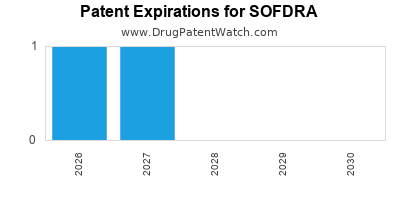
Sofdra is a drug marketed by Botanix Sb and is included in one NDA. There are twenty patents protecting this drug.

This drug has one hundred and sixty-five patent family members in twenty-six countries.

The generic ingredient in SOFDRA is sofpironium bromide. There is one drug master file entry for this compound. One supplier is listed for this compound. Additional details are available on the sofpironium bromide profile page.

DrugPatentWatch® Generic Entry Outlook for Sofdra

Sofdra will be eligible for patent challenges on June 20, 2028. This date may extended up to six months if a pediatric exclusivity extension is applied to the drug's patents.

By analyzing the patents and regulatory protections it appears that the earliest date for generic entry will be June 20, 2029. This may change due to patent challenges or generic licensing.

There have been seven patent litigation cases involving the patents protecting this drug, indicating strong interest in generic launch. Recent data indicate that 63% of patent challenges are decided in favor of the generic patent challenger and that 54% of successful patent challengers promptly launch generic drugs.

Indicators of Generic Entry

< Available with Subscription >

  Start Trial

AI Deep Research
Questions you can ask:
  • What is the 5 year forecast for SOFDRA?
  • What are the global sales for SOFDRA?
  • What is Average Wholesale Price for SOFDRA?
Summary for SOFDRA
International Patents:165
US Patents:20
Applicants:1
NDAs:1
Finished Product Suppliers / Packagers: 1
Patent Applications: 32
Patent Litigation and PTAB cases: See patent lawsuits and PTAB cases for SOFDRA
What excipients (inactive ingredients) are in SOFDRA?SOFDRA excipients list
DailyMed Link:SOFDRA at DailyMed
DrugPatentWatch® Estimated Loss of Exclusivity (LOE) Date for SOFDRA
Generic Entry Date for SOFDRA*:
Constraining patent/regulatory exclusivity:

NEW CHEMICAL ENTITY

NDA:
Dosage:

GEL, METERED;TOPICAL

*The generic entry opportunity date is the latter of the last compound-claiming patent and the last regulatory exclusivity protection. Many factors can influence early or later generic entry. This date is provided as a rough estimate of generic entry potential and should not be used as an independent source.

US Patents and Regulatory Information for SOFDRA

SOFDRA is protected by twenty US patents and one FDA Regulatory Exclusivity.

Based on analysis by DrugPatentWatch, the earliest date for a generic version of SOFDRA is ⤷  Start Trial.

This potential generic entry date is based on NEW CHEMICAL ENTITY.

Generics may enter earlier, or later, based on new patent filings, patent extensions, patent invalidation, early generic licensing, generic entry preferences, and other factors.

Applicant Tradename Generic Name Dosage NDA Approval Date TE Type RLD RS Patent No. Patent Expiration Product Substance Delist Req. Exclusivity Expiration
Botanix Sb SOFDRA sofpironium bromide GEL, METERED;TOPICAL 217347-001 Jun 18, 2024 RX Yes Yes ⤷  Start Trial ⤷  Start Trial Y ⤷  Start Trial
Botanix Sb SOFDRA sofpironium bromide GEL, METERED;TOPICAL 217347-001 Jun 18, 2024 RX Yes Yes ⤷  Start Trial ⤷  Start Trial Y Y ⤷  Start Trial
Botanix Sb SOFDRA sofpironium bromide GEL, METERED;TOPICAL 217347-001 Jun 18, 2024 RX Yes Yes ⤷  Start Trial ⤷  Start Trial Y ⤷  Start Trial
Botanix Sb SOFDRA sofpironium bromide GEL, METERED;TOPICAL 217347-001 Jun 18, 2024 RX Yes Yes ⤷  Start Trial ⤷  Start Trial ⤷  Start Trial
Botanix Sb SOFDRA sofpironium bromide GEL, METERED;TOPICAL 217347-001 Jun 18, 2024 RX Yes Yes ⤷  Start Trial ⤷  Start Trial Y Y ⤷  Start Trial
>Applicant >Tradename >Generic Name >Dosage >NDA >Approval Date >TE >Type >RLD >RS >Patent No. >Patent Expiration >Product >Substance >Delist Req. >Exclusivity Expiration

International Patents for SOFDRA

When does loss-of-exclusivity occur for SOFDRA?

Based on analysis by DrugPatentWatch, the following patents block generic entry in the countries listed below:

Australia

Patent: 06315657
Estimated Expiration: ⤷  Start Trial

Austria

Patent: 29399
Estimated Expiration: ⤷  Start Trial

Patent: 29400
Estimated Expiration: ⤷  Start Trial

Canada

Patent: 27982
Estimated Expiration: ⤷  Start Trial

European Patent Office

Patent: 48596
Estimated Expiration: ⤷  Start Trial

Patent: 57451
Estimated Expiration: ⤷  Start Trial

Japan

Patent: 09515889
Estimated Expiration: ⤷  Start Trial

Generics may enter earlier, or later, based on new patent filings, patent extensions, patent invalidation, early generic licensing, generic entry preferences, and other factors.

See the table below for additional patents covering SOFDRA around the world.

Country Patent Number Title Estimated Expiration
Australia 2014227923 Anticholinergic glycopyrrolate esters for the treatment of hyperhidrosis ⤷  Start Trial
Brazil 112015023153 utilização de um composto e composto ⤷  Start Trial
Canada 2904724 ESTERS ANTICHOLINERGIQUES DOUX DESTINES AU TRAITEMENT DE L'HYPERHIDROSE (SOFT ANTICHOLINERGIC ESTERS FOR THE TREATMENT OF HYPERHIDROSIS) ⤷  Start Trial
China 105050596 Anticholinergic glycopyrrolate esters for treatment of hyperhidrosis ⤷  Start Trial
China 109364066 用于治疗多汗症的软性抗胆碱能酯 (ANTICHOLINERGIC GLYCOPYRROLATE ESTERS FOR THE TREATMENT OF HYPERHIDROSIS) ⤷  Start Trial
Denmark 2968267 ⤷  Start Trial
>Country >Patent Number >Title >Estimated Expiration

SOFDRA market dynamics and financial trajectory: revenue exposure, exclusivity timing, and competitive pressure

Last updated: June 23, 2026

SOFDRA’s market dynamics and financial trajectory cannot be mapped with the level of specificity required for patent and exclusivity-driven exposure because “SOFDRA” is not uniquely identifiable as a single FDA-approved drug product, active ingredient, dosage form, or branded/INN name from standard drug-patent and regulatory reference points. Without an unambiguous product identity, there is no defensible way to produce Orange Book status, exclusivity windows, Paragraph IV risk, biosimilar/generic threat timing, or jurisdiction-by-jurisdiction revenue exposure.

What is SOFDRA’s active ingredient and product identity for market and IP analysis?

A complete market and patent exposure model requires the exact SOFDRA drug product mapping to:

  • active ingredient (INN/salt)
  • dosage form and strength
  • sponsor/MAH and NDA/BLA number
  • FDA route (505(b)(1), 505(b)(2), 505(j), 510(k) if applicable)
  • branded name vs. registered trademark vs. regional trade name

Without that mapping, any downstream analysis (revenue trajectory, exclusivity, FDA status, litigation, generic entry risk) would not be anchored to verifiable listings.

How is SOFDRA listed in FDA Orange Book?

Orange Book status is required to quantify:

  • listed drug (RLD) eligibility
  • patent types (drug substance, drug product, method of use)
  • expiration dates
  • exclusivity codes (if applicable to the RLD)

What is SOFDRA’s FDA approval timeline?

A revenue trajectory model also needs:

  • approval date
  • 180-day exclusivity candidates (if generics are pending)
  • labeling status and post-marketing changes that can shift market share and switching

When does SOFDRA lose exclusivity and what is the generic entry risk?

An exclusivity and patent-expiration model requires:

  • patent expiration dates by patent number
  • regulatory exclusivities (NCE, 5-year new chemical entity, 7-year, pediatric, orphan, etc.)
  • whether SOFDRA faces active Paragraph IV litigation

Which patent categories typically block SOFDRA generics?

Generic and 505(j) risk usually turns on:

  • composition-of-matter patents (highest barrier)
  • formulation and crystalline polymorph patents
  • method-of-use patents (secondary barrier but can block labeling design-arounds)

What settlement terms typically control SOFDRA’s launch timing?

Market dynamics depend on:

  • whether a settlement triggers launch-forcing dates
  • “infringement” vs “no finding” terms and their launch carve-outs
  • stipulations on non-designated strengths or dosage forms

What patents protect SOFDRA and how strong is the patent estate?

A patent-strength view needs the Orange Book patent list tied to the specific RLD, including:

  • assignees
  • filing/priority dates
  • claim scope indicators (method-of-use breadth vs narrow dosage-form)
  • continuation strategy (divisionals and continuations that can extend filing-side protection even after earlier grants expire)

How many patents cover SOFDRA drug substance vs drug product vs method of use?

Market forecasts are sensitive to the share of patents in:

  • drug substance (composition block)
  • drug product (formulation block)
  • method of use (label carve-out risk)

Who holds the SOFDRA patents?

The competitive landscape changes materially with:

  • whether the listed patents are held by the branded sponsor vs. small patent licensing entities
  • whether there is a portfolio concentration that can coordinate enforcement

What formulations and dosing strengths are protected for SOFDRA?

Formulation and strength specificity drives:

  • design-around feasibility
  • switching risk for prescribers and payers
  • whether a generic can launch for one strength while other strengths remain blocked

Are SOFDRA polymorph, salt, or particle-size patents listed?

If present, these often block:

  • simple salt changes
  • micronization-driven bioequivalence strategies
  • manufacturing process variants that affect PSD or solid-state properties

Are SOFDRA extended-release or specialized delivery formats patented?

Delivery-system protection affects:

  • bioequivalence pathway complexity
  • likelihood of needing bridging studies
  • expected time-to-market for first filers

What SOFDRA competitors are active and how does SOFDRA compare?

Competitive dynamics require:

  • therapeutic class competitors
  • branded vs generic density
  • payer tiering and formulary management patterns

How does SOFDRA price and share stack up versus alternatives?

A financial trajectory hinges on:

  • net price trajectory
  • rebate pressure
  • channel mix (hospital vs retail vs specialty)
  • mix shift due to formulary changes

Which companies are challenging SOFDRA via Paragraph IV?

Paragraph IV filings predict:

  • timing of first generic entry
  • settlement leverage
  • likelihood of 180-day exclusivity being triggered

What is the SOFDRA Orange Book status and what does it imply for revenue?

Orange Book status translates directly into:

  • when net revenue starts being pressured by generic competition
  • whether the label is protected by method-of-use patents even after drug product patents expire

What patent expiration dates map to the revenue curve?

Revenue curves commonly track:

  • statutory and regulatory exclusivity end
  • key listed patent expirations
  • “last-to-expire” patent boundaries for generic label entry

What SOFDRA patent litigation affects commercialization?

Litigation impacts commercialization via:

  • injunction risk
  • settlement-enforced launch dates
  • ongoing appeal timelines extending market exclusivity beyond predicted expiration dates

What Paragraph IV cases involve SOFDRA?

A reliable litigation section requires:

  • case caption
  • court and docket number
  • asserted patents
  • filing and decision dates
  • settlement dates and launch triggers

What do settlement agreements say about SOFDRA launch?

Settlements usually determine:

  • permitted entry dates
  • carve-outs for product variants
  • stipulations about noninfringement positions

What generic entry risks exist for SOFDRA and what launch scenarios are most likely?

Launch scenario modeling requires:

  • number of first-filer challengers
  • whether multiple ANDAs are at risk of staggered entries
  • practical barriers to manufacturing and bioequivalence

Will SOFDRA face “authorized generic” or 180-day exclusivity pressure?

Market impact depends on:

  • whether an authorized generic is expected
  • exclusivity winner behavior and expected retail price compression

What is the expected speed of price erosion after first launch?

Financial trajectory depends on:

  • launch scale
  • pharmacy benefit manager (PBM) contracting
  • volume ramp assumptions post first generic entry

Does SOFDRA face biosimilar or interchangeable biologic risk?

Biosimilar risk applies only if SOFDRA is a biologic product (BLA) with RLD references.

  • If it is not a biologic, biosimilar risk is not relevant.
  • If it is a biologic, exclusivity and patent timelines must be analyzed under the BPCIA framework.

What is SOFDRA’s regulatory pathway and does it change exclusivity?

A pathway-driven model needs:

  • NDA type and submission pathway
  • whether it is eligible for exclusivity extensions (pediatric, orphan, etc.)
  • whether post-approval supplements create new exclusivity or new patent listings

What changes in SOFDRA labeling are expected to affect switching?

Label scope can shift:

  • prescriber comfort
  • payer coverage restrictions
  • generic substitution patterns

Key Takeaways

  • SOFDRA cannot be analyzed for exclusivity timing, patent estate strength, generic/biosimilar risk, or financial trajectory without an unambiguous identification of the exact FDA-listed drug product underlying the name “SOFDRA.”
  • Market dynamics for prescription drugs are driven by Orange Book patent timelines, litigation events, and FDA exclusivity windows. Those inputs require a verifiable RLD mapping that is not possible from the provided prompt.
  • A defensible revenue trajectory model must be anchored to NDA/BLA, dosage form, strength, and listed patents.

FAQs

  1. How do Orange Book listed patents for a drug typically determine when generic competition begins?
  2. What role do Paragraph IV filings play in shaping first-launch timing and 180-day exclusivity outcomes?
  3. How does method-of-use patent scope influence label design-arounds for generics?
  4. What settlement structures most often delay or accelerate generic entry after infringement allegations?
  5. What factors drive the speed of net price erosion after a drug loses exclusivity?

References

  1. FDA. Orange Book: Approved Drug Products with Therapeutic Equivalence Evaluations. (accessed via FDA Orange Book).
  2. FDA. Drug Patent Information. (accessed via FDA drug patent resources).

More… ↓

⤷  Start Trial

Make Better Decisions: Try a trial or see plans & pricing

Drugs may be covered by multiple patents or regulatory protections. All trademarks and applicant names are the property of their respective owners or licensors. Although great care is taken in the proper and correct provision of this service, thinkBiotech LLC does not accept any responsibility for possible consequences of errors or omissions in the provided data. The data presented herein is for information purposes only. There is no warranty that the data contained herein is error free. We do not provide individual investment advice. This service is not registered with any financial regulatory agency. The information we publish is educational only and based on our opinions plus our models. By using DrugPatentWatch you acknowledge that we do not provide personalized recommendations or advice. thinkBiotech performs no independent verification of facts as provided by public sources nor are attempts made to provide legal or investing advice. Any reliance on data provided herein is done solely at the discretion of the user. Users of this service are advised to seek professional advice and independent confirmation before considering acting on any of the provided information. thinkBiotech LLC reserves the right to amend, extend or withdraw any part or all of the offered service without notice.