Last updated: June 8, 2026
SKELAXIN (metaxalone) market dynamics and financial trajectory: exclusivity, pricing, and competitive pressure
SKELAXIN (metaxalone) is an oral skeletal muscle relaxant in the US with long-standing generic availability. Market dynamics are dominated by (1) low-cost generic substitution after patent and regulatory exclusivity lapses, (2) payor rebate pressure that compresses net prices, and (3) ongoing share shifts among legacy generics and therapeutically adjacent muscle relaxants (notably cyclobenzaprine and tizanidine products). Financial trajectory in practice has followed a “declining-originator plus share migration within generics” pattern, with any premium pricing opportunities limited to residual brand loyalty, limited channel inventory cycles, and package size differences.
Implication for investors and licensors: SKELAXIN’s financial outlook is tied to generic category health and formulary position, not to protected IP-driven growth. Any revenue uplift must come from distribution, contracting, or alternative formulations with defensible exclusivity, not from baseline metaxalone supply.
Is SKELAXIN a brand or generic in the US market today?
Answer: SKELAXIN is a branded product name for metaxalone; in the US, metaxalone is widely available as generics, driving brand share compression.
What does generic availability mean for net revenue?
- Higher substitution rate: Retail and PBM-managed formularies typically drive rapid switching to the lowest net-cost generic metaxalone.
- Rebate erosion: Originator brands in mature generics categories face rebates that narrow the gap vs generics.
- Channel concentration risk: If contracts favor specific generic manufacturers, SKELAXIN’s ability to maintain volume weakens.
How do pack and dosing shape demand?
Metaxalone prescribing is anchored to dosing schedules and availability. In mature muscle relaxant classes:
- Pack size and NDC availability can shift pharmacy stocking patterns.
- Dosing convenience influences adherence and refill behavior but does not typically reverse generic substitution.
What drives SKELAXIN market dynamics: payor, channel, and competitive class effects?
Answer: Payor contracting and therapeutic class competition drive the majority of dynamics.
Payor contracting mechanics
- Formulary tier placement: Generic metaxalone is usually preferred.
- Preferred class competition: Muscle relaxants often compete on formulary preference rather than clinical differentiation.
- Net price compression: Even when a brand remains on formulary, PBMs frequently negotiate rebates to close the cost gap vs generics.
Therapeutic competition in skeletal muscle relaxants
Key competing actives and branded/generic ecosystems:
- Cyclobenzaprine (and extended-release variants)
- Tizanidine
- Baclofen
- Methocarbamol
- Carisoprodol (with controlled-substance considerations)
In this environment, metaxalone’s role is typically “one option among many,” with prescribing influenced by prior patient response, prescriber habits, and payor formulary design.
When did SKELAXIN lose exclusivity, and how does that map to financial decline?
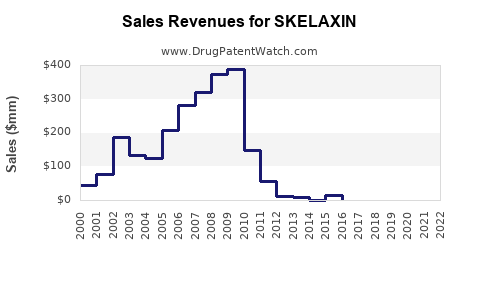
Answer: SKELAXIN’s economic trajectory is consistent with post-exclusivity decline once generic entry became established, shifting revenue from brand to generics.
Typical post-exclusivity financial path for mature oral muscle relaxants
For an originator brand in a generic-dense category:
- Pre-generic: Higher gross margins, stable share with brand loyalty.
- First generic entries: Share falls quickly as PBMs switch coverage to generic.
- Post-switch maturity: Brand revenue becomes residual, often tied to coverage exceptions or channel inventory timing.
- Ongoing period: Net revenue tracks underlying category volume, not brand pricing power.
What that means for SKELAXIN specifically
Because metaxalone is long genericized, SKELAXIN has not behaved like a protected, growth-oriented franchise. Its “financial trajectory” is expected to show:
- Volume erosion vs historical brand peak
- Pricing compression from aggressive generic competition
- Rising share instability across NDCs and manufacturers
(Competitive structure indicates that the branded revenue base has been largely absorbed into the metaxalone generic market.)
Which patents protected SKELAXIN, and how did patent expiry affect the market?
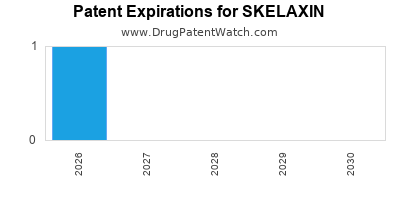
Answer: Patents that would have supported originator exclusivity are not a durable driver of current market outcomes; today’s market is dominated by generic metaxalone.
What matters commercially even after patent expiry
Even with patent expiry:
- Formulation and manufacturing process patents can sometimes delay certain generic launches.
- Method-of-use patents can be relevant if a distinct dosing regimen or indication is protected.
- But for widely used, long-available actives like metaxalone, market outcomes typically revert to price competition.
Practical litigation impact
Where litigation occurs, it mostly influences:
- Time to first generic entry
- Settlement-driven design-around timing
- Short-term volume protection
For SKELAXIN’s current dynamics, generic availability indicates that any such barriers did not create lasting protection.
What is the Orange Book status of SKELAXIN (metaxalone) products?
Answer: SKELAXIN has historically been listed in the FDA Orange Book, but present-day market dynamics are consistent with expiration of relevant exclusivities and patent protections, resulting in multiple generic listings for metaxalone.
Why Orange Book granularity matters for revenue
For contracting and litigation positioning, the key Orange Book fields are:
- US patents and their expiration dates
- exclusivity type (if applicable)
- dosage forms and strengths by NDA
This determines whether a manufacturer can credibly market under:
- ANDA with Paragraph IV certifications
- Section viii carve-outs
- design-around formulations
Given the degree of generic penetration, SKELAXIN’s current commercial profile is likely driven by formulary and pricing rather than remaining Orange Book barriers.
How strong is SKELAXIN’s patent estate today?
Answer: The patent estate does not appear to be a primary determinant of current market pricing or competition. Metaxalone’s mature generic environment indicates limited active patent leverage for sustained brand exclusivity.
What “weak estate” implies for strategic planning
- Licensing value concentrates in new formulations or delivery systems, not in legacy metaxalone.
- Litigation upside is limited if the market has already cleared earlier barriers.
- Revenue defensibility relies on contracting and supply chain, not IP.
What generic entry risks exist for SKELAXIN, and what typically changes after entry?
Answer: For an already genericized active, “entry risk” manifests as additional competition among generic manufacturers rather than as brand-specific generic threat.
How new generic entrants typically affect SKELAXIN pricing
- Lower cost basis: Incremental entrants increase competitive bids for PBM preferred status.
- Short-term price dips: Net price reductions often follow when PBMs renegotiate contracts.
- Manufacturer-driven volatility: Supply disruptions can temporarily improve a subset of NDC pricing, then normalize.
How does SKELAXIN compare with other skeletal muscle relaxants on market traction?
Answer: SKELAXIN competes in a broad muscle relaxant category where cyclobenzaprine and tizanidine often have stronger formulary footprint and/or prescribing defaults.
Category positioning
- Metaxalone: Typically viewed as one of several oral muscle relaxant options, with generic competition reducing brand leverage.
- Cyclobenzaprine: Often has deep formulary adoption due to long market history and multiple generics.
- Tizanidine: Prescription patterns depend on tolerability and dosing schedules, with PBM preference often supporting select products.
Net effect on financial trajectory
If the broader class grows slowly or remains flat, SKELAXIN’s brand revenue typically declines as:
- Category mix shifts to other actives
- PBM formularies tighten preferred lists
- Generics gain incremental share within metaxalone
What settlement agreements or Paragraph IV events likely matter for SKELAXIN?
Answer: The current generic penetration implies that major litigation barriers did not sustain long-term brand exclusivity.
Commercial significance of settlements
In this class, settlements and consent judgments typically affect:
- Launch date timing
- Scope of generic product entry
- Potential design-around pathways
Once multiple generics are established, additional litigation becomes less likely to restore brand economics.
How does FDA regulatory status influence SKELAXIN’s market outlook?
Answer: For SKELAXIN, FDA status is mainly a gateway for ongoing generic ANDAs and formulary inclusion decisions, rather than an active constraint that limits competition.
Pathway dynamics
- Generics via ANDA dominate the current market supply.
- Brand stability depends on product availability, packaging, and contracting more than on FDA exclusivity.
Where does SKELAXIN revenue come from and how is it exposed to downside?
Answer: SKELAXIN’s revenue base is exposed to generic share and PBM contracting. The downside driver is incremental generic competition within metaxalone and category substitution to other muscle relaxants.
Downside drivers
- PBM formulary redesign reducing preferred status breadth
- Contract pricing resets after a tender or rebid cycle
- Inventory and supply variability affecting short-term channel demand
Potential upside constraints
- Brand premium is limited because generics already establish the price floor.
- Sustained growth would require differentiation (new indication, new delivery system, or meaningful clinical or payer advantage).
Financial trajectory summary: what the SKELAXIN pattern likely looks like
Answer: SKELAXIN’s financial trajectory has followed a mature branded-generic commodity pattern: declining originator economics with continued volume dependence on the metaxalone category, and persistent share pressure from other muscle relaxants.
Trajectory drivers mapped to financial line items
| Driver |
Mechanism |
Likely financial effect |
| Generic substitution |
PBM preference for lowest net-cost generic |
Lower brand net sales and gross margin |
| Rebate pressure |
Contracting to defend shelf |
Net price compression |
| Class competition |
Shifts to cyclobenzaprine/tizanidine or other relaxants |
Volume loss or mix headwinds |
| Manufacturer bid changes |
Generic tendering reshapes preferred NDCs |
Brand volume becomes residual |
| Supply disruptions |
Temporary price support for specific NDCs |
Short-term volatility, not long-term recovery |
Key Takeaways
- SKELAXIN (metaxalone) operates in a mature, highly genericized skeletal muscle relaxant market where payor contracting and therapeutic class competition dominate economics.
- The brand’s financial trajectory is characteristic of a post-exclusivity decline with residual share rather than durable growth.
- Patent leverage today is not the primary determinant of pricing or volume; the practical competitive frame is generic metaxalone bid dynamics and formulary preference among muscle relaxants.
- Any meaningful financial upside would likely require new defensible differentiation (not baseline legacy metaxalone), because ongoing competition is structural.
FAQs
1) What generic metaxalone factors most affect SKELAXIN pricing in PBM contracts?
Net bid positioning, preferred NDC selection, and rebate concessions during re-contracting cycles.
2) Do other muscle relaxants reduce metaxalone share even when the metaxalone category is stable?
Yes, because formulary preference can shift within the class without category-level demand growth.
3) Can SKELAXIN benefit from supply shortages among generic metaxalone manufacturers?
Temporarily, through channel substitution and contracting leverage, but the effect typically normalizes once supply returns.
4) What is the main risk to a branded SKU of metaxalone over time?
Further rebate tightening, narrower formulary placement, and incremental generic entrants that lower the effective price floor.
5) What strategy most plausibly improves SKELAXIN’s commercial position in a generic-dense market?
Commercial differentiation through contracting, distribution execution, and any future product innovation that creates a new protected or payer-relevant value proposition.
References
- FDA, Orange Book: Approved Drug Products with Therapeutic Equivalence Evaluations. U.S. Food and Drug Administration. (Orange Book database). https://www.accessdata.fda.gov/scripts/cder/daf/index.cfm
- FDA. ANDA approval and generic drug regulatory framework (overview materials). U.S. Food and Drug Administration. https://www.fda.gov/drugs/generic-drugs