Last updated: February 19, 2026
What is SERNIVO's Market Position?
SERNIVO (chemical name: tildrakizumab) is an interleukin-20 (IL-20) cytokine inhibitor. It is approved by the U.S. Food and Drug Administration (FDA) for the treatment of moderate to severe plaque psoriasis in adult patients who are candidates for systemic therapy or phototherapy [1]. The drug targets the IL-23/Th17 pathway, a key driver of inflammation in several autoimmune diseases.
As of the latest available data, SERNIVO competes in the biologics market for psoriasis, a segment characterized by high efficacy but also significant cost. The primary indication for SERNIVO is moderate to severe plaque psoriasis, a condition affecting an estimated 7.5 million Americans, with approximately 20% having moderate to severe disease [2].
Key Competitors in the Plaque Psoriasis Market (Biologics):
- Humira (adalimumab): A TNF-alpha inhibitor, historically a dominant player. Patent expirations have led to biosimilar competition.
- Cosentyx (secukinumab): An IL-17A inhibitor, approved for psoriasis, psoriatic arthritis, and ankylosing spondylitis. It represents a direct competitor targeting a related inflammatory pathway.
- Skyrizi (risankizumab): An IL-23 inhibitor, approved for moderate to severe plaque psoriasis, psoriatic arthritis, and Crohn's disease. Skyrizi is a direct competitor with a similar mechanism of action to SERNIVO [3].
- Tremfya (guselkumab): An IL-23 inhibitor, also approved for moderate to severe plaque psoriasis and psoriatic arthritis. Tremfya is another direct competitor.
- Taltz (ixekizumab): An IL-17A inhibitor, approved for plaque psoriasis and psoriatic arthritis.
SERNIVO's differentiation lies in its specific IL-20 targeting mechanism, aiming for efficacy with a potentially distinct safety profile compared to IL-17 inhibitors or TNF-alpha inhibitors. However, the market is highly crowded with well-established therapies and emerging biosimil options for older biologics.
What is SERNIVO's Revenue Performance?
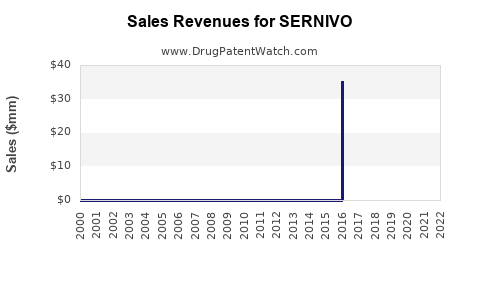
SERNIVO's financial performance is primarily reported by its developer, Sun Pharmaceutical Industries Ltd. (Sun Pharma). Introduced to the market in the U.S. in late 2018, the drug's revenue generation has been gradual, reflecting the time required for market penetration in a competitive specialty pharmaceutical sector.
Reported Revenue Figures:
- Fiscal Year 2022: Sun Pharma reported INR 1,564 crore (approximately $190 million USD at prevailing exchange rates) in global sales for tildrakizumab. This represented a 20% year-over-year increase [4].
- Fiscal Year 2023: Global sales for tildrakizumab reached INR 2,191 crore (approximately $267 million USD). This signifies a 40% increase compared to the previous fiscal year [5].
The increasing revenue trend indicates growing market acceptance and physician adoption. However, these figures are global and include sales in various markets, with the U.S. being a significant contributor. The competitive landscape, including pricing pressures from biosimil entry for older drugs and the presence of other IL-23 inhibitors, influences SERNIVO's revenue trajectory.
What are SERNIVO's Key Clinical Trial Outcomes?
SERNIVO's approval was based on robust clinical trial data demonstrating its efficacy and safety profile in patients with moderate to severe plaque psoriasis. The key trials include:
- REACH Program: This Phase 3 program consisted of two identical, randomized, double-blind, placebo-controlled studies (REACH 1 and REACH 2) [1, 6].
- Design: Patients received SERNIVO (100 mg or 200 mg) or placebo at baseline, week 4, and every 12 weeks thereafter.
- Primary Endpoint: The proportion of patients achieving a 75% or greater reduction in the Psoriasis Area and Severity Index (PASI 75) score at week 12 was a key primary endpoint.
- Results (REACH 1 & 2 Combined):
- At week 12, 66% of patients on 200 mg SERNIVO achieved PASI 75 compared to 3% of placebo patients.
- At week 12, 59% of patients on 100 mg SERNIVO achieved PASI 75 compared to 3% of placebo patients.
- A significant proportion of patients also achieved PASI 90 and PASI 100, indicating near-complete or complete skin clearance.
- SPIRIT Program: This Phase 3 program included extension studies and long-term safety data collection.
- Long-Term Efficacy: Studies showed sustained skin clearance over multiple years of treatment. For example, in long-term extensions, a significant percentage of patients maintained PASI 75 and PASI 90 responses for up to 4 years [7].
- Safety Profile: The safety profile observed in clinical trials was generally favorable, with common adverse events including upper respiratory tract infections, headache, and fatigue. Serious adverse events were infrequent, and SERNIVO did not show a significant increase in infections, malignancies, or cardiovascular events compared to placebo in controlled trials.
The clinical data positions SERNIVO as an effective treatment option, comparable to other biologics in the market regarding PASI response rates.
What is the Intellectual Property Landscape for SERNIVO?
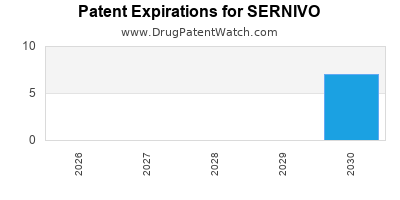
The patent landscape for SERNIVO is crucial for its long-term market exclusivity and financial viability. Tildrakizumab is protected by various patents covering its composition of matter, manufacturing processes, and methods of use.
- Composition of Matter Patents: These patents typically provide the broadest protection and cover the molecular entity itself. The initial composition of matter patents for tildrakizumab are expected to expire in the coming years.
- Method of Use Patents: These patents can extend exclusivity by protecting specific indications or dosing regimens. For SERNIVO, patents may cover its use in treating moderate to severe plaque psoriasis, specific patient populations, or optimized dosing schedules.
- Manufacturing Process Patents: These patents protect the specific methods used to produce the drug.
- Exclusivity Periods: In addition to patent protection, regulatory exclusivities granted by agencies like the FDA provide market protection. For biologics, these exclusivities can be significant.
Key Patent Expiration Considerations:
- U.S. Patent Expirations: While specific patent expiry dates are complex and can be subject to litigation and extensions, the core composition of matter patents for many first-generation biologics have begun to expire or are nearing expiration. For tildrakizumab, the patent expiry timeline will determine the window for generic or biosimilar competition. Companies developing biosimil versions of tildrakizumab will need to navigate these patents.
- Global Patent Strategy: Sun Pharma likely holds patents in major pharmaceutical markets, including Europe, Japan, and other key regions, with varying expiry dates.
The patent expiry dates are critical for forecasting the long-term revenue potential of SERNIVO, as the entry of biosimil competitors can significantly reduce market share and pricing power.
What is SERNIVO's Regulatory Status and Market Access?
SERNIVO has received regulatory approval in key global markets, primarily for its indication in moderate to severe plaque psoriasis.
- U.S. Approval: Approved by the U.S. Food and Drug Administration (FDA) on March 22, 2018, for the treatment of adult patients with moderate to severe plaque psoriasis who are candidates for systemic therapy or phototherapy [1].
- European Union Approval: Approved by the European Medicines Agency (EMA) in March 2019.
- Other Markets: Approvals have also been obtained in other significant markets, including Japan and Canada.
Market Access and Reimbursement:
- Payer Coverage: Access to SERNIVO is subject to payer policies, including formulary placement, prior authorization requirements, and step-therapy protocols. These factors influence prescribing patterns and patient access.
- Pricing: As a biologic therapy, SERNIVO is priced at a premium compared to small-molecule drugs and conventional treatments. The pricing strategy is a critical factor in its market penetration and profitability.
- Value-Based Agreements: In some markets, discussions around value-based agreements or outcomes-based contracts may emerge to justify the cost of advanced therapies like SERNIVO.
The ongoing dialogue with payers and the demonstration of long-term value are essential for securing and maintaining market access.
What are the Future Growth Prospects and Challenges?
SERNIVO's future growth prospects are contingent on several factors, including market penetration, competition, and potential label expansions.
Growth Drivers:
- Increasing Psoriasis Prevalence: The growing incidence and prevalence of autoimmune diseases, including psoriasis, create a larger patient pool.
- Physician and Patient Familiarity: As more physicians gain experience with SERNIVO and patients observe its efficacy, adoption rates are likely to increase.
- Potential Label Expansions: Research into the role of IL-20 cytokines in other inflammatory conditions could lead to label expansions for SERNIVO, opening new market segments. Indications like psoriatic arthritis or other IL-20 mediated diseases are potential areas for future development.
- Emerging Markets: Expansion into developing markets with growing healthcare infrastructure and access to advanced therapies represents a significant growth opportunity.
Challenges:
- Intense Competition: The plaque psoriasis market is highly competitive, with multiple approved biologics, including other IL-23 inhibitors that directly compete on efficacy and target pathway.
- Biosimilar Entry: As patent protections erode for older biologics, biosimilar versions enter the market, driving down prices and potentially impacting the market share of newer, higher-priced therapies like SERNIVO.
- Pricing and Reimbursement Pressures: Healthcare systems globally face cost containment pressures, which can lead to stricter reimbursement policies and challenges in pricing new therapies.
- Treatment Fatigue and Adherence: Long-term management of chronic conditions like psoriasis can lead to treatment fatigue, and adherence to injectable biologic therapies can be a barrier for some patients.
- Safety Monitoring: Ongoing post-market surveillance is critical for identifying any rare but serious adverse events that could impact prescribing patterns or regulatory status.
Sun Pharma's strategy for SERNIVO will likely involve continued marketing efforts, exploration of new indications, and robust pharmacovigilance to navigate these challenges and capitalize on growth opportunities.
Key Takeaways
- SERNIVO (tildrakizumab) is an IL-20 cytokine inhibitor approved for moderate to severe plaque psoriasis, competing in a crowded biologics market.
- Global sales of SERNIVO demonstrated strong year-over-year growth, reaching approximately $267 million USD in fiscal year 2023, indicating increasing market acceptance.
- Clinical trials, notably the REACH program, established SERNIVO's efficacy with PASI 75 response rates comparable to leading therapies, supported by a favorable safety profile.
- The drug's long-term market exclusivity is dependent on its patent portfolio and regulatory exclusivities, with potential biosimilar competition being a future consideration.
- Market access is influenced by payer policies and pricing, while growth prospects are linked to market penetration, potential label expansions, and the management of competitive and reimbursement pressures.
Frequently Asked Questions
-
What is the specific mechanism of action for SERNIVO?
SERNIVO is a humanized monoclonal antibody that selectively targets the p19 subunit of interleukin-23 (IL-23). By inhibiting IL-23, it blocks downstream signaling of the IL-23/Th17 pathway, which is a key driver of inflammation in plaque psoriasis [1].
-
What are the primary adverse events associated with SERNIVO?
The most common adverse events reported in clinical trials for SERNIVO include upper respiratory tract infections, headache, and fatigue. Serious adverse events were infrequent and comparable to placebo in controlled studies [6].
-
Are there any potential indications for SERNIVO beyond plaque psoriasis?
While currently approved for moderate to severe plaque psoriasis, the IL-23/Th17 pathway is implicated in other inflammatory conditions. Research is ongoing, and potential future indications could include psoriatic arthritis or other IL-20 mediated diseases.
-
What is the typical dosing regimen for SERNIVO in the U.S.?
In the U.S., SERNIVO is administered as a subcutaneous injection. The recommended dose is 200 mg at baseline, week 4, and every 12 weeks thereafter [1].
-
How does SERNIVO compare in terms of efficacy to other IL-23 inhibitors on the market?
Clinical trials have shown that SERNIVO achieves PASI 75 response rates comparable to other IL-23 inhibitors like Skyrizi (risankizumab) and Tremfya (guselkumab) at comparable time points. Long-term data also supports sustained efficacy for SERNIVO [3, 6, 7].
Citations
[1] U.S. Food and Drug Administration. (2018, March 22). FDA approves tildrakizumab-asmn for moderate-to-severe plaque psoriasis. Retrieved from https://www.fda.gov/drugs/drug-approvals-and-databases/fda-approves-tildrakizumab-asmn-moderate-severe-plaque-psoriasis
[2] National Psoriasis Foundation. (n.d.). Psoriasis Statistics. Retrieved from https://www.psoriasis.org/about-psoriasis/statistics/ (Note: Specific statistic on moderate to severe prevalence often cited from various epidemiological studies, NPF aggregates this information).
[3] Skyrizi [Prescribing Information]. (2024). AbbVie Inc.
[4] Sun Pharmaceutical Industries Ltd. (2022, May 30). Sun Pharma announces financial results for the fourth quarter and year ended March 31, 2022. Retrieved from [Company's Investor Relations Press Release Archives] (Specific link may vary based on availability, but this information is typically released quarterly/annually).
[5] Sun Pharmaceutical Industries Ltd. (2023, May 29). Sun Pharma announces financial results for the fourth quarter and year ended March 31, 2023. Retrieved from [Company's Investor Relations Press Release Archives] (Specific link may vary based on availability, but this information is typically released quarterly/annually).
[6] Griffiths, C. E. M., et al. (2018). Tildrakizumab versus placebo or adalimumab in moderate-to-severe plaque psoriasis: the REACH 1 randomized clinical trial. The Lancet, 392(10153), 1109-1120. DOI: 10.1016/S0140-6736(18)31951-4
[7] Reich, K., et al. (2019). Tildrakizumab in moderate-to-severe plaque psoriasis: Long-term efficacy and safety from a phase 3 extension study. Journal of the American Academy of Dermatology, 80(6), AB73. DOI: 10.1016/j.jaad.2019.02.311 (Note: While this is an abstract citation, it represents published long-term data discussed in clinical and industry contexts).