RYTARY Drug Patent Profile
✉ Email this page to a colleague
When do Rytary patents expire, and what generic alternatives are available?
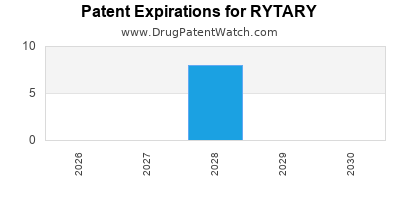
Rytary is a drug marketed by Impax and is included in one NDA. There are eight patents protecting this drug and two Paragraph IV challenges.
This drug has twenty-five patent family members in twelve countries.
The generic ingredient in RYTARY is carbidopa; levodopa. There are eighteen drug master file entries for this compound. Thirty-six suppliers are listed for this compound. Additional details are available on the carbidopa; levodopa profile page.
DrugPatentWatch® Litigation and Generic Entry Outlook for Rytary
A generic version of RYTARY was approved as carbidopa; levodopa by DR REDDYS LABS SA on August 28th, 1992.
AI Deep Research
Questions you can ask:
- What is the 5 year forecast for RYTARY?
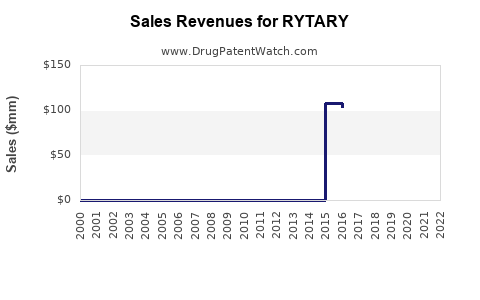
- What are the global sales for RYTARY?
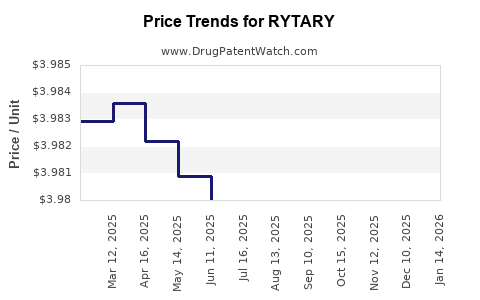
- What is Average Wholesale Price for RYTARY?
Summary for RYTARY
| International Patents: | 25 |
| US Patents: | 8 |
| Applicants: | 1 |
| NDAs: | 1 |
| Finished Product Suppliers / Packagers: | 2 |
| Raw Ingredient (Bulk) Api Vendors: | 7 |
| Clinical Trials: | 2 |
| Drug Prices: | Drug price information for RYTARY |
| Patent Litigation and PTAB cases: | See patent lawsuits and PTAB cases for RYTARY |
| What excipients (inactive ingredients) are in RYTARY? | RYTARY excipients list |
| DailyMed Link: | RYTARY at DailyMed |
Recent Clinical Trials for RYTARY
Identify potential brand extensions & 505(b)(2) entrants
| Sponsor | Phase |
|---|---|
| Amneal Pharmaceuticals, LLC | PHASE4 |
| The Cleveland Clinic | PHASE4 |
| National Institutes of Health (NIH) | Phase 2 |
Pharmacology for RYTARY
| Drug Class | Aromatic Amino Acid |
Paragraph IV (Patent) Challenges for RYTARY
| Tradename | Dosage | Ingredient | Strength | NDA | ANDAs Submitted | Submissiondate |
|---|---|---|---|---|---|---|
| RYTARY | Extended-release Capsules | carbidopa; levodopa | 23.75 mg/95 mg, 36.25 mg/145 mg, 48.75 mg/195 mg | 203312 | 1 | 2015-06-24 |
| RYTARY | Extended-release Capsules | carbidopa; levodopa | 61.25 mg/245 mg | 203312 | 1 | 2015-06-10 |
US Patents and Regulatory Information for RYTARY
RYTARY is protected by fifteen US patents.
| Applicant | Tradename | Generic Name | Dosage | NDA | Approval Date | TE | Type | RLD | RS | Patent No. | Patent Expiration | Product | Substance | Delist Req. | Exclusivity Expiration |
|---|---|---|---|---|---|---|---|---|---|---|---|---|---|---|---|
| Impax | RYTARY | carbidopa; levodopa | CAPSULE, EXTENDED RELEASE;ORAL | 203312-003 | Jan 7, 2015 | RX | Yes | No | ⤷ Get Started Free | ⤷ Get Started Free | Y | ⤷ Get Started Free | |||
| Impax | RYTARY | carbidopa; levodopa | CAPSULE, EXTENDED RELEASE;ORAL | 203312-004 | Jan 7, 2015 | RX | Yes | Yes | ⤷ Get Started Free | ⤷ Get Started Free | Y | ⤷ Get Started Free | |||
| Impax | RYTARY | carbidopa; levodopa | CAPSULE, EXTENDED RELEASE;ORAL | 203312-003 | Jan 7, 2015 | RX | Yes | No | ⤷ Get Started Free | ⤷ Get Started Free | Y | ⤷ Get Started Free | |||
| Impax | RYTARY | carbidopa; levodopa | CAPSULE, EXTENDED RELEASE;ORAL | 203312-004 | Jan 7, 2015 | RX | Yes | Yes | ⤷ Get Started Free | ⤷ Get Started Free | Y | ⤷ Get Started Free | |||
| Impax | RYTARY | carbidopa; levodopa | CAPSULE, EXTENDED RELEASE;ORAL | 203312-003 | Jan 7, 2015 | RX | Yes | No | ⤷ Get Started Free | ⤷ Get Started Free | Y | ⤷ Get Started Free | |||
| Impax | RYTARY | carbidopa; levodopa | CAPSULE, EXTENDED RELEASE;ORAL | 203312-001 | Jan 7, 2015 | RX | Yes | No | ⤷ Get Started Free | ⤷ Get Started Free | Y | ⤷ Get Started Free | |||
| Impax | RYTARY | carbidopa; levodopa | CAPSULE, EXTENDED RELEASE;ORAL | 203312-004 | Jan 7, 2015 | RX | Yes | Yes | ⤷ Get Started Free | ⤷ Get Started Free | Y | ⤷ Get Started Free | |||
| >Applicant | >Tradename | >Generic Name | >Dosage | >NDA | >Approval Date | >TE | >Type | >RLD | >RS | >Patent No. | >Patent Expiration | >Product | >Substance | >Delist Req. | >Exclusivity Expiration |
Expired US Patents for RYTARY
| Applicant | Tradename | Generic Name | Dosage | NDA | Approval Date | Patent No. | Patent Expiration |
|---|---|---|---|---|---|---|---|
| Impax | RYTARY | carbidopa; levodopa | CAPSULE, EXTENDED RELEASE;ORAL | 203312-004 | Jan 7, 2015 | ⤷ Get Started Free | ⤷ Get Started Free |
| Impax | RYTARY | carbidopa; levodopa | CAPSULE, EXTENDED RELEASE;ORAL | 203312-001 | Jan 7, 2015 | ⤷ Get Started Free | ⤷ Get Started Free |
| Impax | RYTARY | carbidopa; levodopa | CAPSULE, EXTENDED RELEASE;ORAL | 203312-003 | Jan 7, 2015 | ⤷ Get Started Free | ⤷ Get Started Free |
| Impax | RYTARY | carbidopa; levodopa | CAPSULE, EXTENDED RELEASE;ORAL | 203312-002 | Jan 7, 2015 | ⤷ Get Started Free | ⤷ Get Started Free |
| >Applicant | >Tradename | >Generic Name | >Dosage | >NDA | >Approval Date | >Patent No. | >Patent Expiration |
EU/EMA Drug Approvals for RYTARY
| Company | Drugname | Inn | Product Number / Indication | Status | Generic | Biosimilar | Orphan | Marketing Authorisation | Marketing Refusal |
|---|---|---|---|---|---|---|---|---|---|
| Amneal Pharma Europe Ltd | Numient | levodopa, carbidopa | EMEA/H/C/002611Symptomatic treatment of adult patients with Parkinson’s disease | Withdrawn | no | no | no | 2015-11-19 | |
| >Company | >Drugname | >Inn | >Product Number / Indication | >Status | >Generic | >Biosimilar | >Orphan | >Marketing Authorisation | >Marketing Refusal |
International Patents for RYTARY
When does loss-of-exclusivity occur for RYTARY?
Based on analysis by DrugPatentWatch, the following patents block generic entry in the countries listed below:
Australia
Patent: 08343787
Patent: Controlled release formulations of levodopa and uses thereof
Estimated Expiration: ⤷ Get Started Free
Canada
Patent: 11014
Patent: FORMULATIONS À LIBERATION CONTRÔLEE DE LEVODOPA ET LEURS UTILISATIONS (CONTROLLED RELEASE FORMULATIONS OF LEVODOPA AND USES THEREOF)
Estimated Expiration: ⤷ Get Started Free
China
Patent: 1910113
Patent: Controlled release formulations of levodopa and uses thereof
Estimated Expiration: ⤷ Get Started Free
European Patent Office
Patent: 34963
Patent: FORMULATIONS À LIBÉRATION CONTRÔLÉE DE LÉVODOPA ET LEURS UTILISATIONS (CONTROLLED RELEASE FORMULATIONS OF LEVODOPA AND USES THEREOF)
Estimated Expiration: ⤷ Get Started Free
Israel
Patent: 6756
Patent: תערובות שחרור מבוקרות של levodopa ושימושיהן (Controlled release formulations of levodopa and uses thereof)
Estimated Expiration: ⤷ Get Started Free
Patent: 8520
Patent: תערובות שחרור מבוקרות של levodopa ושמושיהן (Controlled release formulation of levodopa and uses thereof)
Estimated Expiration: ⤷ Get Started Free
Patent: 3053
Patent: תערובות שחרור מבוקרות של ושמושיהן levodopa (Controlled release formulation of levodopa and uses thereof)
Estimated Expiration: ⤷ Get Started Free
Japan
Patent: 83725
Estimated Expiration: ⤷ Get Started Free
Patent: 33373
Estimated Expiration: ⤷ Get Started Free
Patent: 28205
Estimated Expiration: ⤷ Get Started Free
Patent: 11507956
Estimated Expiration: ⤷ Get Started Free
Patent: 15187178
Patent: レボドパの放出制御製剤及びその使用 (CONTROLLED RELEASE FORMULATIONS OF LEVODOPA AND USES THEREOF)
Estimated Expiration: ⤷ Get Started Free
Patent: 17014295
Patent: レボドパの放出制御製剤及びその使用 (CONTROLLED RELEASE FORMULATIONS OF LEVODOPA AND USES THEREOF)
Estimated Expiration: ⤷ Get Started Free
Mexico
Patent: 10007207
Patent: FORMULACIONES DE LIBERACION CONTROLADA DE LEVODOPA Y USOS DE LAS MISMAS. (CONTROLLED RELEASE FORMULATIONS OF LEVODOPA AND USES THEREOF.)
Estimated Expiration: ⤷ Get Started Free
New Zealand
Patent: 6870
Patent: Controlled release formulations of levodopa, carbidopa andd a caboxylic acid
Estimated Expiration: ⤷ Get Started Free
Patent: 2302
Patent: Controlled release formulations of levodopa and uses thereof
Estimated Expiration: ⤷ Get Started Free
South Africa
Patent: 1005309
Patent: CONTROLLED RELEASE FORMULATIONS OF LEVODOPA AND USES THEREOF
Estimated Expiration: ⤷ Get Started Free
South Korea
Patent: 1451564
Estimated Expiration: ⤷ Get Started Free
Patent: 1569604
Estimated Expiration: ⤷ Get Started Free
Patent: 1752080
Estimated Expiration: ⤷ Get Started Free
Patent: 100099731
Patent: CONTROLLED RELEASE FORMULATIONS OF LEVODOPA AND USES THEREOF
Estimated Expiration: ⤷ Get Started Free
Patent: 130113533
Patent: CONTROLLED RELEASE FORMULATIONS OF LEVODOPA AND USES THEREOF
Estimated Expiration: ⤷ Get Started Free
Patent: 150133854
Patent: 레보도파 방출 제어형 제제 및 이의 용도 (CONTROLLED RELEASE FORMULATIONS OF LEVODOPA AND USES THEREOF)
Estimated Expiration: ⤷ Get Started Free
Spain
Patent: 04348
Estimated Expiration: ⤷ Get Started Free
Generics may enter earlier, or later, based on new patent filings, patent extensions, patent invalidation, early generic licensing, generic entry preferences, and other factors.
See the table below for additional patents covering RYTARY around the world.
| Country | Patent Number | Title | Estimated Expiration |
|---|---|---|---|
| South Africa | 201005309 | CONTROLLED RELEASE FORMULATIONS OF LEVODOPA AND USES THEREOF | ⤷ Get Started Free |
| South Korea | 101569604 | ⤷ Get Started Free | |
| Japan | 2015187178 | レボドパの放出制御製剤及びその使用 (CONTROLLED RELEASE FORMULATIONS OF LEVODOPA AND USES THEREOF) | ⤷ Get Started Free |
| Israel | 263053 | תערובות שחרור מבוקרות של ושמושיהן levodopa (Controlled release formulation of levodopa and uses thereof) | ⤷ Get Started Free |
| Japan | 5783725 | ⤷ Get Started Free | |
| Mexico | 2010007207 | FORMULACIONES DE LIBERACION CONTROLADA DE LEVODOPA Y USOS DE LAS MISMAS. (CONTROLLED RELEASE FORMULATIONS OF LEVODOPA AND USES THEREOF.) | ⤷ Get Started Free |
| China | 101910113 | Controlled release formulations of levodopa and uses thereof | ⤷ Get Started Free |
| >Country | >Patent Number | >Title | >Estimated Expiration |
Supplementary Protection Certificates for RYTARY
| Patent Number | Supplementary Protection Certificate | SPC Country | SPC Expiration | SPC Description |
|---|---|---|---|---|
| 3209302 | 2390502-9 | Sweden | ⤷ Get Started Free | PRODUCT NAME: FOSLEVODOPA/FOSCARBIDOPA; NAT. REG. NO/DATE: MTNR 62386 20220912; FIRST REG.: AT 141371 20220826 |
| >Patent Number | >Supplementary Protection Certificate | >SPC Country | >SPC Expiration | >SPC Description |
Market Dynamics and Financial Trajectory for RYTARY: A Comprehensive Analysis
More… ↓
Make Better Decisions: Try a trial or see plans & pricing
Drugs may be covered by multiple patents or regulatory protections. All trademarks and applicant names are the property of their respective owners or licensors. Although great care is taken in the proper and correct provision of this service, thinkBiotech LLC does not accept any responsibility for possible consequences of errors or omissions in the provided data. The data presented herein is for information purposes only. There is no warranty that the data contained herein is error free. We do not provide individual investment advice. This service is not registered with any financial regulatory agency. The information we publish is educational only and based on our opinions plus our models. By using DrugPatentWatch you acknowledge that we do not provide personalized recommendations or advice. thinkBiotech performs no independent verification of facts as provided by public sources nor are attempts made to provide legal or investing advice. Any reliance on data provided herein is done solely at the discretion of the user. Users of this service are advised to seek professional advice and independent confirmation before considering acting on any of the provided information. thinkBiotech LLC reserves the right to amend, extend or withdraw any part or all of the offered service without notice.
ISSN: 2162-2639

Privacy and Cookies
Terms & Conditions
Site Map
DrugPatentWatch Alternatives
LOE / Major Patent Expirations 2025 - 2026
NCE-1 Patent Challenge Dates 2025 - 2026
Friedman, Yali. "DrugPatentWatch" DrugPatentWatch, thinkBiotech, 2025, www.DrugPatentWatch.com.
See Primary Research Papers Citing DrugPatentWatch