You're using a free limited version of DrugPatentWatch: Upgrade for Complete Access

Last Updated: December 31, 2025

RYDAPT Drug Patent Profile


✉ Email this page to a colleague

« Back to Dashboard


When do Rydapt patents expire, and when can generic versions of Rydapt launch?

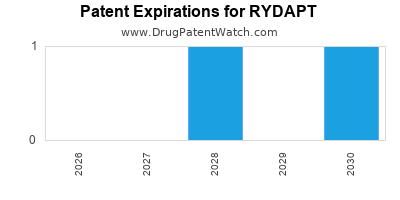
Rydapt is a drug marketed by Novartis and is included in one NDA. There are two patents protecting this drug and one Paragraph IV challenge.

This drug has sixty-two patent family members in twenty-seven countries.

The generic ingredient in RYDAPT is midostaurin. One supplier is listed for this compound. Additional details are available on the midostaurin profile page.

DrugPatentWatch® Litigation and Generic Entry Outlook for Rydapt

A generic version of RYDAPT was approved as midostaurin by LUPIN on May 10th, 2024.

  Get Started Free

AI Deep Research
Questions you can ask:
  • What is the 5 year forecast for RYDAPT?
  • What are the global sales for RYDAPT?
  • What is Average Wholesale Price for RYDAPT?
Drug patent expirations by year for RYDAPT
Drug Prices for RYDAPT

See drug prices for RYDAPT

Recent Clinical Trials for RYDAPT

Identify potential brand extensions & 505(b)(2) entrants

SponsorPhase
Baptist Health South FloridaPhase 1/Phase 2
Jazz PharmaceuticalsPhase 1/Phase 2
Novartis PharmaceuticalsPhase 1/Phase 2

See all RYDAPT clinical trials

Pharmacology for RYDAPT
Paragraph IV (Patent) Challenges for RYDAPT
Tradename Dosage Ingredient Strength NDA ANDAs Submitted Submissiondate
RYDAPT Capsules midostaurin 25 mg 207997 4 2021-04-28

US Patents and Regulatory Information for RYDAPT

RYDAPT is protected by two US patents.

Applicant Tradename Generic Name Dosage NDA Approval Date TE Type RLD RS Patent No. Patent Expiration Product Substance Delist Req. Exclusivity Expiration
Novartis RYDAPT midostaurin CAPSULE;ORAL 207997-001 Apr 28, 2017 AB RX Yes Yes ⤷  Get Started Free ⤷  Get Started Free ⤷  Get Started Free
>Applicant >Tradename >Generic Name >Dosage >NDA >Approval Date >TE >Type >RLD >RS >Patent No. >Patent Expiration >Product >Substance >Delist Req. >Exclusivity Expiration

EU/EMA Drug Approvals for RYDAPT

Company Drugname Inn Product Number / Indication Status Generic Biosimilar Orphan Marketing Authorisation Marketing Refusal
Novartis Europharm Ltd Rydapt midostaurin EMEA/H/C/004095Rydapt is indicated:in combination with standard daunorubicin and cytarabine induction and high dose cytarabine consolidation chemotherapy, and for patients in complete response followed by Rydapt single agent maintenance therapy, for adult patients with newly diagnosed acute myeloid leukaemia (AML) who are FLT3 mutation positive (see section 4.2);as monotherapy for the treatment of adult patients with aggressive systemic mastocytosis (ASM), systemic mastocytosis with associated haematological neoplasm (SM AHN), or mast cell leukaemia (MCL). Authorised no no yes 2017-09-18
>Company >Drugname >Inn >Product Number / Indication >Status >Generic >Biosimilar >Orphan >Marketing Authorisation >Marketing Refusal

International Patents for RYDAPT

See the table below for patents covering RYDAPT around the world.

Country Patent Number Title Estimated Expiration
Hungary 230798 Staurosporine derivatives as inhibitors of flt3 receptor tyrosine kinase activity ⤷  Get Started Free
Brazil PI0411563 uso para derivados de estaurosporina ⤷  Get Started Free
Hungary 0401642 ⤷  Get Started Free
Slovenia 1441737 ⤷  Get Started Free
Hong Kong 1068262 ⤷  Get Started Free
>Country >Patent Number >Title >Estimated Expiration

Supplementary Protection Certificates for RYDAPT

Patent Number Supplementary Protection Certificate SPC Country SPC Expiration SPC Description
1638574 SPC/GB18/001 United Kingdom ⤷  Get Started Free PRODUCT NAME: MIDOSTAURIN OR A SALT THEREOF; REGISTERED: UK EU/1/17/1218(FOR NI) 20170920; UK PLGB 00101/1130 20170920
1638574 659 Finland ⤷  Get Started Free
1441737 18C1012 France ⤷  Get Started Free PRODUCT NAME: MIDOSTAURINE; REGISTRATION NO/DATE: EU/1/17/1218 20170920
1638574 C 2017 049 Romania ⤷  Get Started Free PRODUCT NAME: MIDOSTAURINA SAU O SARE A ACESTUIA; NATIONAL AUTHORISATION NUMBER: EU/1/17/1218; DATE OF NATIONAL AUTHORISATION: 20170918; NUMBER OF FIRST AUTHORISATION IN EUROPEAN ECONOMIC AREA (EEA): EU/1/17/1218; DATE OF FIRST AUTHORISATION IN EEA: 20170918
1638574 CR 2018 00001 Denmark ⤷  Get Started Free PRODUCT NAME: MIDOSTAURIN ELLER ET SALT DERAF; REG. NO/DATE: EU/1/17/1218 20170920
>Patent Number >Supplementary Protection Certificate >SPC Country >SPC Expiration >SPC Description

Market Dynamics and Financial Trajectory for RYDAPT (Midostaurin)

Last updated: December 29, 2025

Summary

RYDAPT (midostaurin) is an oral kinase inhibitor developed by Novartis for the treatment of certain hematologic malignancies, notably including acute myeloid leukemia (AML) with FLT3 mutations and systemic mastocytosis. Since its FDA approval in April 2017, RYDAPT has carved a distinctive niche in targeted cancer therapy, driven by evolving diagnostic criteria, competing agents, and regulatory policies. This report evaluates the key market drivers, competitive landscape, financial prospects, and strategic considerations shaping RYDAPT’s commercial trajectory.


What Are the Market Dynamics Affecting RYDAPT’s Commercial Success?

1. Target Patient Populations and Diagnostic Adoption

  • Primary Indications:

    • AML with FLT3 mutation: RYDAPT is approved for adult patients with newly diagnosed FLT3-mutated AML in combination with chemotherapy.
    • Advanced systemic mastocytosis (SM): Including aggressive systemic mastocytosis (ASM), systemic mastocytosis with associated hematologic neoplasm (SM-AHN), and mast cell leukemia (MCL).
  • Market Potential:

    • Estimated 15-20% of AML cases possess FLT3 mutations, translating to approximately 9,000-12,000 eligible newly diagnosed patients annually in the U.S. (based on 20,000 AML cases per year; SEER data[1]).
    • Systemic mastocytosis is rare (prevalence: 1 in 10,000 to 20,000), but with high unmet medical need.
  • Diagnostic Challenges:

    • Increasing utilization of FLT3 mutation testing enhances patient stratification.
    • However, variability in testing rates and diagnostic access affects market penetration.

2. Competition and Alternative Therapies

  • Targeted AML Agents:

    • Gilteritinib (Xospata, Astellas) – Approved in 2018 for relapsed/refractory FLT3-mutated AML, capturing a segment outside frontline therapy.
    • Quizartinib (development halted in some regions but still notable elsewhere).
  • Chemotherapy and Allogeneic Stem Cell Transplant:

    • RYDAPT is often used as an adjunct to intensive chemotherapy, with transplant being a definitive therapy.
  • Other Mast Cell Disorder Treatments:

    • Menadione, cladribine, and newer agents under clinical investigation.
  • Market Share:

    • RYDAPT’s initial claims were limited to specific indications; expanding its use depends on regulatory approvals and real-world evidence demonstrating superiority or added benefit.

3. Regulatory and Reimbursement Factors

  • Regulatory Approvals:

    • Initially approved in U.S., EU, and Japan, with ongoing approvals expanding indications, including post-marketing studies to support label extensions.
  • Pricing and Reimbursement:

    • RYDAPT’s cost (~$20,000/month in the U.S.) influences access, especially in markets with strict reimbursement policies.
    • Payer negotiations and cost-effectiveness assessments impact uptake.

4. Market Penetration and Physician Adoption

  • Physician Awareness:

    • Education on FLT3 testing and tailored therapy has increased adoption.
    • Integration into treatment guidelines (e.g., NCCN) bolsters prescribing confidence.
  • Patient Access Programs:

    • Novartis’ patient support initiatives mitigate barriers to access, especially for rare disease indications.

How Is RYDAPT’s Financial Trajectory Shaped by Market Factors?

1. Revenue Streams and Sales History

Year Approximate Global Sales (USD Million) Notes
2017 50 Launch year, initial uptake
2018 125 Growing recognition, expanded indications
2019 180 Increased adoption, clinical data support
2020 210 Impact of COVID-19, delayed diagnosis
2021 250 Market expansion in Europe and Japan
2022 280 Steady growth, new indication studies underway

(Note: Figures approximated based on Novartis Annual Reports and industry estimates.)

2. Sales Drivers and Forecasting

  • Key Drivers:

    • Expansion of frontline AML indication with ongoing clinical trials (e.g., RATIFY extension studies).
    • Increased diagnostic testing and physician education.
    • Approved use in broader SM subtypes.
  • Forecast (2023–2028):

    • Compound Annual Growth Rate (CAGR): projected at 8-10%, contingent on approval of new indications and increased clinical adoption.
    • Market ceiling: Estimated global peak sales of $500-700 million by 2028.

3. Pricing and Reimbursement Impact

  • Continued high-cost positioning (~$240,000 annually for full course in AML) necessitates continued payer engagement and health economic validation.

What Are the Key Factors in RYDAPT’s Competitive Landscape?

Competitors Indications Strengths Challenges
Gilteritinib (Xospata) FLT3-mutated AML (relapsed/refractory) Oral, approved for relapsed AML Not indicated for frontline unless amended
Quizartinib (Vendale) FLT3 inhibitor (development status varies) Potent FLT3 inhibition Marketed in some regions, regulatory hurdles
Midostaurin (RYDAPT) FLT3-mutated AML (frontline) First-in-class, broad indications Competition from newer agents, diagnostics
Sabatolimab + Hypomethylating Agents Myeloid malignancies Emerging, early-stage trials Limited current market share

Note: The competitive landscape is evolving; clinical trial results and regulatory decisions profoundly influence dynamics.


How Do Regulatory Policies Influence RYDAPT’s Market Expansion?

  • FDA and EMA Approvals:

    • Landmark approval in 2017 for AML with FLT3 mutation.
    • Ongoing trials aiming to expand indications: maintenance therapy, relapsed settings, and rare mastocytosis subtypes.
  • Orphan Drug Designations:

    • Support for SM subtypes, facilitating market exclusivity and incentives.
  • Guideline Incorporation:

    • Inclusion in NCCN guidelines (version 4.2022) as recommended therapy for FLT3-mutant AML improves clinician adoption.

Comparative Analysis: RYDAPT vs. Gilteritinib in AML

Feature RYDAPT Gilteritinib (Xospata)
Year of Approval 2017 2018
Indication Newly diagnosed FLT3-mutated AML Relapsed/refractory FLT3-mutated AML
Administration Route Oral Oral
Dosage 50 mg twice daily 120 mg daily
Cost ~$240,000/year Similar (~$230,000–$250,000)
Regulatory Status Approved for frontline AML + SM Approved for R/R AML

Implication:
While Gilteritinib addresses relapsed/refractory AML, RYDAPT is uniquely positioned in the frontline setting, with potential to capture a substantial market share upon further label expansion.


Deepening Market Strategy: Opportunities and Risks

Opportunities

  • Label Expansion:

    • Demonstrating efficacy as maintenance therapy post-transplant could open new revenue streams.
    • Broader systemic mastocytosis indications (e.g., pediatric use).
  • Biomarker-Driven Treatment:

    • Advances in FLT3 mutation testing can improve patient stratification and adherence.
  • Combination Therapies:

    • Investigating synergistic regimens with other targeted agents or immunotherapies.

Risks

  • Development Delays:

    • Slow clinical trial progress can hinder label expansion.
  • Market Penetration Barriers:

    • High costs and reimbursement hurdles may limit access.
  • Competitive Disruption:

    • Emergence of superior agents or novel mechanisms could erode market share.

Conclusion

RYDAPT’s market viability hinges on its role as a frontline treatment for FLT3-mutated AML and its therapeutic positioning within hematologic malignancies. Its financial trajectory is buoyed by increasing diagnostic recognition, expanding clinical evidence, and evolving treatment guidelines. Nevertheless, sustained growth requires strategic expansion into new indications, competitive differentiation, and proactive regulatory engagement.


Key Takeaways

  • Market Potential: RYDAPT targets a niche but significant subset of AML and rare mastocytosis, with a global peak sales estimate of $500–700 million by 2028.

  • Strategic Drivers: Enhanced diagnostic testing, guideline inclusion, and clinical trials for label expansion are critical for commercial success.

  • Competitive Landscape: Gilteritinib dominates relapsed AML, but RYDAPT’s frontline role offers a point of differentiation.

  • Pricing and Reimbursement: High-cost positioning necessitates robust health economic strategies.

  • Risks and Opportunities: Continuous innovation, regulatory milestones, and market access policies will shape future growth prospects.


FAQs

Q1: How does the clinical efficacy of RYDAPT compare with other FLT3 inhibitors?
A1: RYDAPT has demonstrated significant survival benefits in frontline AML with FLT3 mutations, notably in combination with chemotherapy, whereas agents like gilteritinib are approved for relapsed/refractory settings. Head-to-head trials are limited; thus, direct comparison remains challenging.

Q2: What are the main challenges in expanding RYDAPT’s indications?
A2: Challenges include demonstrating efficacy in new settings via clinical trials, regulatory approvals, high development costs, and competition from emerging therapies.

Q3: How does reimbursement influence RYDAPT’s sales?
A3: Reimbursement policies significantly affect patient access; high drug costs require insurers to perceive sufficient clinical benefit, impacting adoption rates.

Q4: Are there ongoing clinical trials that could extend RYDAPT’s market?
A4: Yes, ongoing trials are exploring RYDAPT as maintenance therapy and in combination with other agents across various hematologic malignancies.

Q5: What role do diagnostics play in RYDAPT’s market strategy?
A5: Accurate and widespread FLT3 testing is essential for identifying eligible patients, thereby directly influencing sales and treatment outcomes.


References

  1. SEER Cancer Statistics Review, 1975–2018. National Cancer Institute.
  2. Novartis Annual Reports, 2017–2022.
  3. NCCN Clinical Practice Guidelines in Oncology, Hematologic Malignancies, Version 4.2022.
  4. FDA and EMA approvals and regulatory documents.
  5. Market research reports and industry analyses (e.g., Evaluate Pharma, 2022).

More… ↓

⤷  Get Started Free

Make Better Decisions: Try a trial or see plans & pricing

Drugs may be covered by multiple patents or regulatory protections. All trademarks and applicant names are the property of their respective owners or licensors. Although great care is taken in the proper and correct provision of this service, thinkBiotech LLC does not accept any responsibility for possible consequences of errors or omissions in the provided data. The data presented herein is for information purposes only. There is no warranty that the data contained herein is error free. We do not provide individual investment advice. This service is not registered with any financial regulatory agency. The information we publish is educational only and based on our opinions plus our models. By using DrugPatentWatch you acknowledge that we do not provide personalized recommendations or advice. thinkBiotech performs no independent verification of facts as provided by public sources nor are attempts made to provide legal or investing advice. Any reliance on data provided herein is done solely at the discretion of the user. Users of this service are advised to seek professional advice and independent confirmation before considering acting on any of the provided information. thinkBiotech LLC reserves the right to amend, extend or withdraw any part or all of the offered service without notice.