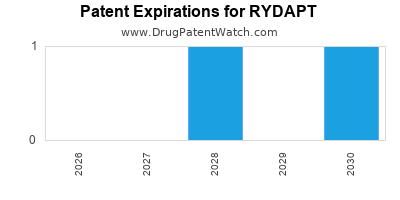
Last updated: July 28, 2026
RYDAPT (midostaurin) market dynamics and financial trajectory: pricing, uptake, loss of exclusivity, competitive threats, and revenue exposure
Executive summary: RYDAPT (midostaurin) generated meaningful oncology sales after launches in advanced systemic mastocytosis and FLT3-mutated AML, but revenue is now pressured by (1) step-down from earlier peak demand, (2) payer controls and site-of-therapy competition, (3) limited indications footprint outside core high-acuity settings, and (4) competitive intensity in FLT3 AML. Near-to-mid-term financial trajectory is driven more by durability of premium-priced access and patient persistence than by new label expansion. Patent and exclusivity timing create generic and biosimilar-adjacent risk primarily through small-molecule generic entry pathways (midostaurin is chemically synthesized, not biologic), with FDA regulatory milestones and Orange Book-driven litigation shaping launch windows.
What is RYDAPT (midostaurin) used for and how do those indications drive sales growth or decline?
Core commercial engine
RYDAPT is an oral kinase inhibitor used in:
- Advanced systemic mastocytosis (AdvSM)
Includes aggressive systemic mastocytosis (ASM) and systemic mastocytosis with an associated hematological neoplasm (SM-AHN).
- FLT3-mutated acute myeloid leukemia (AML), in combination with standard chemotherapy (current label language includes FLT3-mutated AML per FDA approval framework).
How indication mix affects financial trajectory
- AdvSM is smaller but high-value per-patient due to specialty administration patterns and limited alternatives historically.
- FLT3-mutated AML is larger, but midostaurin faces faster treatment-line churn as FLT3 inhibitors with stronger efficacy signals and different dosing schedules compete for the same patient population.
Featured snippet answer: RYDAPT’s revenue trajectory depends on the balance between durable AdvSM patient demand and competitive penetration in FLT3-mutated AML.
Which patient segments have the highest payer friction?
- AdvSM: payer coverage varies by disease classification and documentation burden (histology, KIT D816V status where required by labeling or practice patterns).
- FLT3 AML: payer authorization ties to molecular testing (FLT3 status) and timing with chemotherapy cycles, which can narrow eligible share if testing rates or prior-therapy constraints exist.
What delivery and adherence characteristics matter financially?
- Oral dosing supports convenience versus infusional competitors, but it increases reliance on specialty pharmacy distribution, dose interruptions, and adherence programs.
- Toxicity management (GI effects, hematologic events) drives supportive care and can influence persistence.
How has RYDAPT pricing and reimbursement evolved, and what does that imply for net sales?
Pricing mechanics
Midostaurin is typically reimbursed through:
- Commercial insurance formularies with prior authorization
- Specialty pharmacy benefit management
- Oncology infusion-adjacent bundling for AML chemo combinations (payer structures vary by plan)
Reimbursement pressures that typically compress net sales
- Step therapy or prior authorization tightening over time
- Narrow formulary placement as competing FLT3 inhibitors secure preferred status
- Discounts and rebates increasing as competitor availability rises
Featured snippet answer: Net sales usually flatten when formulary status deteriorates or when competitor FLT3 inhibitors capture preferred coverage for the same biomarker-driven population.
What payer levers most impact midostaurin economics?
- Increased use of preferred FLT3 inhibitor pathways for newly diagnosed FLT3 AML
- Evidence requirements for molecular diagnostics
- Coverage rules based on line of therapy and performance status
How do specialty pharmacy dynamics affect revenue reporting?
- Gross-to-net discounting rises when multiple generics or lower-cost alternatives become plausible, even before full generic entry, because plans renegotiate rebates.
What does the RYDAPT revenue curve look like across time, and what stages dominate financial performance?
A typical branded oncology trajectory for a small molecule like midostaurin follows:
- Launch ramp in AdvSM and AML combination settings
- Peak period tied to guideline adoption and expanding diagnostic throughput
- Mature phase with competitive erosion and payer containment
- Pre-loss-of-exclusivity plateau with heightened rebate pressure
- Post-exclusivity step-down if generic entry succeeds without injunction
Featured snippet answer: Financial trajectory is usually strongest during guideline adoption and testing expansion, then compresses as preferred competitor FLT3 inhibitors increase and as payer controls tighten.
Drivers of post-peak sales compression
- Share loss to newer FLT3 inhibitors and treatment sequencing preferences
- Patient persistence decline if toxicity management differs by regimen
- Lower incremental uptake when market penetration approaches saturation in the biomarker-defined pool
What tends to stabilize branded sales near exclusivity events?
- Patient need in AdvSM with fewer direct substitutes
- Physician reluctance to switch stable patients when clinical uncertainty exists around equivalents (especially if therapeutic windows and adverse effect profiles differ across dosing strategies)
How does FLT3 AML competition affect RYDAPT market share and revenue durability?
Competitive pressure
RYDAPT is contested in FLT3-mutated AML by other FLT3 inhibitor regimens, which affects:
- First-line adoption rates
- Preferred reimbursement placement
- Share of eligible patients treated at the same time point in AML care
Featured snippet answer: Revenue durability for RYDAPT in AML depends on whether it retains preferred formulary status for newly diagnosed FLT3-mutated AML and on regimen preference at induction.
What competition changes at the regimen level
- The number of concurrent marketed FLT3 inhibitors increases plan and clinician choice
- Physicians optimize based on response and tolerability profiles, which can shift uptake away from midostaurin if alternatives show advantages in practice
How guideline and practice patterns translate to sales
- If later-year clinical practice favors another FLT3 inhibitor combination or sequencing, midostaurin share declines even if patients remain biomarker-positive.
What patents protect RYDAPT (midostaurin), and how strong is the patent estate for blocking generic entry?
RYDAPT’s IP posture is evaluated through:
- Composition-of-matter (midostaurin drug substance)
- Formulation patents (capsule composition, release characteristics)
- Method-of-use patents (AdvSM and FLT3-mutated AML clinical uses)
- Manufacturing process patents (if any)
- Regulatory exclusivities (not patent-based but can extend barrier-to-entry)
Featured snippet answer: Generic entry risk is determined by which Orange Book-listed patents are still in force and whether method-of-use or formulation claims remain unexpired and enforceable.
What typically creates the highest litigation exposure
- Method-of-use patents tied to FDA-labeled indications
- Formulation or manufacturing patents that require design-around, even if composition is generic
How “strength” manifests commercially
- Courts or settlements can lead to delayed launch dates
- Agreements can preserve brand share, especially if generics launch with narrow labels or under risk-sharing
When does RYDAPT lose exclusivity, and what are the likely generic launch scenarios?
Exclusivity categories to map
- Patent term expirations (listed in Orange Book)
- Patent-specific expiration and potential pediatric exclusivity extensions (if applicable)
- Non-patent exclusivity (application and marketing exclusivities when relevant)
Featured snippet answer: Generic launch timing usually aligns with the last unexpired Orange Book patent or with an effective settlement date that stipulates entry.
Generic entry scenario matrix (commercial impact)
| Scenario |
What happens legally/regulatorily |
Expected market effect |
| Multiple patents remain unexpired |
Generics delayed |
Sales decline mainly from competition, not price |
| Partial patent carveouts |
Launch on limited label or with restrictions |
Slower share shift, more brand persistence |
| Broad invalidation or settlement permitting entry |
Launch at earliest allowed date |
Rapid price pressure and unit-share loss |
| Design-around avoids some claims |
Launch may proceed with different formulation/process |
Moderate-to-rapid share shift depending on interchangeability |
Note: Specific expiration dates depend on the Orange Book patent list and any litigation or settlement terms; the financial consequences hinge on the “last-to-expire” claims controlling market entry.
What Paragraph IV challenges and ANDA filings affect RYDAPT, and how have settlements shaped timelines?
What matters for revenue
- Whether ANDA filers have triggered Paragraph IV litigation
- Whether courts issue injunctions or design-around determinations
- Whether brand and generic parties settle on launch calendars
Featured snippet answer: The main near-term financial swing factors are court outcomes and settlement launch dates, since they determine when price competition begins.
How litigation outcomes translate into commercial trajectory
- An injunction postpones generic pricing pressure and preserves brand net sales
- A settlement with a licensed entrant can create earlier but controlled erosion
- If multiple defendants settle differently, the market can face staggered entry and tiered discounts
What is the Orange Book status of RYDAPT (midostaurin), and which patents are key to watch?
Orange Book is the definitive map for barriers
RYDAPT’s key-watch set includes:
- The most recently listed patents with the latest expiration among:
- Active ingredient / drug substance
- Formulation and dosage form
- Methods of use tied to labeled indications
- Manufacturing/process claims if listed
Featured snippet answer: The “last unexpired Orange Book patent” determines the earliest credible non-infringing generic entry pathway.
Why Orange Book structure matters for investors
- If the last-to-expire patents are narrow method-of-use claims, generics may seek at-risk entry with label carveouts
- If formulation/process claims are dominant, design-around becomes harder and delays are more likely
How does FDA regulatory status affect RYDAPT financial trajectory (approvals, labeling changes, and exclusivity events)?
Regulatory milestones that move sales
- Label expansions or new indication approvals can extend growth
- Label tightening or safety updates can alter prescribing patterns
- Postmarketing changes to REMS (if applicable) or prescribing restrictions can affect persistence
Featured snippet answer: FDA label scope and any restrictions directly alter eligible patient pools and thus net sales trajectory.
What to watch in FDA filings
- Supplement approvals affecting dosing schedule or indication language
- New risk management requirements
- Any regulatory changes that shift how oncologists prescribe midostaurin in AML combination settings
How does RYDAPT compare with competing FLT3 inhibitors on commercial and IP barriers?
Commercial comparison levers
- Preferred formulary status in FLT3 AML
- Coverage restrictions and prior authorization burden
- Differentiation by dosing cadence and toxicity profile
- Institutional contracting and specialty pharmacy distribution terms
IP comparison levers
- Composition-of-matter and method-of-use patent durability
- Settlement patterns and launch calendars for competitors
- Strength of formulation and process barriers that can slow generics
Featured snippet answer: Even when midostaurin retains label access, competitor IP and payer contracting can dominate share outcomes.
What generic entry risks exist for RYDAPT, and how would they affect revenue exposure?
Revenue exposure channels
- Price erosion at the start of generic availability
- Unit share loss due to switching behavior
- Rebate renegotiation by payers once low-cost alternatives exist
- Institutional purchasing shifts as pharmacy committees standardize on generics
Featured snippet answer: The largest revenue downside is typically concentrated in the first 6 to 18 months after a successful generic launch for midostaurin, driven by both price and switching.
What determines magnitude of erosion
- Market perception of bioequivalence/interchangeability for oral capsules
- Bundling and reimbursement policies in AML treatment pathways
- Physician switching willingness for patients on stable regimens
What is the near-term competitive and financial outlook for RYDAPT based on market structure?
Near-term financial drivers
- Maintenance of preferred status in the remaining concentrated AdvSM and FLT3 patient pool
- Continued performance of AML regimen adoption under payer controls
- Litigation and patent posture that can extend branded economics if injunctions or settlements delay entry
Featured snippet answer: The trajectory is likely to remain “mature-brand pressured” unless a major label expansion or a competitor contraction occurs, and the primary upside/downside hinge remains generic timing governed by Orange Book patents and litigation outcomes.
Key Takeaways
- RYDAPT’s revenue is driven by two specialized oncology anchors: AdvSM and FLT3-mutated AML combination therapy.
- Post-peak performance is constrained more by competition and payer contracting in AML than by patient population growth.
- The decisive future revenue swing is tied to the Orange Book “last-to-expire” patent set and the presence or absence of Paragraph IV ANDA litigation and settlement-driven launch calendars.
- Generic entry would likely trigger the largest revenue drop via price erosion plus unit switching, typically within 6 to 18 months of launch.
FAQs
- How do payer formulary changes for FLT3-mutated AML affect midostaurin net sales independently of patient incidence?
- Which Orange Book patent types (method-of-use vs formulation vs process) most often determine generic launch timing for midostaurin?
- What settlement structures (30-month stay, consent decrees, or licensed entry) most influence the speed of RYDAPT price erosion?
- How do molecular testing rates for FLT3 mutations affect RYDAPT addressable demand in community oncology?
- What unit-share and rebate dynamics typically occur when an oral kinase inhibitor like midostaurin faces its first generic competitor?
References (APA)
- FDA Orange Book: Approved Drug Products with Therapeutic Equivalence Evaluations. (Current online database). U.S. Food and Drug Administration.
- FDA Drug Approvals and Label Information for RYDAPT (midostaurin). (Current online database). U.S. Food and Drug Administration.