Last updated: August 1, 2026
Rozlytrek, Roche’s brand for entrectinib, is a precision oncology drug approved for ROS1-positive non-small cell lung cancer and NTRK gene fusion-positive solid tumors. Its commercial profile is defined by a small biomarker-selected population, high treatment value in central nervous system disease, competition from larotrectinib and other targeted therapies, and a limited but meaningful patent runway.
Roche does not disclose Rozlytrek revenue at the level of its largest oncology products. Public reporting indicates a niche product with substantially lower sales than Roche’s major oncology franchises. The principal long-term risks are limited addressable population, diagnostic dependence, treatment switching, and generic entry after the core U.S. patent estate expires.
What is Rozlytrek and which patients does it treat?
Rozlytrek is an oral tyrosine kinase inhibitor containing entrectinib. It inhibits the ROS1, TRK-A, TRK-B, and TRK-C kinases.
The drug is used for:
- ROS1-positive metastatic non-small cell lung cancer.
- NTRK gene fusion-positive solid tumors in adults and pediatric patients aged 12 years and older, where the tumor is metastatic or surgical resection is likely to cause severe morbidity and no satisfactory alternative treatment exists.
The FDA granted accelerated approval for NTRK fusion-positive solid tumors and regular approval for ROS1-positive metastatic non-small cell lung cancer in August 2019. The drug’s activity against intracranial disease is commercially important because ROS1-positive lung cancer and NTRK fusion tumors can develop or present with central nervous system metastases (FDA, 2019).
Unlike broad-market oncology drugs, Rozlytrek depends on molecular testing. Its sales ceiling is determined by the frequency of ROS1 and NTRK alterations, testing rates, treatment duration, and the share of eligible patients who receive entrectinib rather than a competing targeted therapy.
How large is the market for Rozlytrek?
The market is commercially attractive per patient but small in volume.
ROS1 rearrangements occur in approximately 1% to 2% of non-small cell lung cancers. NTRK gene fusions are rare in common cancers, generally occurring in well below 1% of unselected solid tumors, although prevalence is higher in certain rare cancers and pediatric tumors (Drilon et al., 2018).
The relevant market has four constraints:
- ROS1 and NTRK alterations are uncommon.
- Comprehensive genomic testing is required for reliable identification.
- Patients may receive another targeted therapy before entrectinib.
- Treatment duration is affected by progression, tolerability, and central nervous system disease.
Rozlytrek has a differentiated value proposition in patients with brain metastases. Its label includes intracranial activity, and entrectinib was designed to cross the blood-brain barrier. That advantage is clinically relevant but does not create a large-volume market.
How does Rozlytrek compare with Vitrakvi?
Rozlytrek competes most directly with Vitrakvi, the Bayer and Lilly brand for larotrectinib, in NTRK fusion-positive tumors.
| Category |
Rozlytrek |
Vitrakvi |
| Active ingredient |
Entrectinib |
Larotrectinib |
| Main biomarkers |
ROS1, NTRK |
NTRK |
| FDA approval |
2019 |
2018 |
| Primary commercial strength |
ROS1 lung cancer plus NTRK tumors |
NTRK tumors |
| CNS positioning |
Important clinical differentiator |
Also active in CNS disease |
| Dosage form |
Capsules and oral pellets |
Capsules and oral solution |
| Market exposure |
Broader biomarker coverage |
More concentrated NTRK exposure |
| Main competitive risk |
Lorlatinib, crizotinib, repotrectinib, larotrectinib |
Entrectinib and newer TRK inhibitors |
Rozlytrek’s ROS1 indication gives it a larger addressable market than a product limited to NTRK tumors. Its competitive position in ROS1 lung cancer has weakened as newer-generation agents, particularly repotrectinib and lorlatinib, compete for patients with central nervous system disease and resistance mutations.
What is the financial trajectory for Rozlytrek?
Roche’s public reporting indicates that Rozlytrek remains a small oncology product relative to its established brands. The company reports pharmaceutical sales in Swiss francs, and Rozlytrek has not approached the scale of Tecentriq, Alecensa, Ocrevus, Vabysmo, or other major Roche products.
Public Roche annual reports place Rozlytrek sales in the low hundreds of millions of Swiss francs or below, depending on the reporting year and exchange rates. The overall trajectory has been modest rather than high growth.
| Financial driver |
Effect on Rozlytrek |
| ROS1 approval |
Expands the commercial base beyond rare NTRK tumors |
| NTRK approval |
Provides premium pricing in a high-unmet-need population |
| Low biomarker prevalence |
Caps patient volume |
| Roche diagnostic infrastructure |
Supports testing and treatment identification |
| Larotrectinib competition |
Limits NTRK share |
| Repotrectinib and lorlatinib |
Pressure ROS1 prescribing |
| Pediatric formulation |
Improves access in younger patients but adds limited volume |
| Patent protection |
Supports pricing before generic entry |
| Small sales base |
Limits absolute revenue erosion from future generic competition |
Roche’s financial exposure is therefore limited in group-wide terms. Rozlytrek is strategically relevant as part of Roche’s precision-oncology portfolio, but it is unlikely to become a core revenue driver without a material expansion into additional biomarker-defined cancers or new combination regimens.
Why has Rozlytrek not become a major oncology product?
The principal reason is market size. Rozlytrek is not a broad indication drug. It requires a specific genomic alteration, and the relevant alterations are rare.
The product also entered a competitive category in which physicians have several targeted options. In ROS1-positive lung cancer, treatment selection can depend on central nervous system activity, resistance mutations, prior treatment, toxicity, and physician familiarity. In NTRK tumors, entrectinib and larotrectinib have overlapping positioning.
The commercial impact is amplified by treatment sequencing. A patient who receives another ROS1 or TRK inhibitor first may not later receive Rozlytrek, even if entrectinib remains technically indicated.
When does Rozlytrek lose exclusivity?
Rozlytrek’s regulatory exclusivity and patent exclusivity have different end dates.
The FDA granted five years of new chemical entity exclusivity from the first U.S. approval in August 2019. That period ended in 2024. The product can still have patent protection after regulatory exclusivity ends.
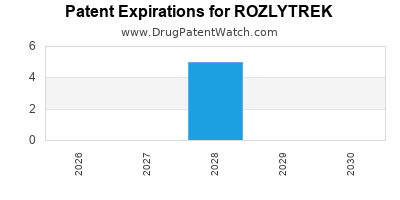
The key composition-of-matter patent family for entrectinib is generally associated with U.S. patent protection extending into the early 2030s, subject to patent-term adjustment, patent-term extension, claim scope, and Orange Book status. The core U.S. patent commonly associated with entrectinib is U.S. Patent No. 10,392,414, which has an expiration date in 2033 before any applicable patent-term extension or adjustment.
| Exclusivity layer |
Approximate timing |
Commercial effect |
| FDA new chemical entity exclusivity |
August 2019 to August 2024 |
Prevented abbreviated new drug approval submissions during the NCE period |
| Core compound patent |
Into approximately 2033 |
Main barrier to an identical generic product |
| Formulation and pediatric patents |
Potentially later or overlapping dates |
May protect specific presentations and uses |
| Orphan-drug exclusivity |
Depends on the designated indication |
Can block approval for the same orphan indication during the exclusivity period |
| Regulatory exclusivity for supplements |
Varies |
May protect specific new indications or pediatric data |
Exact generic entry depends on the claims listed in the Orange Book, any later-issued patents, patent-term calculations, Paragraph IV litigation, and settlement terms. The earliest practical launch date is not necessarily the nominal expiration date of the oldest patent.
What patents protect Rozlytrek?
The patent estate includes protection for the active compound, pharmaceutical compositions, treatment methods, and potentially specific dosage forms.
Core compound patents
Core compound claims are the most commercially important because they can prevent a generic manufacturer from marketing entrectinib in any indication before expiration. U.S. Patent No. 10,392,414 is associated with the entrectinib compound family and is generally reported with expiration in 2033.
The underlying patent family includes international filings directed to substituted kinase inhibitors and related pharmaceutical compounds. Patent protection outside the United States varies by national phase, prosecution history, granted claims, and local term rules.
Formulation patents
Rozlytrek is available as capsules and oral pellets. The oral pellet presentation is relevant to pediatric administration and patients who cannot swallow capsules.
Formulation patents may protect:
- Oral solid dosage forms.
- Entrectinib compositions with specific excipients.
- Pellet or sprinkle formulations.
- Stability characteristics.
- Pediatric administration methods.
A generic manufacturer may avoid a formulation claim by using a different excipient system or dosage form. That does not necessarily avoid a compound patent covering entrectinib itself.
Method-of-use patents
Method-of-use protection can cover treatment of:
- ROS1-positive non-small cell lung cancer.
- NTRK fusion-positive solid tumors.
- Patients with central nervous system metastases.
- Pediatric patients with qualifying NTRK fusion tumors.
- Specific dosing regimens or treatment settings.
Method patents are narrower than composition-of-matter claims. Their value depends on whether a generic product can be marketed with a label that omits the patented indication. Skinny-label strategies can reduce infringement exposure, although patent litigation may still focus on prescribing behavior, promotional activity, and induced infringement.
What is the Orange Book status of Rozlytrek?
The FDA Orange Book is the central U.S. source for listed patents and exclusivity associated with approved small-molecule products.
Rozlytrek is an Orange Book-listed small-molecule drug rather than a biologic. Its listing can include patents directed to the active ingredient, formulation, and approved methods of use. The Orange Book status matters because listed patents can trigger a 30-month stay if a brand company files an infringement action after receiving a Paragraph IV notice.
The commercial analysis should distinguish between:
- Patents listed for the reference drug.
- Patents that remain unexpired.
- Patents covering all uses versus only one indication.
- Patents subject to pediatric or orphan exclusivity.
- Patents that a generic applicant certifies against.
No major publicly reported Paragraph IV litigation campaign had established a generic launch date for Rozlytrek through the latest widely available public records. The absence of a reported challenge does not eliminate future litigation risk.
Which companies are challenging Rozlytrek?
The principal competitive threats are not biosimilars. Entrectinib is a chemically synthesized small molecule, so the relevant challengers are generic drug manufacturers and competing targeted-therapy companies.
Potential generic challengers include manufacturers that file ANDAs with Paragraph IV certifications against Orange Book-listed patents. The commercial economics are less attractive than for a mass-market drug because the eligible patient population is small, but high pricing can support a niche generic launch.
Clinical competitors include:
- Bayer and Lilly, with larotrectinib.
- Pfizer, with lorlatinib in ALK-positive and ROS1-relevant treatment discussions depending on jurisdiction and indication.
- Bristol Myers Squibb, with repotrectinib for ROS1-positive non-small cell lung cancer.
- Pfizer, with crizotinib in ROS1-positive disease in applicable markets.
- Other investigational TRK, ROS1, and pan-kinase inhibitors.
What generic entry risks exist for Rozlytrek?
Generic entry is likely to be gradual rather than disruptive at the population level.
The principal scenarios are:
| Scenario |
Timing |
Likely effect |
| No early Paragraph IV challenge |
Before core patent expiry |
Roche retains branded pricing and share |
| Paragraph IV challenge with settlement |
Before 2033 |
Entry occurs on a negotiated date, potentially with limited indication labeling |
| At-risk launch |
Before final patent resolution |
High litigation exposure for the generic and Roche |
| Post-patent generic entry |
Around or after core patent expiry |
Rapid price erosion but limited absolute market impact |
| Formulation-only challenge |
After compound patent issues |
Generic may enter selected presentations or avoid certain formulation claims |
A generic version could capture patients in ROS1-positive lung cancer and NTRK-positive tumors, but physician adoption may be constrained by diagnostic precision, treatment complexity, pediatric dosing, and concern over supply reliability.
Does Rozlytrek face biosimilar risk?
Rozlytrek does not face conventional biosimilar risk because entrectinib is a small-molecule drug regulated through the FDA’s ANDA pathway.
The relevant risk is generic substitution. An ANDA applicant must demonstrate pharmaceutical equivalence and bioequivalence, not biosimilarity. Once an AB-rated generic is approved and eligible for substitution under state law and payer policy, pharmacy substitution can place substantial pressure on the branded product.
What FDA regulatory risks affect Rozlytrek?
Rozlytrek’s NTRK tumor approval was granted under an accelerated approval framework tied to tumor response data. Continued commercial support depends on confirmatory evidence and maintenance of the approved benefit-risk profile.
Regulatory risks include:
- Failure to confirm clinical benefit in required postmarketing studies.
- Label revisions based on safety or efficacy findings.
- Increased scrutiny of rare-tumor response data.
- New competitor approvals with superior evidence.
- Expanded testing requirements.
- Safety concerns involving cardiac, neurologic, skeletal, or reproductive effects.
The product’s label includes warnings and precautions relevant to congestive heart failure, central nervous system effects, skeletal fractures, hepatotoxicity, and embryo-fetal toxicity. These risks can affect treatment selection and monitoring costs (FDA, 2024).
What licensing deals support the Rozlytrek franchise?
Entrectinib was developed through collaborations involving Ignyta, a biotechnology company acquired by Roche in 2017. Roche paid approximately $1.7 billion to acquire Ignyta, gaining entrectinib and other precision-oncology assets (Roche, 2017).
The acquisition gave Roche control over global development and commercialization. It also integrated entrectinib into Roche’s oncology and companion-diagnostic infrastructure.
The transaction’s return profile is constrained by the drug’s niche market. Roche’s strategic rationale depended on:
- A differentiated pan-TRK and ROS1 mechanism.
- Regulatory approvals across multiple tumor types.
- Global access to genomic testing.
- Premium pricing for rare molecularly defined cancers.
- Potential use in pediatric and CNS disease.
How strong is the Rozlytrek patent estate?
The estate is strongest at the compound level and weaker at the indication level.
| Patent category |
Relative strength |
Reason |
| Composition of matter |
High |
Can block generic entrectinib across indications |
| Pharmaceutical composition |
Medium to high |
May block specific formulations but can sometimes be designed around |
| Oral pellet formulation |
Medium |
Important for pediatric use, but narrower than compound protection |
| ROS1 method of use |
Medium |
Commercially relevant but potentially vulnerable to skinny-label strategies |
| NTRK method of use |
Medium |
Important for rare tumors, with narrower patient population |
| Dosing and administration |
Low to medium |
Dependent on claim drafting and generic labeling |
| Manufacturing process |
Variable |
May create supply and process barriers without blocking alternative processes |
Geographic coverage is strongest in the United States, Europe, Japan, and other markets where Roche pursued national-phase patents and regulatory approvals. Expiration dates differ by jurisdiction. Patent term extensions, supplementary protection certificates, pediatric extensions, and local prosecution outcomes can change effective exclusivity.
What is the commercial outlook for Rozlytrek?
Rozlytrek is likely to remain a durable niche oncology product rather than a high-growth franchise.
Upside factors include:
- Increased comprehensive genomic testing.
- More routine identification of NTRK fusions.
- Earlier use in ROS1-positive disease.
- Pediatric uptake of oral pellets.
- Greater recognition of CNS activity.
- Expansion into new tumor types or treatment lines.
Downside factors include:
- Competition from larotrectinib in NTRK tumors.
- Repotrectinib and other agents in ROS1-positive lung cancer.
- Small biomarker-defined populations.
- Reimbursement restrictions for rare indications.
- Declining price after generic entry.
- Limited ability to offset loss of exclusivity with new indications.
Revenue exposure to Roche is modest compared with the company’s largest products. The principal investment question is not whether Rozlytrek can materially change Roche’s consolidated earnings. It is whether Roche can preserve a premium position in rare genomic cancers until core patent protection expires and whether additional indications can expand the addressable population.
Key Takeaways
- Rozlytrek is Roche’s entrectinib product for ROS1-positive non-small cell lung cancer and NTRK fusion-positive solid tumors.
- Its market is small but commercially valuable because treatment is targeted and often used in serious metastatic disease.
- Roche’s revenue from Rozlytrek is materially below its major oncology products.
- The drug competes with larotrectinib in NTRK tumors and with repotrectinib, lorlatinib, and crizotinib in ROS1-related treatment markets.
- FDA new chemical entity exclusivity ended in 2024.
- Core U.S. compound patent protection is generally associated with expiration in the early 2030s, including U.S. Patent No. 10,392,414.
- Formulation and method-of-use patents may extend protection for selected presentations and indications but are narrower than compound claims.
- Rozlytrek faces generic, not biosimilar, risk.
- No major publicly established Paragraph IV launch or settlement had defined an earlier generic entry date in the available record.
- Roche’s acquisition of Ignyta for approximately $1.7 billion provided control of entrectinib and related precision-oncology assets.
FAQs About Rozlytrek Market and Patent Protection
Is Rozlytrek a high-revenue drug for Roche?
No. Rozlytrek is a niche product with sales far below Roche’s largest oncology and immunology medicines.
What is the main competitor to Rozlytrek?
Larotrectinib, marketed as Vitrakvi, is the closest competitor in NTRK fusion-positive tumors. Repotrectinib is an important competitor in ROS1-positive lung cancer.
Can a generic company launch entrectinib before 2033?
A generic company could potentially launch earlier through a patent settlement, successful Paragraph IV challenge, or a non-infringing label and formulation strategy. The core compound patent remains the main barrier.
Does Rozlytrek have orphan-drug protection?
Rozlytrek received regulatory treatment for rare molecularly defined cancers, including NTRK fusion-positive solid tumors. Orphan-drug exclusivity applies by indication and does not necessarily prevent all generic or competing approvals.
Why is genomic testing important to Rozlytrek sales?
Physicians must identify ROS1 rearrangements or NTRK gene fusions to select eligible patients. Higher testing rates directly expand the diagnosed treatment population.
References
-
Drilon, A., Laetsch, T. W., Kummar, S., DuBois, S. G., Lassen, U. N., Demetri, G. D., Nathenson, M., Doebele, R. C., Farago, A. F., Pappo, A. S., Turpin, B., Dowlati, A., Brose, M. S., Hawryluk, E., Fischer, M., Voss, M. H., Witzig, T. E., Wolf, J., Ziegler, D. S., ... Siena, S. (2018). Efficacy of larotrectinib in TRK fusion-positive cancers in adults and children. New England Journal of Medicine, 378(8), 731-739.
-
Roche. (2017). Roche to acquire Ignyta, Inc. for approximately $1.7 billion. F. Hoffmann-La Roche Ltd.
-
U.S. Food and Drug Administration. (2019). FDA approves entrectinib for NTRK solid tumors and ROS-1 positive non-small cell lung cancer. FDA.
-
U.S. Food and Drug Administration. (2024). Rozlytrek prescribing information. Genentech USA, Inc.
-
U.S. Patent No. 10,392,414. (2019). Substituted 3-amino-pyridine compounds. U.S. Patent and Trademark Office.