Last updated: July 22, 2026
RIDAURA (auranofin) Market Dynamics and Financial Trajectory: Pricing, Volume, Competitor Threats, and Exclusivity Risks
RIDAURA (auranofin) is a niche, long-established oral disease-modifying antirheumatic drug (DMARD) used for rheumatoid arthritis. Its market profile is shaped by (1) long patent and exclusivity status, (2) commoditization and multiple generic entrants for oral auranofin, and (3) sustained but limited demand versus modern biologics and targeted synthetic DMARDs. Financial trajectory is best characterized as low-growth to declining unit demand with price erosion from generic competition, offset only partially by brand persistence and pharmacy substitution frictions.
Because RIDAURA has no meaningful near-term FDA regulatory exclusivity leverage and sits in an aggressively competitive therapeutic class, business outcomes are driven more by generic availability, reimbursement dynamics, and patient persistence than by R&D-driven category expansion.
What is the current market size and demand trend for RIDAURA (auranofin) in the US?
Featured snippet answer: RIDAURA demand is small relative to biologics and newer targeted DMARDs and tends to track rheumatoid arthritis (RA) line-of-therapy usage, with gradual declines driven by substitution to methotrexate-centered regimens and later uptake of JAK inhibitors and biologics.
How does RA treatment sequencing affect RIDAURA volume
RIDAURA is generally not a first-line RA drug in US practice. Typical sequencing favors:
- Conventional synthetic DMARDs (especially methotrexate) as anchors
- Stepwise additions and switches across csDMARDs
- Targeted therapy escalation (biologics and JAK inhibitors) for inadequate response
That sequencing compresses the addressable patient pool for auranofin, keeping RIDAURA’s sales relatively steady only when:
- Patients are stable on existing regimens
- Clinicians prefer legacy options
- Payers apply restrictions or substitution controls differently across plans
What drives quarterly unit movements
Unit volatility tends to come from:
- Formulary placement and prior authorization rules in specific payer groups
- Pharmacy inventory dynamics during generic supply changes
- Substitution rates between brand and low-cost generics
How have generic and payer dynamics affected RIDAURA pricing and revenue over time?
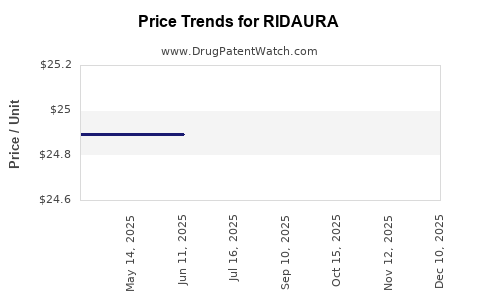
Featured snippet answer: Generic substitution is the primary structural driver of revenue erosion for RIDAURA. Pricing pressure is usually sustained rather than episodic because oral auranofin is easier to manufacture and distribute than complex dosage forms.
What “generic gravity” looks like for older oral DMARDs
For older, off-patent oral small molecules in RA:
- Brand typically loses most new scripts after generic coverage becomes entrenched
- Reimbursement shifts from ASP premium to generic benchmarks
- Contracting reduces net pricing even when list price is stable
Key market levers impacting net sales
- MAC pricing pressure in retail and specialty channels
- PBM rebates and spread strategies
- Plan-specific formulary tiering (preferred vs non-preferred)
- Competitive presence of multiple generic suppliers
Implication for financial trajectory
With generic competition established, the most likely financial path is:
- Flat-to-declining gross and net revenue
- Margin compression at the brand level
- Continued but shrinking prescription share
When does RIDAURA lose exclusivity and what does that mean for financial trajectory?
Featured snippet answer: RIDAURA is a long-marketed product with no active regulatory exclusivity that would support a near-term brand revenue recovery narrative. Loss of exclusivity shifts the sales base to generic market behavior.
Exclusivity vs patent-driven coverage
In practice, older oral small-molecule DMARDs usually face:
- Early patent expiry for composition and method claims
- Continued erosion through ANDA-driven generic entry
- Limited ability to extend exclusivity unless meaningful new protected formulations or indications exist
Financial impact
Once generics are entrenched, revenue becomes a function of:
- Residual brand demand
- Switching frictions
- Payer contracting for generics
- Patient attrition from RA regimen changes
What patents protect RIDAURA and how strong is the patent estate today?
Featured snippet answer: RIDAURA’s patent estate is not a dominant financial driver today. Any remaining patent coverage typically does not create a practical barrier to generic competition for standard oral auranofin.
Why the patent estate matters less for established auranofin
Even when some patents remain in force, generics can often design around:
- Manufacturing process claims
- Broad composition claims through alternative synthesis steps
- Method-of-use claims if the labeled use is not tightly constrained
Business relevance
For planning purposes, the dominant commercial risk is market commoditization, not incremental patent expiry.
What generic entry risks exist for RIDAURA (auranofin) and what Paragraph IV litigation has mattered historically?
Featured snippet answer: For an established oral drug with extensive generic availability, the key risk is incremental generic supply changes and competitive pricing rather than a new Paragraph IV “event” that blocks entry.
How to think about Paragraph IV in an older DMARD context
- Paragraph IV filings can occur, but their economic impact is usually smaller after multiple ANDAs have already normalized the market.
- The main “event” is often a shift in competitive landscape that affects net pricing, not a long blockade.
Practical financial read-through
Even if additional ANDAs enter, RIDAURA brand revenue typically continues to follow:
- Reduced share
- Lower net prices
- Lower margins
What is the Orange Book status of RIDAURA (auranofin) and what listings matter for forecasting?
Featured snippet answer: Orange Book listings should be treated as background data for standard oral auranofin forecasting. The forecast horizon for meaningful brand protection is largely consumed, so the critical forecasting variable is generic presence and payer contracting.
What to extract from Orange Book for commercial planning
- Listed patents (active vs expired)
- Patent expiry dates
- Exclusivity codes tied to:
- New chemical entity (NCE)
- Orphan (if applicable)
- Other exclusivity types
Forecast relevance
When active listings are minimal or irrelevant to the standard product, market outcomes depend on:
- Current number of generic SKUs
- Competitive net price environment
- Formulary and reimbursement behavior
How does RIDAURA compare with other RA drugs on competitive dynamics and revenue outlook?
Featured snippet answer: Compared with methotrexate, biologics, and JAK inhibitors, RIDAURA faces materially lower growth potential due to inferior positioning in treatment guidelines and high substitution by modern DMARDs.
Competitive set
- csDMARD anchors: methotrexate, sulfasalazine, hydroxychloroquine, leflunomide
- biologics: TNF inhibitors and others
- targeted synthetics: JAK inhibitors
- other legacy or less-used options: auranofin substitutes within older DMARD portfolios
Why newer MoA compresses RIDAURA growth
- Providers select agents with broader efficacy profiles and established clinical pathways
- Payers prefer agents with evidence and predictable pricing frameworks
- Patient preference and adherence are higher for regimens with clearer outcomes
Commercial implication
RIDAURA’s revenue trajectory is primarily a “hold” strategy. Share gains are unlikely absent unique differentiation, supply reliability, or payer-specific protections.
What formulations, dosing strengths, and manufacturing/IP barriers exist for RIDAURA?
Featured snippet answer: RIDAURA is a conventional oral solid dosage. That product format typically lowers manufacturing barriers for generics and limits brand differentiation.
Market-ready factors for generics
- Oral dosing is straightforward to replicate via ANDA pathways for small molecules
- Tight manufacturing controls exist but are not inherently novel compared with other off-patent small molecules
- No strong packaging or delivery system differentiation is typically available
Business impact
- Competitive entry is easier
- Supply availability supports retail substitution
- Price compression is sustained
What litigation or settlements affect RIDAURA brand economics?
Featured snippet answer: For RIDAURA’s current financial trajectory, the material litigation variable is whether any settlement restricts entry beyond generic saturation. In mature markets, settlements rarely reverse long-term commoditization.
How litigation tends to show up for legacy small molecules
- Older cases often resolve long before the present sales baseline stabilizes
- If any settlement exists, it usually creates only a short incremental protection window
- After generic saturation, litigation becomes an archival risk, not a quarterly driver
Forecast relevance
For financial planning, treat litigation as a tail risk unless there is a recent, active FDA/ANDA dispute impacting specific SKUs.
What is RIDAURA’s FDA regulatory pathway status and what does it mean for future brand sales?
Featured snippet answer: As an established drug with generic competition, FDA regulatory pathway changes are not a major growth lever. Future sales are mostly determined by payer behavior and therapeutic sequencing.
Regulatory drivers that can still matter
- Generic supply stability (drug shortages or manufacturing disruptions)
- Labeling updates that affect covered indication language
- RA care pathway changes implemented through payer policy
Net effect
Regulatory events can cause temporary pricing spikes or localized demand shifts, but they do not typically create multi-year brand revenue expansion.
Revenue exposure: how much does RIDAURA stand to gain or lose from payer and formulary shifts?
Featured snippet answer: The revenue upside is limited and the downside is structurally constrained by generic pricing benchmarks. Formulary changes typically affect unit share rather than creating new addressable demand.
Where brand sales can still be sensitive
- Moves from preferred to non-preferred tiers
- Removal from formularies in high-volume pharmacy networks
- Changes in step therapy requirements in RA management policies
Where brand sales can be resilient
- Local payer policies where generics are less aggressively substituted
- Prescriber preference for stable patients on brand
- Contract terms that reduce net difference between brand and generic
Actionable financial takeaway
Treat RIDAURA forecast as share-and-net-price sensitive rather than growth sensitive. The dominant model inputs are net pricing trends and prescription share under generic competition.
Key Takeaways
- RIDAURA’s market dynamics are dominated by generic substitution and commoditized pricing for a long-established oral small molecule DMARD.
- Therapeutic sequencing in RA limits addressable demand and suppresses growth relative to methotrexate-centered regimens, biologics, and JAK inhibitors.
- Patent and exclusivity effects are not a near-term revenue driver; forecast outcomes hinge on payer formulary placement, net pricing versus generics, and prescription share.
- Incremental changes in generic supply or payer contracting can move quarterly sales but are unlikely to reverse the long-run decline pattern typical of mature, off-patent oral drugs.
FAQs
1) Why does RIDAURA typically have slower growth than biologic RA therapies?
Because it is positioned more often as a legacy or later-line option, while biologics and JAK inhibitors capture larger proportions of modern RA treatment escalation.
2) What payer actions most often reduce RIDAURA prescriptions?
Formulary tier downgrades, removal of brand preferred status, increased step edits, and stronger generic substitution rules or MAC enforcement.
3) Can shortages of auranofin generics increase RIDAURA brand sales?
Yes, temporary supply disruptions can shift demand toward available SKUs, including brand, but the effect is usually short and contract-dependent.
4) Do formulation or dosing changes create meaningful RIDAURA revenue lift?
Not usually, because standard oral solid format limits differentiation and generic replication.
5) How should investors model RIDAURA revenues in a mature generic market?
Use a share-and-net-price framework tied to formulary status and generic pricing rather than a growth framework tied to clinical expansion.
References (APA)
- FDA. Orange Book: Approved Drug Products with Therapeutic Equivalence Evaluations. U.S. Food and Drug Administration.
- FDA. Drug Approval Reports and Labeling for NDA/ANDA products (RIDAURA/auranofin entries where applicable). U.S. Food and Drug Administration.
- National Library of Medicine. PubChem Compound Summary for auranofin.