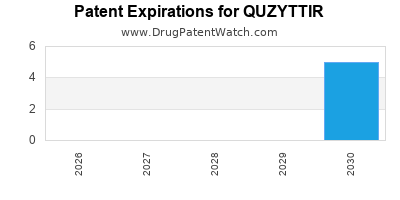
Last updated: August 22, 2026
Quzyttir is a branded intravenous cetirizine product used for acute urticaria in adults and pediatric patients six months and older. The product occupies a narrow hospital and emergency-department niche where rapid administration, lower sedation than diphenhydramine, and use in patients unable to take oral medication support demand. Its commercial ceiling is limited by generic oral cetirizine, widespread injectable diphenhydramine use, hospital cost controls, and the absence of a broad chronic-use indication.
Public sources do not provide audited Quzyttir revenue, product-level sales, or a detailed financial forecast. The available evidence supports a directional assessment rather than a verified revenue series: regulatory differentiation and hospital adoption potential are positive, while limited indication breadth, generic competition, and private-company disclosure constraints restrict valuation visibility.
What is Quzyttir and how is it used?
Quzyttir is cetirizine hydrochloride injection, supplied as a 10 mg/mL intravenous product. The U.S. Food and Drug Administration approved it in October 2019 for the treatment of acute urticaria in adults and pediatric patients six months and older.[1]
The product is administered by intravenous push over one to two minutes. Label dosing is weight and age dependent:
| Patient group |
Label dose |
| Adults and adolescents 12 years and older |
10 mg |
| Children 6 to 11 years |
5 mg or 10 mg |
| Children 6 months to 5 years |
2.5 mg; maximum 5 mg |
| Route |
Intravenous push over 1 to 2 minutes |
Quzyttir is designed for acute-care settings, including emergency departments, hospitals, infusion centers, and other sites where a patient requires parenteral antihistamine treatment.
Its clinical positioning is based on the limitations of commonly used alternatives. Diphenhydramine is available in injectable form and is familiar to hospitals, but it is associated with sedation and anticholinergic effects. Oral cetirizine is inexpensive and widely available, but it is unsuitable for patients who cannot swallow, are vomiting, or require intravenous treatment.
What drives Quzyttir demand in the hospital market?
Quzyttir demand depends more on formulary penetration and institutional protocols than on consumer prescribing.
Acute-care workflow is the primary commercial driver
The product can be used when emergency clinicians want a second-generation antihistamine but need intravenous delivery. Potential use cases include:
- Acute urticaria and allergic skin reactions
- Patients unable to tolerate oral medication
- Emergency-department treatment pathways
- Hospital protocols seeking to reduce sedating antihistamine use
- Pediatric acute-care settings where oral administration is impractical
The addressable population is materially smaller than the population receiving oral cetirizine. Quzyttir therefore depends on conversion from injectable diphenhydramine and other acute-care practices rather than on expansion of the overall allergy market.
Reduced sedation supports institutional adoption
The pivotal evidence submitted to the FDA compared intravenous cetirizine with intravenous diphenhydramine in adults with acute urticaria. The clinical rationale was faster symptom control without the same degree of sedation associated with diphenhydramine.[1]
Reduced sedation can produce operational benefits in the emergency department. Patients may be discharged sooner, require less monitoring, and avoid impaired driving instructions associated with sedating antihistamines. These benefits can support pharmacy-and-therapeutics committee adoption even when the acquisition cost per dose is higher than generic diphenhydramine.
The economic case depends on whether the hospital credits these workflow benefits. Hospitals focused only on acquisition cost may continue to prefer diphenhydramine.
How large is the Quzyttir market opportunity?
Quzyttir addresses a specialty segment rather than the full antihistamine market.
| Market layer |
Competitive position of Quzyttir |
| Oral allergy treatment |
Weak; generic cetirizine and levocetirizine dominate |
| Injectable antihistamine treatment |
Differentiated by second-generation profile and IV delivery |
| Emergency-department urticaria care |
Relevant niche opportunity |
| Pediatric acute care |
Potentially attractive because IV administration can solve oral-delivery problems |
| Chronic allergy treatment |
Limited; the approved indication is acute urticaria |
| Hospital formulary market |
Dependent on protocol adoption and contracting |
The most realistic commercial opportunity is a focused hospital product with repeat institutional use, not a mass-market allergy product. The addressable market expands when hospitals adopt Quzyttir in standardized allergic-reaction protocols. It contracts when clinicians reserve it for cases where oral therapy is impossible.
Quzyttir also competes against clinical habit. Diphenhydramine has decades of hospital familiarity, broad generic availability, and low acquisition cost. Changing order sets requires evidence, pharmacy approval, clinician education, and procurement support.
What is Quzyttir’s financial trajectory?
Public disclosure does not establish a reliable annual revenue trajectory for Quzyttir. The product is associated with a private commercial structure, and available public materials do not provide audited product sales, operating margin, prescription volume, or market-share data.
The commercial trajectory can be divided into four phases:
| Period |
Likely market dynamic |
Financial implication |
| 2019 launch |
Initial formulary review and physician education |
High launch expense and limited early volume |
| 2020 |
COVID-19 disruption to emergency and elective care |
Pressure on hospital-administered product utilization |
| 2021-2022 |
Recovery in emergency-care activity and renewed formulary engagement |
Potential unit-volume recovery |
| 2023 onward |
Focus on account expansion, protocol inclusion, and price discipline |
Growth depends on hospital penetration rather than broad consumer demand |
The product’s revenue model is likely driven by institutional purchasing, specialty distribution, and hospital account contracts. This structure creates a different growth pattern from retail drugs. A single health-system contract can create meaningful volume, but sales cycles are long and purchasing decisions are concentrated.
Key financial variables
The most important commercial variables are:
- Number of hospitals with Quzyttir on formulary.
- Percentage of emergency departments using it as a protocol-preferred alternative.
- Average doses per treated account.
- Net price after wholesaler, group-purchasing, and hospital discounts.
- Conversion rate from injectable diphenhydramine.
- Pediatric utilization.
- Product availability and supply reliability.
- Selling expense per newly activated hospital account.
Unit growth without formulary expansion may plateau because acute urticaria is a limited indication. Net price increases also face resistance from hospital procurement groups, particularly when generic alternatives are available.
What products compete with Quzyttir?
Quzyttir’s closest competitor is injectable diphenhydramine, not oral cetirizine.
Quzyttir versus injectable diphenhydramine
| Factor |
Quzyttir |
Injectable diphenhydramine |
| Drug class |
Second-generation H1 antihistamine |
First-generation H1 antihistamine |
| Administration |
Intravenous |
Intravenous or intramuscular, depending on product |
| Sedation |
Lower relative sedation profile |
More sedating |
| Cost |
Branded-product economics |
Generic economics |
| Hospital familiarity |
Newer and protocol dependent |
Established |
| Acute-care role |
Acute urticaria and allergic reactions |
Broad emergency and inpatient use |
| Commercial risk |
Limited adoption and price resistance |
Quzyttir conversion barrier |
Quzyttir’s value proposition is strongest where sedation creates a measurable clinical or operational disadvantage. It is weakest where hospitals prioritize the lowest acquisition cost or where clinicians regard sedation as clinically acceptable.
Oral cetirizine and levocetirizine
Generic oral cetirizine and levocetirizine set a low price benchmark. They can limit Quzyttir use whenever patients can safely take oral medication. Their presence also makes it difficult to position Quzyttir as a broad cetirizine franchise.
Other acute allergy treatments
Quzyttir may be used alongside epinephrine, corticosteroids, H2 antagonists, and other supportive treatments. These products are generally complements rather than direct substitutes, although treatment protocols can determine whether an injectable antihistamine is used at all.
What is the FDA regulatory status of Quzyttir?
The FDA approved Quzyttir in 2019 under a new drug application for acute urticaria.[1] The product is a small-molecule drug, not a biologic, so biosimilar competition is not relevant.
The regulatory profile has three commercial consequences:
- The product has a specific acute-urticaria indication rather than a broad allergy indication.
- Pediatric labeling supports use across a wide age range.
- The intravenous dosage form creates differentiation from oral cetirizine but also limits distribution to professional-care settings.
The product does not benefit from the commercial scale associated with chronic allergic rhinitis, seasonal allergy, or over-the-counter cetirizine markets unless physicians use it beyond the core labeled setting.
What patents protect Quzyttir and when does it lose exclusivity?
Quzyttir’s commercial protection should be analyzed through three separate layers: regulatory exclusivity, Orange Book listings, and non-Orange-Book patent rights.
The FDA approval itself is not a guarantee of long-term market exclusivity. Small-molecule injectable products can face generic competition through an abbreviated new drug application once relevant patents and regulatory protections no longer block approval.
Orange Book and patent risk
A current Orange Book review is required to confirm:
- Whether Quzyttir’s NDA has active listed patents.
- The specific patent numbers and expiration dates.
- Whether any patents cover the drug substance, formulation, route of administration, or method of use.
- Whether pediatric exclusivity or other regulatory extensions apply.
- Whether an ANDA applicant has submitted a Paragraph IV certification.
The public regulatory record establishes the 2019 approval, but it does not by itself establish a definitive generic-entry date. Patent status can change through listing updates, terminal disclaimers, litigation, settlements, or delisting.
Formulation and method-of-use protection
The commercially relevant patent categories would include:
- Injectable cetirizine formulations
- Stabilized or preservative-specific compositions
- Intravenous administration of cetirizine for acute urticaria
- Pediatric dosing or age-specific use
- Manufacturing and packaging processes
Formulation and method-of-use patents can delay direct competition, but they do not necessarily prevent all alternative injectable cetirizine products. The scope of each claim determines whether an ANDA applicant can design around it or certify non-infringement.
Are there Paragraph IV challenges or Quzyttir patent litigation?
No publicly established Paragraph IV challenge, ANDA litigation outcome, or settlement agreement should be treated as confirmed without a current FDA Orange Book review and federal court docket search.
The absence of a publicly identified challenge in the available record does not establish that no ANDA has been filed. Small hospital products can receive limited public litigation attention, and patent disputes may develop after an ANDA notice is served.
The primary legal risks are:
- A generic applicant challenges listed patents through Paragraph IV certification.
- A generic applicant avoids listed claims through a Paragraph III certification or design-around strategy.
- A competing injectable cetirizine product enters after patent expiry or after a successful non-infringement decision.
- The patent holder faces an invalidity challenge based on oral cetirizine, injectable antihistamine prior art, or obviousness arguments involving route and dosage.
How strong is the Quzyttir patent estate?
Quzyttir’s practical exclusivity strength is moderate rather than automatically strong.
The product has meaningful differentiation from oral cetirizine because it combines the active ingredient with intravenous delivery and a hospital indication. That distinction can support formulation and method-of-use claims. The patent estate is less defensible if claims broadly cover known cetirizine properties or conventional injectable compositions.
Patent strength depends on:
- Claim breadth
- Validity over prior cetirizine and antihistamine disclosures
- Patent expiration timing
- Orange Book listing status
- Ability to enforce claims against an ANDA product
- Availability of non-infringing alternative formulations
- Whether hospital use creates inducement or contributory-infringement exposure
The strongest commercial barrier would be a valid, unexpired formulation claim covering the generic’s exact injectable composition. A narrow method-of-use patent may provide less protection if the generic uses a skinny label or markets the product for non-patented indications.
What generic launch risks exist for Quzyttir?
Generic-entry risk is structurally significant because Quzyttir is a small-molecule injectable product and the active ingredient, cetirizine, is widely known.
A generic launch would likely cause:
- Rapid hospital price erosion
- Formulary substitution
- Reduced branded purchasing leverage
- Higher contracting pressure
- Lower return on salesforce investment
- Possible loss of protocol-preferred status
The rate of erosion could be slower than for a high-volume retail tablet because hospital injectable markets involve procurement contracts, supply qualification, and manufacturing requirements. That same complexity can create a manufacturing barrier for generic entrants.
What manufacturing and supply barriers affect Quzyttir?
Sterile injectable manufacturing is more demanding than oral solid-dose production. Generic competitors must demonstrate adequate aseptic processing, container-closure integrity, stability, sterility assurance, and reliable commercial supply.
These requirements can reduce the number of viable entrants. They do not create permanent protection. If the formulation is technically straightforward and demand is sufficient, established injectable manufacturers can enter after regulatory and patent barriers fall.
Supply continuity is also commercially important. Hospitals may avoid adopting a branded injectable product if they perceive shortage risk or inconsistent wholesaler availability. Conversely, reliable supply can help preserve accounts even when a lower-priced generic becomes available.
What licensing or commercial deals affect Quzyttir?
Quzyttir was developed by JDP Therapeutics and is associated with TerSera Therapeutics commercialization. Publicly available company materials identify TerSera as the commercial organization for Quzyttir, while product-level royalty rates, milestone payments, transfer pricing, and territory rights are not publicly disclosed.[2]
The commercial relationship matters because net economics depend on:
- Ownership of U.S. and international rights
- Royalty obligations
- Manufacturing transfer costs
- Distribution margins
- Hospital contracting terms
- Salesforce allocation
- Responsibility for post-approval regulatory work
No confirmed large-scale licensing transaction or acquisition valuation tied specifically to Quzyttir establishes the product’s financial value.
How does Quzyttir compare with other antihistamine franchises?
Quzyttir has a narrower but more differentiated position than oral cetirizine and a more modern clinical profile than injectable diphenhydramine.
| Franchise |
Main advantage |
Main limitation |
| Quzyttir |
IV second-generation antihistamine for acute urticaria |
Narrow hospital niche and branded pricing |
| Generic cetirizine |
Very low cost and broad availability |
Oral route |
| Generic levocetirizine |
Oral efficacy and low cost |
Oral route and limited acute-care differentiation |
| Injectable diphenhydramine |
Low cost, familiarity, broad use |
Sedation and anticholinergic burden |
| Epinephrine |
Essential for anaphylaxis |
Not a substitute for routine antihistamine treatment |
Quzyttir should therefore be evaluated as a hospital workflow product, not as a direct competitor to the consumer cetirizine category.
Key Takeaways
- Quzyttir is an FDA-approved intravenous cetirizine product for acute urticaria in adults and pediatric patients six months and older.
- Its commercial differentiation is lower relative sedation than injectable diphenhydramine combined with IV administration.
- The principal market is hospital and emergency-department formularies, not retail allergy treatment.
- Public sources do not disclose audited Quzyttir revenue or a verified product-level financial trajectory.
- Growth depends on formulary inclusion, protocol adoption, pediatric use, and conversion from injectable diphenhydramine.
- Generic oral cetirizine limits expansion outside acute-care settings.
- Injectable diphenhydramine remains the main commercial competitor because of low cost and established hospital use.
- Quzyttir is a small-molecule product, so biosimilar risk does not apply.
- Generic-entry risk remains material because cetirizine is an established active ingredient and sterile injectable manufacturing is feasible for experienced manufacturers.
- A current Orange Book and litigation review is necessary to establish definitive patent expiry, Paragraph IV activity, and generic-entry timing.
FAQs About Quzyttir Market and Exclusivity
Is Quzyttir a biologic drug?
No. Quzyttir is a small-molecule cetirizine hydrochloride injection. Biosimilars are not relevant; any future competition would generally arise through generic-drug pathways.
Does Quzyttir compete with Zyrtec?
Yes, but only indirectly. Zyrtec and generic cetirizine are primarily oral products, while Quzyttir is an intravenous formulation used in acute-care settings.
Why would a hospital use Quzyttir instead of diphenhydramine?
The principal rationale is intravenous delivery with less sedation than diphenhydramine. The decision depends on clinical protocols, acquisition cost, and the hospital’s assessment of emergency-department workflow benefits.
Can a generic manufacturer copy Quzyttir?
A generic manufacturer may be able to develop an injectable cetirizine product, but approval and launch depend on applicable patents, FDA requirements, formulation equivalence, sterile manufacturing capability, and any litigation or settlement restrictions.
Is Quzyttir revenue publicly reported?
No verified public source establishes a standalone audited revenue figure or complete annual sales history for Quzyttir. Its commercial performance must be inferred from regulatory status, hospital adoption, distribution activity, and competitive conditions.
References
- U.S. Food and Drug Administration. (2019). Quzyttir (cetirizine hydrochloride injection) prescribing information.
- TerSera Therapeutics LLC. (n.d.). Quzyttir: Cetirizine hydrochloride injection product information.
- U.S. Food and Drug Administration. (n.d.). Approved drug products with therapeutic equivalence evaluations: Orange Book.
- U.S. Food and Drug Administration. (n.d.). Abbreviated new drug application and patent certification procedures.