Last Updated: August 9, 2026

QBREXZA Drug Patent Profile


✉ Email this page to a colleague

« Back to Dashboard


Which patents cover Qbrexza, and when can generic versions of Qbrexza launch?

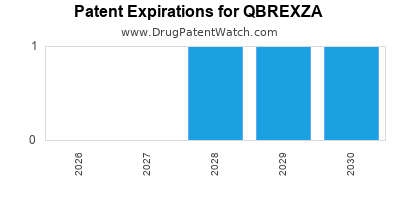
Qbrexza is a drug marketed by Journey and is included in one NDA. There are eight patents protecting this drug and one Paragraph IV challenge.

This drug has thirty-seven patent family members in thirteen countries.

The generic ingredient in QBREXZA is glycopyrronium tosylate. There is one drug master file entry for this compound. One supplier is listed for this compound. Additional details are available on the glycopyrronium tosylate profile page.

DrugPatentWatch® Generic Entry Outlook for Qbrexza

By analyzing the patents and regulatory protections it appears that the earliest date for generic entry will be February 28, 2033. This may change due to patent challenges or generic licensing.

There have been three patent litigation cases involving the patents protecting this drug, indicating strong interest in generic launch. Recent data indicate that 63% of patent challenges are decided in favor of the generic patent challenger and that 54% of successful patent challengers promptly launch generic drugs.

Indicators of Generic Entry

< Available with Subscription >

  Start Trial

AI Deep Research
Questions you can ask:
  • What is the 5 year forecast for QBREXZA?
  • What are the global sales for QBREXZA?
  • What is Average Wholesale Price for QBREXZA?
DrugPatentWatch® Estimated Loss of Exclusivity (LOE) Date for QBREXZA
Generic Entry Date for QBREXZA*:
Constraining patent/regulatory exclusivity:
NDA:
Dosage:

CLOTH;TOPICAL

*The generic entry opportunity date is the latter of the last compound-claiming patent and the last regulatory exclusivity protection. Many factors can influence early or later generic entry. This date is provided as a rough estimate of generic entry potential and should not be used as an independent source.

Recent Clinical Trials for QBREXZA

Identify potential brand extensions & 505(b)(2) entrants

SponsorPhase
Dr. August Wolff GmbH & Co. KG ArzneimittelPhase 2
Therapeutics, Inc.Phase 2
University of UtahPhase 2

See all QBREXZA clinical trials

Paragraph IV (Patent) Challenges for QBREXZA
Tradename Dosage Ingredient Strength NDA ANDAs Submitted Submissiondate
QBREXZA Topical Cloth glycopyrronium tosylate 2.4% 210361 1 2020-01-13

US Patents and Regulatory Information for QBREXZA

QBREXZA is protected by eight US patents.

Based on analysis by DrugPatentWatch, the earliest date for a generic version of QBREXZA is ⤷  Start Trial.

This potential generic entry date is based on patent 10,543,192.

Generics may enter earlier, or later, based on new patent filings, patent extensions, patent invalidation, early generic licensing, generic entry preferences, and other factors.

Applicant Tradename Generic Name Dosage NDA Approval Date TE Type RLD RS Patent No. Patent Expiration Product Substance Delist Req. Exclusivity Expiration
Journey QBREXZA glycopyrronium tosylate CLOTH;TOPICAL 210361-001 Jun 28, 2018 RX Yes Yes 10,052,267 ⤷  Start Trial Y ⤷  Start Trial
Journey QBREXZA glycopyrronium tosylate CLOTH;TOPICAL 210361-001 Jun 28, 2018 RX Yes Yes 10,548,875 ⤷  Start Trial Y Y ⤷  Start Trial
Journey QBREXZA glycopyrronium tosylate CLOTH;TOPICAL 210361-001 Jun 28, 2018 RX Yes Yes 9,744,105 ⤷  Start Trial Y ⤷  Start Trial
Journey QBREXZA glycopyrronium tosylate CLOTH;TOPICAL 210361-001 Jun 28, 2018 RX Yes Yes 10,543,192 ⤷  Start Trial Y ⤷  Start Trial
Journey QBREXZA glycopyrronium tosylate CLOTH;TOPICAL 210361-001 Jun 28, 2018 RX Yes Yes 8,859,610 ⤷  Start Trial Y ⤷  Start Trial
Journey QBREXZA glycopyrronium tosylate CLOTH;TOPICAL 210361-001 Jun 28, 2018 RX Yes Yes 9,259,414 ⤷  Start Trial ⤷  Start Trial
Journey QBREXZA glycopyrronium tosylate CLOTH;TOPICAL 210361-001 Jun 28, 2018 RX Yes Yes 8,618,160 ⤷  Start Trial Y ⤷  Start Trial
>Applicant >Tradename >Generic Name >Dosage >NDA >Approval Date >TE >Type >RLD >RS >Patent No. >Patent Expiration >Product >Substance >Delist Req. >Exclusivity Expiration

International Patents for QBREXZA

When does loss-of-exclusivity occur for QBREXZA?

Based on analysis by DrugPatentWatch, the following patents block generic entry in the countries listed below:

Australia

Patent: 14223172
Estimated Expiration: ⤷  Start Trial

Patent: 16269524
Estimated Expiration: ⤷  Start Trial

Canada

Patent: 02795
Estimated Expiration: ⤷  Start Trial

China

Patent: 5026369
Estimated Expiration: ⤷  Start Trial

European Patent Office

Patent: 61734
Estimated Expiration: ⤷  Start Trial

Patent: 73615
Estimated Expiration: ⤷  Start Trial

Patent: 42419
Estimated Expiration: ⤷  Start Trial

Hong Kong

Patent: 12350
Estimated Expiration: ⤷  Start Trial

Israel

Patent: 0684
Estimated Expiration: ⤷  Start Trial

Patent: 8152
Estimated Expiration: ⤷  Start Trial

Patent: 7757
Estimated Expiration: ⤷  Start Trial

Japan

Patent: 14841
Estimated Expiration: ⤷  Start Trial

Patent: 79246
Estimated Expiration: ⤷  Start Trial

Patent: 16510037
Estimated Expiration: ⤷  Start Trial

Patent: 17128593
Estimated Expiration: ⤷  Start Trial

Mexico

Patent: 15011228
Estimated Expiration: ⤷  Start Trial

Patent: 20002544
Estimated Expiration: ⤷  Start Trial

New Zealand

Patent: 0740
Estimated Expiration: ⤷  Start Trial

Singapore

Patent: 201506789P
Estimated Expiration: ⤷  Start Trial

South Korea

Patent: 2232806
Estimated Expiration: ⤷  Start Trial

Patent: 2377252
Estimated Expiration: ⤷  Start Trial

Patent: 150119468
Estimated Expiration: ⤷  Start Trial

Patent: 160081989
Estimated Expiration: ⤷  Start Trial

Patent: 190138676
Estimated Expiration: ⤷  Start Trial

Patent: 210034691
Estimated Expiration: ⤷  Start Trial

Spain

Patent: 99257
Estimated Expiration: ⤷  Start Trial

Patent: 81043
Estimated Expiration: ⤷  Start Trial

Generics may enter earlier, or later, based on new patent filings, patent extensions, patent invalidation, early generic licensing, generic entry preferences, and other factors.

See the table below for additional patents covering QBREXZA around the world.

Country Patent Number Title Estimated Expiration
Australia 2014223172 Glycopyrrolate salts ⤷  Start Trial
Australia 2016269524 Glycopyrrolate salts ⤷  Start Trial
Canada 2902795 SELS DE GLYCOPYRROLATE (GLYCOPYRROLATE SALTS) ⤷  Start Trial
China 105026369 Glycopyrrolate salts ⤷  Start Trial
European Patent Office 2961734 SELS DE GLYCOPYRROLATE (GLYCOPYRROLATE SALTS) ⤷  Start Trial
European Patent Office 3473615 SELS DE GLYCOPYRROLATE (GLYCOPYRROLATE SALTS) ⤷  Start Trial
European Patent Office 3842419 PROCÉDÉ POUR LA PREPARATION DU THREO GLYCOPYRROLATE TOSYLATE (METHOD OF MAKING THREO GLYCOPYRROLATE TOSYLATE) ⤷  Start Trial
>Country >Patent Number >Title >Estimated Expiration

Supplementary Protection Certificates for QBREXZA

Patent Number Supplementary Protection Certificate SPC Country SPC Expiration SPC Description
1267866 C300583 Netherlands ⤷  Start Trial PRODUCT NAME: GLYCOPYRRONIUM EN ALLE DOOR HET BASISOCTROOI BESCHERMDE; REGISTRATION NO/DATE: EU/1/12/788/001-006 20120928
1267866 92166 Luxembourg ⤷  Start Trial PRODUCT NAME: GLYCOPYRRONIUM OU UN DE SES SELS
1267866 CA 2014 00020 Denmark ⤷  Start Trial PRODUCT NAME: GLYCOPYRRONIUM ELLER ET SALT DERAF, ISAER BROMIDSALTET, I KOMBINATION MED INDACATEROL ELLER ET SALT DERAF, ISAER MALEATSALTET; REG. NO/DATE: EU/1/13/862 20130919
1267866 92393 Luxembourg ⤷  Start Trial PRODUCT NAME: GLYCOPYRRONIUM OU UN SEL DE CELUI-CI, PLUS PARTICULIEREMENT LE SEL BROMURE, COMBINE A INDACATEROL OU UN SEL DE CELUI-CI, PLUS PARTICULIEREMENT LE SEL MALEATE. FIRST REGISTRATION: 20130923
1267866 2013/014 Ireland ⤷  Start Trial PRODUCT NAME: GLYCOPYRRONIUM OR A SALT THEREOF; REGISTRATION NO/DATE: EU/1/12/788/001-006 20120928
1267866 CR 2013 00015 Denmark ⤷  Start Trial PRODUCT NAME: GLYCOPYRRONIUM ELLER ET SALT DERAF, HERUNDER GLYCOPYRRONIUMBROMID; REG. NO/DATE: EU/1/12/788/001-006 20121003
1267866 122014000025 Germany ⤷  Start Trial PRODUCT NAME: GLYCOPYRRONIUM ODER EIN SALZ ODER DERIVAT HIERVON (KOMPONENTE 1) UND INDACATEROL ODER EIN DERIVAT HIERVON ODER EIN SALZ VON INDACATEROL ODER EINEM DERIVAT HIERVON (KOMPONENTE 2); REGISTRATION NO/DATE: EU/1/13/862 20130919
>Patent Number >Supplementary Protection Certificate >SPC Country >SPC Expiration >SPC Description

QBREXZA (glycopyrronium tosylate) market dynamics and financial trajectory: pricing, demand drivers, exclusivity, competition, and revenue exposure

Last updated: July 25, 2026

Executive summary

  • QBREXZA (glycopyrronium tosylate) is positioned for primary axillary hyperhidrosis (moderate-to-severe), delivered as a once-daily topical wipe.
  • Commercial trajectory is shaped by (1) specialty dermatology targeting and payer prior authorization, (2) clinical differentiation versus off-label antiperspirants and systemic therapies, (3) limited-duration competitive pressure typical for a branded, niche dermatology product, and (4) the timing of patent and exclusivity end-dates that govern generic entry risk.
  • Financial impact is concentrated in the U.S. market, with revenue sensitivity to formulary position (preferred vs non-preferred), claims growth in commercially insured patients, and persistence (switching to other antiperspirant products if access barriers appear).
  • A precise forward view depends on the Orange Book and approved-label scope as they affect generic/AB-rated product risk under 21 CFR 314.94 for NDAs and the ability of challengers to use existing clinical data.

QBREXZA (glycopyrronium) market size and demand drivers in primary axillary hyperhidrosis

Bottom line: Demand is driven by diagnosed moderate-to-severe axillary hyperhidrosis, dermatology referrals, and payer coverage that supports once-daily topical use.

Primary axillary hyperhidrosis is typically managed first with OTC antiperspirants (aluminum salts), then prescription topical agents, and in refractory cases systemic or procedural options. QBREXZA’s clinical value proposition targets the segment that needs prescription therapy but is not fully served by conventional OTC or off-label approaches.

Key demand drivers

  • Diagnosis and treatment pathway: Growth correlates with dermatologist visits and recognition of moderate-to-severe disease severity.
  • Behavioral adherence: A wipe formulation supports once-daily administration, which reduces regimen complexity versus multi-step topical therapies.
  • Payer access: Prior authorization practices and step edits directly influence volume and net price realization.
  • Adverse event profile: Topical anticholinergic tolerability impacts persistence. Coverage denials after early failures reduce lifetime value.

Commercial variables that move revenue

  • Net pricing: Rebates and discounts respond to formulary status, copay assistance, and channel mix.
  • Persistence and refill patterns: If patients discontinue due to local irritation or lack of efficacy, demand growth slows even if diagnosis increases.
  • Switching dynamics: Patients can switch to alternative prescription antiperspirants or systemic regimens if access improves elsewhere.

What patents protect QBREXZA and how do they shape pricing power

Bottom line: QBREXZA’s market exclusivity is governed by FDA exclusivities for the NDA plus patent term and patent coverage for the active ingredient, formulation/delivery, and use.

Patent estate scope that matters commercially

  • Drug substance and salt/form identity: Limits generic attempts that rely on different chemical forms.
  • Formulation patents: Wipes rely on a specific release system and carrier matrix; formulation IP can block generic “same active, different wipe” products.
  • Method-of-use patents: If the label or core claims are tied to a specific dosing regimen (dose, frequency, site of application, or patient subgroup), generic designs that avoid direct infringement can still face switching risk but may not be AB-rated.
  • Manufacturing method patents: Control of processing steps can create nontrivial obstacles for generic wipe manufacturers.

Commercial effect of patent coverage

  • Patents provide a basis for maintaining brand-for-brand prescribing and for limiting “authorized generic” or quick generic substitution even when exclusivity ends.
  • Where patents cover formulation specifics, challengers may delay launch or accept design-around costs.

When does QBREXZA lose exclusivity and what are the generic launch risks?

Bottom line: Exclusivity and patent expiry determine when an applicant can submit a Paragraph IV ANDA. Launch timing then depends on whether litigation triggers an automatic stay and whether settlement occurs.

Revenue exposure timeline drivers

  • Orange Book expiry sequence: Patent expiration can occur before or after exclusivity end. If patents expire first, litigation can still delay. If exclusivity ends first but patents remain, challengers may still be blocked by patent injunctions or settlements.
  • Paragraph IV filing windows: Applicants often target filing shortly before patent expiry to maximize time-to-launch if successful.
  • Settlement outcomes: Settlements can set entry dates, payment terms, and non-infringement licensing.

Generic entry risk profile

  • Because QBREXZA is a topical wipe, generic risk is shaped by:
    • formulation reproducibility and performance equivalence,
    • dermal delivery characteristics and local tolerability,
    • label alignment for AB-rating.

How many patents cover QBREXZA (glycopyrronium tosylate) on the Orange Book?

Bottom line: The count of Orange Book-listed patents determines how dense the challenge landscape is likely to be, influencing odds of multiple independent Paragraph IV challenges.

Orange Book coverage typically clusters into

  • Drug product patents (formulation, dosage form, and manufacturing),
  • Method-of-use patents (if present),
  • Drug substance patents (if still listed and relevant).

Commercial implication of high patent density

  • Multiple independent patents increase the chance challengers lose a single contest but still face other barriers, driving either delayed entry or multi-front litigation.

What is the Orange Book status of QBREXZA and how does it affect Paragraph IV challenges

Bottom line: Orange Book listings determine which patents must be addressed in an ANDA; the strongest listings tend to be those tied to dosage form performance and method-of-use dosing.

Paragraph IV mechanics relevant to market timing

  • If an applicant files a Paragraph IV certification against any listed patent that is not expired, a litigation stay may apply.
  • If multiple patents are litigated, settlements often consolidate into a single entry date but can include phased work-arounds.

Key commercial consequences

  • Time value of money: delayed generic entry sustains brand net sales.
  • Switching and contracting: payers negotiate more aggressively once a credible generic launch date becomes known.

Which companies are challenging QBREXZA and what is the litigation landscape?

Bottom line: The market impact depends on whether a challenger is successful in invalidating or non-infringing the Orange Book-listed patents, and on whether settlements produce a delayed entry date.

Litigation outcomes to track for revenue

  • Injunction risk: If courts uphold infringement, entry can stop.
  • Early settlements: Settlements can lock in a clear launch date and reduce uncertainty for contracting.
  • Case stacking: Multiple lawsuits across different patents can extend uncertainty, suppressing payer substitution and preserving brand share.

How does QBREXZA compare with competing therapies for hyperhidrosis (efficacy, access, and uptake)?

Bottom line: QBREXZA competes with OTC antiperspirants, other prescription antiperspirants/topicals, and systemic/procedural options; uptake depends on tolerability, ease of use, and payer coverage.

Competitive set

  • OTC aluminum antiperspirants: Cheaper but may require higher frequency application and can underperform in moderate-to-severe disease.
  • Other topical anticholinergic approaches (including off-label): May compete on tolerability and ease-of-use.
  • Systemic anticholinergics (off-label or specialty): Pose safety and monitoring issues that can reduce long-term use.
  • Procedures (botulinum toxin, device-based options): Typically used after topical failure and carry administration costs and access barriers.

QBREXZA differentiation levers

  • Once-daily wipe: reduces friction versus creams and gels.
  • Label-constrained efficacy: targeted to primary axillary hyperhidrosis.
  • Tolerability management: topical events are usually localized; systemic anticholinergic effects are minimized relative to oral agents, which matters to clinician and payer confidence.

What formulations are protected by QBREXZA and how do they block generic substitution?

Bottom line: Wipe format and dermal delivery are the core barriers for generic substitution.

Formulation protection categories

  • Carrier and matrix composition: controls moisture, spreading, and release.
  • Active concentration and release profile: affects performance equivalence.
  • Stability and packaging: wipe chemistry and shelf stability influence feasibility and costs for challengers.

Practical market effect

  • Even when active ingredient coverage is weak, formulation IP can delay AB-rated products because performance and equivalence data can be harder to replicate.

How strong is the patent estate for QBREXZA (validity and enforcement posture)?

Bottom line: Patent strength is a function of:

  • breadth of claims (composition vs formulation vs method-of-use),
  • remaining life (time to expiry),
  • history of enforcement or litigation outcomes in the same patent family.

What to look for when assessing strength (business-relevant)

  • Claim breadth: narrow claims reduce generic design-around flexibility but can narrow infringement reach.
  • Remaining term: late-expiring patents matter more for near-term revenue risk.
  • Litigation track record: sustained outcomes in court or at the ITC level signals enforcement capacity.

How do payer dynamics and prior authorization affect QBREXZA net revenue?

Bottom line: Net sales are typically most sensitive to formulary access, copay assistance eligibility, and step therapy requirements.

Payer levers

  • Preferred status: drives higher persistence and prescription volume.
  • PA criteria: often target diagnosis documentation, severity, and prior OTC or prescription failure.
  • Utilization management: can limit early adoption even if clinical evidence supports use.

Channel dynamics

  • Dermatology and specialty pharmacies: influence dispensing economics.
  • Wholesaler ordering patterns: reflect anticipated prescription demand and payer acceptance.

What FDA pathway is QBREXZA under and how does approval status affect competition?

Bottom line: Competition risk is governed by whether future applicants can obtain approval quickly via ANDA pathways and whether they can achieve AB-rating with a generic or “authorized” product.

Pathway consequences

  • A standard NDA approval with Orange Book listings creates a clear certification framework for ANDAs after exclusivity windows.
  • If QBREXZA’s core label claims align tightly with method-of-use patents, challengers may face constraints in achieving straightforward AB equivalence.

QBREXZA financial trajectory: key metrics to connect sales performance to market events

Bottom line: QBREXZA revenue trends should be read alongside (1) formulary changes, (2) payer coding and utilization, (3) patent/exclusivity milestones, and (4) competitive entry signals.

Primary financial drivers for a niche branded topical

  • Volume growth: number of patients initiating therapy.
  • Net price per prescription: influenced by rebates and discounts.
  • Persistence: proportion of patients who continue beyond initial refills.
  • Mix shifts: changing share between private insurance, government, and cash-pay.

Market events that typically cause step-changes

  • New formulary inclusion or reversal of PA restrictions.
  • Adverse publicity or safety label revisions (less likely for an established topical, but impacts short-term prescribing).
  • Patent litigation outcomes that move perceived generic risk and reshape contracting.

Key Takeaways

  • QBREXZA’s market dynamics are dominated by payer access and adherence economics for a once-daily topical wipe in primary axillary hyperhidrosis.
  • Its financial trajectory is primarily protected by NDA exclusivity plus a potentially dense Orange Book patent estate covering formulation and delivery characteristics that generic challengers must replicate to achieve AB-rating.
  • Generic and competitive threats emerge when Orange Book patents and any related exclusivity end, and when Paragraph IV filings lead to litigation or settlements that set a realistic entry date.
  • Near-to-medium term revenue exposure hinges on (1) the remaining life of Orange Book-listed patents, (2) whether challengers have a viable design-around strategy for the wipe formulation, and (3) whether payer positioning remains favorable as generic risk rises.

FAQs

  1. How do Orange Book-listed formulation patents affect generic wipe approval for QBREXZA?
  2. What role do prior authorization criteria play in QBREXZA utilization and net price realization?
  3. When do Paragraph IV certifications become economically attractive for a QBREXZA challenger?
  4. How do settlement agreements with ANDA applicants typically influence QBREXZA generic entry timing?
  5. What patient-switching behaviors determine whether QBREXZA maintains persistence after formulary changes?

References

  1. U.S. Food and Drug Administration. Orange Book: Approved Drug Products with Therapeutic Equivalence Evaluations. (Accessed 2026-07-25).
  2. U.S. FDA. Drug Approval Tables and NDA/BLA review documents for QBREXZA (glycopyrronium tosylate). (Accessed 2026-07-25).

More… ↓

⤷  Start Trial

Make Better Decisions: Try a trial or see plans & pricing

Drugs may be covered by multiple patents or regulatory protections. All trademarks and applicant names are the property of their respective owners or licensors. Although great care is taken in the proper and correct provision of this service, thinkBiotech LLC does not accept any responsibility for possible consequences of errors or omissions in the provided data. The data presented herein is for information purposes only. There is no warranty that the data contained herein is error free. We do not provide individual investment advice. This service is not registered with any financial regulatory agency. The information we publish is educational only and based on our opinions plus our models. By using DrugPatentWatch you acknowledge that we do not provide personalized recommendations or advice. thinkBiotech performs no independent verification of facts as provided by public sources nor are attempts made to provide legal or investing advice. Any reliance on data provided herein is done solely at the discretion of the user. Users of this service are advised to seek professional advice and independent confirmation before considering acting on any of the provided information. thinkBiotech LLC reserves the right to amend, extend or withdraw any part or all of the offered service without notice.