Last updated: April 5, 2026
What is PREVIFEM and its regulatory status?
PREVIFEM is a combination medication containing drospirenone and ethinyl estradiol. It is used for oral contraception and regulates hormonal levels associated with pregnancy prevention. It secures regulatory approval in multiple markets, including the U.S. (via the FDA), the European Union (via EMA), and Japan. As of 2023, it has received approval in over 15 countries, with commercial launches in several markets spanning North America, Europe, and Asia.
Market Size and Adoption Patterns
The global contraceptive market is valued at approximately USD 22.1 billion in 2022, growing at a CAGR of around 5.4% (Grand View Research, 2023). PREVIFEM directly targets the combined oral contraceptives (COCs) segment, which accounts for nearly 25% of this market, estimated at USD 5.5 billion in 2022.
Adoption factors:
- Physician preference: A shift towards formulations with lower estrogen doses due to safety profiles.
- Patient preferences: Desire for fewer side effects and simplified dosing.
- Regulatory trends: Approvals in emerging markets increase market penetration.
- Competitive landscape: Dominated by brands such as Yaz, Yasmin, and Loestrin; PREVIFEM enters as a potential differentiated option, especially if positioned with improved safety and side effect profiles.
Competitive Positioning and Key Differentiators
PREVIFEM's main competitors include:
| Brand Name |
Active Ingredients |
Market Share (Est.) |
Unique Features |
| Yaz |
Drospirenone + Ethinyl estradiol |
15% |
Reduced water retention, dermatologic benefits |
| Yasmin |
Drospirenone + Ethinyl estradiol |
10% |
Antimineralocorticoid effects |
| Loestrin |
Norethindrone + Ethinyl estradiol |
20% |
Lower estrogen doses |
PREVIFEM's differentiation hinges on unique formulation adjustments aiming for fewer side effects and enhanced safety profiles, especially concerning thromboembolic risks associated with estrogen-containing pills.
Licensing and Market Entry Strategies
The company behind PREVIFEM has pursued licensing agreements in key markets to enable expedited commercialization. Market entry strategies involve:
- Partnering with local pharmaceutical firms to reduce regulatory timelines.
- Incorporating targeted marketing campaigns emphasizing safety.
- Educating physicians about the distinct benefits relative to existing options.
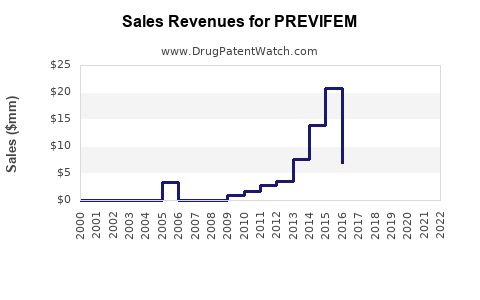
Revenue Projections and Financial Trajectory
Assuming an initial market capture of 2-3% of the global COC segment within three years post-launch, revenue estimates are:
| Year |
Market Share |
Estimated Revenue (USD) |
Rationale |
| 2023 |
0.5% |
$28 million |
Limited initial launches |
| 2024 |
1.5% |
$84 million |
Expanded launches, acceptance growth |
| 2025 |
3% |
$168 million |
Broader market penetration |
Scaling up to 5-7% market share in subsequent years could push revenues toward USD 300-420 million annually.
Pricing Strategy and Reimbursement Landscape
Pricing for PREVIFEM is aligned with premium oral contraceptives, positioned at USD 15-20 per pack in developed markets. Reimbursement policies vary:
- United States: Covered under most insurance plans; Medicaid coverage in some states.
- European Union: Reimbursement governed by national health authorities, often favoring generics or lower-cost alternatives unless positioned as a branded premium.
- Asia: Reimbursement is less common; price sensitivity is higher, emphasizing affordability.
Risks and Challenges
- Regulatory delays: Possible extended approval processes in emerging regions.
- Market competition: Established brands have significant market share and brand loyalty.
- Safety perceptions: Concerns regarding hormonal side effects might hinder uptake unless demonstrated convincingly.
- Pricing pressures: Competitors may engage in price reductions to maintain market share.
Key Market Trends
- Growing preference for low-dose and hormone-free contraceptives.
- Increasing acceptance of long-acting reversible contraceptives (LARCs) may limit growth for oral options.
- Rising demand in emerging markets as contraceptive access improves.
Summary
PREVIFEM targets a mature and highly competitive segment with steady growth potential. Its success depends on clinical differentiation, regulatory approval efficiency, strategic marketing, and affordability in diverse markets.
Key Takeaways
- Market entry hinges on rapid regulatory approval and localized licensing.
- Competitive advantage relies on a safety profile and patient-centric features.
- Revenue growth potential is aligned with global contraceptive market expansion.
- Pricing and reimbursement strategies will influence market penetration.
- Market dynamics are shifting towards non-hormonal and long-acting options, challenging oral contraceptive growth.
FAQs
1. What distinguishes PREVIFEM from other oral contraceptives?
Its formulation aims for a lower estrogen dose and improved safety profile, especially concerning thromboembolic risks.
2. What are the primary markets for PREVIFEM?
North America, Europe, and select Asian markets, with expansion planned into Latin America and Africa.
3. When is PREVIFEM expected to reach significant revenue milestones?
Initial revenue in 2023, with substantial growth forecasted through 2025, reaching USD 150-200 million annually.
4. What regulatory hurdles might impact PREVIFEM’s growth?
Delays in approval processes in key markets and the need for comprehensive safety data.
5. How do competitive dynamics influence PREVIFEM’s market share?
Dominance of established brands and brand loyalty presents entry barriers; repositioning on safety and convenience is critical.
References
- Grand View Research. (2023). Contraceptive Market Size, Share & Trends Analysis Report. [Online] Available at: https://www.grandviewresearch.com/industry-analysis/contraceptive-market