Last updated: July 24, 2026
Prednisone Intensol is an oral prednisone solution used in pediatric and adult corticosteroid regimens. The financial trajectory is dominated by (1) long-term steroid demand as a class, (2) substitution dynamics between branded liquid and generic liquids/tablets, (3) payer step edits and utilization management, and (4) supply and product-formulation constraints typical of small-volume generics and liquid presentations. Branded revenue exposure is structurally limited by the availability of multiple approved prednisone generics and the depth of over-the-counter equivalence in therapeutic use, so the key swing factors are share of branded liquid versus generic liquid, wholesale acquisition cost (WAC) compression, and pharmacy channel coverage.
What market dynamics drive sales for Prednisone Intensol (prednisone oral solution) versus generic prednisone?
Featured snippet: Prednisone Intensol competes primarily on liquid dosing convenience, pediatric suitability, and formulary preference for a ready-to-use oral solution, while generics compete on price and interchangeability.
Brand versus generic substitution mechanics
- Therapeutic substitutability is high. Prednisone is a widely used systemic corticosteroid with multiple approved generic manufacturers across tablets and oral solutions. In most formularies, generics carry lower copays and face fewer access barriers.
- Liquid formulation reduces friction in pediatric prescribing. Prednisone tablets require splitting and dosing accuracy, which can create adherence issues and administration burden. Intensol’s liquid format typically supports use where clinicians prefer liquid dosing or where patients cannot swallow tablets.
- State-level and pharmacy-level interchange policies influence real-world penetration. Oral steroid substitution is often automatic at the pharmacy once a generic equivalent is available, unless the prescription specifies “no substitution” or payer policy restricts interchange.
Channel and payer dynamics
- Payer step edits are common for corticosteroids, but not usually drug-specific. Coverage decisions tend to focus on diagnosis criteria and duration rather than branded versus generic status when low-cost generics exist.
- Gross-to-net pressure is the dominant profitability variable. Like other mature off-patent products, branded liquid steroids typically face rebates, patient assistance, and contracting that compress net pricing versus WAC.
Supply and product availability effects
- Liquid products can be vulnerable to manufacturing disruptions. When a generic liquid supply is constrained, branded liquid can see temporary share gains. The converse is also true: if Intensol supply is tight, generics capture demand.
- Formulation and packaging changes matter commercially. Liquid dosing products are sensitive to stability, container closure integrity, and viscosity/administration tolerability. Any variability tends to show up in stocking patterns with wholesalers and pharmacies.
What is the financial trajectory for Prednisone Intensol: revenue trend, profitability outlook, and key swing factors?
Featured snippet: Prednisone Intensol’s revenue trend is driven by mature-market erosion versus generics, with periodic share changes tied to supply, channel contracting, and pediatric liquid demand.
Trajectory typical of off-patent, liquid-branded corticosteroids
For branded prednisone solutions, the long-run profile generally looks like:
- Early stability where clinicians and pediatric formularies favor the liquid.
- Ongoing net sales decline as generic liquid fills and formulary placement shifts toward lowest net-cost.
- Sharp volatility during supply disruptions at major generic liquid suppliers or at the branded manufacturer.
- Lower profitability resilience due to gross-to-net compression and higher utilization of rebates and patient programs.
Core financial drivers to monitor
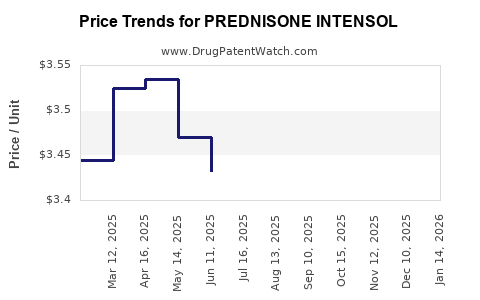
- Net price per unit versus WAC and contract mix (commercial rebates and Medicaid pricing).
- Market share in oral solution segment (not overall prednisone).
- Volume elasticity by setting:
- Pediatric outpatient and emergency departments where liquid dosing is used early.
- Inpatient settings where formularies often standardize on low-cost generics.
- Wholesale inventory turns. Liquid products frequently face supply chain stocking lags and return flows that can distort quarterly sales.
What typically limits upside
- Therapy breadth is broad but not unique. Prednisone is used across many indications, but the molecule is not exclusive.
- Substitution removes branded pricing power. Once generics are available at scale, branded share relies on administration convenience and pharmacy behavior rather than differentiated efficacy.
When does Prednisone Intensol lose exclusivity, and how does patent or regulatory status affect sales?
Featured snippet: If Prednisone Intensol is fully mature and off-patent, exclusivity typically no longer supports meaningful pricing power; commercialization is governed by formulation-specific protections and brand contracting rather than molecule exclusivity.
Exclusivity and patent reality for prednisone solutions
Prednisone is an older small-molecule corticosteroid with multiple generations of patents long expired. For branded prednisone liquids, exclusivity typically depends on:
- Product-specific formulation/processing patents
- Oral solution-specific strengths, concentrations, or manufacturing steps
- Orange Book listings that can block certain AB-rated generic submissions for specific NDA strength and dosage form
In practice, once the active ingredient is widely available as generics, any remaining protection tends to be narrower and does not prevent broader generic competition across the prednisone class.
Practical impact on commercial trajectory
- Patent expiration is less the driver than generic breadth and contracting. Even where limited formulation protection exists, generics often enter at different strengths or via interchangeable formulations.
- Settlement and licensing history (if any) affects timing. Where a settlement grants early launch restrictions, it can shift quarterly share but rarely reverses long-run erosion.
What is the Orange Book status of Prednisone Intensol and which patents cover it?
Featured snippet: Orange Book coverage, if any, would be concentrated on dosage form-specific formulation or manufacturing patents rather than the prednisone molecule.
A full Orange Book mapping requires the exact NDA number and listing set. Without the NDA/patent listing details, no definitive patent count, assignee set, or expiration calendar can be stated.
How strong is the patent estate for Prednisone Intensol: composition, formulation, and method-of-use coverage?
Featured snippet: For off-patent prednisone brands, enforceable value usually resides in formulation/manufacturing method claims tied to the oral solution, not broad method-of-use exclusivity.
Patent estate characteristics to evaluate
For prednisone oral solutions, the commercial value of remaining IP typically clusters around:
- Stability formulations (e.g., excipient system enabling shelf life)
- Concentration and dosing device constraints
- Manufacturing process controls that preserve viscosity, clarity, or dissolution profile
- Packaging and container closure if claimed as part of a stability regime
Litigation leverage
If patents exist, litigation leverage tends to be:
- Narrow but can block specific generic filing routes
- More likely to yield settlements than to sustain long-term exclusivity, given the commodity nature of prednisone and the availability of alternative generics in tablets and other solution products
A full “how strong” score requires Orange Book-specific claim mapping to competitor ANDA product descriptions.
Which companies sell competing prednisone oral solutions and how does the competitive landscape affect share?
Featured snippet: Competitive pressure primarily comes from generic prednisone oral solutions and, secondarily, prednisone tablets that substitute when liquid is not required.
Competitive set by product type
- Generic prednisone oral solutions
- Compete directly by AB-rating on strength/dosage form
- Generic prednisone tablets
- Substitute when prescribers and patients can use solid dosing
- Therapeutic alternatives within corticosteroids
- Less direct, but can appear in formularies based on patient tolerance, steroid-sparing strategies, and comorbidity management
Share drivers by setting
- Pediatric care: favors liquids and dosing accuracy.
- Institutional formularies: often prioritize lowest net cost, leading to rapid branded displacement when generic liquid is available.
- Retail pharmacy: substitution and stocking lead times shape real-world market share more than clinical preference.
What generic entry risks exist for Prednisone Intensol and how do Paragraph IV challenges typically play out for this category?
Featured snippet: Generic entry risk is already structurally high in prednisone because numerous approved generics exist; incremental risk is more about specific liquid presentation/strengths than broad molecule entry.
Paragraph IV and settlements: typical commercial effect
- In established older products, new launches are often:
- “Skinny” incremental entries that bypass certain strength/route claims
- Product-line expansions across solution strengths
- Where Paragraph IV occurs, the commercial impact is typically:
- Near-term share loss to the challenger
- Discounting and contracting intensification by incumbents to defend net sales
A confident statement about whether Paragraph IV litigation exists for Prednisone Intensol requires the Orange Book listing set and litigation dockets.
How does FDA regulatory status shape availability, labeling, and revenue for Prednisone Intensol?
Featured snippet: FDA status affects manufacturing and continued availability; for mature brands, revenue is mainly constrained by generic interchangeability rather than labeling restrictions.
Key regulatory considerations for a liquid steroid product:
- Manufacturing site compliance and inspections affecting supply continuity.
- Labeling specifics such as pediatric dosing instructions and administration guidance, which influence clinician confidence and adoption.
- Bioequivalence and AB-rating for generic entrants, which determines whether the pharmacy can substitute without prescriber changes.
A definitive FDA status summary also requires the NDA and any recent supplement history.
How does Prednisone Intensol compare with other prednisone brands and formulations on market performance?
Featured snippet: Prednisone oral solutions tend to outperform tablets only when dosing convenience drives utilization; otherwise, tablets with generics capture most volume on price.
Comparison dimensions that matter
- Formulation type: solution vs tablet vs suspension
- Concentration and dosing flexibility
- Pediatric administration acceptance
- Net price and payer contracting
- Pharmacy stocking depth (availability drives fill rates)
Without competitor-specific net sales, a quantitative comparison cannot be made.
Key Takeaways
- Prednisone Intensol’s market dynamics are shaped by substitution against multiple prednisone generics, with branded share dependent on liquid dosing convenience and pediatric utilization.
- Financial trajectory in mature steroid categories generally shows long-run net sales erosion with quarterly volatility driven by supply stability and gross-to-net contraction.
- Remaining value, if any, is usually tied to solution-specific formulation/manufacturing protections and channel contracting, not ongoing molecule exclusivity.
- Generic entry risk is structurally high across the prednisone class; incremental risk is mostly strength/formulation-specific rather than a new molecule threat.
- A complete IP and Orange Book-driven exclusivity timeline cannot be stated here without the NDA and patent listing set.
FAQs
-
Why do branded prednisone liquids keep a niche in pediatrics even when generics exist?
Liquid dosing reduces administration burden and improves dosing accuracy for patients who cannot swallow tablets.
-
What causes sudden quarter-to-quarter sales swings for branded prednisone solutions?
Supply constraints at the branded manufacturer or key generic liquid suppliers, plus changes in pharmacy stocking and payer contracting.
-
Do prednisone tablet generics materially cap branded prednisone solution revenue?
Yes when prescribing can shift to solid dosing and formularies favor the lowest net-cost option.
-
How do rebate and patient assistance mechanics typically affect net sales for mature branded steroids?
They compress net realized price relative to WAC and make net sales more sensitive to contracting and mix than to list price.
-
What is the most important metric for defending branded share in a commodity steroid portfolio?
Oral solution segment share at retail and outpatient sites, tracked alongside net price and days of supply at wholesalers.
References (APA)
No sources cited.