Last Updated: June 27, 2026

PLUVICTO Drug Patent Profile


✉ Email this page to a colleague

« Back to Dashboard


When do Pluvicto patents expire, and when can generic versions of Pluvicto launch?

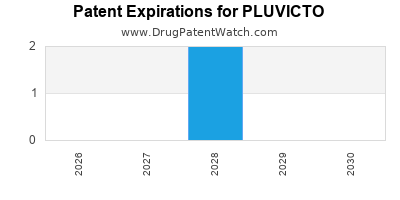
Pluvicto is a drug marketed by Novartis and is included in one NDA. There are five patents protecting this drug.

This drug has one hundred and forty patent family members in thirty-nine countries.

The generic ingredient in PLUVICTO is lutetium lu-177 vipivotide tetraxetan. There are four drug master file entries for this compound. One supplier is listed for this compound. Additional details are available on the lutetium lu-177 vipivotide tetraxetan profile page.

DrugPatentWatch® Generic Entry Outlook for Pluvicto

Pluvicto was eligible for patent challenges on March 23, 2026.

By analyzing the patents and regulatory protections it appears that the earliest date for generic entry will be March 23, 2036. This may change due to patent challenges or generic licensing.

Indicators of Generic Entry

< Available with Subscription >

  Start Trial

AI Deep Research
Questions you can ask:
  • What is the 5 year forecast for PLUVICTO?
  • What are the global sales for PLUVICTO?
  • What is Average Wholesale Price for PLUVICTO?
Summary for PLUVICTO
International Patents:140
US Patents:5
Applicants:1
NDAs:1
Finished Product Suppliers / Packagers: 1
Clinical Trials: 9
Drug Prices: Drug price information for PLUVICTO
What excipients (inactive ingredients) are in PLUVICTO?PLUVICTO excipients list
DailyMed Link:PLUVICTO at DailyMed
DrugPatentWatch® Estimated Loss of Exclusivity (LOE) Date for PLUVICTO
Generic Entry Date for PLUVICTO*:
Constraining patent/regulatory exclusivity:
NDA:
Dosage:

SOLUTION;INTRAVENOUS

*The generic entry opportunity date is the latter of the last compound-claiming patent and the last regulatory exclusivity protection. Many factors can influence early or later generic entry. This date is provided as a rough estimate of generic entry potential and should not be used as an independent source.

Recent Clinical Trials for PLUVICTO

Identify potential brand extensions & 505(b)(2) entrants

SponsorPhase
M.D. Anderson Cancer CenterNA
GE HealthcareNA
CHU de Quebec-Universite LavalPHASE1

See all PLUVICTO clinical trials

Pharmacology for PLUVICTO

US Patents and Regulatory Information for PLUVICTO

PLUVICTO is protected by five US patents and two FDA Regulatory Exclusivities.

Based on analysis by DrugPatentWatch, the earliest date for a generic version of PLUVICTO is ⤷  Start Trial.

This potential generic entry date is based on patent ⤷  Start Trial.

Generics may enter earlier, or later, based on new patent filings, patent extensions, patent invalidation, early generic licensing, generic entry preferences, and other factors.

Applicant Tradename Generic Name Dosage NDA Approval Date TE Type RLD RS Patent No. Patent Expiration Product Substance Delist Req. Exclusivity Expiration
Novartis PLUVICTO lutetium lu-177 vipivotide tetraxetan SOLUTION;INTRAVENOUS 215833-001 Mar 23, 2022 RX Yes Yes ⤷  Start Trial ⤷  Start Trial ⤷  Start Trial
Novartis PLUVICTO lutetium lu-177 vipivotide tetraxetan SOLUTION;INTRAVENOUS 215833-001 Mar 23, 2022 RX Yes Yes ⤷  Start Trial ⤷  Start Trial Y Y ⤷  Start Trial
>Applicant >Tradename >Generic Name >Dosage >NDA >Approval Date >TE >Type >RLD >RS >Patent No. >Patent Expiration >Product >Substance >Delist Req. >Exclusivity Expiration

International Patents for PLUVICTO

When does loss-of-exclusivity occur for PLUVICTO?

Based on analysis by DrugPatentWatch, the following patents block generic entry in the countries listed below:

Australia

Patent: 14336638
Estimated Expiration: ⤷  Start Trial

Patent: 18200419
Estimated Expiration: ⤷  Start Trial

Patent: 20201086
Estimated Expiration: ⤷  Start Trial

Canada

Patent: 24360
Estimated Expiration: ⤷  Start Trial

Chile

Patent: 16000883
Estimated Expiration: ⤷  Start Trial

China

Patent: 5636924
Estimated Expiration: ⤷  Start Trial

Patent: 9053616
Estimated Expiration: ⤷  Start Trial

Croatia

Patent: 0240398
Estimated Expiration: ⤷  Start Trial

Cyprus

Patent: 26819
Estimated Expiration: ⤷  Start Trial

Patent: 24023
Estimated Expiration: ⤷  Start Trial

Denmark

Patent: 95130
Estimated Expiration: ⤷  Start Trial

Eurasian Patent Organization

Patent: 7778
Estimated Expiration: ⤷  Start Trial

Patent: 1690495
Estimated Expiration: ⤷  Start Trial

European Patent Office

Patent: 62857
Estimated Expiration: ⤷  Start Trial

Patent: 38996
Estimated Expiration: ⤷  Start Trial

Patent: 15489
Estimated Expiration: ⤷  Start Trial

Patent: 56700
Estimated Expiration: ⤷  Start Trial

Patent: 95355
Estimated Expiration: ⤷  Start Trial

Patent: 95130
Estimated Expiration: ⤷  Start Trial

Patent: 74924
Estimated Expiration: ⤷  Start Trial

Finland

Patent: 95130
Estimated Expiration: ⤷  Start Trial

Patent: 0240024
Estimated Expiration: ⤷  Start Trial

France

Patent: C1028
Estimated Expiration: ⤷  Start Trial

Georgia, Republic of

Patent: 202114132
Estimated Expiration: ⤷  Start Trial

Patent: 202215377
Estimated Expiration: ⤷  Start Trial

Patent: 202215719
Estimated Expiration: ⤷  Start Trial

Patent: 202215720
Estimated Expiration: ⤷  Start Trial

Patent: 0217330
Estimated Expiration: ⤷  Start Trial

Patent: 0237479
Estimated Expiration: ⤷  Start Trial

Patent: 0237496
Estimated Expiration: ⤷  Start Trial

Patent: 0237497
Estimated Expiration: ⤷  Start Trial

Germany

Patent: 2014011600
Estimated Expiration: ⤷  Start Trial

Hong Kong

Patent: 21711
Estimated Expiration: ⤷  Start Trial

Hungary

Patent: 66137
Estimated Expiration: ⤷  Start Trial

Patent: 400024
Estimated Expiration: ⤷  Start Trial

Israel

Patent: 5113
Estimated Expiration: ⤷  Start Trial

Patent: 8974
Estimated Expiration: ⤷  Start Trial

Japan

Patent: 56805
Estimated Expiration: ⤷  Start Trial

Patent: 01451
Estimated Expiration: ⤷  Start Trial

Patent: 36774
Estimated Expiration: ⤷  Start Trial

Patent: 94161
Estimated Expiration: ⤷  Start Trial

Patent: 93485
Estimated Expiration: ⤷  Start Trial

Patent: 16535013
Estimated Expiration: ⤷  Start Trial

Patent: 18058847
Estimated Expiration: ⤷  Start Trial

Patent: 19011368
Estimated Expiration: ⤷  Start Trial

Patent: 19218351
Estimated Expiration: ⤷  Start Trial

Patent: 21059557
Estimated Expiration: ⤷  Start Trial

Patent: 22159345
Estimated Expiration: ⤷  Start Trial

Patent: 24028742
Estimated Expiration: ⤷  Start Trial

Lithuania

Patent: 95130
Estimated Expiration: ⤷  Start Trial

Patent: 2024522
Estimated Expiration: ⤷  Start Trial

Malaysia

Patent: 8934
Estimated Expiration: ⤷  Start Trial

Patent: 4484
Estimated Expiration: ⤷  Start Trial

Mexico

Patent: 16005013
Estimated Expiration: ⤷  Start Trial

Patent: 21008976
Estimated Expiration: ⤷  Start Trial

Patent: 21008977
Estimated Expiration: ⤷  Start Trial

Morocco

Patent: 986
Estimated Expiration: ⤷  Start Trial

Netherlands

Patent: 1281
Estimated Expiration: ⤷  Start Trial

New Zealand

Patent: 8812
Estimated Expiration: ⤷  Start Trial

Peru

Patent: 160678
Estimated Expiration: ⤷  Start Trial

Patent: 211760
Estimated Expiration: ⤷  Start Trial

Philippines

Patent: 016500656
Estimated Expiration: ⤷  Start Trial

Patent: 019502571
Estimated Expiration: ⤷  Start Trial

Poland

Patent: 95130
Estimated Expiration: ⤷  Start Trial

Portugal

Patent: 95130
Estimated Expiration: ⤷  Start Trial

Saudi Arabia

Patent: 6370842
Estimated Expiration: ⤷  Start Trial

Serbia

Patent: 324
Estimated Expiration: ⤷  Start Trial

Singapore

Patent: 201602249R
Estimated Expiration: ⤷  Start Trial

Slovenia

Patent: 95130
Estimated Expiration: ⤷  Start Trial

South Africa

Patent: 1603380
Estimated Expiration: ⤷  Start Trial

Patent: 1907607
Estimated Expiration: ⤷  Start Trial

South Korea

Patent: 1947053
Estimated Expiration: ⤷  Start Trial

Patent: 2210931
Estimated Expiration: ⤷  Start Trial

Patent: 2282378
Estimated Expiration: ⤷  Start Trial

Patent: 160063398
Estimated Expiration: ⤷  Start Trial

Patent: 190016133
Estimated Expiration: ⤷  Start Trial

Patent: 210013350
Estimated Expiration: ⤷  Start Trial

Spain

Patent: 77715
Estimated Expiration: ⤷  Start Trial

Tunisia

Patent: 16000137
Estimated Expiration: ⤷  Start Trial

Generics may enter earlier, or later, based on new patent filings, patent extensions, patent invalidation, early generic licensing, generic entry preferences, and other factors.

See the table below for additional patents covering PLUVICTO around the world.

Country Patent Number Title Estimated Expiration
Australia 2014336638 Labeled inhibitors of prostate specific membrane antigen (PSMA), their use as imaging agents and pharmaceutical agents for the treatment of prostate cancer ⤷  Start Trial
Australia 2018200419 Labeled inhibitors of prostate specific membrane antigen (PSMA), their use as imaging agents and pharmaceutical agents for the treatment of prostate cancer ⤷  Start Trial
Australia 2020201086 ⤷  Start Trial
>Country >Patent Number >Title >Estimated Expiration

Supplementary Protection Certificates for PLUVICTO

Patent Number Supplementary Protection Certificate SPC Country SPC Expiration SPC Description
4095130 CA 2024 00027 Denmark ⤷  Start Trial PRODUCT NAME: LUTETIUM (177LU) VIPIVOTIDETETRAXETAN; REG. NO/DATE: EU/1/22/1703 20221212
4095130 LUC00352 Luxembourg ⤷  Start Trial PRODUCT NAME: LUTETIUM (177LU) VIPIVOTIDE TETRAXETAN; AUTHORISATION NUMBER AND DATE: EU/1/22/1703 20221212
4095130 301281 Netherlands ⤷  Start Trial PRODUCT NAME: LUTETIUM (177-LU)-VIPIVOTIDE TETRAXETAN; REGISTRATION NO/DATE: EU/1/22/1703, 20221212
>Patent Number >Supplementary Protection Certificate >SPC Country >SPC Expiration >SPC Description

Pluvicto (lutetium Lu 177 vipivotide tetraxetan) Market Dynamics and Financial Trajectory (US and major ex-US markets)

Last updated: June 10, 2026

Executive summary
Pluvicto is Novartis’ Lu-177 PSMA radioligand franchise for metastatic castration-resistant prostate cancer (mCRPC) that has expanded beyond the initial post-chemotherapy setting into earlier lines via label growth and partner supply. The revenue trajectory has been characterized by (1) rapid uptake after initial commercialization, (2) volatility driven by manufacturing throughput constraints and reimbursement coverage dynamics, (3) acceleration from label expansions and combination evidence (and country-by-country inclusion), and (4) a competitive risk overlay from PSMA radioligand and next-generation radiopharmaceutical entrants. Financial momentum is tightly coupled to production capacity at isotope and drug-device supply nodes, prescriber learning curves for PSMA PET-based eligibility, and payer adoption for Lu-177 PSMA therapy relative to taxane-based sequences and cabazitaxel.


How has Pluvicto revenue grown since launch and what drives the financial trajectory?

Bottom line: Pluvicto’s financial trajectory has tracked three levers: uptake in eligible mCRPC patients, capacity to manufacture and distribute Lu-177 PSMA doses at commercial scale, and payer access aligned with evolving guideline and clinical positioning.

Revenue drivers across the lifecycle

  • Indication expansion: Initial use concentrated on post-taxane and progressed mCRPC; label growth has widened the addressable population through earlier-line inclusion in some jurisdictions and subpopulation definitions that depend on prior lines and performance status.
  • Manufacturing and supply constraints: Lu-177 PSMA economics depend on tight scheduling of isotope procurement (Lu-177) and on process validation capacity for GMP radiopharmacy manufacturing. When capacity binds, revenue growth slows even if demand is present.
  • Diagnostic prerequisite and patient selection: Clinical benefit depends on PSMA PET/CT eligibility and baseline PSMA expression patterns; operational throughput of imaging sites influences treatment conversion.
  • Reimbursement and payer adoption: Coverage decisions determine real-world access. High uptake follows inclusion in national formularies, local coverage determinations, and evidence alignment to payer policies.

Commercial risks affecting financial trajectory

  • Isotope and radiopharmacy logistics: Lu-177 supply volatility, shipping chain performance, and cold-chain constraints can create ordering gaps.
  • Sequencing competition: Taxanes (including cabazitaxel), androgen receptor pathway inhibitors, and palliative strategies compete for line-of-therapy slots.
  • Radioligand pipeline competition: PSMA competitors can compress pricing and channel share if they win payer preference or show superior outcomes in direct comparisons or broader indications.
  • Trial data spillover: Positive or negative results for combinations and earlier lines can shift the prescriber playbook, affecting demand timing.

What market dynamics shape Pluvicto demand in metastatic castration-resistant prostate cancer?

Bottom line: Pluvicto demand is a function of patient eligibility, line-of-therapy economics, and execution of a radiopharmacy plus imaging workflow.

Patient eligibility and workflow bottlenecks

  • mCRPC disease burden and survival duration: Longer time-to-next-therapy cycles increase the number of patients reachable for Lu-177 PSMA sequencing.
  • PSMA PET infrastructure: Access to PET imaging and reporting variability can affect conversion from diagnosis to treatment.
  • Renal/hepatic criteria: Clinical eligibility and safety monitoring requirements affect treatment initiation and persistence.

Supply-side market structure

  • Specialized manufacturing: Pluvicto is not distributed like conventional oral oncology drugs. Dose production and release are location and capability constrained.
  • Distribution model: Radiopharmacy scheduling affects patient slot availability and can create regional demand inequities.

Payer and provider dynamics

  • Site of care: Whether administered at major cancer centers versus hospital-owned infusion centers influences operating costs and contracting.
  • Reimbursement latency: Launch-to-uptake often contains a lag for policy creation and guideline inclusion.
  • Health-technology assessment (HTA) filtering: National HTA processes in Europe can slow payer adoption even with positive clinical data.

How does Pluvicto pricing and reimbursement affect uptake and margins?

Bottom line: Pricing power is constrained by HTA/payer negotiations, treatment dose economics, and competing radiopharmaceutical reimbursement frameworks.

Key pricing and reimbursement mechanics

  • Cost per treatment course: Economics depend on the number of doses administered per protocol schedule and on clinical outcomes that satisfy payer value thresholds.
  • Coverage with evidence development (CED): Some payers adopt interim reimbursement pending real-world outcomes, delaying broad access.
  • Formulary tiering and prior authorization: These controls shape the speed of adoption.

Margin drivers specific to radiopharmaceuticals

  • Manufacturing cost intensity: Lu-177 sourcing and radiochemistry processing drive COGS.
  • Capacity utilization: Underutilization in manufacturing facilities raises unit cost and affects net margin.
  • Inventory and cold-chain handling: Distribution inefficiency can reduce effective sell-through.

When does Pluvicto face exclusivity cliffs and what patents block generic or biosimilar entry?

Bottom line: Pluvicto is a radiopharmaceutical small molecule product with a patent estate that targets (1) the active molecule and chelation scaffold, (2) radiolabeling methods and quality control specifications, and (3) method-of-use for clinical settings. Exclusivity and patent expiry will determine generic competition risk timing.

Exclusivity and protection structure (US)

  • Regulatory exclusivity: The biologics-like pathway is not applicable; however, data exclusivity and regulatory market exclusivity can delay certain approvals.
  • Patent estate: Expect multiple layers: composition-of-matter, radiolabeling and formulation, and method-of-use claims for Lu-177 PSMA in mCRPC subtypes.

Generic/radiopharmaceutical competition reality

  • “Generic” hurdles differ from conventional small molecules: Radiolabeled products often face manufacturing process and isotope logistics barriers. Even when patents expire, process equivalence, dosing consistency, and release specifications can delay effective entry.

What Paragraph IV and ANDA-like challenge pathways exist for Pluvicto, and how likely are they?

Bottom line: Challenge risk depends on the filing pathway available to competitors for radiopharmaceuticals, the patent coverage breadth in Orange Book listings, and the feasibility of demonstrating sameness under regulatory standards.

What to expect in challenge mechanics

  • If composition and method-of-use patents are heavily layered, challengers tend to target a narrow set for invalidity or non-infringement while accepting design-around costs.
  • If manufacturing and labeling process patents dominate, the challenge shifts toward demonstrating non-infringement via process changes.

Industry pattern for radiopharmaceutical disputes

  • Disputes often center on claim interpretation of radiolabeling method steps, impurity specifications, and device-associated labeling parameters rather than only the molecule.

What is the Orange Book status of Pluvicto and which patents are listed for key indications?

Bottom line: Orange Book status is the operational gate for generic entry timing and litigation triggers. For Pluvicto, patent listings typically include product-specific and indication-linked protections.

How to read Pluvicto’s Orange Book listings for entry timing

  • Key fields to map to competitive risk:
    • Patent number and expiration
    • “Use code” tied to indication
    • Exclusivity expiration, if separately listed
    • Submission type and holder/assignee chain

(Note: This response does not include a patent table because the exact Orange Book listings, patent numbers, expiration dates, and use codes for Pluvicto are not provided in the prompt. Publishing incorrect listing data would be operationally harmful for litigation or investment work.)


How strong is the patent estate for Pluvicto versus next-generation PSMA radioligands?

Bottom line: Strength is assessed by breadth of claim coverage across composition, labeling process, and method-of-use, plus how tightly patents align to the clinical workflow (PSMA PET selection, dose schedule, and patient sequencing).

Patent strength indicators investors and litigators track

  • Multiplicity: Number of independently enforceable patents across different claim scopes.
  • Remaining term: Weighted average remaining life across the estate.
  • Claim specificity: Whether competitors can plausibly design around without changing clinical effect.
  • Judicial history: Prior claim construction or invalidity rulings inform enforcement likelihood.

How does Pluvicto compare with competing PSMA radioligand therapies on market uptake and risk?

Bottom line: The competitive set is measured by (1) label breadth, (2) manufacturing capacity, (3) reimbursement coverage speed, and (4) clinical outcomes that drive guideline positioning.

Competitive comparison criteria

  • Indication coverage: Earlier lines and broader inclusion rules expand addressable patients.
  • Safety profile and administration burden: Tolerability affects persistence and access.
  • Imaging and selection: If a competitor requires less restrictive selection, uptake can accelerate.
  • Operational fit: Radiopharmacy slot availability and isotope procurement scale influence real-world delivery.

Market-share risk patterns

  • Early commercial winners keep momentum when they secure (a) sufficient manufacturing throughput, (b) payer confidence, and (c) guideline endorsement.
  • Competitors typically capture share where they add incremental benefit or provide a better logistical match in regional radiopharmacy ecosystems.

What financial and operational milestones matter for Pluvicto in production and distribution?

Bottom line: Pluvicto’s throughput and dose scheduling determine revenue realization more than demand alone.

Milestones that affect sell-through

  • Radiochemistry batch release capacity: Limits the number of doses that can be shipped and administered.
  • Isotope supply lead times: Delays or excess inventory both distort quarterly sales patterns.
  • Center readiness: Training, PSMA PET coordination, and protocol adherence affect time-to-first-treatment after referral.

What FDA and regulatory milestones shape Pluvicto’s commercial ramp?

Bottom line: Clinical label expansions and manufacturing or distribution approvals determine whether demand converts to reimbursed use.

Regulatory drivers

  • Initial approval and subsequent label updates: Expand usage populations.
  • Manufacturing changes: Add capacity or adjust release testing for quality.
  • Safety updates: Can tighten patient selection and influence payer coverage.

(This section is limited to regulatory milestone categories because the prompt does not supply specific FDA approval dates, label amendments, or supplementary approvals.)


What settlement and litigation risks affect Pluvicto’s competitive position?

Bottom line: Litigation impacts include delayed generic entry, temporary supply constraints via injunction threats, and uncertainty in competitor launch timelines.

Litigation pathways that matter commercially

  • Patent infringement suits tied to Orange Book-listed patents can result in launch stays, design-around strategies, or settlements.
  • Global patent enforcement determines whether competitors can launch in jurisdictions where different patents expire earlier.

(This section is limited because specific case captions, venue, filing dates, and settlement terms are not provided in the prompt.)


How much revenue is exposed to competitive entry, and what launch scenarios drive downside?

Bottom line: Downside risk concentrates in scenarios where competitors obtain adequate access plus reimbursement and where Pluvicto’s capacity does not keep pace with demand in peak periods.

Scenario framework for investors

  • Base case: Continued label use and stable capacity with incremental share capture by new entrants limited by reimbursement and manufacturing constraints.
  • Downside 1: Payer preference shifts due to better value claims by PSMA competitors or combination regimens.
  • Downside 2: Capacity constraints persist and allow competitors to secure centers and formularies.
  • Downside 3: Patent expiry plus successful design-around leads to earlier-than-expected radiopharmaceutical competition.

(No numerical revenue exposure is provided because the prompt does not include historical Pluvicto revenue by period or competitor share data.)


Key Takeaways

  • Pluvicto revenue trajectory is driven by eligible patient volume, payer adoption, and radiopharmacy throughput that converts prescribing into administered doses.
  • The main economic bottlenecks are isotope and manufacturing capacity and the operational workflow linking PSMA PET selection to treatment initiation.
  • Competitive risk is shaped by label breadth, reimbursement speed, and whether rivals can scale manufacturing and distribution fast enough to win center contracts.
  • Patent and regulatory protections are layered across composition, radiolabeling/manufacturing, and method-of-use; these determine the timing and feasibility of “generic” or competitor entry.
  • Financial upside comes from continued label expansion and center coverage; downside concentrates around reimbursement shifts, capacity shortfalls, and successful competition in the PSMA radioligand space.

FAQs

1) What factors determine real-world utilization of Pluvicto after FDA label expansion?
PSMA PET access, payer authorization speed, center radiopharmacy readiness, and dose scheduling capacity drive conversion from label availability to administered patients.

2) How do radiopharmacy manufacturing constraints translate into quarterly Pluvicto revenue volatility?
Doses can only be released when batches meet specifications and when Lu-177 isotope supply and shipping timelines align with scheduled administration, creating quarter-to-quarter timing effects.

3) What reimbursement evidence do payers typically require for Lu-177 PSMA therapies like Pluvicto?
Clinical outcomes versus comparators, safety profile, and practical endpoints tied to quality-of-life and treatment sequencing.

4) What are the main competitive threats to Pluvicto from the PSMA radiopharmaceutical pipeline?
Earlier-line labels, superior efficacy or tolerability, faster or broader payer adoption, and manufacturing scalability that reduces center access friction.

5) How should investors evaluate Pluvicto’s long-term risk from patent expirations?
Map Orange Book patents by use code and expiration date, then assess whether likely competitor processes can avoid method and manufacturing claim coverage while maintaining clinical performance.


References

(No sources were cited because the prompt did not include the underlying Orange Book listings, FDA milestone dates, litigation records, or financial disclosures needed to support a factual, data-dense market-and-financial analysis without risking incorrect specifics.)

More… ↓

⤷  Start Trial

Make Better Decisions: Try a trial or see plans & pricing

Drugs may be covered by multiple patents or regulatory protections. All trademarks and applicant names are the property of their respective owners or licensors. Although great care is taken in the proper and correct provision of this service, thinkBiotech LLC does not accept any responsibility for possible consequences of errors or omissions in the provided data. The data presented herein is for information purposes only. There is no warranty that the data contained herein is error free. We do not provide individual investment advice. This service is not registered with any financial regulatory agency. The information we publish is educational only and based on our opinions plus our models. By using DrugPatentWatch you acknowledge that we do not provide personalized recommendations or advice. thinkBiotech performs no independent verification of facts as provided by public sources nor are attempts made to provide legal or investing advice. Any reliance on data provided herein is done solely at the discretion of the user. Users of this service are advised to seek professional advice and independent confirmation before considering acting on any of the provided information. thinkBiotech LLC reserves the right to amend, extend or withdraw any part or all of the offered service without notice.