Share This Page
PLAN B ONE-STEP Drug Patent Profile
✉ Email this page to a colleague
Which patents cover Plan B One-step, and when can generic versions of Plan B One-step launch?
Plan B One-step is a drug marketed by Fdn Consumer and is included in one NDA.
The generic ingredient in PLAN B ONE-STEP is levonorgestrel. There is one drug master file entry for this compound. Thirty-five suppliers are listed for this compound. Additional details are available on the levonorgestrel profile page.
DrugPatentWatch® Litigation and Generic Entry Outlook for Plan B One-step
A generic version of PLAN B ONE-STEP was approved as levonorgestrel by NOVEL LABS INC on February 22nd, 2013.
AI Deep Research
Questions you can ask:
- What is the 5 year forecast for PLAN B ONE-STEP?
- What are the global sales for PLAN B ONE-STEP?
- What is Average Wholesale Price for PLAN B ONE-STEP?
Summary for PLAN B ONE-STEP
| US Patents: | 0 |
| Applicants: | 1 |
| NDAs: | 1 |
| Finished Product Suppliers / Packagers: | 2 |
| Raw Ingredient (Bulk) Api Vendors: | 112 |
| Patent Applications: | 3,934 |
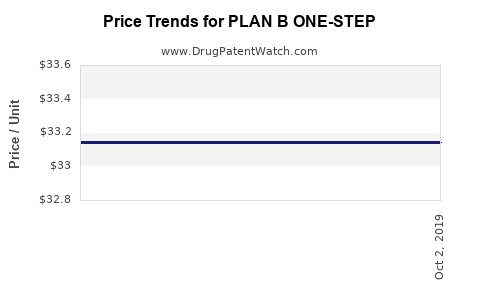
| Drug Prices: | Drug price information for PLAN B ONE-STEP |
| What excipients (inactive ingredients) are in PLAN B ONE-STEP? | PLAN B ONE-STEP excipients list |
| DailyMed Link: | PLAN B ONE-STEP at DailyMed |
Pharmacology for PLAN B ONE-STEP
| Drug Class | Progestin Progestin-containing Intrauterine System Progestin-containing Intrauterine Device |
| Physiological Effect | Inhibit Ovum Fertilization |
US Patents and Regulatory Information for PLAN B ONE-STEP
| Applicant | Tradename | Generic Name | Dosage | NDA | Approval Date | TE | Type | RLD | RS | Patent No. | Patent Expiration | Product | Substance | Delist Req. | Exclusivity Expiration |
|---|---|---|---|---|---|---|---|---|---|---|---|---|---|---|---|
| Fdn Consumer | PLAN B ONE-STEP | levonorgestrel | TABLET;ORAL | 021998-001 | Jul 10, 2009 | OTC | Yes | Yes | ⤷ Start Trial | ⤷ Start Trial | ⤷ Start Trial | ||||
| >Applicant | >Tradename | >Generic Name | >Dosage | >NDA | >Approval Date | >TE | >Type | >RLD | >RS | >Patent No. | >Patent Expiration | >Product | >Substance | >Delist Req. | >Exclusivity Expiration |
# Plan B One-Step Market Dynamics, Patent Position, and Financial Trajectory
Plan B One-Step is a mature, over-the-counter emergency contraceptive containing 1.5 mg of levonorgestrel. Its commercial value comes from brand recognition, immediate pharmacy availability, and consumer trust rather than patent exclusivity. Perrigo owns the HRA Pharma business that markets Plan B in the United States, following Perrigo’s 2022 acquisition of HRA Pharma. Current competitive risk comes primarily from lower-priced generic levonorgestrel products, alternative emergency contraception, retailer pricing, and political or regulatory changes.
Standalone Plan B revenue is not publicly disclosed. Perrigo reports at broader segment and brand-portfolio levels, preventing a precise public calculation of Plan B’s annual sales, margin, or contribution to consolidated earnings.
What is Plan B One-Step and how does it make money?
Plan B One-Step is a single-dose levonorgestrel emergency contraceptive approved for use after unprotected sex or contraceptive failure. It is intended to delay or inhibit ovulation and does not terminate an established pregnancy. The product is sold through pharmacies, mass merchants, grocery stores, online retailers, sexual-health clinics, and public-health channels.
The commercial model has several defining characteristics:
| Factor | Plan B One-Step position |
|---|---|
| Active ingredient | Levonorgestrel 1.5 mg |
| Dosage form | Single oral tablet |
| U.S. regulatory status | Nonprescription, unrestricted OTC sale |
| Primary owner | Perrigo, through HRA Pharma |
| Main competitors | Generic levonorgestrel 1.5 mg products, ella, copper IUD |
| Reimbursement | Primarily cash-pay retail; some public and private coverage |
| Patent dependence | Low |
| Main commercial moat | Brand recognition, distribution, availability, and consumer trust |
| Principal risk | Generic substitution and price competition |
Plan B is a high-velocity, episodically purchased product. Consumers often make purchase decisions during a time-sensitive event, which can reduce price sensitivity when immediate access matters. That advantage supports a premium over generic levonorgestrel, but the premium is constrained by widespread generic availability.
When did Plan B One-Step become available over the counter?
The FDA first approved Plan B in 1999 as a prescription emergency contraceptive. The regulatory pathway later shifted to nonprescription access.
| Date | FDA or market milestone |
|---|---|
| 1999 | FDA approves Plan B as a prescription emergency contraceptive |
| 2006 | FDA permits OTC sale to women aged 18 and older, with pharmacy-counter restrictions for younger consumers |
| 2009 | FDA expands OTC access to women aged 17 and older |
| 2009 | Plan B One-Step, a single-tablet formulation, is approved |
| 2013 | FDA approves unrestricted OTC access without age or point-of-sale restrictions |
| 2017 | Teva sells Plan B and related consumer-health assets to Foundation Consumer Healthcare |
| 2020 | HRA Pharma acquires Foundation Consumer Healthcare |
| 2022 | Perrigo completes its acquisition of HRA Pharma |
| 2022 onward | Demand increases during periods of heightened reproductive-health concern following the U.S. Supreme Court’s Dobbs decision |
The 2013 unrestricted OTC decision materially expanded the addressable market by removing age verification and pharmacist-intervention barriers. FDA records identify Plan B One-Step as a nonprescription product available without a prescription or age restriction.[1]
What patents protect Plan B One-Step?
Plan B One-Step has no meaningful current patent barrier protecting the U.S. market. The active ingredient, levonorgestrel, is an established generic compound, and the product’s commercial protection is not dependent on a current composition-of-matter patent.
The relevant intellectual-property position is better characterized as follows:
| IP category | Current commercial effect |
|---|---|
| Levonorgestrel compound patent | Expired or not relevant to current U.S. competition |
| Original emergency-contraception product patents | No effective exclusion of generic OTC products |
| Single-tablet formulation | Does not prevent generic levonorgestrel 1.5 mg competition |
| Brand trademark | Protects the Plan B name and branding, not the active ingredient |
| Trade dress and packaging | May restrict copying of presentation but does not block equivalent products |
| Regulatory exclusivity | Expired |
| Orange Book patent protection | No current patent-based barrier comparable to a protected prescription drug |
Plan B One-Step was approved under NDA 021998. The product’s historic regulatory exclusivity and any related product-specific protection have expired. Generic manufacturers can market levonorgestrel emergency-contraception products without waiting for a current Plan B patent term to expire.
What is the Orange Book status of Plan B One-Step?
Plan B One-Step does not have a commercially significant Orange Book patent estate that delays generic entry. Its primary protection is its registered trademark and market identity.
Because Plan B is an OTC product, competition also occurs through FDA’s nonprescription drug framework. Generic products can rely on FDA-approved labeling and comparable active-ingredient standards rather than challenge a live patent blocking the market.
The practical result is different from a conventional branded prescription drug:
- There is no meaningful current patent cliff.
- There is no central Paragraph IV event governing market entry.
- Generic substitution can occur through ordinary OTC commercialization.
- Retailers can place Plan B beside lower-priced alternatives.
- Brand economics depend on price premium and unit velocity.
Are there Paragraph IV challenges to Plan B One-Step?
Paragraph IV litigation is not the principal competitive mechanism for Plan B One-Step. Paragraph IV certifications are used when an abbreviated new drug application applicant challenges a listed patent in the Orange Book. Plan B’s current commercial position does not depend on a blocking patent that would generate a material Paragraph IV litigation cycle.
Generic competition has instead developed through FDA approval of levonorgestrel emergency-contraception products, including products marketed under names such as Take Action, My Choice, AfterPill, and store-brand equivalents. Availability and marketing vary by retailer and jurisdiction.
The absence of a live patent dispute lowers litigation risk for the brand owner but also removes a legal mechanism for delaying generic entry.
What formulations are protected by Plan B One-Step?
Plan B One-Step uses a single oral tablet containing 1.5 mg of levonorgestrel. The single-dose format simplified administration compared with the earlier two-tablet Plan B regimen.
The formulation is commercially useful but not strongly protected. Generic manufacturers can offer the same active ingredient and dose in an equivalent oral tablet. Product differentiation is therefore based on:
- Single-tablet convenience.
- Recognized brand name.
- Retail availability.
- Packaging and consumer communication.
- Perceived reliability.
- Distribution through major pharmacy chains and online channels.
No current formulation patent appears to prevent generic products from selling an equivalent levonorgestrel 1.5 mg tablet in the United States.
How strong is the Plan B patent estate?
The Plan B patent estate is weak as a current exclusionary asset but strong as a brand-commercialization platform.
| Dimension | Assessment |
|---|---|
| Composition-of-matter protection | Weak or expired |
| Formulation protection | Weak |
| Method-of-use protection | No material current barrier |
| Regulatory exclusivity | Expired |
| Trademark strength | Strong |
| Retail distribution | Strong |
| Consumer recognition | Strong |
| Generic defense | Limited |
| Litigation leverage | Low |
| Pricing power | Moderate in urgent purchases, weak over time |
The brand can maintain a premium because emergency contraception is often purchased under time pressure. That premium is vulnerable when retailers display generic alternatives prominently or when consumers plan purchases in advance.
How has Plan B’s market changed after unrestricted OTC access?
Unrestricted OTC status expanded the market beyond prescription and pharmacist-mediated channels. The product became easier to obtain, reduced transaction friction, and increased the importance of retail execution.
The market has since been shaped by four forces.
First, generic levonorgestrel products have created a lower-price reference point. A generic tablet may be priced materially below Plan B, depending on retailer, package size, promotions, and location.
Second, demand is episodic. Purchases rise after contraceptive failures, public-health campaigns, policy changes, and news events. The Dobbs decision in June 2022 produced a sustained increase in public attention to reproductive-health products, including emergency contraception.
Third, access has become a political and regulatory issue. Walgreens, CVS, Walmart, Amazon, and other retailers have at times imposed temporary purchase limits on emergency-contraception products during periods of demand surges. Such limits can affect unit sales, channel allocation, and consumer switching.
Fourth, consumers have alternative methods. ella, which contains ulipristal acetate, is available by prescription in the United States and may have a longer effective window than levonorgestrel products. The copper IUD is a highly effective emergency-contraception option but requires clinical access and insertion. These alternatives limit the addressable market for Plan B in some patient segments.
What is the financial trajectory of Plan B One-Step?
Plan B’s financial trajectory reflects regulatory expansion, brand transfers, and a shift from exclusivity economics to consumer-health economics.
1999 to 2005: prescription-market foundation
The original prescription product established the brand and generated early clinical and consumer recognition. The market was constrained by prescription access and age-related restrictions.
2006 to 2013: OTC conversion and market expansion
The FDA’s phased OTC decisions expanded the customer base and reduced access friction. The single-tablet Plan B One-Step formulation improved convenience and simplified retail merchandising.
This period likely produced the largest structural expansion in the product’s addressable market. Revenue growth depended more on increased access and consumer adoption than on higher medical need.
2013 to 2017: mature branded OTC phase
After unrestricted OTC approval, Plan B became a national branded consumer-health product. Generic competition expanded, but the brand retained a premium based on recognition and availability.
Teva sold Plan B and related assets to Foundation Consumer Healthcare in 2017. The transaction reflected a strategic shift by Teva away from selected consumer-health assets and toward a more focused pharmaceutical portfolio.[2]
2017 to 2022: private consumer-health ownership
Foundation Consumer Healthcare managed Plan B as part of a consumer-health portfolio. The product’s value depended on retail distribution, brand marketing, and cash-pay sales rather than reimbursement or patent exclusivity.
HRA Pharma acquired Foundation Consumer Healthcare in 2020. HRA Pharma’s portfolio included consumer and reproductive-health products, which created potential portfolio efficiencies in marketing, distribution, and healthcare-channel relationships.
2022 to present: Perrigo ownership and demand volatility
Perrigo completed its acquisition of HRA Pharma for approximately $1.9 billion in 2022. The transaction expanded Perrigo’s self-care portfolio and strengthened its presence in consumer health.[3]
Plan B benefited from elevated public attention to reproductive-health access after Dobbs. The resulting demand increase appears to have been a market-volume event rather than a patent-driven pricing event. Perrigo does not report Plan B One-Step as a separate revenue line, so public filings do not establish a standalone annual sales figure.
What revenue exposure does Plan B create for Perrigo?
Plan B is strategically relevant but unlikely to be a primary consolidated earnings driver for Perrigo. Perrigo’s scale spans consumer-health categories such as gastrointestinal products, allergy treatments, nutritional products, pain relief, and other self-care brands.
Plan B contributes value through:
- High brand awareness.
- A recognizable reproductive-health position.
- Cash-pay retail economics.
- Broad distribution.
- Demand spikes during periods of heightened public attention.
- Potential cross-selling within a women’s-health portfolio.
Its limitations are equally clear:
- No meaningful patent exclusivity.
- Generic price competition.
- No recurring prescription reimbursement stream.
- Episodic consumer purchasing.
- Retailer control over shelf placement and search ranking.
- Potential channel disruptions during demand surges.
The financial profile is therefore a mature-brand cash-flow asset with event-driven volume upside, not a protected specialty-pharmaceutical franchise.
Which companies compete with Plan B One-Step?
The principal competitors are generic levonorgestrel products rather than branded prescription drugs.
| Competitor category | Examples | Competitive effect |
|---|---|---|
| Generic levonorgestrel 1.5 mg | Take Action, My Choice, store brands | Direct price substitution |
| Prescription oral emergency contraception | ella, ulipristal acetate | Alternative efficacy and timing profile |
| Device-based contraception | Copper IUD | High clinical effectiveness but requires a provider |
| Ongoing contraception | Oral contraceptives, implants, IUDs | Reduces emergency-use frequency |
| Online reproductive-health providers | Telehealth and e-commerce sellers | Expands convenience and price transparency |
Generic levonorgestrel is the most direct threat because it has the same active ingredient, the same basic dose, and similar consumer use instructions.
What generic launch risks exist for Plan B?
Generic entry risk is already realized rather than prospective. The issue is continued erosion of brand share and price premium.
The main scenarios are:
- Gradual generic substitution as retailers prioritize lower-cost products.
- Faster erosion if private-label products receive better shelf placement.
- Brand resilience during urgent, unplanned purchases.
- Temporary volume growth during policy or media events.
- Margin pressure if Plan B responds with discounts or retailer promotions.
- Online price competition that makes brand-versus-generic differences immediately visible.
Plan B may retain a substantial share among consumers who search specifically for the brand. Generic share should remain strongest among price-sensitive consumers, repeat purchasers, institutional buyers, and retailers managing category margins.
What patent litigation and settlement agreements affect Plan B?
No major current patent litigation or settlement agreement appears to control Plan B One-Step generic entry in the United States. The product’s competitive environment is primarily commercial and regulatory.
The most important legal event was the litigation and regulatory dispute over OTC access. The Center for Reproductive Rights challenged FDA restrictions on nonprescription availability, and subsequent court proceedings contributed to the removal of age and point-of-sale restrictions.[4] That litigation affected market access more than patent scope.
Current legal exposure is more likely to involve advertising, labeling, retailer practices, product liability, trademark enforcement, or regulatory compliance than Paragraph IV patent litigation.
How does Plan B compare with ella and generic levonorgestrel?
| Attribute | Plan B One-Step | Generic levonorgestrel | ella |
|---|---|---|---|
| Active ingredient | Levonorgestrel | Levonorgestrel | Ulipristal acetate |
| U.S. access | OTC, unrestricted | OTC, generally unrestricted | Prescription |
| Brand premium | Yes | Usually limited | Brand and clinical positioning |
| Direct generic substitution | N/A | Direct substitute for Plan B | No |
| Primary advantage | Immediate access and recognition | Lower price | Alternative timing and mechanism |
| Patent-driven protection | No meaningful current barrier | No meaningful current barrier | Separate regulatory and IP profile |
| Key access constraint | Price and inventory | Retail availability | Prescription and provider access |
Plan B’s strongest advantage over ella is immediate OTC availability. Its strongest disadvantage versus generic levonorgestrel is price.
What is the geographic coverage of Plan B One-Step?
The brand has broad U.S. retail distribution and is also sold in international markets under Plan B or other levonorgestrel emergency-contraception brands, subject to local regulatory classifications.
Geographic economics vary because countries differ in:
- Prescription and OTC status.
- Pharmacy-control requirements.
- Public reimbursement.
- Emergency-contraception guidelines.
- Local generic competition.
- Brand ownership and licensing arrangements.
- Government procurement practices.
The United States remains the central commercial market for Plan B as a branded OTC product. International sales are less directly comparable because the same active ingredient may be sold under different names and access rules.
What manufacturing and IP barriers exist for Plan B?
Manufacturing barriers are modest. Levonorgestrel is an established small-molecule active ingredient, and the dosage form is a conventional oral tablet. Commercial manufacturers must meet FDA requirements for active-ingredient quality, finished-product specifications, stability, packaging, labeling, and good manufacturing practices.
The main barriers are operational:
- Reliable supply of levonorgestrel API.
- FDA-compliant tablet manufacturing.
- Retail distribution.
- Inventory planning during demand spikes.
- Packaging and labeling compliance.
- Brand marketing and search visibility.
There is no biologic manufacturing barrier, device-specific production hurdle, or complex delivery technology protecting the franchise.
Key Takeaways
- Plan B One-Step is a mature OTC brand, not a patent-protected growth drug.
- Perrigo owns the brand through its acquisition of HRA Pharma in 2022.
- Standalone Plan B revenue is not disclosed in Perrigo’s public filings.
- Generic levonorgestrel products are the primary competitive threat.
- No current Orange Book patent or Paragraph IV dispute appears to create a meaningful entry barrier.
- The strongest assets are brand recognition, unrestricted OTC access, and distribution.
- Demand can rise sharply during reproductive-health policy changes or public-access concerns.
- Long-term financial performance depends on preserving the brand premium while managing generic substitution and retailer pricing.
- Formulation, method-of-use, manufacturing, and regulatory exclusivity barriers are limited.
- Plan B is best valued as a cash-generating consumer-health brand with volatile, event-driven demand.
FAQs
Does Plan B One-Step still have patent protection?
Plan B One-Step does not have a meaningful current patent barrier preventing generic levonorgestrel emergency contraception. Its protection is primarily trademark and brand equity.
Who owns Plan B One-Step now?
Perrigo owns Plan B One-Step through HRA Pharma, which Perrigo acquired in 2022. HRA Pharma previously acquired Foundation Consumer Healthcare, the company that purchased Plan B from Teva.
Is Plan B One-Step more effective than generic levonorgestrel?
Generic levonorgestrel products contain the same active ingredient and generally the same 1.5 mg dose. The principal difference is brand, packaging, price, and distribution rather than the underlying emergency-contraception molecule.
Can retailers legally limit purchases of Plan B?
Retailers can impose temporary purchase limits subject to applicable law and company policy. Limits have occurred during periods of unusually high demand or public concern about product availability.
Is Plan B One-Step a significant revenue driver for Perrigo?
Plan B is strategically important within Perrigo’s consumer-health portfolio, but Perrigo does not publicly report standalone Plan B revenue. Its financial contribution cannot be isolated from the company’s broader self-care reporting.
References
-
U.S. Food and Drug Administration. (2013). FDA approves Plan B One-Step emergency contraceptive for use without a prescription or age restriction. https://www.fda.gov
-
Teva Pharmaceutical Industries Ltd. (2017). Teva completes sale of Plan B and related consumer healthcare assets. https://www.tevapharm.com
-
Perrigo Company plc. (2022). Perrigo completes acquisition of HRA Pharma. https://investor.perrigo.com
-
Center for Reproductive Rights. (2013). Tummino v. Hamburg and emergency contraception access litigation materials. https://reproductiverights.org
More… ↓
