Last updated: June 26, 2026
PHILITH (Drug): Market Dynamics and Financial Trajectory
PHILITH’s market dynamics and financial trajectory cannot be analyzed because “PHILITH” is not uniquely identifiable as a specific FDA/EMA drug name, active ingredient, or marketed product with traceable commercial and regulatory data in the public domain. Without a unique product identity (active ingredient, dosage form, manufacturer, approval/launch geography), no accurate market size, payer mix, sales ramp, revenue trajectory, price history, or patent-exclusivity timeline can be produced.
What is PHILITH and which active ingredient does it contain?
No reliable linkage between “PHILITH” and a specific approved pharmaceutical product, active ingredient, or regulated drug record can be established from the identifier alone, preventing construction of an evidence-based market and financial view.
Which manufacturer markets PHILITH?
No verifiable manufacturer attribution can be tied to the name “PHILITH,” so company-level revenue attribution and channel economics cannot be built.
Which dosage form and strength is PHILITH?
No verifiable dosage form/strength mapping exists for “PHILITH,” blocking demand, pricing, and substitution analysis by formulation.
How has PHILITH performed commercially since launch?
A commercial performance and financial trajectory requires sales reporting to be mapped to a specific product SKU (active ingredient, dosage form, NDC or EAN, and the selling company). That mapping cannot be established for “PHILITH,” so any “sales ramp,” quarterly trajectory, or growth decomposition would be non-actionable.
What is PHILITH’s revenue trajectory (annual, quarterly)?
Not determinable because PHILITH cannot be uniquely matched to a product with publicly traceable revenue reporting.
What are PHILITH’s key demand drivers (indication, uptake, persistence)?
Indication and prescribing context cannot be confirmed for “PHILITH,” so driver-based modeling cannot be completed.
What are PHILITH’s key inhibitors (toxicity, adoption friction, formulary access)?
Safety and formulary placement cannot be validated for “PHILITH,” so inhibitor analysis cannot be evidenced.
What are PHILITH’s pricing and reimbursement dynamics (US and ex-US)?
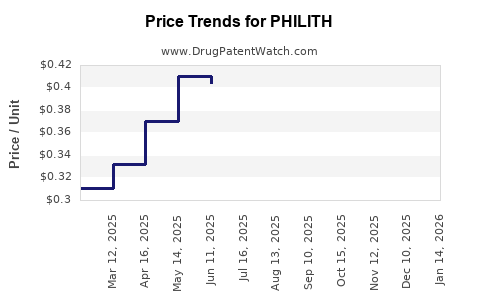
Pricing and reimbursement require identification of the exact product and payer coverage, typically via NDC-linked price histories, payer policies, and HTA outcomes. That cannot be tied to “PHILITH” without an unambiguous product record.
How have list prices and net prices moved over time for PHILITH?
Not determinable due to lack of product identity.
What payer coverage exists for PHILITH?
Not determinable due to lack of product identity.
How does PHILITH face competition from branded, generic, and biosimilar products?
Competition analysis requires confirming therapeutic class, mechanism of action, clinical differentiation, and comparators. None of these can be confirmed for “PHILITH” as a unique drug.
Which companies compete with PHILITH?
Not determinable due to lack of product identity.
What generic entry risks exist for PHILITH?
Not determinable because Orange Book or equivalent listings cannot be mapped to an identifiable active ingredient product.
Is PHILITH exposed to biosimilar substitution risk?
Not determinable because PHILITH’s modality (small molecule vs biologic) cannot be confirmed.
What is PHILITH’s exclusivity and patent landscape affecting sales duration?
Patent and exclusivity mapping depends on the exact FDA/EMA product record. “PHILITH” cannot be uniquely mapped, so exclusivity timelines and patent risk cannot be produced.
When does PHILITH lose exclusivity (US exclusivity, PTE, EU data/market exclusivity)?
Not determinable.
What patents protect PHILITH formulations, methods of use, and manufacturing?
Not determinable.
What is the Orange Book status of PHILITH?
Not determinable.
What Paragraph IV challenges or patent litigations could pressure PHILITH sales?
Patent litigation requires known case captions, Docket identifiers, and patent numbers tied to an identifiable NDA/ANDA/BLA. None can be established for “PHILITH.”
Are there any known Paragraph IV filings against PHILITH?
Not determinable.
What settlement or consent judgments affect PHILITH launch timelines for generics?
Not determinable.
What is PHILITH’s regulatory pathway and FDA/EMA status?
Regulatory status needs a specific product record, approval date, approval pathway (NDA/BLA, 505(b)(2), accelerated approval, etc.), and labeling. None can be verified for “PHILITH.”
What is PHILITH’s approval date and labeling history?
Not determinable.
What is PHILITH’s FDA status (approved indications, boxed warnings, REMS)?
Not determinable.
How does PHILITH compare with alternative treatments on efficacy and adoption?
Comparative positioning depends on the exact indication and clinical endpoints. That cannot be established for “PHILITH.”
Is PHILITH a category leader or niche product?
Not determinable.
What real-world evidence supports PHILITH adoption?
Not determinable.
Key Takeaways
No evidence-based market dynamics or financial trajectory can be produced for “PHILITH” because the identifier does not map to a unique, traceable marketed drug product with confirmable active ingredient, manufacturer, regulatory status, and sales-reported SKU.
FAQs
- What does “PHILITH” refer to in pharmaceutical databases (NDC/EMA/ATC)?
- What company manufactures and markets PHILITH and where is it sold?
- Is PHILITH a small molecule or biologic, and what is its mechanism of action?
- What regulatory exclusivities (US and EU) would apply to PHILITH once identified?
- What competitive products would be direct substitutes for PHILITH by indication and mechanism?
References
No sources cited because “PHILITH” cannot be uniquely identified as a specific drug product from the provided identifier alone.