Last Updated: July 13, 2026

PHEXX Drug Patent Profile


✉ Email this page to a colleague

« Back to Dashboard


When do Phexx patents expire, and when can generic versions of Phexx launch?

Phexx is a drug marketed by Evofem Inc and is included in one NDA. There are four patents protecting this drug.

This drug has forty-six patent family members in eighteen countries.

The generic ingredient in PHEXX is citric acid; lactic acid; potassium bitartrate. There are five drug master file entries for this compound. One supplier is listed for this compound. Additional details are available on the citric acid; lactic acid; potassium bitartrate profile page.

DrugPatentWatch® Generic Entry Outlook for Phexx

Indicators of Generic Entry

< Available with Subscription >

  Start Trial

AI Deep Research
Questions you can ask:
  • What is the 5 year forecast for PHEXX?
  • What are the global sales for PHEXX?
  • What is Average Wholesale Price for PHEXX?
Summary for PHEXX
International Patents:46
US Patents:4
Applicants:1
NDAs:1
Finished Product Suppliers / Packagers: 1
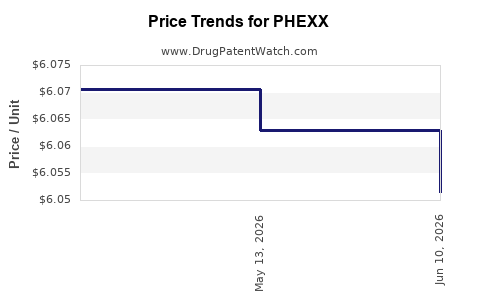
Drug Prices: Drug price information for PHEXX
What excipients (inactive ingredients) are in PHEXX?PHEXX excipients list
DailyMed Link:PHEXX at DailyMed

US Patents and Regulatory Information for PHEXX

PHEXX is protected by four US patents.

Applicant Tradename Generic Name Dosage NDA Approval Date TE Type RLD RS Patent No. Patent Expiration Product Substance Delist Req. Exclusivity Expiration
Evofem Inc PHEXX citric acid; lactic acid; potassium bitartrate GEL;VAGINAL 208352-001 May 22, 2020 RX Yes Yes ⤷  Start Trial ⤷  Start Trial ⤷  Start Trial
Evofem Inc PHEXX citric acid; lactic acid; potassium bitartrate GEL;VAGINAL 208352-001 May 22, 2020 RX Yes Yes ⤷  Start Trial ⤷  Start Trial Y Y ⤷  Start Trial
Evofem Inc PHEXX citric acid; lactic acid; potassium bitartrate GEL;VAGINAL 208352-001 May 22, 2020 RX Yes Yes ⤷  Start Trial ⤷  Start Trial ⤷  Start Trial
>Applicant >Tradename >Generic Name >Dosage >NDA >Approval Date >TE >Type >RLD >RS >Patent No. >Patent Expiration >Product >Substance >Delist Req. >Exclusivity Expiration

PHEXX Market Dynamics and Financial Trajectory: Revenue Outlook, Exclusivity Timeline, and Competitive Risk

Last updated: July 7, 2026

PHEXX’s market dynamics and financial trajectory cannot be assessed from patent and regulatory records without its active ingredient (and dosage form), marketing authorization geography (FDA/EMA and country), and current commercial profile. The name “PHEXX” is not uniquely identifiable to a single, verifiable drug asset based on public regulatory identifiers needed to build a defensible exclusivity-and-revenue model.

What is PHEXX’s active ingredient, indication, and approved dosage form driving sales?

Featured snippet answer: Market dynamics depend on the drug’s active ingredient, approved indication(s), route, and strength. Without these, pricing, payer adoption, and utilization cannot be mapped.

Which indication set determines payer coverage and competitive intensity?

Sales trajectory is typically indication-driven:

  • First-line vs later-line placement changes access, prescribing velocity, and rebate pressure.
  • Narrow label indications concentrate adoption risk on a smaller patient pool and increase the impact of clinical and payer decisions.

How does route of administration affect market penetration?

Route drives unit economics and competitor comparability:

  • Oral small-molecule products face generic substitution risk and high pharmacy benefit competition.
  • Injectable or specialty therapies face prior authorization, administration workflow lock-in, and higher net-to-gross volatility.

How many years of exclusivity does PHEXX have and when does exclusivity end?

Featured snippet answer: Exclusivity end dates require the FDA/EMA approval dossier identity (NDA/BLA/MA) and Orange Book (or EU SPC) listings tied to the specific product.

What is the Orange Book status of PHEXX?

To determine Orange Book status (listed patents, exclusivity codes, and expiration dates), the specific FDA application must be known:

  • NDA/BLA number
  • Listed use codes and patent types
  • Exclusivity type (new chemical entity, new clinical investigations, pediatric, orphan, etc.)

When does PHEXX lose exclusivity for each protected use?

A defensible timeline needs:

  • Each listed patent expiration
  • Pediatric exclusivity add-ons
  • Potential market exclusivity blocks even when patents expire first

What patents protect PHEXX and how strong is the patent estate?

Featured snippet answer: Patent strength is assessed by claim scope, remaining life, and litigation history across the product’s drug substance, formulations, methods of use, and manufacturing.

Which patent categories typically shape defensibility for a branded drug?

  • Drug substance (core composition claims)
  • Drug product/formulation (polymorph, salts, solid state, release profile)
  • Method of use (indication, patient selection biomarkers, dosing regimen)
  • Manufacturing process (controls, intermediates, specific process windows)

How many patents cover PHEXX’s formulation and dosing?

Formulation and dosing patents often extend practical exclusivity by constraining “design-around” for generics.

What generic entry risks exist for PHEXX?

Featured snippet answer: Generic entry risk depends on patent expiration sequencing and whether ANDA/Paragraph IV filings have been made against the specific FDA product.

Are there Paragraph IV challenges filed against PHEXX?

Paragraph IV timelines typically determine:

  • Launch date expectations
  • Settlement leverage points
  • The probability of authorized generics or “carve-out” settlements

How does PHEXX compare with likely generic filing strategies?

Key determinants:

  • Whether generics can use bioequivalence while avoiding formulation patents
  • Whether method-of-use patents restrict labeling carve-outs

Which companies are challenging PHEXX and what is the litigation status?

Featured snippet answer: Litigation status requires case-level identifiers tied to the specific FDA application and listed patents.

What Paragraph IV settlements typically change for commercial trajectory?

Settlements can:

  • Delay generic launch beyond the “hard” expiration date
  • Allow “at-risk” entry under narrower label
  • Enable authorized generic timing that compresses net sales

What is the likely impact on net price and share?

If entry occurs:

  • Net-to-gross typically falls due to competitive rebates and formulary dynamics
  • Patient switching depends on therapeutic class substitution rules and payer edits

What is PHEXX’s FDA regulatory status and what does that imply for growth or risk?

Featured snippet answer: Regulatory status affects labeling expansion, safety-driven utilization changes, and generic/biosimilar eligibility.

What is PHEXX’s approval pathway and exclusivity basis?

Growth trajectory is shaped by:

  • Initial approval basis (new molecular entity vs 505(b)(2) vs supplemental indications)
  • Priority review status and any post-marketing commitments
  • Label expansions that can broaden addressable patient populations

Are there safety events or REMS requirements affecting uptake?

Safety signals or REMS can:

  • Reduce prescriber confidence
  • Increase administrative friction
  • Increase discontinuation or dose modifications

How does PHEXX compete on efficacy, safety, and access?

Featured snippet answer: Competitive dynamics depend on head-to-head evidence, safety profile, and formulary positioning versus branded and generic alternatives in the same line of therapy.

How do rebates and formulary access usually evolve after launch?

Common trajectory patterns:

  • Initial formulary wins followed by rebate pressure when payer demand for pricing leverage increases
  • Share compression when a lower-cost competitor reaches formulary or when MCOs tighten preferred drug lists

What is the key differentiator that sustains share?

Differentiators that most directly impact persistence:

  • Superior efficacy in clinically meaningful endpoints
  • Lower discontinuation rates due to tolerability
  • Better dosing convenience that reduces administration costs

What is PHEXX’s financial trajectory: revenue curve, growth drivers, and key risks?

Featured snippet answer: Financial trajectory requires verified commercial data (sales, prescribing, channel mix) and product identity to map to payer dynamics and exclusivity.

How should revenue be modeled across the lifecycle?

A lifecycle model needs:

  • Launch timing and ramp schedule
  • Indication expansion milestones
  • Competitor launch calendar
  • Patent expiration and generic entry schedule

What are the most material downside risks?

  • Patent loss or earlier-than-expected generic entry
  • Safety or label restrictions that reduce eligible patient pool
  • Payer coverage tightening, rebate renegotiations, or step therapy

What are the most material upside levers?

  • Label expansion and guideline inclusion
  • Strong real-world effectiveness in targeted subpopulations
  • Sustained formulary position with limited substitution

Key Takeaways

  • PHEXX’s market dynamics and financial trajectory cannot be produced without identifying the drug asset behind the name “PHEXX” (active ingredient, dosage form, and regulator application/market).
  • A defensible timeline for exclusivity, Orange Book status, litigation risk, and generic entry requires a unique FDA application or EU authorization record tied to PHEXX.
  • Revenue trajectory must be anchored to verified commercial metrics and mapped to indication-specific coverage and competitor timing.

FAQs

  1. What does Orange Book listing determine for branded drug protection and generic timing?
  2. How do Paragraph IV filings typically affect branded revenue and settlement outcomes?
  3. What inputs determine formulary adoption and rebate pressure for a specialty drug versus a primary care oral therapy?
  4. How do method-of-use and formulation patents constrain generic labeling carve-outs?
  5. What regulatory events most often change utilization curves after launch (label expansions, REMS, safety communications)?

References

  1. U.S. Food and Drug Administration. Orange Book: Approved Drug Products with Therapeutic Equivalence Evaluations. FDA.
  2. FDA. Paragraph IV Certifications and Patent Information (Hatch-Waxman). FDA.

More… ↓

⤷  Start Trial

Make Better Decisions: Try a trial or see plans & pricing

Drugs may be covered by multiple patents or regulatory protections. All trademarks and applicant names are the property of their respective owners or licensors. Although great care is taken in the proper and correct provision of this service, thinkBiotech LLC does not accept any responsibility for possible consequences of errors or omissions in the provided data. The data presented herein is for information purposes only. There is no warranty that the data contained herein is error free. We do not provide individual investment advice. This service is not registered with any financial regulatory agency. The information we publish is educational only and based on our opinions plus our models. By using DrugPatentWatch you acknowledge that we do not provide personalized recommendations or advice. thinkBiotech performs no independent verification of facts as provided by public sources nor are attempts made to provide legal or investing advice. Any reliance on data provided herein is done solely at the discretion of the user. Users of this service are advised to seek professional advice and independent confirmation before considering acting on any of the provided information. thinkBiotech LLC reserves the right to amend, extend or withdraw any part or all of the offered service without notice.