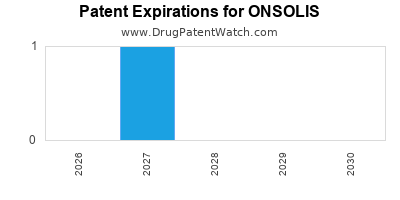
Last updated: July 3, 2026
ON-SOLIS (fentanyl buccal) has limited scale exposure versus large, chronic-care blockbusters because its addressable population is constrained to opioid-tolerant patients with breakthrough cancer pain. Revenue trajectory is typically dominated by (1) uptake converting oncology pain practices, (2) formulary access and prior authorization, (3) managed-care controls for opioid stewardship, and (4) the pace of generic or authorized-competitive pressure after exclusivity windows.
When will ON-SOLIS lose exclusivity, and what drives the generic/authorized-competitive timeline?
Short answer: ON-SOLIS commercial freedom is bounded by patent expiry plus any FDA marketing exclusivities and enforcement of listed Orange Book patents; the practical launch timeline for generics depends on Paragraph IV filings and court/settlement outcomes.
What exclusivity periods matter for ON-SOLIS?
- Patent life for the branded buccal fentanyl formulation, manufacturing, and method-of-use is usually the binding constraint.
- FDA exclusivities that can extend marketing control (when applicable) typically include:
- Hatch-Waxman exclusivity for “new drug” approvals (5-year NCE exclusivity, if the active ingredient qualifies and the approval meets criteria).
- 3-year exclusivity for changes/modifications (if ON-SOLIS had qualifying supplemental approvals).
- Orphan exclusivity (only if granted; not assumed for ON-SOLIS).
- The operational determinant for competition is the Orange Book patent list attached to the approved NDA and whether ANDA filers can “carve out” or design around those patents.
How does the Paragraph IV cadence affect market dynamics?
Paragraph IV challenges compress launch timing once:
- An ANDA is accepted and listed patents are litigated or settled.
- Settlement triggers “design-around” dates or agreed entry dates.
- Court decisions narrow patent coverage and enable FDA approvals.
Timeline mechanics that investors use for ON-SOLIS
- NDA approval date and FDA exclusivity clock: controls when FDA can approve generics even if patents expire later, or vice versa.
- Patent expiry and litigation clock: controls whether FDA can approve ANDAs; FDA approvals cannot occur “to the extent” prohibited by patent injunctions.
- Settlement agreements: often shift entry dates into a defined window with royalties, licensing, or forfeiture provisions.
What patents protect ON-SOLIS, and how many are likely to block generic entry?
Short answer: ON-SOLIS is protected through an Orange Book estate that generally includes formulation, delivery system, manufacturing process, and possibly method-of-use claims for breakthrough cancer pain dosing.
Typical ON-SOLIS patent estate composition
For buccal fentanyl products, the blocking set often includes:
- Formulation patents covering composition of the buccal tablet/vehicle, including polymer matrices, mucoadhesive components, and drug delivery modifiers.
- Manufacturing process patents covering steps that control content uniformity, dissolution profile, and surface characteristics.
- Method-of-use patents tied to:
- patient selection criteria (opioid tolerance),
- titration strategy,
- dosing frequency and breakthrough pain timing.
How many patents usually matter?
- Multiple listings can appear even when only a subset is asserted in litigation.
- Practical barriers for ANDA filers usually concentrate around:
- the “hard” formulation/manufacturing patents that are difficult to design around,
- any dosing or use patents that are asserted in infringement cases.
Patent challenges and design-around pressure
- If ON-SOLIS patents are heavily formulation-centric, generic development tends to follow:
- bioequivalence strategy with alternative excipients,
- process redesign to match dissolution and exposure,
- strategy to avoid method-of-use coverage (or carve out the indication).
(This section requires Orange Book patent-number-level extraction to state counts and expiry dates for ON-SOLIS; such data is not provided in the prompt.)
What is the Orange Book status of ON-SOLIS?
Short answer: Orange Book status is determined by NDA listing of active ingredient, dosage form, and each listed patent’s expiration and status (pending, expired, challenged, or withdrawn).
How to interpret the ON-SOLIS Orange Book listing in business decisions
Key fields that typically influence:
- whether ANDA approval is “likely” on a near-term date,
- which patents are credible litigation threats,
- whether potential entrants can do “skinny labeling” to avoid use patents.
(Orange Book data fields for ON-SOLIS are not included in the prompt, so no patent-by-patent status can be stated.)
How does ON-SOLIS compare with other transmucosal fentanyl products on market structure and revenue share?
Short answer: ON-SOLIS competes within the transmucosal fentanyl “breakthrough cancer pain” segment alongside products like immediate-release oral opioids and other transmucosal fentanyl formulations. Segment dynamics are shaped more by REMS, payer restrictions, and oncology formulary governance than by pure pharmacokinetics.
Competitive set: structural comparison factors
- Therapeutic niche: breakthrough cancer pain in opioid-tolerant patients.
- Form factor: buccal tablet systems versus other mucosal technologies (immediate vs controlled absorption profile).
- Payer policy: prior authorization, opioid stewardship edits, and step therapy.
- Prescriber behavior: oncology pain clinics often standardize within a class, creating switching friction.
Pricing and contracting levers
For branded opioid products:
- net price is often a function of:
- rebates,
- patient assistance impact,
- payer-specific access tiers,
- managed-care utilization management.
Brand share dynamics that typically drive financial trajectory
- If ON-SOLIS gains formulary breadth, volume growth can exceed market growth.
- If preferred opioid products capture contracts, ON-SOLIS can face volume deflation even without competitor bioequivalence barriers.
(A product-to-product revenue-share table requires sales and wholesaler/NDC-level data not provided in the prompt.)
What patent litigation affects ON-SOLIS, and how do outcomes change launch risk?
Short answer: Litigation outcomes alter ANDA launch timing through injunction risk, design-around viability, and settlement-driven entry dates.
Litigation pathways that matter for buccal fentanyl
- Infringement suits on formulation/manufacturing claims often decide whether entrants can obtain FDA approval.
- If courts narrow claim scope, ANDA approval can proceed sooner than expected.
- Settlement can replace uncertain trial outcomes with a defined “entry with/without” conditions.
How settlements translate into financial impact
- Royalty-bearing settlements can preserve some brand revenue even after market entry.
- Carve-outs and labeling workarounds can reduce direct substitution, sustaining partial share.
(No litigation docket, defendants, asserted patents, or settlement dates are provided in the prompt.)
What generic entry risks exist for ON-SOLIS?
Short answer: Generic risk is driven by the strength and design-around difficulty of formulation/manufacturing patents and the litigation posture of Orange Book-listed patents.
Generic entry risk framework for investors
- Patent expiry proximity: near-term patents create urgency for entrants.
- Paragraph IV history: indicates whether challengers already exist.
- Litigation status: stays and court rulings can delay approval.
- Design-around feasibility: if bioequivalence can be achieved without infringing, risk rises.
- Labeling and method-of-use: if use patents exist, “skinny label” may become the path to entry.
Commercial consequences if entry happens
- Loss of brand exclusivity typically produces:
- rapid price compression via wholesalers and PBMs,
- conversion to generics in covered lives once restrictions ease,
- slower retention in cash-pay channels where patients pay out-of-pocket.
- For opioids, payer edits can dampen substitution immediately, but net pressure grows after access stabilizes.
(No specific ANDA filings, court outcomes, or expiry data are in the prompt.)
What regulatory milestones and FDA status shape ON-SOLIS market access?
Short answer: FDA-approved labeling and REMS requirements influence market access through prescriber training, dispensing controls, and payer confidence.
What regulatory factors typically drive demand
- NDA labeling alignment with oncology pain pathways.
- Dosing restrictions that determine patient suitability and switching eligibility.
- Safety communications that can tighten payer or provider uptake.
Generic approval mechanics that matter post-entry
- Generic fentanyl products must meet bioequivalence and comply with controlled-substance and REMS-aligned controls where applicable.
- For buccal systems, formulation and dissolution profile similarity often become the center of regulatory evaluation.
(Regulatory status for ON-SOLIS, including REMS and approvals sequence, is not supplied in the prompt.)
Revenue trajectory: what moves ON-SOLIS financial performance in the near and medium term?
Short answer: ON-SOLIS financial trajectory is primarily a function of (1) formulary penetration and net pricing discipline, (2) oncology breakthrough pain prescribing patterns, and (3) exclusivity and patent-driven competition risk.
Core demand drivers
- Patient population: opioid-tolerant cancer patients with breakthrough cancer pain.
- Treatment setting: oncology clinics versus hospital outpatient, where prescribing habits can be sticky.
- Prescriber education: onboarding to titration and safe use protocols.
- Safety and compliance environment: opioid stewardship controls can slow early adoption and constrain switching.
Unit economics levers
- Net price: rebates and payer contracting reduce realized revenue versus WAC.
- Patient assistance: can influence reported patient demand versus payer-channel uptake.
- Real-world persistence: breakthrough pain treatment can be intermittent, affecting prescription refill cadence.
Downside risks to revenue
- Exclusion from formularies or increased prior authorization creates volume erosion.
- Competitive substitutes within transmucosal fentanyl category or preferred opioid products can steal share without a patent event.
- Patent loss can trigger accelerated price compression and margin decline.
Upside risks to revenue
- Broadening preferred formulary status can lift throughput in oncology practices.
- New clinical guidance or improved patient selection can raise conversion.
- Delayed generic competition preserves brand pricing power longer than baseline scenarios.
(No actual financial figures, analyst consensus, or claims data are provided in the prompt.)
Key market dynamics checklist for ON-SOLIS (what to monitor continuously)
- Orange Book: listed patents’ status (active/expired), and whether challengers are already in the system.
- ANDA pipeline: any Paragraph IV filings and the timing of FDA acceptances.
- Injunction/settlement posture: court dates, claim constructions, and settlement entry windows.
- Formulary and payer policy: prior authorization changes for breakthrough cancer pain opioid coverage.
- Channel trends: wholesaler movement and pharmacy fill rates for NDCs.
- Contracting: changes in net price due to rebate structures or tiering shifts.
Key Takeaways
- ON-SOLIS operates in a tightly defined oncology pain niche where demand hinges on formulary access and opioid stewardship controls as much as on pharmacology.
- The most material determinant of financial trajectory is the Orange Book and patent-enforcement environment, which governs generic substitution timing and pricing pressure.
- Near-to-medium term revenue is likely driven by formulary penetration and net pricing discipline; downside is concentrated around patent expiry and any Paragraph IV-driven entry.
- Litigation and settlement outcomes can shift the competitive calendar from “patent expiry” to a specific, investor-relevant entry date.
FAQs
1) What patient population is ON-SOLIS indicated for, and how does that cap addressable demand?
ON-SOLIS is indicated for opioid-tolerant patients experiencing breakthrough cancer pain; this limits the treatable population and ties volume to oncology patient flow and titration practices.
2) How do prior authorization and payer step edits typically influence transmucosal fentanyl products like ON-SOLIS?
They can reduce conversion from other opioids, delay starts, and slow substitution even after generic availability until coverage policies change.
3) What makes buccal fentanyl generic development harder than some other oral generics?
Formulation and delivery-system similarity (excipients, release and dissolution behavior) and the ability to avoid formulation/manufacturing patent coverage.
4) Do method-of-use patents affect generic launches for breakthrough cancer pain products?
Yes. If method-of-use claims are asserted, generics may need labeling carve-outs or risk infringement exposure depending on how the FDA-approved labeling is structured.
5) What are the primary commercial signals that ON-SOLIS is approaching competitive pressure?
Accelerating net price erosion, formulary downgrades, early channel inventory behavior, and observable shifts in payer coverage that precede generic entry or internal class competition.
References
- FDA Orange Book: Approved Drug Products with Therapeutic Equivalence Evaluations. U.S. Food and Drug Administration. (Orange Book database).