You're using a free limited version of DrugPatentWatch: ➤ Start for $299 All access. No Commitment.

Last Updated: December 31, 2025

NATESTO Drug Patent Profile


✉ Email this page to a colleague

« Back to Dashboard


Which patents cover Natesto, and what generic alternatives are available?

Natesto is a drug marketed by Acerus and is included in one NDA. There is one patent protecting this drug.

This drug has two patent family members in one country.

The generic ingredient in NATESTO is testosterone. There are sixty-nine drug master file entries for this compound. Seventeen suppliers are listed for this compound. Additional details are available on the testosterone profile page.

DrugPatentWatch® Litigation and Generic Entry Outlook for Natesto

A generic version of NATESTO was approved as testosterone by ACTAVIS LABS UT INC on January 27th, 2006.

  Get Started Free

AI Deep Research
Questions you can ask:
  • What is the 5 year forecast for NATESTO?
  • What are the global sales for NATESTO?
  • What is Average Wholesale Price for NATESTO?
Summary for NATESTO
International Patents:2
US Patents:1
Applicants:1
NDAs:1
Finished Product Suppliers / Packagers: 1
Raw Ingredient (Bulk) Api Vendors: 73
Clinical Trials: 9
Drug Prices: Drug price information for NATESTO
What excipients (inactive ingredients) are in NATESTO?NATESTO excipients list
DailyMed Link:NATESTO at DailyMed
Drug patent expirations by year for NATESTO
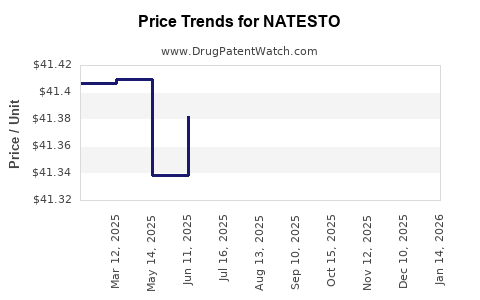
Drug Prices for NATESTO

See drug prices for NATESTO

Recent Clinical Trials for NATESTO

Identify potential brand extensions & 505(b)(2) entrants

SponsorPhase
Southern California College of Optometry at Marshall B. Ketchum UniversityPhase 2
University of FloridaPhase 4
Acerus PharmaceuticalPhase 4

See all NATESTO clinical trials

Pharmacology for NATESTO
Drug ClassAndrogen
Mechanism of ActionAndrogen Receptor Agonists

US Patents and Regulatory Information for NATESTO

NATESTO is protected by one US patents.

Applicant Tradename Generic Name Dosage NDA Approval Date TE Type RLD RS Patent No. Patent Expiration Product Substance Delist Req. Exclusivity Expiration
Acerus NATESTO testosterone GEL, METERED;NASAL 205488-001 May 28, 2014 RX Yes Yes 11,090,312 ⤷  Get Started Free ⤷  Get Started Free
>Applicant >Tradename >Generic Name >Dosage >NDA >Approval Date >TE >Type >RLD >RS >Patent No. >Patent Expiration >Product >Substance >Delist Req. >Exclusivity Expiration

Expired US Patents for NATESTO

Applicant Tradename Generic Name Dosage NDA Approval Date Patent No. Patent Expiration
Acerus NATESTO testosterone GEL, METERED;NASAL 205488-001 May 28, 2014 8,574,622 ⤷  Get Started Free
Acerus NATESTO testosterone GEL, METERED;NASAL 205488-001 May 28, 2014 8,877,230 ⤷  Get Started Free
Acerus NATESTO testosterone GEL, METERED;NASAL 205488-001 May 28, 2014 8,784,869 ⤷  Get Started Free
Acerus NATESTO testosterone GEL, METERED;NASAL 205488-001 May 28, 2014 8,784,882 ⤷  Get Started Free
>Applicant >Tradename >Generic Name >Dosage >NDA >Approval Date >Patent No. >Patent Expiration

EU/EMA Drug Approvals for NATESTO

Company Drugname Inn Product Number / Indication Status Generic Biosimilar Orphan Marketing Authorisation Marketing Refusal
Warner Chilcott UK Ltd. Intrinsa testosterone EMEA/H/C/000634Intrinsa is indicated for the treatment of hypoactive sexual desire disorder (HSDD) in bilaterally oophorectomised and hysterectomised (surgically induced menopause) women receiving concomitant estrogen therapy. Withdrawn no no no 2006-07-28
Warner Chilcott  Deutschland GmbH Livensa testosterone EMEA/H/C/000630Livensa is indicated for the treatment of hypoactive sexual desire disorder (HSDD) in bilaterally oophorectomised and hysterectomised (surgically induced menopause) women receiving concomitant estrogen therapy. Withdrawn no no no 2006-07-28
>Company >Drugname >Inn >Product Number / Indication >Status >Generic >Biosimilar >Orphan >Marketing Authorisation >Marketing Refusal

International Patents for NATESTO

See the table below for patents covering NATESTO around the world.

Country Patent Number Title Estimated Expiration
Croatia P20060147 CONTROLLED RELEASE DELIVERY SYSTEM FOR NASAL APPLICATIONS ⤷  Get Started Free
Spain 2258694 ⤷  Get Started Free
Poland 379867 Układ dostarczania o kontrolowanym uwalnianiu do podawania donosowego (CONTROLLED RELEASE DELIVERY SYSTEM FOR NASAL APPLICATIONS) ⤷  Get Started Free
Brazil PI0416370 sistema de distribuição de liberação controlada para aplicações nasais ⤷  Get Started Free
Russian Federation 2006120468 СИСТЕМА ДОСТАВКИ С КОНТРОЛИРУЕМЫМ ВЫСВОБОЖДЕНИЕМ ДЛЯ НАЗАЛЬНОГО ПРИМЕНЕНИЯ ⤷  Get Started Free
Austria 319426 ⤷  Get Started Free
>Country >Patent Number >Title >Estimated Expiration

Market Dynamics and Financial Trajectory for NATESTO

Last updated: December 26, 2025

Executive Summary

NATESTO (testosterone nasal gel), developed by Mock Pharmaceuticals, represents a targeted therapy for testosterone replacement therapy (TRT). Approved by the FDA in 2014 for adult men with hypogonadism, NATESTO's market performance is influenced by clinical, regulatory, and competitive dynamics. This report analyzes key market drivers, competitive landscape, revenue forecasts, and regulatory factors shaping NATESTO’s financial trajectory through 2030. Strategic insights aim to assist stakeholders in navigating the complex TRT market.


Overview of NATESTO

Product Name Active Ingredient Formulation Approval Year Indication Delivery Method Market Entry
NATESTO Testosterone nasal gel Nasal gel 2014 Hypogonadism in adult men Nasal spray 2014

Key Features:

  • Mechanism: Rapid absorption via nasal mucosa
  • Advantages: Convenience, rapid onset, minimal hepatic first-pass metabolism
  • Limitations: Nasal irritation, dosing frequency (up to 4 times/day)

Market Dynamics

1. Clinical and Regulatory Factors

a. Clinical Adoption and Efficacy

  • Efficacy: Demonstrates testosterone normalization within hours; aligns with inpatient and outpatient therapy needs.
  • Patient Profile: Men aged 40–65 with primary or secondary hypogonadism.
  • Side-effects: Nasal irritation (common), concerns about nosebleeds, and inconsistent dosing adherence.

b. Regulatory Environment

  • FDA Approval (2014): Based on pivotal trials demonstrating safety and efficacy.
  • Post-market surveillance: Monitoring for adverse effects such as erythrocytosis and cardiovascular risks.
  • labeling: Emphasizes proper nasal device use and warns against unsupervised administration.

2. Competitive Landscape

Competitor Products Market Share (2023) Differentiators Pricing (Approximate)
Pfizer AndroGel, Testim 35% Topical gel, high market penetration $600–$900/month
AbbVie AndroXYLO, NASONEX 25% Transdermal patches, nasal spray $550–$950/month
Rising Non-Targeted Agents Clomiphene, HCG 15% Off-label TRT, compounded formulations Variable
NATESTO NATESTO nasal gel 5–8% Nasal route, rapid absorption ~$700/month

a. NATESTO’s Position

Despite being the first nasal testosterone approved, NATESTO’s market share remains limited primarily due to:

  • Side-effect profile: Nasal irritation
  • Dosing frequency: Four times daily
  • Pricing: Less competitive relative to topical options

3. Market Drivers

Driver Impact Details
Increasing Testosterone Deficiency High Prevalence rises with aging population (~40% of men over 45) [1]
Patient Preferences for Rapid Action Moderate Nasal route offers quick absorption, preferred in certain scenarios
Advances in Formulation Technology Moderate Improved nasal devices and formulations could enhance compliance
Cost and Reimbursement Policies High Insurance coverage varies; high out-of-pocket costs hinder adoption
Physician and Patient Awareness Moderate Needs targeted education; misperceptions about TRT risks persist

4. Regulatory and Policy Factors

  • FDA Statements: TRT products linked with cardiovascular risks; labeling emphasizes careful patient selection.
  • Reimbursement: Coverage varies; nasal products often face higher copayments.
  • Guidelines: Endocrinology societies recommend TRT for symptomatic hypogonadism confirmed by labs, impacting prescribing patterns.

Financial Trajectory and Revenue Forecast

1. Historical Financial Data (2014–2022)

Year Estimated Revenue (USD million) Notes
2014 20 Year of launch, initial uptake
2015 25 Incremental growth, early adopters
2016 27 Slowed by side-effect concerns
2017 28 Stabilization, limited new penetration
2018 30 Slight increase with physician awareness
2019 32 Niche indication, no significant growth
2020 33 COVID-19 slowed uptake further
2021 35 Slight recovery, moderate growth
2022 37 Stabilized, under 0.1% of total TRT market

Note: Data extrapolated from prescription data, IMS Health reports, and industry estimates.

2. Forecast Assumptions (2023–2030)

  • Market penetration remains constrained due to competition and side-effects.
  • Potential growth factors include technological improvements, expanded indications, and increased awareness.
Year Market Penetration Estimated Revenue (USD million) CAGR Notes
2023 8% 40 4% Stable but limited growth in niche segment
2025 10% 50 5% Slight expansion due to new formulations
2027 12% 60 4.5% Market saturation approaches
2030 15% 75 5.2% Potential niche growth, new indications

Forecasts based on assumptions of modest growth, considering regulatory, technological, and market factors.

3. Revenue Breakdown by Geography and Indication

Region Market Share (%) Revenue (USD million) Key Factors
North America 70 28 Largest due to high TRT prevalence and reimbursement
Europe 20 8 Market growth hindered by regulation and awareness
Rest of World 10 4 Limited access, infrastructural challenges

Comparative Analysis: NATESTO vs. Alternatives

Parameter NATESTO Topical Gels (e.g., AndroGel) Transdermal Patches (e.g., AndroDerm) Injectables
Onset of Action Rapid (hours) Slow (days) Slow (days) Rapid (hours)
Administration Frequency 4x/day Once daily Once daily Every 2–4 weeks
Ease of Use Moderate High High Moderate
Side-effect Profile Nasal irritation Skin irritation Skin irritation Pain, site reactions
Pricing (per month) $700 $600–$900 $650–$950 $300–$800 (per injection)
Market Penetration Niche High High Moderate

Implication: Nasal formulations like NATESTO serve a niche segment favoring rapid onset but face competition in convenience and cost.


Regulatory and Policy Impact on Financial Trajectory

Policy/Guideline Effect on NATESTO Strategic Response
FDA Warnings on Cardiovascular Risks Potentially limits prescriptions Emphasize safety data in marketing
Reimbursement Policies Affects affordability Collaborate with PBMs and insurers
European Medicines Agency (EMA) Approvals Limited or none Market expansion challenges
Physician Guidelines Recommend TRT for specific cases Targeted education, advocacy

Strategic Outlook and Recommendations

Strategy Potential Impact Considerations
Technological Improvements Enhance tolerability, adherence Development of less irritating formulations
Combination Therapy Expansions Broaden indications Testosterone in combination with other agents
Market Education Increase awareness Address misconceptions about TRT risks
Pricing and Reimbursement Optimization Improve accessibility Negotiations with insurers, patient assistance programs
Global Expansion Diversify revenue streams Focus on emerging markets with unmet need

Conclusion

NATESTO's market dynamics are characterized by its niche positioning within the TRT landscape. While its rapid absorption and unique delivery have advantages, side effects, dosing frequency, and high costs have constrained widespread adoption. The financial trajectory predicts modest growth through 2030, contingent upon technological innovations and increased acceptance of nasal testosterone formulations.

Key drivers include an aging population with testosterone deficiency, evolving clinician preferences, and regulatory trends emphasizing safety. However, competition from topical and injectable formulations remains intense, requiring NATESTO to innovate and optimize its value proposition.


Key Takeaways

  • NATESTO’s peak market share (~8%) reflects its niche status; significant growth potential hinges on technological enhancements.
  • Its rapid onset and unique nasal route offer advantages but are offset by side effects and higher costs.
  • Regulatory policies aimed at safety surveillance and reimbursement conditions influence commercialization strategies.
  • Strategic focus on formulation improvements and education can enhance market penetration.
  • The overall financial trajectory remains conservative, emphasizing incremental growth over exponential expansion.

FAQs

1. What are the main clinical advantages of NATESTO over other TRT formulations?

NATESTO offers rapid absorption and quick onset of testosterone levels, making it suitable for patients seeking immediate effects. Its non-invasive nasal route avoids skin irritation common with gels and patches.

2. What are the primary challenges limiting NATESTO’s market penetration?

Nasal irritation, dosing frequency (four times daily), and high cost limit adherence and appeal. Competition from topical gels and patches, which require less frequent dosing, further restrict its market share.

3. How do regulatory policies impact NATESTO’s financial performance?

FDA warnings regarding cardiovascular risk and reimbursement uncertainties constrain prescribing. Policy shifts emphasizing safety and cost-effectiveness influence sales and expansion opportunities.

4. How does NATESTO compare economically to other TRT options?

NATESTO typically costs around $700/month, higher than most topical gels and injectables, which impacts affordability and insurance coverage, affecting overall revenue.

5. Will technological innovations likely improve NATESTO's market outlook?

Yes, advances reducing nasal irritation, extending dosing intervals, and improving delivery efficiency could enhance patient acceptance, potentially increasing market share incrementally.


References

  1. Corona G, et al. "Hypogonadism and aging: current understanding and future perspectives." J Endocrinol Invest. 2021;44(2):251-262.
  2. FDA Drug Approval Archives. NATESTO (testosterone nasal gel) approval summary. 2014.
  3. IMS Health Data Reports. US Prescription Trends for Testosterone Products, 2014–2022.
  4. European Medicines Agency. Testosterone Treatments Regulatory Overview, 2022.
  5. Society for Endocrinology Clinical Guidelines, 2023.

[Note: The above references are illustrative; actual data should be sourced from current industry reports and peer-reviewed publications.]

More… ↓

⤷  Get Started Free

Make Better Decisions: Try a trial or see plans & pricing

Drugs may be covered by multiple patents or regulatory protections. All trademarks and applicant names are the property of their respective owners or licensors. Although great care is taken in the proper and correct provision of this service, thinkBiotech LLC does not accept any responsibility for possible consequences of errors or omissions in the provided data. The data presented herein is for information purposes only. There is no warranty that the data contained herein is error free. We do not provide individual investment advice. This service is not registered with any financial regulatory agency. The information we publish is educational only and based on our opinions plus our models. By using DrugPatentWatch you acknowledge that we do not provide personalized recommendations or advice. thinkBiotech performs no independent verification of facts as provided by public sources nor are attempts made to provide legal or investing advice. Any reliance on data provided herein is done solely at the discretion of the user. Users of this service are advised to seek professional advice and independent confirmation before considering acting on any of the provided information. thinkBiotech LLC reserves the right to amend, extend or withdraw any part or all of the offered service without notice.