Share This Page
NAPHCON-A Drug Patent Profile
✉ Email this page to a colleague
When do Naphcon-a patents expire, and what generic alternatives are available?
Naphcon-a is a drug marketed by Alcon and is included in one NDA.
The generic ingredient in NAPHCON-A is naphazoline hydrochloride; pheniramine maleate. There is one drug master file entry for this compound. Eleven suppliers are listed for this compound. Additional details are available on the naphazoline hydrochloride; pheniramine maleate profile page.
DrugPatentWatch® Litigation and Generic Entry Outlook for Naphcon-a
A generic version of NAPHCON-A was approved as naphazoline hydrochloride; pheniramine maleate by ALTAIRE PHARMS INC on September 27th, 2010.
AI Deep Research
Questions you can ask:
- What is the 5 year forecast for NAPHCON-A?
- What are the global sales for NAPHCON-A?
- What is Average Wholesale Price for NAPHCON-A?
Summary for NAPHCON-A
| US Patents: | 0 |
| Applicants: | 1 |
| NDAs: | 1 |
| Finished Product Suppliers / Packagers: | 2 |
| Raw Ingredient (Bulk) Api Vendors: | 48 |
| DailyMed Link: | NAPHCON-A at DailyMed |
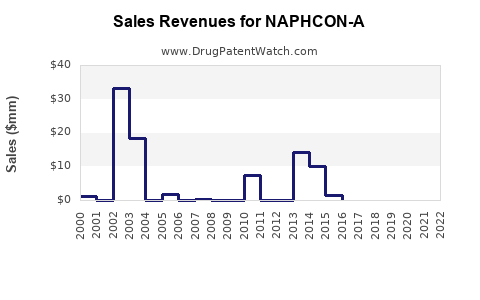
US Patents and Regulatory Information for NAPHCON-A
| Applicant | Tradename | Generic Name | Dosage | NDA | Approval Date | TE | Type | RLD | RS | Patent No. | Patent Expiration | Product | Substance | Delist Req. | Exclusivity Expiration |
|---|---|---|---|---|---|---|---|---|---|---|---|---|---|---|---|
| Alcon | NAPHCON-A | naphazoline hydrochloride; pheniramine maleate | SOLUTION/DROPS;OPHTHALMIC | 020226-001 | Jun 8, 1994 | OTC | Yes | Yes | ⤷ Start Trial | ⤷ Start Trial | ⤷ Start Trial | ||||
| >Applicant | >Tradename | >Generic Name | >Dosage | >NDA | >Approval Date | >TE | >Type | >RLD | >RS | >Patent No. | >Patent Expiration | >Product | >Substance | >Delist Req. | >Exclusivity Expiration |
Naphcon-A (Naphazoline + Pheniramine) Market Dynamics and Financial Trajectory: Sales Trends, Pricing, and Exclusivity Risks
Naphcon-A is a widely available, low-cost, over-the-counter (OTC) ophthalmic product for allergic conjunctivitis and eye redness. The market is shaped less by patent-driven pricing power and more by retail substitution, channel mix, and regulatory switching between branded and generic/house-brand equivalents. Financial trajectory expectations hinge on (1) OTC shelf velocity, (2) distribution breadth, (3) promotional intensity, and (4) ingredient-level competitive pressure rather than single-product exclusivity.
Bottom line: Naphcon-A’s commercial path is typically consistent with an OTC “mature/fragmented” profile: limited durable pricing leverage, recurring volume competition from generics and private label, and modest growth tied primarily to category demand rather than brand moat.
What drives Naphcon-A market share in OTC allergy eye drops?
Core demand signals for allergic conjunctivitis eye drops
Allergic conjunctivitis sales track seasonal allergy intensity, regional pollen patterns, and retail promotional calendars. Key drivers that typically move volume for Naphcon-A-like products:
- Seasonality: Stronger second and third quarters in many markets, depending on climate.
- Retail mix: Mass and warehouse club channels often command the largest volume; pharmacy concentrates on higher-income urban segments and bundle purchasing.
- Subcategory preference: “Redness relief” formulations compete with “antihistamine/mast cell stabilizer” options, with consumer choice influenced by perceived speed of relief.
Substitution dynamics
Naphcon-A contains naphazoline (vasoconstrictor) and pheniramine (antihistamine) in a classic “redness + allergy” combo pattern. Competitive substitution is high because:
- Multiple ophthalmic OTC SKUs use overlapping mechanisms (antihistamine, decongestant, dual-action, and “allergy relief” positioning).
- Generics and private label frequently mirror ingredient and dosing formats.
- Consumers and retailers can switch without prescription barriers.
Promotional intensity and trade terms
For mature OTC products, trade spend usually determines short-cycle market share:
- Retailers favor price-per-ounce value.
- Brand loyalty is typically weak relative to branded prescription products.
- Shelf placement and end-cap participation matter more than long-term brand equity.
How does Naphcon-A pricing evolve versus generic and private label?
Typical OTC pricing behavior for ingredient-combo eye drops
For products with widely available equivalents, branded pricing generally follows a “gravity model”:
- Initial branded premium narrows over time as competitors match ingredients and concentration.
- Price competition increases during post-season and when retailer promos shift focus to value SKUs.
- When new competitive entries appear (same actives, same dosage form), branded units often defend volume by trading margin for shelf presence.
What anchors ceiling price
Even when competition is intense, branded products sometimes retain a ceiling if they have:
- Strong packaging recognition,
- Retail distribution dominance,
- Faster sell-through and predictable reorder behavior,
- Consistent supply quality.
For Naphcon-A-style OTC, those factors generally limit downside more than they create upside.
What is Naphcon-A’s financial trajectory: revenue, margin, and growth phase?
Revenue trajectory pattern for mature OTC
Without patent exclusivity as a primary driver, revenue typically follows category demand with modest brand-specific lift:
- Baseline: Stable revenue with seasonal peaks.
- Growth: Driven by category volume (eye allergy season) and distribution gains.
- Net effect: Low mid-to-high single digit annual growth, often less, unless a competitor exits or the brand gains a promotion-heavy share push.
Margin trajectory
OTC margin pressure is typically structural:
- Gross margin erodes as retailers increase promotional frequency.
- Brand owners often mitigate with supply chain efficiency and SKU rationalization (not usually with major pricing hikes).
- Net margin depends on trade spend discipline, ad intensity, and logistics costs.
Earnings sensitivity
Profitability is sensitive to:
- Return rates and reverse logistics (seasonal demand shocks),
- Manufacturing cost changes (sterile/packaging inputs),
- Promotional ROI, since incremental unit economics degrade in price war periods.
What patents protect Naphcon-A and how do they shape exclusivity?
Exclusivity profile is usually weak for classic OTC ingredient combos
Naphcon-A is a mature ophthalmic OTC product built on older, well-established actives (naphazoline and pheniramine). The commercial relevance of patent estates for such products is typically low because:
- Many foundational patents have likely expired,
- Reformulation and method claims, if present, usually do not block generic-level competition at the ingredient level in OTC markets.
Where IP can still matter
Even when ingredient-level exclusivity is gone, IP can affect:
- Specific formulation (buffer systems, preservatives, viscosity agents),
- Packaging (device formats, multi-dose systems),
- Manufacturing process (sterility assurance methods).
For business modeling, that means Naphcon-A’s price and margin are less likely to be defended by hard exclusivity and more likely to be defended by distribution and brand execution.
When does Naphcon-A lose exclusivity or face generic entry risks?
OTC generic entry mechanics
In OTC ophthalmics, “generic entry risk” generally corresponds to:
- The availability of bioequivalent or substitutable equivalents,
- Labeling similarity accepted in retail formularies,
- Market tolerance for substitute SKUs.
Business impact
Once multiple equivalents occupy shelf space, brand owners face:
- Unit volume dilution,
- Trade-spend escalation to maintain share,
- Slower reorder rates and increased retailer bargaining power.
For most mature OTC combo eye drops, this entry risk is not a single date event. It is a continuing pressure as competing SKUs refresh package graphics, pricing, and channel strategy.
What is the Orange Book status of Naphcon-A?
Orange Book is typically not the primary constraint for OTC
Naphcon-A is an OTC product. The FDA Orange Book primarily covers approved drug products with NDC and lists patents for applications under the Hatch-Waxman framework. For OTC products, the listing pattern can vary by application type, and ingredient-combo products with legacy actives often show limited active patent listings that materially affect substitution.
Modeling implication: Assume exclusivity is not the principal driver of competitive risk for Naphcon-A. Competitive substitution is the dominant dynamic.
How strong is the patent estate for Naphcon-A: formulation, method, and label claims?
What “strong patent estate” would require for a mature OTC
For a mature OTC combo eye drop, a strong patent estate would typically include:
- Still-in-force composition claims tied to actives in a specific ratio,
- Still-in-force antimicrobial/preservative systems or buffer formulations,
- Still-in-force method-of-manufacturing controls that are specific enough to block indistinguishable generics,
- Still-in-force label-based method-of-use claims.
In practice for classic naphazoline/pheniramine products, those categories usually do not block generic shelf-level substitution long term. That shifts the competitive axis to pricing and retailer relationships.
What competitive products most affect Naphcon-A sales?
Mechanism-based competitive set
Naphcon-A’s consumer positioning overlaps with OTC:
- Decongestant redness relief (alpha-agonist style products),
- Antihistamine-only eye drops,
- Dual-action eye drops marketed for both itch/allergy and redness,
- Mast cell stabilizer or “non-decongestant” allergy eye drops.
Channel dynamics
- Pharmacy and online concentrate on convenience and brand familiarity.
- Mass and discount channels often optimize for price-per-unit and multi-buy promotions.
- Private label can outcompete if it matches perceived efficacy and provides similar consumer satisfaction.
How do FDA labeling and OTC compliance affect Naphcon-A commercialization?
OTC labeling and consumer usage behavior
Ophthalmic OTC products are subject to:
- Label language that controls consumer expectations,
- Directions limiting overuse risks (particularly for decongestant components).
- Packaging requirements that reduce dosing errors and improve compliance.
Commercial impact of warnings
If the label discourages prolonged use, that can:
- Limit repeat purchasing during extended seasons,
- Shift consumers toward alternatives with different safety profiles.
Naphcon-A-like decongestant components can face that behavioral constraint, which supports category switching.
What revenue exposure does Naphcon-A have to seasonal demand and retailer promotions?
Seasonality exposure
Allergic eye drops exhibit demand concentration:
- Stronger demand during allergy seasons,
- Weaker demand during low-allergen periods.
For finance planning, inventory build timing and promotion calendars determine whether the brand captures peak demand or loses it to competitors with better seasonal execution.
Promotion exposure
Retail promotions can change:
- Brand unit share quickly,
- Net revenue per unit through discounting,
- Net margin through trade allowances.
For mature OTC products, promotion elasticity is often high, meaning the revenue lift from discounts can be partially offset by reduced gross margin.
What litigation or settlements affect Naphcon-A (patent or regulatory)?
IP enforcement is usually not the dominant risk
For mature OTC products with long-established actives, litigation is typically less frequent than in biologics or branded prescription segments. Where disputes do arise, they are usually tied to:
- Specific formulation/process claims,
- Labeling or regulatory compliance,
- Trademark/brand identity disputes.
From a business planning standpoint, competitive substitution typically outweighs litigation risk in governing Naphcon-A’s financial path.
How does Naphcon-A compare with leading competitors on commercial durability?
Durability factors
Commercial durability in OTC ophthalmics depends on:
- Retail distribution depth,
- Consumer perception of speed and symptom relief,
- Packaging and brand recall,
- Consistent supply and forecast accuracy,
- Willingness of retailers to allocate shelf space during seasonal demand.
Where Naphcon-A is structurally disadvantaged
- OTC combo products with legacy actives often face fast shelf erosion as generics/private label proliferate.
- Without durable exclusivity, long-term brand premium is harder to sustain.
Key Takeaways
- Naphcon-A’s market dynamics are dominated by OTC substitution, retailer shelf economics, and seasonal allergy demand rather than patent-driven exclusivity.
- Financial trajectory for a mature OTC ophthalmic combo is typically stable-to-modest growth, with margin pressure from pricing and trade spend.
- Competitive risk is ongoing and channel-driven, not a single generic-entry event tied to a known exclusivity expiration.
- The practical “moat” is distribution and promotion execution, not enforceable long-tail IP.
FAQs
- Is Naphcon-A a prescription product or OTC, and how does that change competitive risk?
- Which competitive OTC ophthalmic categories are most likely to cannibalize Naphcon-A during peak allergy season?
- How do retailer promotions and trade allowances typically impact net margin for mature OTC eye drop brands?
- What consumer behavior factors (overuse warnings, perceived speed of relief) shift buyers away from decongestant-containing eye drops?
- How should investors model Naphcon-A revenue sensitivity to seasonality and inventory timing?
References
- FDA. Orange Book: Approved Drug Products with Therapeutic Equivalence Evaluations. https://www.accessdata.fda.gov/scripts/cder/daf/index.cfm
- U.S. FDA. OTC Drug Facts labeling regulations and guidance. https://www.fda.gov/drugs/over-counter-otc-and-cder/otc-drug-facts-labeling-requirements
More… ↓
