Last Updated: November 16, 2026

MULPLETA Drug Patent Profile

« Back to Dashboard


When do Mulpleta patents expire, and when can generic versions of Mulpleta launch?

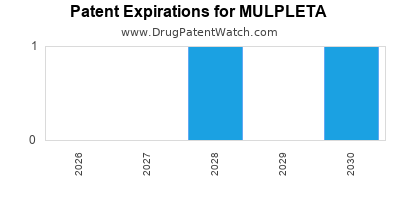
Mulpleta is a drug marketed by Vancocin Italia and is included in one NDA. There are three patents protecting this drug.

The generic ingredient in MULPLETA is lusutrombopag. There is one drug master file entry for this compound. Three suppliers are listed for this compound. Additional details are available on the lusutrombopag profile page.

DrugPatentWatch® Generic Entry Outlook for Mulpleta

Mulpleta was eligible for patent challenges on July 31, 2022.

By analyzing the patents and regulatory protections it appears that the earliest date for generic entry will be January 21, 2030. This may change due to patent challenges or generic licensing.

Indicators of Generic Entry

< Available with Subscription >

  Start Trial

AI Deep Research
Questions you can ask:
  • What is the 5 year forecast for MULPLETA?
  • What are the global sales for MULPLETA?
  • What is Average Wholesale Price for MULPLETA?
Summary for MULPLETA
DrugPatentWatch® Estimated Loss of Exclusivity (LOE) Date for MULPLETA
Generic Entry Date for MULPLETA*:
Constraining patent/regulatory exclusivity:
NDA:
Dosage:

TABLET;ORAL

*The generic entry opportunity date is the latter of the last compound-claiming patent and the last regulatory exclusivity protection. Many factors can influence early or later generic entry. This date is provided as a rough estimate of generic entry potential and should not be used as an independent source.

US Patents and Regulatory Information for MULPLETA

MULPLETA is protected by three US patents.

Based on analysis by DrugPatentWatch, the earliest date for a generic version of MULPLETA is ⤷  Start Trial.

This potential generic entry date is based on patent 8,530,668.

Generics may enter earlier, or later, based on new patent filings, patent extensions, patent invalidation, early generic licensing, generic entry preferences, and other factors.

Applicant Tradename Generic Name Dosage NDA Approval Date TE Type RLD RS Patent No. Patent Expiration Product Substance Delist Req. Exclusivity Expiration
Vancocin Italia MULPLETA lusutrombopag TABLET;ORAL 210923-001 Jul 31, 2018 RX Yes Yes 9,427,402 ⤷  Start Trial Y ⤷  Start Trial
Vancocin Italia MULPLETA lusutrombopag TABLET;ORAL 210923-001 Jul 31, 2018 RX Yes Yes 8,889,722 ⤷  Start Trial Y Y ⤷  Start Trial
Vancocin Italia MULPLETA lusutrombopag TABLET;ORAL 210923-001 Jul 31, 2018 RX Yes Yes 8,530,668 ⤷  Start Trial Y Y ⤷  Start Trial
>Applicant >Tradename >Generic Name >Dosage >NDA >Approval Date >TE >Type >RLD >RS >Patent No. >Patent Expiration >Product >Substance >Delist Req. >Exclusivity Expiration

EU/EMA Drug Approvals for MULPLETA

Company Drugname Inn Product Number / Indication Status Generic Biosimilar Orphan Marketing Authorisation Marketing Refusal
Shionogi B.V. Mulpleo (previously Lusutrombopag Shionogi) lusutrombopag EMEA/H/C/004720Mulpleo is indicated for the treatment of severe thrombocytopenia in adult patients with chronic liver disease undergoing invasive procedures Authorised no no no 2019-02-18
>Company >Drugname >Inn >Product Number / Indication >Status >Generic >Biosimilar >Orphan >Marketing Authorisation >Marketing Refusal

International Patents for MULPLETA

When does loss-of-exclusivity occur for MULPLETA?

Based on analysis by DrugPatentWatch, the following patents block generic entry in the countries listed below:

Australia

Patent: 08283357
Estimated Expiration: ⤷  Start Trial

Brazil

Patent: 0814891
Estimated Expiration: ⤷  Start Trial

Canada

Patent: 94567
Estimated Expiration: ⤷  Start Trial

China

Patent: 1809008
Estimated Expiration: ⤷  Start Trial

Patent: 3393678
Estimated Expiration: ⤷  Start Trial

Patent: 3396313
Estimated Expiration: ⤷  Start Trial

Patent: 3450110
Estimated Expiration: ⤷  Start Trial

Croatia

Patent: 0150062
Estimated Expiration: ⤷  Start Trial

Cyprus

Patent: 16190
Estimated Expiration: ⤷  Start Trial

Denmark

Patent: 84279
Estimated Expiration: ⤷  Start Trial

European Patent Office

Patent: 84279
Estimated Expiration: ⤷  Start Trial

France

Patent: C1043
Estimated Expiration: ⤷  Start Trial

Japan

Patent: 64181
Estimated Expiration: ⤷  Start Trial

Patent: 2009017098
Estimated Expiration: ⤷  Start Trial

Mexico

Patent: 10001082
Estimated Expiration: ⤷  Start Trial

Netherlands

Patent: 0998
Estimated Expiration: ⤷  Start Trial

Poland

Patent: 84279
Estimated Expiration: ⤷  Start Trial

Portugal

Patent: 84279
Estimated Expiration: ⤷  Start Trial

Russian Federation

Patent: 76429
Estimated Expiration: ⤷  Start Trial

Patent: 10107169
Estimated Expiration: ⤷  Start Trial

Slovenia

Patent: 84279
Estimated Expiration: ⤷  Start Trial

South Korea

Patent: 100027243
Estimated Expiration: ⤷  Start Trial

Spain

Patent: 28196
Estimated Expiration: ⤷  Start Trial

Taiwan

Patent: 0914000
Estimated Expiration: ⤷  Start Trial

Patent: 22371
Estimated Expiration: ⤷  Start Trial

Generics may enter earlier, or later, based on new patent filings, patent extensions, patent invalidation, early generic licensing, generic entry preferences, and other factors.

See the table below for additional patents covering MULPLETA around the world.

Country Patent Number Title Estimated Expiration
Australia 2004263442 Compounds having thrombopoietin receptor agonism ⤷  Start Trial
Canada 2535511 COMPOSES AGONISTES DU RECEPTEUR DE LA THROMBOPOIETINE (COMPOUNDS HAVING THROMBOPOIETIN RECEPTOR AGONISM) ⤷  Start Trial
China 102796058 Compound having thrombopoietin receptor agonism ⤷  Start Trial
>Country >Patent Number >Title >Estimated Expiration

Supplementary Protection Certificates for MULPLETA

Patent Number Supplementary Protection Certificate SPC Country SPC Expiration SPC Description
2184279 300998 Netherlands ⤷  Start Trial PRODUCT NAME: LUSUTROMBOPAG OF FARMACEUTISCH AANVAARDBARE ZOUTEN OF SOLVATEN DAARVAN; REGISTRATION NO/DATE: EU/1/18/1348 20190220
2184279 122019000065 Germany ⤷  Start Trial PRODUCT NAME: LUSUTROMBOPAG; REGISTRATION NO/DATE: EU/1/18/1348 20190218
2184279 2019C/534 Belgium ⤷  Start Trial PRODUCT NAME: LUSUTROMBOPAG OF EEN FARMACEUTISCH AANVAARDBAAR ZOUT OF SOLVAAT HIERVAN; AUTHORISATION NUMBER AND DATE: EU/1/18/1348 20190220
>Patent Number >Supplementary Protection Certificate >SPC Country >SPC Expiration >SPC Description

MULPLETA Market Dynamics and Financial Trajectory: Lusutrombopag Sales, Competition, Patents, and Generic Risk

Last updated: August 5, 2026

MULPLETA, the U.S. brand name for lusutrombopag, is a thrombopoietin receptor agonist marketed by Shionogi for adults with chronic liver disease and thrombocytopenia who are scheduled to undergo a procedure. Its commercial value is concentrated in a narrow procedural market rather than chronic platelet management. The product has a differentiated oral dosing profile, but its growth is constrained by limited treatment duration, hospital formulary control, competing platelet-raising agents, and the absence of separately reported product revenue in Shionogi’s public financial disclosures.

What is MULPLETA and what is it approved to treat?

MULPLETA contains lusutrombopag, an orally administered thrombopoietin receptor agonist. The FDA approved it in July 2018 for adults with chronic liver disease and thrombocytopenia scheduled to undergo a procedure. Treatment is administered once daily for seven days, with the procedure generally occurring between Days 9 and 14 after treatment begins.[1]

Attribute MULPLETA
Active ingredient Lusutrombopag
Drug class Oral thrombopoietin receptor agonist
U.S. sponsor Shionogi Inc.
U.S. indication Thrombocytopenia in adults with chronic liver disease scheduled for a procedure
FDA approval July 2018
Dosage 3 mg orally once daily for seven days
Primary commercial use Avoidance or reduction of platelet transfusion before procedures
Administration setting Primarily specialty, hospital, and procedural care
Biosimilar pathway Not applicable; MULPLETA is a small molecule

MULPLETA increases platelet production by activating the thrombopoietin receptor. It is not approved for routine long-term correction of thrombocytopenia or for emergency treatment of active bleeding. Its label carries warnings concerning portal vein and other thrombotic events, particularly in patients with chronic liver disease.[1]

How large is the MULPLETA market?

MULPLETA addresses a defined but limited patient population: adults with chronic liver disease, clinically significant thrombocytopenia, and an upcoming invasive procedure. The market is driven by the number of eligible procedures, platelet-transfusion practices, payer coverage, and treatment-site protocols.

The addressable market is narrower than the broader thrombocytopenia market for three reasons:

  1. The drug is used before a scheduled procedure.
  2. The seven-day regimen limits repeat and chronic use.
  3. Patients with very high thrombotic risk or other contraindications may not be suitable candidates.

The commercial opportunity is concentrated in hepatology, gastroenterology, interventional radiology, surgery, and transplant-related care. Hospitals and procedural centers often determine whether oral platelet-raising therapy is used instead of platelet transfusion.

The principal value proposition is operational. MULPLETA can reduce or avoid platelet transfusion and may reduce procedure delays associated with arranging blood products. The economic case depends on the cost of transfusion, the procedure’s urgency, local blood-bank capacity, and reimbursement policy.

How does MULPLETA compare with DOPTELET?

DOPTELET, or avatrombopag, is MULPLETA’s closest branded competitor in the U.S. market. Both products are oral thrombopoietin receptor agonists approved for thrombocytopenia in adults with chronic liver disease scheduled to undergo a procedure.

Factor MULPLETA DOPTELET
Active ingredient Lusutrombopag Avatrombopag
Manufacturer Shionogi Dova Pharmaceuticals, now within Sobi
FDA approval for CLD thrombocytopenia 2018 2018
Treatment schedule 3 mg daily for seven days Dose varies by baseline platelet count; generally five days
Platelet assessment Less dependent on dose adjustment by baseline count Baseline platelet count determines dose
Main use Planned procedures in chronic liver disease Planned procedures in chronic liver disease
Competitive distinction Simple fixed-dose regimen Shorter regimen and dose-based treatment
Biosimilar risk None None

The competitive decision is usually based on procedure timing, baseline platelet count, payer policy, physician familiarity, contract pricing, and institutional protocols. DOPTELET’s shorter treatment course can be commercially attractive where procedure scheduling is compressed. MULPLETA’s fixed-dose regimen can simplify prescribing and pharmacy operations.

Platelet transfusion remains a substitute, particularly when the procedure is urgent, the patient is admitted, or clinicians prefer immediate correction. Other thrombopoietin receptor agonists, including eltrombopag and romiplostim, are less direct substitutes because their approved uses, dosing patterns, or procedural indications differ.

What is the financial trajectory of MULPLETA?

Shionogi does not generally disclose MULPLETA revenue as a separate public line item in the company’s consolidated financial reporting. The product is included within broader categories of prescription medicines or products, depending on the reporting period and geographic segment.[2]

As a result, a reliable public year-by-year sales series for MULPLETA cannot be established from Shionogi’s standard annual reports alone. The financial trajectory is best assessed through commercial indicators rather than reported product revenue.

Financial driver Effect on MULPLETA
U.S. launch in 2018 Created a new branded oral option for procedure-related thrombocytopenia
DOPTELET competition Limited pricing power and increased formulary pressure
Narrow indication Restricts patient volume and repeat utilization
Seven-day course Limits cumulative treatment exposure per patient
Transfusion avoidance Supports value-based adoption in selected institutions
Lack of chronic indication Reduces recurring prescription volume
Specialty distribution Concentrates sales through controlled channels and procedural centers
Shionogi portfolio strategy Makes product-level capital allocation difficult to assess externally

MULPLETA is more likely to generate stable niche revenue than blockbuster-scale revenue. The product’s economics depend on maintaining access in treatment centers and securing reimbursement for a short, procedure-linked course. Its revenue base is less exposed to daily adherence than chronic medicines but more exposed to procedure volume and hospital purchasing decisions.

When does MULPLETA lose exclusivity?

MULPLETA’s U.S. market exclusivity is determined by several separate rights:

  • FDA regulatory exclusivity
  • Listed patents in the Orange Book
  • Unlisted or non-Orange-Book patent rights
  • Pediatric exclusivity, if granted
  • Hatch-Waxman litigation and settlement outcomes

The FDA approval in 2018 did not create a long-term biologic-style exclusivity period because lusutrombopag is a small molecule. The product is therefore exposed to ANDA-based generic competition once applicable patent and regulatory barriers have expired.

Public FDA materials establish the approval and labeling history, but an exact generic-entry date cannot be inferred from approval alone. A definitive date requires a current review of the FDA Orange Book, patent certifications filed by ANDA applicants, any Paragraph IV litigation, and settlement terms. The same analysis must distinguish patent expiry from the date on which a generic could actually launch.

What patents protect MULPLETA?

MULPLETA may be protected by composition, pharmaceutical formulation, manufacturing, and method-of-use rights. The commercial relevance of each category differs.

Composition patents

Composition patents generally provide the strongest protection because they cover the active molecule or a defined chemical class. Their value depends on claim scope, validity, terminal disclaimers, patent-term adjustment, and expiration.

Formulation patents

Formulation claims may cover tablet composition, excipients, dissolution, stability, or dosage characteristics. These patents can create additional litigation exposure for an ANDA applicant, but they are often narrower than composition claims and may be easier to design around.

Method-of-use patents

MULPLETA’s procedural indication creates potential method-of-use protection around increasing platelet counts in patients with chronic liver disease before an invasive procedure. An ANDA applicant may use a Paragraph IV certification, a Section viii statement, or labeling strategies that omit patented uses, depending on the scope of the listed claims.

Manufacturing patents

Manufacturing rights can cover intermediates, stereochemistry, crystallization, purification, or production processes. These rights may not block a conventional ANDA if the generic manufacturer can use a non-infringing process, but they can raise supply-chain and technical-development costs.

An accurate current patent table with patent numbers, expiration dates, assignees, and Orange Book status is not established by the FDA approval label or Shionogi’s general public financial reports. Treating an unverified patent number as a MULPLETA blocking patent would create material diligence risk.

Which companies are challenging MULPLETA with generics?

No publicly established, commercially material Paragraph IV challenge to MULPLETA can be confirmed from the core FDA label and Shionogi financial disclosures alone. Generic competition remains a future risk because lusutrombopag is a small molecule and can be pursued through the ANDA pathway.

A generic entrant would need to demonstrate pharmaceutical equivalence and bioequivalence, address any listed patents, and obtain approval for an appropriate label. The most likely challenge sequence would be:

  1. ANDA filing with Paragraph IV or Section viii certifications.
  2. Notice to the patent holder.
  3. Potential Hatch-Waxman litigation.
  4. A 30-month stay if statutory conditions are met.
  5. Settlement, licensed entry, or litigation-driven launch.
  6. Commercial entry after approval and the resolution of enforceable barriers.

What is the FDA and Orange Book status of MULPLETA?

The FDA approved MULPLETA in 2018, and the product remains regulated as an approved small-molecule prescription medicine. FDA labeling identifies the indication, dosing, warnings, and clinical-study results.[1]

Orange Book status is more dynamic than approval status. Patent listings, delistings, expiry calculations, pediatric extensions, and generic applications can change over time. The presence of a patent listing does not establish that the patent will survive litigation. Conversely, the absence of a public litigation record does not eliminate future Paragraph IV risk.

What patent litigation affects MULPLETA?

A material, publicly established MULPLETA patent litigation record is not identified in the core approval materials or Shionogi’s general financial reporting. This does not establish that no patent dispute exists in every jurisdiction. U.S. litigation risk would depend on the patents listed for the reference product and the certifications made by individual ANDA applicants.

The litigation risk is likely to center on:

  • Active-ingredient or composition claims
  • Procedure-related method-of-use claims
  • Formulation claims
  • Patent-term calculations
  • Carve-out labeling
  • Whether a generic launch would induce infringement

What licensing deals affect MULPLETA?

MULPLETA is primarily associated with Shionogi’s development and commercialization platform. No major third-party licensing transaction is required to explain its U.S. commercial position. Shionogi’s public corporate disclosures do not present a separately quantified MULPLETA royalty stream or a major external co-commercialization arrangement comparable to the licensing structures used for some other branded medicines.[2]

This reduces disclosure visibility. It also means that product economics are largely embedded in Shionogi’s consolidated pharmaceutical performance rather than reported as a transparent asset-level income statement.

What generic launch scenarios exist for MULPLETA?

Scenario 1: No near-term generic entry

A generic may not launch if no applicant files an ANDA, if patent protection remains enforceable, or if the market is too small to justify development and litigation costs.

Scenario 2: First generic entry after settlement

A Paragraph IV settlement could establish a future licensed-entry date. This scenario would preserve some branded revenue before entry while creating a defined erosion point.

Scenario 3: At-risk generic launch

An applicant could launch before final patent resolution if it accepts infringement risk. This would create the sharpest exposure to MULPLETA revenue, price, and formulary share.

Scenario 4: Limited substitution

Even after generic approval, substitution may be slower than in large retail markets because use is concentrated in hospitals, specialty pharmacies, and procedure centers. Institutional contracts and physician protocols can delay full conversion.

How strong is the MULPLETA commercial and patent estate?

Commercially, MULPLETA has moderate product differentiation but limited market breadth. Its fixed seven-day regimen and oral administration support adoption, while DOPTELET, platelet transfusion, and procedure-specific clinical practices constrain expansion.

The patent estate cannot be rated definitively without a current, claim-level review of U.S., European, Japanese, and other jurisdictional records. The most important diligence question is whether enforceable composition protection remains in force or whether the remaining barriers are limited to narrower formulation and method-of-use claims.

Geographically, Shionogi’s strongest strategic control is likely in Japan and the United States, where the company has established commercial infrastructure. Europe and other markets depend on country-specific approvals, reimbursement, patent terms, and local competitors.

Key Takeaways

  • MULPLETA is lusutrombopag, an oral thrombopoietin receptor agonist approved for adults with chronic liver disease and thrombocytopenia before a scheduled procedure.
  • Its market is specialized and procedure-driven, not a broad chronic thrombocytopenia market.
  • DOPTELET is the closest branded competitor and offers a shorter, platelet-count-dependent regimen.
  • Shionogi does not generally disclose MULPLETA revenue separately, preventing a reliable public product-level sales trajectory.
  • The product’s financial outlook depends on procedure volumes, hospital access, reimbursement, transfusion avoidance, and competition from DOPTELET.
  • MULPLETA is a small molecule and therefore has future ANDA and Paragraph IV exposure.
  • An exact U.S. patent-expiration and generic-entry date is not established by the FDA approval label or Shionogi’s general financial filings.
  • The principal commercial risk is not biosimilar substitution. It is conventional generic entry combined with institutional formulary switching.
  • The most valuable remaining IP would be enforceable composition protection. Narrower formulation or method-of-use patents would provide less durable protection.

FAQs about MULPLETA exclusivity, pricing, and competition

Is MULPLETA a biologic or a small-molecule drug?

MULPLETA is a small-molecule drug containing lusutrombopag. It is subject to the conventional generic-drug framework rather than the biosimilar pathway.

Can MULPLETA be used for chronic immune thrombocytopenia?

The FDA indication is thrombocytopenia in adults with chronic liver disease who are scheduled for a procedure. It is not approved as a general chronic treatment for immune thrombocytopenia.

What is the main substitute for MULPLETA?

The main branded substitute is DOPTELET, or avatrombopag. Platelet transfusion is the principal procedural alternative.

Does MULPLETA have biosimilar risk?

No. Biosimilars apply to biological products. MULPLETA’s relevant post-exclusivity threat is generic lusutrombopag.

Why are MULPLETA sales difficult to estimate?

Shionogi’s public financial reports generally do not provide a separate MULPLETA revenue line. Sales are embedded in broader product or pharmaceutical categories.

References

  1. U.S. Food and Drug Administration. (2018). Mulpleta (lusutrombopag) prescribing information. FDA.

  2. Shionogi & Co., Ltd. (2024). Annual report and financial results materials. Shionogi & Co., Ltd.

More… ↓

⤷  Start Trial

Make Better Decisions: Try a trial or see plans & pricing

Drugs may be covered by multiple patents or regulatory protections. All trademarks and applicant names are the property of their respective owners or licensors. Although great care is taken in the proper and correct provision of this service, thinkBiotech LLC does not accept any responsibility for possible consequences of errors or omissions in the provided data. The data presented herein is for information purposes only. There is no warranty that the data contained herein is error free. We do not provide individual investment advice. This service is not registered with any financial regulatory agency. The information we publish is educational only and based on our opinions plus our models. By using DrugPatentWatch you acknowledge that we do not provide personalized recommendations or advice. thinkBiotech performs no independent verification of facts as provided by public sources nor are attempts made to provide legal or investing advice. Any reliance on data provided herein is done solely at the discretion of the user. Users of this service are advised to seek professional advice and independent confirmation before considering acting on any of the provided information. thinkBiotech LLC reserves the right to amend, extend or withdraw any part or all of the offered service without notice.