Share This Page
MESTINON Drug Patent Profile
✉ Email this page to a colleague
When do Mestinon patents expire, and what generic alternatives are available?
Mestinon is a drug marketed by Bausch and is included in four NDAs.
The generic ingredient in MESTINON is pyridostigmine bromide. There is one drug master file entry for this compound. Twenty-one suppliers are listed for this compound. Additional details are available on the pyridostigmine bromide profile page.
DrugPatentWatch® Litigation and Generic Entry Outlook for Mestinon
A generic version of MESTINON was approved as pyridostigmine bromide by IMPAX LABS on April 24th, 2003.
AI Deep Research
Questions you can ask:
- What is the 5 year forecast for MESTINON?
- What are the global sales for MESTINON?
- What is Average Wholesale Price for MESTINON?
Summary for MESTINON
| US Patents: | 0 |
| Applicants: | 1 |
| NDAs: | 4 |
| Finished Product Suppliers / Packagers: | 2 |
| Raw Ingredient (Bulk) Api Vendors: | 125 |
| Clinical Trials: | 21 |
| Patent Applications: | 1,329 |
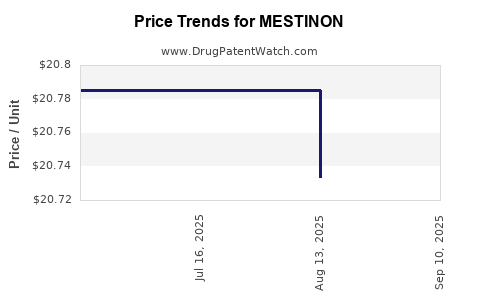
| Drug Prices: | Drug price information for MESTINON |
| What excipients (inactive ingredients) are in MESTINON? | MESTINON excipients list |
| DailyMed Link: | MESTINON at DailyMed |
Recent Clinical Trials for MESTINON
Identify potential brand extensions & 505(b)(2) entrants
| Sponsor | Phase |
|---|---|
| Open Medicine Foundation | PHASE2 |
| Brigham and Women's Hospital | PHASE2 |
| Eastern Virginia Medical School | Phase 4 |
Pharmacology for MESTINON
| Drug Class | Cholinesterase Inhibitor |
| Mechanism of Action | Cholinesterase Inhibitors |
US Patents and Regulatory Information for MESTINON
| Applicant | Tradename | Generic Name | Dosage | NDA | Approval Date | TE | Type | RLD | RS | Patent No. | Patent Expiration | Product | Substance | Delist Req. | Exclusivity Expiration |
|---|---|---|---|---|---|---|---|---|---|---|---|---|---|---|---|
| Bausch | MESTINON | pyridostigmine bromide | INJECTABLE;INJECTION | 009830-001 | Approved Prior to Jan 1, 1982 | AP | RX | Yes | Yes | ⤷ Start Trial | ⤷ Start Trial | ⤷ Start Trial | |||
| Bausch | MESTINON | pyridostigmine bromide | TABLET;ORAL | 009829-002 | Approved Prior to Jan 1, 1982 | AB | RX | Yes | Yes | ⤷ Start Trial | ⤷ Start Trial | ⤷ Start Trial | |||
| Bausch | MESTINON | pyridostigmine bromide | SYRUP;ORAL | 015193-001 | Approved Prior to Jan 1, 1982 | AA | RX | Yes | Yes | ⤷ Start Trial | ⤷ Start Trial | ⤷ Start Trial | |||
| Bausch | MESTINON | pyridostigmine bromide | TABLET, EXTENDED RELEASE;ORAL | 011665-001 | Approved Prior to Jan 1, 1982 | AB | RX | Yes | Yes | ⤷ Start Trial | ⤷ Start Trial | ⤷ Start Trial | |||
| >Applicant | >Tradename | >Generic Name | >Dosage | >NDA | >Approval Date | >TE | >Type | >RLD | >RS | >Patent No. | >Patent Expiration | >Product | >Substance | >Delist Req. | >Exclusivity Expiration |
Mestinon (Pyridostigmine) Market Dynamics, Patent Status, and Financial Trajectory
Mestinon is the branded form of pyridostigmine, an acetylcholinesterase inhibitor used primarily to manage myasthenia gravis. Its commercial profile is defined by mature-product economics: the core molecule is long off-patent, multiple generic manufacturers compete in the United States, and the brand has limited ability to sustain premium pricing. Standalone Mestinon revenue is not publicly reported by its current commercial owner, so financial analysis relies on product status, prescription-market structure, and disclosed company-level results rather than a verified brand-sales figure.
What is Mestinon and how is pyridostigmine used?
Mestinon contains pyridostigmine bromide and is approved in the United States for the symptomatic treatment of myasthenia gravis. The product is marketed in several oral dosage forms:
| Product | Strength or form | Principal use | U.S. regulatory status |
|---|---|---|---|
| Mestinon tablets | 60 mg | Myasthenia gravis | Approved prescription product |
| Mestinon Timespan | 180 mg extended-release tablet | Longer-duration symptomatic treatment | Approved prescription product |
| Mestinon syrup | 60 mg per 5 mL | Oral liquid treatment | Approved prescription product |
| Generic pyridostigmine bromide | Tablets, extended-release tablets, and oral solution | Primarily myasthenia gravis | Approved abbreviated and supplemental products |
Pyridostigmine improves neuromuscular transmission by inhibiting acetylcholinesterase. It does not modify the autoimmune cause of myasthenia gravis and is generally used as symptomatic therapy alongside immunosuppressive or other disease-management treatments.
The product is also used in certain military and occupational settings as a pretreatment against nerve-agent exposure, but that use is distinct from the principal outpatient pharmaceutical market. The FDA-approved labeling identifies myasthenia gravis as the core indication for Mestinon products (U.S. Food and Drug Administration [FDA], 2023).
When did Mestinon lose exclusivity?
Mestinon lost meaningful composition-of-matter exclusivity decades ago. Pyridostigmine was developed and commercialized long before the modern Hatch-Waxman framework, and the present U.S. market is a mature generic market.
There is no practical basis for treating Mestinon as a patent-protected growth product. The commercial barriers are instead:
- physician familiarity with the branded product;
- availability and continuity of generic supply;
- dosage-form preferences;
- pharmacy substitution;
- contracts with wholesalers, hospitals, and payers;
- manufacturing economics for a relatively low-volume prescription drug.
The United States grants five years of new chemical entity exclusivity for qualifying new active ingredients, but that framework does not create a current exclusivity period for pyridostigmine. No current regulatory exclusivity period is generally associated with the established Mestinon products.
Mestinon exclusivity timeline
| Event | Approximate timing | Commercial effect |
|---|---|---|
| Pyridostigmine developed and introduced | Mid-20th century | Originator commercialization |
| Mestinon established in myasthenia gravis | Historical | Brand recognition and clinical adoption |
| Core patent protection | Expired many years ago | Generic entry became possible |
| Generic pyridostigmine approvals | Long established | Price and share pressure on brand |
| Current market | Mature | Limited brand pricing power and low growth |
What patents protect Mestinon?
The core active ingredient, pyridostigmine bromide, is not protected by a current composition-of-matter patent in the United States. The primary intellectual-property value of Mestinon is therefore historical rather than patent-driven.
Potentially relevant patent categories include:
- Extended-release formulation patents. These could cover release-control mechanisms, tablet matrices, coating systems, or dosing profiles. Any enforceable patents would need to be evaluated against the specific generic product and the FDA Orange Book.
- Manufacturing patents. Process patents may cover synthesis, purification, crystallization, or formulation steps. Such patents are generally less visible commercially than product claims and may be difficult to enforce against an independently developed process.
- Method-of-use patents. A patent could theoretically claim a particular dosing regimen or patient population. The commercial value of such claims would depend on FDA labeling, prescriber behavior, and the ability to enforce divided or induced infringement.
- Trade dress and trademarks. "Mestinon" remains a brand identifier, but trademark rights do not prevent approval or sale of therapeutically equivalent pyridostigmine products.
What is the Orange Book status of Mestinon?
Mestinon products are legacy FDA-approved products. The key commercial question is whether an active Orange Book patent listing blocks or delays an abbreviated new drug application. For an old product such as pyridostigmine, the principal tablet and liquid presentations do not carry the type of current, high-value patent estate associated with newer branded drugs.
Orange Book review should be performed by NDA and dosage form because patent listings can differ between immediate-release tablets, extended-release tablets, and oral solution. The FDA Orange Book identifies approved products, reference listed drugs, patent information, and exclusivity data where applicable (FDA, 2024a).
The absence of a material current patent barrier means generic applicants generally face an ANDA pathway rather than a commercially significant Paragraph IV campaign.
Are there Paragraph IV challenges to Mestinon?
Paragraph IV litigation is not a central feature of the current Mestinon market. A Paragraph IV certification is relevant when an ANDA applicant asserts that a listed patent is invalid, unenforceable, or not infringed. That mechanism is most commercially significant when the reference product has active, valuable Orange Book patents.
For pyridostigmine, generic competition has been established for many years. The main competitive issues are therefore supply, pricing, formulation substitution, and market access rather than a new wave of patent challenges.
| Litigation issue | Current commercial relevance |
|---|---|
| Core molecule patent challenge | Low; protection is historical and expired |
| Immediate-release generic entry | Established |
| Extended-release formulation challenge | Product-specific; potentially relevant if a listing exists |
| Method-of-use litigation | Limited practical relevance |
| Settlement-driven delayed generic entry | No widely recognized current market event driving Mestinon economics |
A definitive litigation review would require docket-level searches across U.S. district courts, the Federal Circuit, and individual ANDA filings. Public company disclosures do not identify Mestinon as a major current patent-litigation asset.
What is the FDA regulatory status of Mestinon?
Mestinon is an FDA-approved prescription drug. Pyridostigmine products have a long clinical and regulatory history, and the active ingredient is supported by extensive post-market use.
The key FDA regulatory features are:
- Reference product status: Mestinon products function as reference products for generic competition where the applicable dosage form and strength have been approved.
- Generic substitution: State substitution rules and payer formularies typically favor generic pyridostigmine when therapeutically equivalent products are available.
- Extended-release differentiation: Timespan may retain some prescribing value because dosing frequency and release characteristics differ from immediate-release tablets.
- Safety monitoring: Common adverse effects reflect cholinergic activity, including gastrointestinal symptoms, increased secretions, muscle cramping, and bradycardia risk in susceptible patients.
- Label limitations: The approved labeling is centered on myasthenia gravis, while other uses may be off-label or governed by separate government procurement decisions.
The FDA’s Orange Book and Drugs@FDA databases are the primary sources for current approval, reference-product, and patent-listing information (FDA, 2024a; FDA, 2024b).
How many companies compete with Mestinon?
The U.S. market includes the branded product and several generic pyridostigmine suppliers. Availability varies by strength, dosage form, manufacturer, pharmacy wholesaler, and periodic supply conditions.
Typical competitors include:
- generic pyridostigmine bromide tablet manufacturers;
- generic extended-release tablet manufacturers;
- generic oral-solution suppliers;
- specialty and hospital distributors;
- the branded Mestinon supplier.
The number of approved ANDAs does not equal the number of active commercial suppliers. Some approved products may be discontinued, intermittently supplied, or limited to selected channels. The competitive market is better characterized as a multi-supplier generic market than as a two-product branded-versus-generic contest.
How does Mestinon compare with generic pyridostigmine?
| Factor | Mestinon | Generic pyridostigmine |
|---|---|---|
| Active ingredient | Pyridostigmine bromide | Pyridostigmine bromide |
| FDA pathway | Original or legacy NDA | ANDA or applicable supplemental pathway |
| Price | Usually higher | Usually lower |
| Prescriber familiarity | High | High and increasing |
| Payer preference | Often weaker | Usually stronger |
| Supply economics | Brand-specific | Manufacturer and wholesaler dependent |
| Patent protection | No meaningful core exclusivity | No core patent barrier |
| Differentiation | Brand, packaging, dosage-form recognition | Price, availability, contract access |
Generic products can capture substantial volume even when the brand retains a residual share among patients and physicians who prefer a consistent product or experience changes after substitution.
What formulations are protected by Mestinon?
Mestinon’s most commercially relevant formulation distinction is Timespan, an extended-release 180 mg tablet. The extended-release product can support a narrower differentiation strategy because patients may value less frequent dosing or a specific release profile.
That distinction does not automatically create durable exclusivity. A generic extended-release product can compete if it demonstrates bioequivalence under the applicable FDA requirements. The commercial value of the formulation depends on:
- the number of approved generic extended-release products;
- prescriber willingness to switch patients;
- pharmacy substitution rules;
- reimbursement differentials;
- supply reliability;
- whether patients use immediate-release and extended-release products interchangeably.
Immediate-release 60 mg tablets are more exposed to commodity-style generic competition because the product is simple, familiar, and widely substitutable. Oral solution may have a smaller patient population but can encounter different manufacturing and supply constraints.
How strong is the Mestinon patent estate?
The Mestinon patent estate is weak as a current exclusivity asset and moderate only as a brand and formulation franchise.
| Patent-estate category | Assessment |
|---|---|
| Composition of matter | Expired or commercially irrelevant |
| Core product patent | No material current barrier identified |
| Immediate-release tablet | Low protection |
| Extended-release tablet | Potentially more differentiated, but not equivalent to broad exclusivity |
| Oral solution | Low patent-based protection |
| Manufacturing know-how | Possible operational value |
| Method of use | Limited value unless tied to enforceable, approved claims |
| Trademark and brand | Residual commercial value |
| Regulatory exclusivity | No meaningful current period |
The strongest practical defenses are not patent claims. They are manufacturing consistency, supply-chain execution, product familiarity, and patient retention.
What is the financial trajectory for Mestinon?
Standalone Mestinon revenue is not separately disclosed in the public financial reporting of its commercial owner. The product is typically included within broader pharmaceutical portfolios, and reported company results do not provide a reliable product-level revenue series.
The financial trajectory can therefore be summarized as follows:
Historical phase: branded product economics
Mestinon historically benefited from:
- established clinical demand;
- limited treatment alternatives for symptomatic relief;
- strong physician recognition;
- long-term use by patients with chronic myasthenia gravis;
- recurring prescription volume.
The brand could generate durable cash flow because treatment is often chronic and the patient population is clinically defined.
Generic-entry phase: price compression
Generic entry changed the revenue model. Volume may remain stable or grow with diagnosis and treatment prevalence, but the originator’s realized price and market share decline as:
- pharmacy substitution increases;
- payers impose lower copay tiers for generics;
- wholesalers prioritize contracted generic supply;
- hospitals and integrated delivery networks use formulary controls;
- patients accept therapeutically equivalent alternatives.
Mature phase: low-growth, supply-sensitive market
The current market is likely characterized by:
- low unit growth;
- low or negative price growth for the branded product;
- stable demand linked to myasthenia gravis prevalence;
- limited ability to raise prices without accelerating substitution;
- revenue sensitivity to shortages and distributor inventory;
- residual brand sales concentrated in loyal or clinically stable users.
Financial trajectory summary
| Metric | Expected direction |
|---|---|
| Total pyridostigmine demand | Stable to modest growth |
| Branded Mestinon volume share | Downward or stable at a low residual level |
| Branded net price | Downward pressure |
| Generic volume | Stable to increasing |
| Generic pricing | Competitive and volatile |
| Gross margin for brand | Potentially attractive if manufacturing costs are low |
| Revenue visibility | Limited because standalone results are not disclosed |
| Growth investment case | Weak without a new formulation or distribution strategy |
The underlying disease market can grow even while Mestinon brand revenue declines. That distinction is important: patient demand and brand economics are not the same metric.
What market factors could affect Mestinon revenue?
Myasthenia gravis treatment evolution
Newer therapies, including complement inhibitors, FcRn-targeted therapies, biologics, and immunosuppressive regimens, may reduce reliance on symptomatic treatment for some patients. Mestinon remains useful because it is inexpensive, familiar, orally administered, and often used across disease severities.
The impact of newer therapies is mixed. Patients receiving advanced immunomodulatory treatment may still use pyridostigmine, while some may reduce or discontinue symptomatic therapy after improved disease control.
Generic pricing and supply
Supply interruptions can temporarily improve branded demand if generic products become unavailable. The opposite occurs when multiple generic suppliers compete aggressively and maintain high pharmacy availability.
Formulation mix
Timespan and oral solution can create narrower commercial niches than immediate-release tablets. The value of those niches depends on the number of approved equivalents and payer treatment.
Distribution and contracting
Mestinon’s residual demand is influenced by:
- specialty pharmacy policies;
- Medicare Part D formulary placement;
- Medicaid reimbursement;
- hospital purchasing;
- national pharmacy chain substitution;
- direct contracting and wholesaler inventory.
Regulatory changes
Changes in FDA requirements for legacy drugs, manufacturing inspections, labeling, or drug-shortage management could affect the cost and reliability of supply. These factors are more relevant than patent expiry because the primary patent expiry event occurred long ago.
Which companies are challenging Mestinon commercially?
The main challengers are generic pyridostigmine manufacturers rather than branded pharmaceutical innovators. Competition is fragmented and may change as companies enter or leave the market.
The principal competitive groups are:
- Generic manufacturers, which compete on acquisition cost and supply.
- Contract manufacturers, which may support private-label or distributor products.
- The brand owner, which competes through product continuity and physician recognition.
- Advanced myasthenia gravis therapy companies, which compete indirectly by reducing patients’ need for symptomatic therapy.
No single competing drug fully replaces pyridostigmine across the entire market. The principal threat to Mestinon is substitution by equivalent generic pyridostigmine, not direct replacement by one branded product.
What licensing deals affect Mestinon?
No major recent licensing transaction is widely associated with Mestinon as a standalone strategic asset. The product has historically changed hands as part of broader pharmaceutical portfolios or commercial-rights transactions rather than through a high-value, product-specific licensing model.
The absence of a visible licensing market reflects the product’s mature economics:
- no meaningful composition-of-matter exclusivity;
- limited price expansion;
- numerous generic alternatives;
- modest strategic value relative to newer specialty medicines;
- operational value concentrated in manufacturing and distribution.
Any current rights analysis should distinguish among NDA ownership, trademark ownership, manufacturing rights, U.S. commercial rights, and international distribution rights. Those rights may not reside with the same entity.
What generic entry risks exist for Mestinon?
Generic entry risk is already realized for Mestinon rather than prospective. The residual risks are incremental:
- further price erosion;
- additional generic approvals;
- loss of preferred formulary placement;
- substitution from Timespan to lower-cost alternatives;
- supply-driven share loss;
- generic manufacturers discontinuing low-margin presentations;
- patient switching caused by pharmacy-level substitution.
A realistic launch scenario for a new generic would be rapid market access if no blocking patent or exclusivity period applies. The likely commercial outcome would be share capture through price and supply contracts, not a prolonged litigation-led launch delay.
What is the geographic coverage of Mestinon?
Mestinon and pyridostigmine products are marketed in multiple countries, but commercial conditions differ materially by jurisdiction.
| Region | Market structure |
|---|---|
| United States | Brand plus established generic competition; payer substitution is important |
| European Union | National reimbursement systems, generic penetration, and country-specific approvals |
| United Kingdom | Generic prescribing and NHS procurement exert strong price pressure |
| Japan | Distinct regulatory and reimbursement environment; local product and manufacturer dynamics |
| Emerging markets | Variable access, local manufacturing, and public procurement influence share |
| Military procurement markets | Separate demand drivers and government contracting |
International revenue cannot be inferred from U.S. prescription volume. Brand ownership, product names, approved strengths, and dosage forms may differ across markets.
What manufacturing and intellectual-property barriers remain?
Manufacturing is a more credible barrier than patent protection. Pyridostigmine is an established small molecule, but suppliers must maintain:
- validated active pharmaceutical ingredient production;
- consistent tablet potency;
- stable extended-release performance;
- acceptable dissolution profiles;
- reliable packaging and serialization;
- FDA-compliant quality systems;
- supply continuity for low-volume presentations.
Extended-release manufacturing can impose more technical requirements than immediate-release tablets. Oral solution production requires control of concentration, microbial quality, stability, and packaging.
These barriers can protect a supplier from rapid competitive entry, but they do not create the same economic moat as a valid blocking patent. They primarily affect supply reliability and cost.
Key Takeaways
- Mestinon is the branded pyridostigmine product used mainly for symptomatic treatment of myasthenia gravis.
- The active ingredient and core product protection are long expired.
- The U.S. market is mature and includes established generic pyridostigmine competition.
- Mestinon’s strongest differentiation is brand recognition and, to a lesser extent, the Timespan extended-release formulation.
- No current patent estate is apparent that would support meaningful broad exclusivity for the brand.
- Paragraph IV litigation is not the primary commercial issue.
- Standalone Mestinon revenue is not publicly disclosed, preventing a verified brand-specific sales trajectory.
- The product’s financial profile is likely stable to declining for the brand, with generic substitution offsetting disease-market growth.
- Newer myasthenia gravis biologics and targeted therapies create indirect substitution risk but do not eliminate pyridostigmine’s role.
- Manufacturing quality, supply continuity, payer contracting, and pharmacy substitution are more important than patent enforcement.
FAQs
Is Mestinon still under patent?
No material current composition-of-matter or broad product patent protection is associated with pyridostigmine. Any formulation-specific patent analysis must be performed by dosage form and jurisdiction.
Is pyridostigmine the same drug as Mestinon?
Yes. Mestinon is a branded product containing pyridostigmine bromide. Generic pyridostigmine products are intended to be therapeutically equivalent when approved for the same dosage form and strength.
Can a generic manufacturer launch pyridostigmine without waiting for a patent settlement?
Generally, established generic products do not face the type of delayed launch risk associated with newly patented branded drugs. The relevant issue is the current FDA approval and Orange Book status of the specific reference product.
Does Timespan have stronger commercial protection than Mestinon tablets?
Timespan has greater formulation differentiation because it is extended release. That does not necessarily mean it has active blocking patents or durable exclusivity. Generic extended-release competition remains the key risk.
Could new myasthenia gravis biologics eliminate Mestinon demand?
They could reduce pyridostigmine use in some patients, particularly those achieving better disease control with targeted therapies. Low cost, oral administration, clinical familiarity, and broad symptomatic utility support continued demand.
References
-
U.S. Food and Drug Administration. (2023). Mestinon pyridostigmine bromide prescribing information. FDA.
-
U.S. Food and Drug Administration. (2024a). Approved drug products with therapeutic equivalence evaluations: Orange Book. FDA.
-
U.S. Food and Drug Administration. (2024b). Drugs@FDA: FDA-approved drugs database. FDA.
-
U.S. Food and Drug Administration. (2024c). Electronic Orange Book patent and exclusivity information. FDA.
-
National Organization for Rare Disorders. (2024). Myasthenia gravis. NORD.
-
U.S. Securities and Exchange Commission. (2024). Public company filings and pharmaceutical product revenue disclosures. SEC.
More… ↓
