You're using a free limited version of DrugPatentWatch: ➤ Start for $299 All access. No Commitment.

Last Updated: December 28, 2025

MAYZENT Drug Patent Profile


✉ Email this page to a colleague

« Back to Dashboard


When do Mayzent patents expire, and what generic alternatives are available?

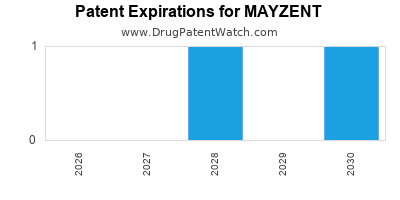
Mayzent is a drug marketed by Novartis and is included in one NDA. There are four patents protecting this drug and one Paragraph IV challenge.

This drug has one hundred and ninety-four patent family members in forty-five countries.

The generic ingredient in MAYZENT is siponimod. One supplier is listed for this compound. Additional details are available on the siponimod profile page.

DrugPatentWatch® Generic Entry Outlook for Mayzent

Mayzent was eligible for patent challenges on March 26, 2023.

By analyzing the patents and regulatory protections it appears that the earliest date for generic entry will be August 27, 2028. This may change due to patent challenges or generic licensing.

There has been one patent litigation case involving the patents protecting this drug, indicating strong interest in generic launch. Recent data indicate that 63% of patent challenges are decided in favor of the generic patent challenger and that 54% of successful patent challengers promptly launch generic drugs.

There are two tentative approvals for the generic drug (siponimod), which indicates the potential for near-term generic launch.

Indicators of Generic Entry

< Available with Subscription >

  Get Started Free

AI Deep Research
Questions you can ask:
  • What is the 5 year forecast for MAYZENT?
  • What are the global sales for MAYZENT?
  • What is Average Wholesale Price for MAYZENT?
Drug patent expirations by year for MAYZENT
Drug Prices for MAYZENT

See drug prices for MAYZENT

DrugPatentWatch® Estimated Loss of Exclusivity (LOE) Date for MAYZENT
Generic Entry Date for MAYZENT*:
Constraining patent/regulatory exclusivity:
NDA:
Dosage:
TABLET;ORAL

*The generic entry opportunity date is the latter of the last compound-claiming patent and the last regulatory exclusivity protection. Many factors can influence early or later generic entry. This date is provided as a rough estimate of generic entry potential and should not be used as an independent source.

Recent Clinical Trials for MAYZENT

Identify potential brand extensions & 505(b)(2) entrants

SponsorPhase
Robert Zivadinov, MD, PhDPhase 4
Novartis PharmaceuticalsPhase 4
Novartis PharmaceuticalsPhase 3

See all MAYZENT clinical trials

Pharmacology for MAYZENT
Paragraph IV (Patent) Challenges for MAYZENT
Tradename Dosage Ingredient Strength NDA ANDAs Submitted Submissiondate
MAYZENT Tablets siponimod 0.25 mg, 1 mg and 2 mg 209884 5 2023-03-27

US Patents and Regulatory Information for MAYZENT

MAYZENT is protected by four US patents and one FDA Regulatory Exclusivity.

Based on analysis by DrugPatentWatch, the earliest date for a generic version of MAYZENT is ⤷  Get Started Free.

This potential generic entry date is based on patent ⤷  Get Started Free.

Generics may enter earlier, or later, based on new patent filings, patent extensions, patent invalidation, early generic licensing, generic entry preferences, and other factors.

Applicant Tradename Generic Name Dosage NDA Approval Date TE Type RLD RS Patent No. Patent Expiration Product Substance Delist Req. Exclusivity Expiration
Novartis MAYZENT siponimod TABLET;ORAL 209884-001 Mar 26, 2019 RX Yes No ⤷  Get Started Free ⤷  Get Started Free ⤷  Get Started Free
Novartis MAYZENT siponimod TABLET;ORAL 209884-003 Aug 24, 2021 RX Yes No ⤷  Get Started Free ⤷  Get Started Free ⤷  Get Started Free
Novartis MAYZENT siponimod TABLET;ORAL 209884-001 Mar 26, 2019 RX Yes No ⤷  Get Started Free ⤷  Get Started Free Y ⤷  Get Started Free
>Applicant >Tradename >Generic Name >Dosage >NDA >Approval Date >TE >Type >RLD >RS >Patent No. >Patent Expiration >Product >Substance >Delist Req. >Exclusivity Expiration

Supplementary Protection Certificates for MAYZENT

Patent Number Supplementary Protection Certificate SPC Country SPC Expiration SPC Description
2379069 132020000000076 Italy ⤷  Get Started Free PRODUCT NAME: SIPONIMOD(MAYZENT ); AUTHORISATION NUMBER(S) AND DATE(S): EU/1/19/1414, 20200115
2379069 2020017 Norway ⤷  Get Started Free PRODUCT NAME: SIPONIMOD; REG. NO/DATE: EU/1/19/1414 20200127
2379069 CA 2020 00026 Denmark ⤷  Get Started Free PRODUCT NAME: SIPONIMOD; REG. NO/DATE: EU/1/19/1414 20200115
>Patent Number >Supplementary Protection Certificate >SPC Country >SPC Expiration >SPC Description

Market Dynamics and Financial Trajectory for MAYZENT (Siponimod): A Comprehensive Analysis

Last updated: July 27, 2025

Introduction

MAYZENT (siponimod) is an oral sphingosine-1-phosphate (S1P) receptor modulator approved for the treatment of secondary progressive multiple sclerosis (SPMS) in adults. Since its FDA approval in March 2019, MAYZENT has increasingly influenced the neurological disease therapeutics market. Understanding the evolving market dynamics and financial trajectory of MAYZENT involves analyzing factors such as its competitive positioning, clinical efficacy, regulatory landscape, pricing strategies, and the broader multiple sclerosis (MS) market trends.

Market Landscape for Multiple Sclerosis Treatments

Multiple sclerosis (MS) remains a significant global health challenge, with over 2.8 million affected individuals worldwide, and the market is projected to reach approximately USD 29 billion by 2026 [1]. The MS treatment market is characterized by a diverse portfolio of disease-modifying therapies (DMTs), including injectable agents, oral drugs like siponimod, and imminently, emerging therapies with novel mechanisms of action.

Within this landscape, oral S1P receptor modulators, including MAYZENT, have gained prominence for their convenience and efficacy profiles, challenging traditional injectable therapies. The competition includes drugs such as Gilenya (fingolimod), Ozanimod, and Ponesimod, all of which modulate immune response by targeting S1P receptors.

Market Dynamics Influencing MAYZENT

1. Clinical Efficacy and Approval Milestones

MAYZENT's primary advantage stems from its targeted activity in secondary progressive MS (SPMS), a stage previously limited in approved treatment options. The Phase III EXPAND trial demonstrated that MAYZENT significantly slowed disability progression compared with placebo [2], reinforcing its position as a first-in-class therapy for SPMS. This clinical success expanded the drug's potential market, positioning it as a specialized agent for a previously underserved patient subset.

Regulatory milestones have solidified MAYZENT’s market presence. The European Medicines Agency (EMA) approved it in September 2019, with subsequent approvals in Japan and other markets, broadening commercial opportunities.

2. Competitive Positioning and Market Share

Despite being a pioneering oral S1P modulator, MAYZENT faces fierce competition from newer agents, notably Ozanimod (sold as Zeposia), which benefits from a broader indication profile that includes relapsing-remitting MS (RRMS). Ozanimod's more favorable side effect profile and extensive marketing have allowed it to gain considerable market share [3].

Gilenya, the original S1P modulator, remains a strong competitor but has faced declining use due to safety concerns and routes of administration. Ponesimod, another promising agent, is in late-stage development, further intensifying the competitive environment.

3. Pricing Strategy and Market Penetration

Pricing remains a critical factor influencing healthcare providers' adoption. Mayzent’s list price in the U.S. was approximately USD 7,500 per month (as of 2022), positioning it within a high-value segment but also prompting payor scrutiny [4]. Reimbursement policies, insurance coverage, and regional pricing negotiations directly impact sales volume, especially in price-sensitive markets.

Patient access programs and patient assistance initiatives help expand the drug’s reach, thereby increasing prescriptions and revenue streams.

4. Regulatory and Safety Profiles

MAYZENT's safety profile, notably its cardiovascular effects, necessitates careful patient screening, which could limit prescription in some patient populations. These safety considerations influence prescribing behavior, impacting market penetration and long-term sales growth.

Regulatory agencies continue to monitor post-marketing safety data, which could influence usage patterns, especially if new adverse events are identified.

5. Market Expansion and Label Expansion Opportunities

The potential expansion of MAYZENT's label to include additional indications, such as early-stage MS or other neurodegenerative conditions, could substantially influence the financial trajectory. Additionally, exploring combination therapies and biosimilar development could further enhance market penetration.

Financial Trajectory and Revenue Projections

Current Performance and Revenue

Since its initial launch, MAYZENT has experienced steady sales growth. In 2021, Sanofi reported that Mayzent generated over EUR 350 million in revenue globally [5]. The United States remains the largest market, accounting for approximately 65-70% of sales, driven by the high prevalence of SPMS and established reimbursement pathways.

Forecasting Future Revenue

Analysts project that MAYZENT’s sales could reach USD 1 billion by 2025-2026, contingent upon several factors:

  • Market Penetration: Expansion into earlier MS stages or other neuroinflammatory diseases could broaden its user base.
  • Competitive Dynamics: Gilenya’s expected decline in market share due to safety and convenience considerations paves the way for MAYZENT to capture more patients.
  • Pricing and Access Strategies: Enhanced patient support and strategic pricing negotiations will influence revenue growth.
  • Regulatory Advances: Approval for additional indications or formulations will act as catalysts.

Potential Challenges

Market saturation, the emergence of next-generation S1P receptor modulators, and evolving safety profiles could temper growth. Additionally, patent expirations and generic entry, although unlikely in the near term, could influence pricing power.

Strategic Outlook

The overarching strategy for MAYZENT revolves around leveraging its efficacy in SPMS, expanding indications responsibly, and differentiating through safety and convenience advantages. Pharmaceutical companies may also pursue lifecycle management programs such as sustained-release formulations and combination therapies.

Continued investment in real-world evidence generation will underpin clinical confidence and reimbursement stability, further shaping its financial trajectory.

Key Market Drivers & Risks

Drivers Risks
Demonstrated efficacy in SPMS Competition from newer agents
Broadening global approvals Safety concerns impacting prescribing
Advantageous dosing regimen Regulatory delays or restrictions
Strategic reimbursement negotiations Patent expirations or biosimilar entry

Conclusion

MAYZENT’s market dynamics hinge on its clinical success, competitive positioning, pricing strategies, and broader MS market trends. While it enjoys a strong foothold in SPMS treatment, its future financial trajectory depends on public health policies, competitive innovations, and ongoing clinical data. As MS treatments evolve, MAYZENT must adapt to maintain and grow its market share, ultimately contributing to its long-term revenue stability.


Key Takeaways

  • MAYZENT benefits from targeted approval for SPMS, a niche with limited prior treatment options, underpinning solid market potential.
  • The drug competes primarily with Ozanimod and Gilenya; its success relies on differentiating safety, efficacy, and ease of use.
  • Pricing and reimbursement strategies critically influence sales trajectory amid cost-sensitive healthcare systems.
  • Expansion into additional indications and formulations presents growth opportunities but requires strategic regulatory and clinical steps.
  • The competitive landscape’s evolution, safety considerations, and patent protections will shape MAYZENT’s revenue outlook through 2026.

FAQs

1. How does MAYZENT differ from other S1P receptor modulators?
MAYZENT selectively modulates S1P receptor subtypes 1 and 5, offering targeted efficacy in SPMS with a safety profile that emphasizes cardiovascular monitoring. Its selectivity differentiates it from earlier agents like Gilenya, which affect multiple receptor subtypes and have broader side effects.

2. What markets are the most critical for MAYZENT’s future sales?
The United States remains the primary market due to its large SPMS patient population and reimbursement infrastructure. European markets, especially Germany and France, are also significant, with expanding approvals bolstering growth prospects.

3. Can MAYZENT be used in relapsing-remitting MS (RRMS)?
Currently, MAYZENT is approved predominantly for SPMS. There is ongoing research into its potential use in RRMS, but regulatory approval for broader MS stages remains to be achieved.

4. What are the main safety considerations for prescribing MAYZENT?
Patients require screening for cardiovascular risk factors before initiation. Common side effects include headache, hypertension, and elevated liver enzymes. Serious adverse events, such as bradyarrhythmia, necessitate close monitoring during treatment initiation.

5. How might biosimilar or generic entry affect MAYZENT’s market share?
Given that MAYZENT is a small-molecule oral therapy with patent protections, generic entry is unlikely in the near term. However, increased competition from newer branded agents could influence market share, emphasizing the importance of clinical differentiation and strategic pricing.


Sources

  1. MS International Federation. (2022). Global MS Data.
  2. Mann, R. et al. (2019). "Siponimod in SPMS: Results from the EXPAND trial." New England Journal of Medicine.
  3. Zeposia FDA Briefing Document. (2020). FDA.
  4. Sanofi. (2022). Mayzent pricing and reimbursement details.
  5. Sanofi Annual Report. (2021).

More… ↓

⤷  Get Started Free

Make Better Decisions: Try a trial or see plans & pricing

Drugs may be covered by multiple patents or regulatory protections. All trademarks and applicant names are the property of their respective owners or licensors. Although great care is taken in the proper and correct provision of this service, thinkBiotech LLC does not accept any responsibility for possible consequences of errors or omissions in the provided data. The data presented herein is for information purposes only. There is no warranty that the data contained herein is error free. We do not provide individual investment advice. This service is not registered with any financial regulatory agency. The information we publish is educational only and based on our opinions plus our models. By using DrugPatentWatch you acknowledge that we do not provide personalized recommendations or advice. thinkBiotech performs no independent verification of facts as provided by public sources nor are attempts made to provide legal or investing advice. Any reliance on data provided herein is done solely at the discretion of the user. Users of this service are advised to seek professional advice and independent confirmation before considering acting on any of the provided information. thinkBiotech LLC reserves the right to amend, extend or withdraw any part or all of the offered service without notice.