Last Updated: November 5, 2026

MAYZENT Drug Patent Profile


✉ Email this page to a colleague

« Back to Dashboard


When do Mayzent patents expire, and what generic alternatives are available?

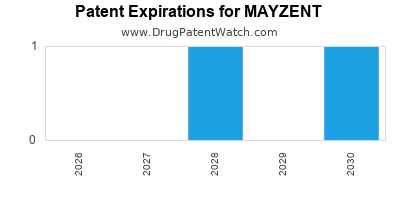
Mayzent is a drug marketed by Novartis and is included in one NDA. There are five patents protecting this drug and one Paragraph IV challenge.

The generic ingredient in MAYZENT is siponimod. There is one drug master file entry for this compound. One supplier is listed for this compound. Additional details are available on the siponimod profile page.

DrugPatentWatch® Generic Entry Outlook for Mayzent

Mayzent was eligible for patent challenges on March 26, 2023.

By analyzing the patents and regulatory protections it appears that the earliest date for generic entry will be January 5, 2032. This may change due to patent challenges or generic licensing.

There have been two patent litigation cases involving the patents protecting this drug, indicating strong interest in generic launch. Recent data indicate that 63% of patent challenges are decided in favor of the generic patent challenger and that 54% of successful patent challengers promptly launch generic drugs.

There are two tentative approvals for the generic drug (siponimod), which indicates the potential for near-term generic launch.

Indicators of Generic Entry

< Available with Subscription >

  Start Trial

AI Deep Research
Questions you can ask:
  • What is the 5 year forecast for MAYZENT?
  • What are the global sales for MAYZENT?
  • What is Average Wholesale Price for MAYZENT?
DrugPatentWatch® Estimated Loss of Exclusivity (LOE) Date for MAYZENT
Generic Entry Date for MAYZENT*:
Constraining patent/regulatory exclusivity:
NDA:
Dosage:

TABLET;ORAL

*The generic entry opportunity date is the latter of the last compound-claiming patent and the last regulatory exclusivity protection. Many factors can influence early or later generic entry. This date is provided as a rough estimate of generic entry potential and should not be used as an independent source.

Recent Clinical Trials for MAYZENT

Identify potential brand extensions & 505(b)(2) entrants

SponsorPhase
Robert Zivadinov, MD, PhDPhase 4
Novartis PharmaceuticalsPhase 4
Novartis PharmaceuticalsPhase 3

See all MAYZENT clinical trials

Pharmacology for MAYZENT
Paragraph IV (Patent) Challenges for MAYZENT
Tradename Dosage Ingredient Strength NDA ANDAs Submitted Submissiondate
MAYZENT Tablets siponimod 0.25 mg, 1 mg and 2 mg 209884 5 2023-03-27

US Patents and Regulatory Information for MAYZENT

MAYZENT is protected by five US patents.

Based on analysis by DrugPatentWatch, the earliest date for a generic version of MAYZENT is ⤷  Start Trial.

This potential generic entry date is based on patent ⤷  Start Trial.

Generics may enter earlier, or later, based on new patent filings, patent extensions, patent invalidation, early generic licensing, generic entry preferences, and other factors.

Applicant Tradename Generic Name Dosage NDA Approval Date TE Type RLD RS Patent No. Patent Expiration Product Substance Delist Req. Exclusivity Expiration
Novartis MAYZENT siponimod TABLET;ORAL 209884-001 Mar 26, 2019 RX Yes No ⤷  Start Trial ⤷  Start Trial ⤷  Start Trial
Novartis MAYZENT siponimod TABLET;ORAL 209884-003 Aug 24, 2021 RX Yes No ⤷  Start Trial ⤷  Start Trial ⤷  Start Trial
Novartis MAYZENT siponimod TABLET;ORAL 209884-001 Mar 26, 2019 RX Yes No ⤷  Start Trial ⤷  Start Trial Y Y ⤷  Start Trial
Novartis MAYZENT siponimod TABLET;ORAL 209884-002 Mar 26, 2019 RX Yes Yes ⤷  Start Trial ⤷  Start Trial ⤷  Start Trial
>Applicant >Tradename >Generic Name >Dosage >NDA >Approval Date >TE >Type >RLD >RS >Patent No. >Patent Expiration >Product >Substance >Delist Req. >Exclusivity Expiration

International Patents for MAYZENT

When does loss-of-exclusivity occur for MAYZENT?

Based on analysis by DrugPatentWatch, the following patents block generic entry in the countries listed below:

Argentina

Patent: 4801
Estimated Expiration: ⤷  Start Trial

Patent: 4662
Estimated Expiration: ⤷  Start Trial

Australia

Patent: 12204835
Estimated Expiration: ⤷  Start Trial

Brazil

Patent: 2013017302
Estimated Expiration: ⤷  Start Trial

Canada

Patent: 23616
Estimated Expiration: ⤷  Start Trial

Chile

Patent: 13001979
Estimated Expiration: ⤷  Start Trial

China

Patent: 3458877
Estimated Expiration: ⤷  Start Trial

Colombia

Patent: 61402
Estimated Expiration: ⤷  Start Trial

Croatia

Patent: 0191842
Estimated Expiration: ⤷  Start Trial

Cyprus

Patent: 22182
Estimated Expiration: ⤷  Start Trial

Denmark

Patent: 61261
Estimated Expiration: ⤷  Start Trial

Ecuador

Patent: 13012812
Estimated Expiration: ⤷  Start Trial

Eurasian Patent Organization

Patent: 6144
Estimated Expiration: ⤷  Start Trial

Patent: 1391018
Estimated Expiration: ⤷  Start Trial

European Patent Office

Patent: 61261
Estimated Expiration: ⤷  Start Trial

Patent: 90507
Estimated Expiration: ⤷  Start Trial

Guatemala

Patent: 1300178
Estimated Expiration: ⤷  Start Trial

Hungary

Patent: 45612
Estimated Expiration: ⤷  Start Trial

Israel

Patent: 7094
Estimated Expiration: ⤷  Start Trial

Japan

Patent: 11202
Estimated Expiration: ⤷  Start Trial

Patent: 24569
Estimated Expiration: ⤷  Start Trial

Patent: 14501770
Estimated Expiration: ⤷  Start Trial

Patent: 17141248
Estimated Expiration: ⤷  Start Trial

Jordan

Patent: 19
Estimated Expiration: ⤷  Start Trial

Lithuania

Patent: 61261
Estimated Expiration: ⤷  Start Trial

Malaysia

Patent: 1162
Estimated Expiration: ⤷  Start Trial

Mexico

Patent: 7304
Estimated Expiration: ⤷  Start Trial

Patent: 1290
Estimated Expiration: ⤷  Start Trial

Patent: 13007909
Estimated Expiration: ⤷  Start Trial

Morocco

Patent: 897
Estimated Expiration: ⤷  Start Trial

New Zealand

Patent: 2420
Estimated Expiration: ⤷  Start Trial

Peru

Patent: 140216
Estimated Expiration: ⤷  Start Trial

Philippines

Patent: 013501442
Estimated Expiration: ⤷  Start Trial

Poland

Patent: 61261
Estimated Expiration: ⤷  Start Trial

Portugal

Patent: 61261
Estimated Expiration: ⤷  Start Trial

Singapore

Patent: 1286
Estimated Expiration: ⤷  Start Trial

Slovenia

Patent: 61261
Estimated Expiration: ⤷  Start Trial

South Africa

Patent: 1304465
Estimated Expiration: ⤷  Start Trial

South Korea

Patent: 1951966
Estimated Expiration: ⤷  Start Trial

Patent: 2166885
Estimated Expiration: ⤷  Start Trial

Patent: 140037815
Estimated Expiration: ⤷  Start Trial

Patent: 190025727
Estimated Expiration: ⤷  Start Trial

Spain

Patent: 51920
Estimated Expiration: ⤷  Start Trial

Taiwan

Patent: 1249438
Estimated Expiration: ⤷  Start Trial

Patent: 1609092
Estimated Expiration: ⤷  Start Trial

Patent: 83380
Estimated Expiration: ⤷  Start Trial

Patent: 10672
Estimated Expiration: ⤷  Start Trial

Tunisia

Patent: 13000257
Estimated Expiration: ⤷  Start Trial

Ukraine

Patent: 4283
Estimated Expiration: ⤷  Start Trial

Generics may enter earlier, or later, based on new patent filings, patent extensions, patent invalidation, early generic licensing, generic entry preferences, and other factors.

See the table below for additional patents covering MAYZENT around the world.

Country Patent Number Title Estimated Expiration
Canada 2973540 TRAITEMENT DE MALADIE AUTO-IMMUNE CHEZ UN PATIENT RECEVANT EN OUTRE UN BETABLOQUANT (TREATMENT OF AUTOIMMUNE DISEASE IN A PATIENT RECEIVING ADDITIONALLY A BETA-BLOCKER) ⤷  Start Trial
World Intellectual Property Organization (WIPO) 2016135644 ⤷  Start Trial
Argentina 084801 ⤷  Start Trial
Argentina 124662 ⤷  Start Trial
>Country >Patent Number >Title >Estimated Expiration

Supplementary Protection Certificates for MAYZENT

Patent Number Supplementary Protection Certificate SPC Country SPC Expiration SPC Description
2379069 301046 Netherlands ⤷  Start Trial PRODUCT NAME: SIPONIMOD; REGISTRATION NO/DATE: EU/1/19/1414 20200115
2379069 CA 2020 00026 Denmark ⤷  Start Trial PRODUCT NAME: SIPONIMOD; REG. NO/DATE: EU/1/19/1414 20200115
2379069 122020000025 Germany ⤷  Start Trial PRODUCT NAME: SIPONIMOD; REGISTRATION NO/DATE: EU/1/19/1414 20200113
2379069 LUC00160 Luxembourg ⤷  Start Trial PRODUCT NAME: SIPONIMOD; AUTHORISATION NUMBER AND DATE: EU/1/19/1414 20200115
>Patent Number >Supplementary Protection Certificate >SPC Country >SPC Expiration >SPC Description

Mayzent Market Dynamics, Patent Exclusivity, and Financial Trajectory

Last updated: August 19, 2026

Mayzent, the brand name for siponimod, is a Novartis oral sphingosine-1-phosphate receptor modulator approved for adults with active secondary progressive multiple sclerosis (SPMS). Its commercial position depends on a narrow but clinically important indication, a first-mover advantage in active SPMS, and continued differentiation from broader multiple sclerosis therapies. Novartis reported Mayzent sales growth after launch, but the product faces competitive pressure from Ocrevus, Kesimpta, Briumvi, Ponvory, Zeposia, generic fingolimod, and other disease-modifying therapies.

The principal commercial issue is the size and treatment rate of the active-SPMS population. The principal legal issue is the remaining U.S. patent estate after Mayzent’s five-year new chemical entity exclusivity ended in March 2024. No biosimilar pathway applies because siponimod is a synthetic small molecule.

What is Mayzent and how does siponimod work?

Mayzent contains siponimod, an oral selective modulator of sphingosine-1-phosphate receptor subtypes 1 and 5. The drug reduces lymphocyte migration from lymphoid tissue and has central nervous system activity relevant to multiple sclerosis. The FDA approved Mayzent on March 26, 2019, for adults with active SPMS, defined by relapses or imaging evidence of inflammatory disease activity (FDA, 2024a).

Unlike treatments approved for relapsing forms of multiple sclerosis, Mayzent’s U.S. label specifically addresses active SPMS. That positioning gives Novartis access to a clinically differentiated population, but the label does not cover all nonactive SPMS patients.

What clinical evidence supports Mayzent?

The approval was based primarily on the EXPAND study, a randomized Phase 3 trial in patients with SPMS. Siponimod reduced the risk of three-month confirmed disability progression compared with placebo in the overall study population. The treatment effect was more pronounced in patients with active SPMS, which became the basis for the U.S. indication (Kappos et al., 2018).

Mayzent requires CYP2C9 genotype testing before initiation. Patients with certain CYP2C9 genotypes are unsuitable for treatment because of altered siponimod exposure. The drug also requires dose titration and has contraindications and warnings involving cardiac conduction, macular edema, liver function, infections, and fetal risk (FDA, 2024a).

What is the FDA regulatory status of Mayzent?

Mayzent is FDA-approved and commercially marketed in the United States. Its regulatory milestones are:

Milestone Date
FDA approval March 26, 2019
U.S. indication Adults with active SPMS
Active ingredient Siponimod
Dosage form Oral tablets
NCE exclusivity Approximately March 2019 to March 2024
Biosimilar pathway Not applicable
Generic pathway Abbreviated New Drug Application, or ANDA

The approval did not create orphan-drug exclusivity because multiple sclerosis is not an orphan disease in the United States. Mayzent’s initial regulatory protection therefore came principally from its NCE status, listed patents, and any applicable pediatric or regulatory extensions.

When does Mayzent lose exclusivity?

Mayzent’s five-year NCE exclusivity expired in March 2024, assuming no regulatory extension altered the date. NCE exclusivity prevents FDA approval of an ANDA or 505(b)(2) application that relies on the drug’s reference product during the exclusivity period. It does not prevent independent approval of a full new drug application.

Patent protection can extend beyond NCE exclusivity. The relevant commercial question is the earliest date on which a generic applicant can both obtain FDA approval and launch without violating enforceable patent claims or a settlement agreement.

What patents protect Mayzent?

Mayzent’s protection is based on a combination of compound, pharmaceutical composition, dosing, and method-of-use claims. The exact Orange Book listing and expiration analysis should be performed against the current FDA database because patent listings and expiration dates can change through corrections, terminal disclaimers, pediatric extensions, or litigation outcomes.

The principal patent categories are:

Patent category Commercial purpose Generic risk
Siponimod compound patents Protect the active pharmaceutical ingredient and related chemical forms Highest barrier if valid and unexpired
Pharmaceutical composition patents Protect tablet formulations and excipient combinations Potentially avoidable through formulation design
Dosing and titration patents Protect treatment initiation or dose-adjustment regimens May be avoided by label carving or alternative instructions
Method-of-use patents Protect treatment of SPMS or particular patient populations Vulnerable to skinny-label strategies
Manufacturing and process patents Protect synthesis, purification, or solid-state forms Can delay development but may not block all generic entry

Publicly available patent records associate siponimod protection with Novartis entities and related research organizations. The most important diligence source for U.S. launch timing is the current FDA Orange Book listing, followed by USPTO prosecution records and any Paragraph IV litigation docket.

What is the Orange Book status of Mayzent?

The Orange Book determines which patents Novartis has listed against the reference product and identifies the regulatory exclusivity framework relevant to ANDA applicants. For Mayzent, the key distinction is between:

  1. Patents that claim siponimod itself.
  2. Patents that claim formulations or dosage forms.
  3. Patents that claim methods of treating multiple sclerosis or SPMS.
  4. Patents that may be challenged through a Paragraph IV certification.

An ANDA applicant can certify that a listed patent has expired, will expire before commercial marketing, is not infringed, or is invalid. A Paragraph IV notice gives the brand company 45 days to file an infringement action. A timely lawsuit can trigger a 30-month stay of FDA approval, subject to statutory exceptions and court decisions.

No broad public record through mid-2024 established a major Mayzent Paragraph IV litigation campaign comparable to the litigation surrounding larger multiple sclerosis brands such as Gilenya. That absence does not eliminate generic risk. Generic applicants may remain in confidential development, pursue non-infringement positions, or wait for patent expiration without triggering a public dispute.

What Mayzent patent litigation affects generic entry?

The main litigation risks concern whether generic applicants challenge:

  • The validity of the core compound patent.
  • The scope of claims covering siponimod polymorphs or salts.
  • Formulation claims covering the commercial tablet.
  • Method-of-use claims covering active SPMS.
  • Any patent listed after the original approval date.

A generic applicant may seek approval with a label that omits patented indications or dosing instructions. This strategy, known as a skinny label, is more viable when the core compound patent has expired and the remaining patents cover only methods of use.

For Novartis, formulation and method patents are commercially useful because they can extend protection beyond the active-ingredient patent. Their practical strength is lower if a generic can demonstrate bioequivalence using a different formulation or market a label that omits the protected use.

How strong is the Mayzent patent estate?

Mayzent’s patent estate is strategically meaningful but less durable than estates built around multiple high-value formulation platforms, long-acting delivery systems, or biologic manufacturing controls.

Strengths

  • A differentiated active-SPMS indication creates method-of-use value.
  • Siponimod’s pharmacogenomic dosing requirements may complicate development and labeling.
  • Tablet formulation claims can create a secondary barrier after compound protection expires.
  • The commercial product has a defined titration schedule and patient-selection process.

Weaknesses

  • Mayzent is a small molecule, so generic substitution is technically feasible.
  • NCE exclusivity has expired.
  • Formulation claims may be designed around.
  • Method-of-use claims may be avoided through a narrower label.
  • The product competes with therapies that are approved across broader multiple sclerosis populations.

The estate is strongest when the core active-ingredient patent remains enforceable. It becomes materially weaker when only formulation, dosing, or method-of-use claims remain.

How has Mayzent revenue developed?

Mayzent revenue grew from a low post-launch base as neurologists adopted siponimod for active SPMS and Novartis expanded payer and clinical awareness. Novartis reported the following approximate annual sales trajectory in its financial reporting:

Year Mayzent sales
2019 Initial launch year
2020 Approximately $272 million
2021 Approximately $480 million
2022 Approximately $600 million
2023 Approximately $780 million

Sources report results in U.S. dollars and may present growth on a constant-currency basis. Novartis financial statements should control for audited annual totals and currency presentation (Novartis, 2021, 2022, 2023).

The pattern indicates a product that reached meaningful scale but remained below the multibillion-dollar revenue level of leading broad-population multiple sclerosis therapies. The revenue base reflects the narrower active-SPMS label, competition from high-efficacy agents, and the limited size of the addressable population.

What drives Mayzent revenue?

Mayzent sales depend on:

  • The number of patients diagnosed with active SPMS.
  • Neurologist willingness to use disease-modifying treatment after transition from relapsing disease.
  • Payer coverage and prior-authorization criteria.
  • Acceptance of CYP2C9 testing.
  • Persistence and adherence with oral treatment.
  • Switching from other disease-modifying therapies.
  • The extent to which physicians use broader-label competitors before or after SPMS progression.

The product has a commercial advantage in oral administration and an indication directly associated with active SPMS. It has a disadvantage against therapies with stronger familiarity, broader labels, larger sales forces, or established treatment pathways.

How does Mayzent compare with competing multiple sclerosis drugs?

Drug Company Route Key competitive position
Mayzent Novartis Oral Approved for active SPMS; CYP2C9-guided dosing
Ocrevus Roche/Genentech Intravenous Broad use in relapsing MS and primary progressive MS
Kesimpta Novartis Subcutaneous High-growth self-administered anti-CD20 therapy
Briumvi TG Therapeutics Intravenous Anti-CD20 competitor for relapsing MS
Ponvory Johnson & Johnson Oral S1P modulator for relapsing forms of MS
Zeposia Bristol Myers Squibb Oral S1P modulator for relapsing MS
Gilenya Novartis and generics Oral Established S1P product with generic competition
Mavenclad Merck KGaA Oral Short-course immune reconstitution approach

Mayzent competes most directly with high-efficacy therapies used in patients with active disease. It also competes indirectly with products that prevent or delay progression before patients reach active SPMS.

Kesimpta creates a particularly important internal Novartis comparison. Kesimpta has a broader relapsing-MS opportunity and has been one of Novartis’s fastest-growing products. Internal portfolio decisions may favor Kesimpta in earlier-line or broader populations, while Mayzent remains focused on active SPMS.

What generic entry risks exist for Mayzent?

Generic entry risk is low during any period in which a valid, enforceable compound patent blocks approval or launch. Risk rises in stages:

Near-term risk

After NCE exclusivity expiration, ANDA applicants can submit applications and challenge listed patents. This creates regulatory and litigation risk even before approval.

Mid-term risk

If compound protection expires or is invalidated, generic applicants may target the tablet formulation and seek approval with a label excluding patented methods of use.

Launch risk

The first successful Paragraph IV applicant may qualify for 180 days of generic exclusivity, depending on the statutory and litigation circumstances. A settlement could authorize an agreed launch date earlier than the final patent expiration date.

Price erosion

A first generic entrant can reduce net price materially, although erosion may be slower than in high-volume primary-care products because Mayzent is a specialty medicine with specialist prescribing, diagnostic requirements, and payer controls.

What manufacturing and intellectual-property barriers affect Mayzent?

Siponimod is a synthetic small molecule, so its manufacturing barrier is lower than the barrier for a monoclonal antibody. Generic developers must establish:

  • Chemical synthesis and impurity control.
  • Solid-state or polymorph consistency.
  • Tablet dissolution and stability.
  • Bioequivalence across the titration regimen.
  • Reliable supply of the active pharmaceutical ingredient.
  • Appropriate labeling for CYP2C9 testing and contraindications.

Process patents may raise development costs but generally do not block entry if a non-infringing manufacturing route is available. The more durable barriers are likely to be active-ingredient, formulation, and regulatory patents rather than manufacturing complexity alone.

Has Novartis licensed Mayzent rights?

Mayzent was developed and commercialized by Novartis. No widely disclosed third-party licensing transaction has been identified as a central element of the product’s commercial rights structure through 2024. Any regional co-promotion, manufacturing, or distribution arrangements would need to be assessed separately from ownership of the core siponimod intellectual property.

What is the geographic coverage of Mayzent?

Mayzent has been commercialized in the United States and other major pharmaceutical markets, subject to local regulatory approvals and reimbursement decisions. Patent coverage differs by jurisdiction. U.S. timing is governed by FDA Orange Book listings, U.S. patent term rules, and Paragraph IV litigation. European timing depends on European Patent Convention designations, national validation, supplementary protection certificates, and national litigation.

A U.S. generic launch does not automatically establish freedom to launch in Europe, Japan, Canada, or other markets. Geographic risk must be analyzed on a country-by-country basis.

What is the outlook for Mayzent’s financial trajectory?

Mayzent’s revenue outlook is likely to follow three phases:

  1. Continued specialty-product growth while Novartis expands active-SPMS use and protects share.
  2. Slower growth as the eligible population matures and competitors capture patients earlier in the disease course.
  3. Revenue compression after generic entry, with the magnitude determined by patent settlements, launch sequencing, payer substitution, and the number of entrants.

The product’s revenue ceiling is constrained by its indication. Novartis can improve the trajectory through diagnosis of active SPMS, treatment persistence, evidence generation, and payer access. It cannot fully offset the structural limitation that Ocrevus, Kesimpta, Briumvi, Zeposia, and other agents address broader or overlapping populations.

Revenue exposure is material for Novartis but modest relative to its largest franchises. Mayzent is strategically relevant as an active-SPMS product and as part of Novartis’s multiple sclerosis portfolio, while Kesimpta has the stronger long-term growth profile because of its broader addressable market.

Key Takeaways

  • Mayzent is an FDA-approved oral treatment for adults with active SPMS.
  • Its five-year NCE exclusivity ended in March 2024.
  • The remaining commercial barrier depends on listed patents covering siponimod, formulations, dosing, and methods of use.
  • Siponimod is a small molecule, so biosimilar risk does not apply and generic development is technically feasible.
  • The product generated approximately $780 million in 2023 sales based on Novartis reporting.
  • Its market is constrained by the size of the active-SPMS population and competition from broader multiple sclerosis therapies.
  • The most important launch variables are core patent expiry, Paragraph IV filings, settlement terms, and the number of generic entrants.
  • Mayzent’s patent estate is strongest when compound protection remains enforceable and weaker when only formulation or method-of-use claims remain.

FAQs About Mayzent Patents, Sales, and Competition

Is Mayzent a biologic or a small-molecule drug?

Mayzent is a synthetic small-molecule drug containing siponimod. Generic companies can pursue an ANDA rather than a biosimilar application.

Does Mayzent have orphan-drug exclusivity?

No. Mayzent’s U.S. approval for active SPMS did not provide orphan-drug exclusivity because multiple sclerosis is not an orphan indication under the applicable FDA framework.

Does Mayzent require genetic testing?

Yes. CYP2C9 genotype testing is required before treatment to identify patients who may have excessive siponimod exposure or should not receive the drug.

Which Novartis drug has greater growth potential, Mayzent or Kesimpta?

Kesimpta has the broader growth opportunity because it addresses relapsing multiple sclerosis across a larger patient population. Mayzent has a more specialized position in active SPMS.

Can a generic launch after Mayzent’s NCE exclusivity expires?

Not necessarily. NCE exclusivity expiration permits ANDA review, but a generic may still be blocked by unexpired patents, a 30-month litigation stay, a court injunction, or a settlement restricting launch.

References

Food and Drug Administration. (2024a). Mayzent (siponimod) prescribing information. U.S. Department of Health and Human Services.

Food and Drug Administration. (2024b). Approved drug products with therapeutic equivalence evaluations: Orange Book. U.S. Department of Health and Human Services.

Kappos, L., Bar-Or, A., Cree, B. A. C., Fox, R. J., Giovannoni, G., Gold, R., Vermersch, P., Arnold, D. L., Arnould, S., Scherzinger, A., Wolf, C., Wallström, E., and the EXPAND Clinical Investigators. (2018). Siponimod versus placebo in secondary progressive multiple sclerosis. The Lancet, 391(10127), 1263-1273.

Novartis AG. (2021). Annual report 2021. Novartis.

Novartis AG. (2022). Annual report 2022. Novartis.

Novartis AG. (2023). Annual report 2023. Novartis.

More… ↓

⤷  Start Trial

Make Better Decisions: Try a trial or see plans & pricing

Drugs may be covered by multiple patents or regulatory protections. All trademarks and applicant names are the property of their respective owners or licensors. Although great care is taken in the proper and correct provision of this service, thinkBiotech LLC does not accept any responsibility for possible consequences of errors or omissions in the provided data. The data presented herein is for information purposes only. There is no warranty that the data contained herein is error free. We do not provide individual investment advice. This service is not registered with any financial regulatory agency. The information we publish is educational only and based on our opinions plus our models. By using DrugPatentWatch you acknowledge that we do not provide personalized recommendations or advice. thinkBiotech performs no independent verification of facts as provided by public sources nor are attempts made to provide legal or investing advice. Any reliance on data provided herein is done solely at the discretion of the user. Users of this service are advised to seek professional advice and independent confirmation before considering acting on any of the provided information. thinkBiotech LLC reserves the right to amend, extend or withdraw any part or all of the offered service without notice.