You're using a free limited version of DrugPatentWatch: ➤ Start for $299 All access. No Commitment.

Last Updated: December 12, 2025

LOTENSIN Drug Patent Profile


✉ Email this page to a colleague

« Back to Dashboard


AI Deep Research
Questions you can ask:
  • What is the 5 year forecast for LOTENSIN?
  • What are the global sales for LOTENSIN?
  • What is Average Wholesale Price for LOTENSIN?
Summary for LOTENSIN
Drug patent expirations by year for LOTENSIN
Drug Prices for LOTENSIN

See drug prices for LOTENSIN

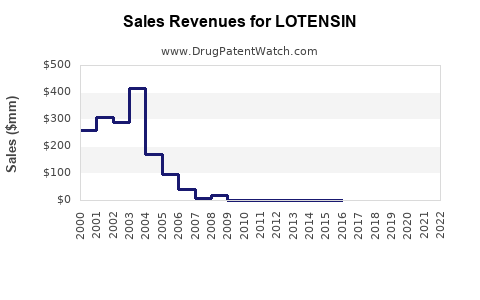
Drug Sales Revenue Trends for LOTENSIN

See drug sales revenues for LOTENSIN

Recent Clinical Trials for LOTENSIN

Identify potential brand extensions & 505(b)(2) entrants

SponsorPhase
Nanjing Children's HospitalPhase 2
University of NebraskaPhase 4
Children's Hospital of Fudan UniversityPhase 1/Phase 2

See all LOTENSIN clinical trials

Pharmacology for LOTENSIN

US Patents and Regulatory Information for LOTENSIN

Applicant Tradename Generic Name Dosage NDA Approval Date TE Type RLD RS Patent No. Patent Expiration Product Substance Delist Req. Exclusivity Expiration
Validus Pharms LOTENSIN benazepril hydrochloride TABLET;ORAL 019851-001 Jun 25, 1991 DISCN Yes No ⤷  Get Started Free ⤷  Get Started Free ⤷  Get Started Free
Validus Pharms LOTENSIN HCT benazepril hydrochloride; hydrochlorothiazide TABLET;ORAL 020033-004 May 19, 1992 AB RX Yes No ⤷  Get Started Free ⤷  Get Started Free ⤷  Get Started Free
Validus Pharms LOTENSIN benazepril hydrochloride TABLET;ORAL 019851-004 Jun 25, 1991 AB RX Yes No ⤷  Get Started Free ⤷  Get Started Free ⤷  Get Started Free
>Applicant >Tradename >Generic Name >Dosage >NDA >Approval Date >TE >Type >RLD >RS >Patent No. >Patent Expiration >Product >Substance >Delist Req. >Exclusivity Expiration

Expired US Patents for LOTENSIN

Applicant Tradename Generic Name Dosage NDA Approval Date Patent No. Patent Expiration
Validus Pharms LOTENSIN benazepril hydrochloride TABLET;ORAL 019851-001 Jun 25, 1991 ⤷  Get Started Free ⤷  Get Started Free
Validus Pharms LOTENSIN benazepril hydrochloride TABLET;ORAL 019851-004 Jun 25, 1991 ⤷  Get Started Free ⤷  Get Started Free
Validus Pharms LOTENSIN benazepril hydrochloride TABLET;ORAL 019851-003 Jun 25, 1991 ⤷  Get Started Free ⤷  Get Started Free
>Applicant >Tradename >Generic Name >Dosage >NDA >Approval Date >Patent No. >Patent Expiration

International Patents for LOTENSIN

See the table below for patents covering LOTENSIN around the world.

Country Patent Number Title Estimated Expiration
Spain 526888 ⤷  Get Started Free
Ireland 821929 ⤷  Get Started Free
Argentina 242190 PROCEDIMIENTO PARA OBTENER NOVEDOSOS ACIDOS 3-(5-AMINOPENTIL)-AMINO-1-BENZACEPIN-2-ONA-1-ALCANOICOS. (3-AMINO-(1)-BENZAZEPIN-2-ONE-1-ALKANOIC ACIDS) ⤷  Get Started Free
>Country >Patent Number >Title >Estimated Expiration

Market Dynamics and Financial Trajectory for the Pharmaceutical Drug: LOTENSIN

Last updated: July 28, 2025


Introduction

Lotensin, generically known as benazepril, is a prominent medication in the treatment of hypertension and certain cardiovascular conditions. As an ACE (angiotensin-converting enzyme) inhibitor, Lotensin has garnered significant market attention due to its proven efficacy, favorable safety profile, and its pivotal role within the broader antihypertensive drug class. This report analyzes the current market dynamics, competitive landscape, regulatory environment, and financial trajectory of Lotensin, offering strategic insights for stakeholders such as pharmaceutical companies, investors, and healthcare policymakers.


Market Overview

Historical Context and Global Penetration

Introduced in the early 1990s, Lotensin quickly fortressed its position as a reliable antihypertensive agent. Its initial approval by the US Food and Drug Administration (FDA) set the stage for widespread adoption in the US, Europe, and emerging markets. The global antihypertensive market is projected to reach USD 32 billion by 2027 (CAGR of 3.8%), with ACE inhibitors comprising a substantial segment. Lotensin's established clinical efficacy earned it a steady market share, particularly among patients intolerant to other classes such as beta-blockers or diuretics.

Market Segments and Patient Demographics

The predominant segment for Lotensin comprises adult patients diagnosed with hypertension, often as part of polypharmacy regimens for comorbid conditions like heart failure, diabetic nephropathy, and stroke prevention. The aging global population and increasing awareness about cardiovascular risk factors bolster demand for effective antihypertensives.


Market Dynamics

Competitive Landscape

Lotensin operates within a mature segment dominated by several key players, including generic ACE inhibitors such as lisinopril, ramipril, and enalapril. While patent protections have long expired, leading to widespread generic availability, certain branded formulations still command premium pricing due to physician preference, formulation differences, or marketing strategies.

Vitamin and supplement trends, along with the advent of alternative therapies like angiotensin receptor blockers (ARBs), influence the competitive dynamics. Notably, ARBs such as losartan have posed competitive threats due to perceptions of fewer side effects, though cost and formulary preferences often favor ACE inhibitors like Lotensin.

Regulatory Factors

Regulatory pathways significantly influence Lotensin’s market trajectory. Johnson & Johnson initially marketed Lotensin, but subsequent generic proliferation has introduced pricing pressures. Government health programs and formularies increasingly favor cost-effective generics, which impact revenue streams. Additionally, evolving clinical guidelines from organizations such as the American College of Cardiology (ACC) and the American Heart Association (AHA) influence prescribing patterns, emphasizing combination therapies and newer agents.

Pricing and Reimbursement Trends

The shift towards value-based healthcare and cost containment exerts downward pressure on drug pricing. Generic versions of benazepril have led to substantial price erosion, impacting revenue potential. However, the drug's long-term affordability sustains its utilization across various healthcare systems, especially in resource-constrained regions.

Innovation and New Formulations

While the core molecule of benazepril remains unchanged, incremental innovations such as fixed-dose combinations (e.g., with amlodipine or hydrochlorothiazide) have expanded therapeutic options. These combination therapies enhance patient adherence and clinical outcomes, potentially elevating the drug’s market share.


Financial Trajectory

Revenue Trends

Historically, Lotensin generated annual revenues in the hundreds of millions USD, with peak sales observed during the early 2000s. As patents expired and generics flooded the market, revenues declined sharply, echoing a typical post-patent expiry curve. Currently, the drug’s revenue estimates are within the USD 50-100 million range globally, primarily driven by markets like the US, Europe, and select emerging economies.

Profitability Outlook

The profitability of Lotensin hinges on manufacturing efficiencies and generics competition. Margins are compressed due to intense price competition, but incremental sales from fixed-dose combinations and expanding global markets mitigate some revenue erosion.

Emerging Markets and Growth Opportunities

Emerging markets, including China, India, and Latin America, present growth avenues driven by increased hypertension awareness and healthcare infrastructure investments. Local manufacturing and regulatory approvals facilitate faster access, enabling potential revenue expansion.


Future Market Trends

Digital Health and Precision Medicine

Integration of digital health tools and personalized medicine approaches can reshape Lotensin's financial pathway. Pharmacogenomic insights could optimize patient-specific therapy, streamlining treatment efficacy and reducing adverse effects, thus reinforcing market retention.

Over-the-Counter (OTC) Potential

While currently prescription-only, ongoing debates about the OTC availability of antihypertensives could influence future accessibility and sales models. Such shifts might initially challenge or augment existing revenue streams depending on regulatory decisions.

Regulatory Approvals and Innovation

New formulations, fixed-dose combinations, or biosimilars can rejuvenate the market. Additionally, regulatory approvals for higher-risk patient populations or extended indications could open new revenue streams.


Strategic Implications

  • Pricing Strategies: Engage in formulary negotiations emphasizing cost-effectiveness and clinical reliability.
  • Market Expansion: Focus on developing countries with rising hypertension prevalence.
  • Innovation: Invest in formulation advancements and combo therapies.
  • Regulatory Engagement: Collaborate with authorities to expedite approvals for new indications and formulations.
  • Digital Integration: Leverage digital health platforms for adherence and patient engagement.

Key Takeaways

  • Market maturity and generic competition have placed downward pressure on Lotensin’s revenue, emphasizing the importance of strategic innovation and emerging market penetration.
  • Cost-effectiveness remains pivotal; formulary inclusion tends to favor generic ACE inhibitors.
  • Expansion into emerging markets offers potential growth, driven by increased hypertension awareness and healthcare investments.
  • Combination therapies and formulation innovations are key drivers of future sales and market relevance.
  • Regulatory and digital health developments may influence its financial trajectory by facilitating access and personalized treatment paradigms.

FAQs

1. How does the expiration of patent protection impact Lotensin’s market position?
Patent expiry led to widespread generic availability, significantly reducing the drug's price and market share. While generic competition erodes revenue for branded versions, it increases overall access and volume in the global market.

2. What competitive advantages does Lotensin hold against other ACE inhibitors?
Longstanding clinical familiarity, established efficacy, and safety profile solidify its position. However, newer agents and ARBs often compete due to perceived fewer side effects.

3. What emerging markets present the greatest growth opportunities for Lotensin?
Countries like India and China, where hypertension prevalence is rising and healthcare infrastructure is expanding, offer substantial growth potential due to cost-competitive manufacturing and increasing awareness.

4. How might innovation strategies influence Lotensin’s future financial trajectory?
Development of fixed-dose combinations and novel formulations can revitalize sales, improve patient adherence, and open new revenue streams despite generic competition.

5. Will regulatory changes or digital health innovations significantly alter Lotensin’s market dynamics?
Yes, regulatory approvals for new indications and digital tools for patient management can enhance market access, improve outcomes, and sustain its relevance in evolving healthcare environments.


References

  1. Grand View Research. Antihypertensive Drugs Market Size, Share & Trends Analysis. 2021.
  2. FDA. Benazepril hydrochloride drug approval. 1995.
  3. IQVIA. Global Pharmaceuticals Market Data & Trends. 2022.
  4. American College of Cardiology. Hypertension Management Guidelines. 2017.
  5. Deloitte. Emerging Market Healthcare Outlook. 2022.

More… ↓

⤷  Get Started Free

Make Better Decisions: Try a trial or see plans & pricing

Drugs may be covered by multiple patents or regulatory protections. All trademarks and applicant names are the property of their respective owners or licensors. Although great care is taken in the proper and correct provision of this service, thinkBiotech LLC does not accept any responsibility for possible consequences of errors or omissions in the provided data. The data presented herein is for information purposes only. There is no warranty that the data contained herein is error free. We do not provide individual investment advice. This service is not registered with any financial regulatory agency. The information we publish is educational only and based on our opinions plus our models. By using DrugPatentWatch you acknowledge that we do not provide personalized recommendations or advice. thinkBiotech performs no independent verification of facts as provided by public sources nor are attempts made to provide legal or investing advice. Any reliance on data provided herein is done solely at the discretion of the user. Users of this service are advised to seek professional advice and independent confirmation before considering acting on any of the provided information. thinkBiotech LLC reserves the right to amend, extend or withdraw any part or all of the offered service without notice.