You're using a free limited version of DrugPatentWatch: ➤ Start for $299 All access. No Commitment.

Last Updated: March 26, 2026

LOCAMETZ Drug Patent Profile


✉ Email this page to a colleague

« Back to Dashboard


When do Locametz patents expire, and what generic alternatives are available?

Locametz is a drug marketed by Novartis and is included in one NDA. There are two patents protecting this drug.

This drug has fifty-four patent family members in sixteen countries.

The generic ingredient in LOCAMETZ is gallium ga-68 gozetotide. There are sixteen drug master file entries for this compound. Six suppliers are listed for this compound. Additional details are available on the gallium ga-68 gozetotide profile page.

DrugPatentWatch® Generic Entry Outlook for Locametz

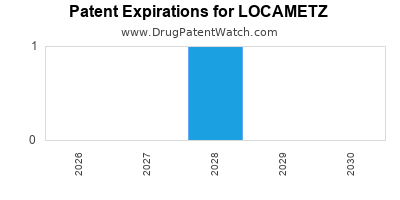
By analyzing the patents and regulatory protections it appears that the earliest date for generic entry will be August 15, 2028. This may change due to patent challenges or generic licensing.

Indicators of Generic Entry

< Available with Subscription >

  Start Trial

AI Deep Research
Questions you can ask:
  • What is the 5 year forecast for LOCAMETZ?
  • What are the global sales for LOCAMETZ?
  • What is Average Wholesale Price for LOCAMETZ?
Summary for LOCAMETZ
International Patents:54
US Patents:2
Applicants:1
NDAs:1
Finished Product Suppliers / Packagers: 2
Drug Prices: Drug price information for LOCAMETZ
What excipients (inactive ingredients) are in LOCAMETZ?LOCAMETZ excipients list
DailyMed Link:LOCAMETZ at DailyMed
Drug patent expirations by year for LOCAMETZ
Drug Prices for LOCAMETZ

See drug prices for LOCAMETZ

DrugPatentWatch® Estimated Loss of Exclusivity (LOE) Date for LOCAMETZ
Generic Entry Date for LOCAMETZ*:
Constraining patent/regulatory exclusivity:
NDA:
Dosage:
POWDER;INTRAVENOUS

*The generic entry opportunity date is the latter of the last compound-claiming patent and the last regulatory exclusivity protection. Many factors can influence early or later generic entry. This date is provided as a rough estimate of generic entry potential and should not be used as an independent source.

US Patents and Regulatory Information for LOCAMETZ

LOCAMETZ is protected by two US patents.

Based on analysis by DrugPatentWatch, the earliest date for a generic version of LOCAMETZ is ⤷  Start Trial.

This potential generic entry date is based on patent ⤷  Start Trial.

Generics may enter earlier, or later, based on new patent filings, patent extensions, patent invalidation, early generic licensing, generic entry preferences, and other factors.

Applicant Tradename Generic Name Dosage NDA Approval Date TE Type RLD RS Patent No. Patent Expiration Product Substance Delist Req. Exclusivity Expiration
Novartis LOCAMETZ gallium ga-68 gozetotide POWDER;INTRAVENOUS 215841-001 Mar 23, 2022 RX Yes Yes ⤷  Start Trial ⤷  Start Trial Y Y ⤷  Start Trial
Novartis LOCAMETZ gallium ga-68 gozetotide POWDER;INTRAVENOUS 215841-001 Mar 23, 2022 RX Yes Yes ⤷  Start Trial ⤷  Start Trial ⤷  Start Trial
>Applicant >Tradename >Generic Name >Dosage >NDA >Approval Date >TE >Type >RLD >RS >Patent No. >Patent Expiration >Product >Substance >Delist Req. >Exclusivity Expiration

International Patents for LOCAMETZ

When does loss-of-exclusivity occur for LOCAMETZ?

Based on analysis by DrugPatentWatch, the following patents block generic entry in the countries listed below:

Australia

Patent: 08289108
Estimated Expiration: ⤷  Start Trial

Canada

Patent: 96627
Estimated Expiration: ⤷  Start Trial

China

Patent: 2014956
Estimated Expiration: ⤷  Start Trial

Patent: 4873982
Estimated Expiration: ⤷  Start Trial

Denmark

Patent: 87965
Estimated Expiration: ⤷  Start Trial

European Patent Office

Patent: 87965
Estimated Expiration: ⤷  Start Trial

Patent: 88086
Estimated Expiration: ⤷  Start Trial

Patent: 56403
Estimated Expiration: ⤷  Start Trial

Patent: 31380
Estimated Expiration: ⤷  Start Trial

Patent: 38298
Estimated Expiration: ⤷  Start Trial

Patent: 58347
Estimated Expiration: ⤷  Start Trial

Patent: 64384
Estimated Expiration: ⤷  Start Trial

Hong Kong

Patent: 12588
Estimated Expiration: ⤷  Start Trial

Hungary

Patent: 47200
Estimated Expiration: ⤷  Start Trial

Israel

Patent: 3998
Estimated Expiration: ⤷  Start Trial

Japan

Patent: 02237
Estimated Expiration: ⤷  Start Trial

Patent: 96479
Estimated Expiration: ⤷  Start Trial

Patent: 25690
Estimated Expiration: ⤷  Start Trial

Patent: 38118
Estimated Expiration: ⤷  Start Trial

Patent: 79355
Estimated Expiration: ⤷  Start Trial

Patent: 09824
Estimated Expiration: ⤷  Start Trial

Patent: 10536790
Estimated Expiration: ⤷  Start Trial

Patent: 14221779
Estimated Expiration: ⤷  Start Trial

Patent: 16153410
Estimated Expiration: ⤷  Start Trial

Patent: 18058864
Estimated Expiration: ⤷  Start Trial

Patent: 18150350
Estimated Expiration: ⤷  Start Trial

Patent: 20073472
Estimated Expiration: ⤷  Start Trial

Patent: 21075561
Estimated Expiration: ⤷  Start Trial

Patent: 22110118
Estimated Expiration: ⤷  Start Trial

Patent: 24117783
Estimated Expiration: ⤷  Start Trial

New Zealand

Patent: 3931
Estimated Expiration: ⤷  Start Trial

Patent: 0085
Estimated Expiration: ⤷  Start Trial

Poland

Patent: 87965
Estimated Expiration: ⤷  Start Trial

Portugal

Patent: 87965
Estimated Expiration: ⤷  Start Trial

Slovenia

Patent: 87965
Estimated Expiration: ⤷  Start Trial

Spain

Patent: 68224
Estimated Expiration: ⤷  Start Trial

Patent: 30116
Estimated Expiration: ⤷  Start Trial

Generics may enter earlier, or later, based on new patent filings, patent extensions, patent invalidation, early generic licensing, generic entry preferences, and other factors.

See the table below for additional patents covering LOCAMETZ around the world.

Country Patent Number Title Estimated Expiration
Japan 7609824 ⤷  Start Trial
European Patent Office 3268337 ⤷  Start Trial
Poland 2187965 ⤷  Start Trial
European Patent Office 3831380 ⤷  Start Trial
Japan 5902237 ⤷  Start Trial
>Country >Patent Number >Title >Estimated Expiration

LOCAMETZ: Market Dynamics and Financial Trajectory

Last updated: February 19, 2026

LOCAMETZ (gallium Ga 68 PSMA-1007) is a positron emission tomography (PET) imaging agent approved for prostate cancer detection. Its market entry and subsequent financial performance are influenced by diagnostic imaging market trends, competitor landscape, and reimbursement policies.

What is LOCAMETZ and Its Mechanism of Action?

LOCAMETZ is a radiopharmaceutical used in PET imaging. It targets prostate-specific membrane antigen (PSMA), a protein highly expressed on prostate cancer cells. By binding to PSMA, LOCAMETZ allows for the visualization and localization of cancerous lesions throughout the body. This diagnostic capability is crucial for staging, treatment planning, and monitoring recurrence in prostate cancer patients. The gallium-68 isotope provides the positron emissions necessary for PET detection.

Who Developed and Markets LOCAMETZ?

LOCAMETZ was developed by AAA Advanced Accelerator Applications, a subsidiary of Novartis. Novartis is responsible for the commercialization and distribution of LOCAMETZ. This affiliation provides access to Novartis's established global pharmaceutical network and commercial infrastructure, facilitating market penetration.

What is the Target Indication for LOCAMETZ?

The primary indication for LOCAMETZ is the detection of PSMA-positive lesions in adult patients with prostate cancer. This includes patients with suspected metastatic disease who are candidates for initial curative treatment or for the detection of recurrence. Its utility spans various stages of prostate cancer management, from initial diagnosis to post-treatment surveillance.

What is the Competitive Landscape for PSMA-Targeted PET Imaging Agents?

The PSMA-targeted PET imaging market is competitive and evolving. Key competitors include:

  • Pylarify (piflufoloxam F 18) by Veracyte: Approved in the U.S. for PSMA-positive prostate cancer.
  • Netspot (gallium Ga 68 dotatate) by GE Healthcare: Used for neuroendocrine tumor imaging, but PSMA agents are distinct in their prostate cancer focus.
  • Other PSMA-targeting agents in development or with regional approvals, such as Ga-68 PSMA-1007 in Europe (under the same name as LOCAMETZ) and 18F-DCFPyL.

The choice between agents often depends on imaging characteristics, availability, cost, and specific clinical guidelines. Regulatory approvals and reimbursement status play significant roles in market adoption.

What is the Reimbursement Status of LOCAMETZ?

Reimbursement for diagnostic imaging agents like LOCAMETZ is critical for market access and financial viability. In the United States, coverage decisions are made by Medicare (Centers for Medicare & Medicaid Services - CMS) and private insurers.

  • CMS Coverage: CMS has issued National Coverage Decisions (NCDs) and Local Coverage Determinations (LCDs) that impact the reimbursement landscape for PET imaging. The inclusion of PSMA-PET agents within these policies, particularly for specific indications like recurrent or metastatic prostate cancer, is a key driver of uptake. For instance, CMS has expanded coverage for certain PSMA-PET agents under specific conditions [1]. The reimbursement rate for the imaging procedure, which includes the agent, is established by CMS fee schedules.
  • Private Payer Coverage: Private insurance companies typically follow CMS guidance but also conduct their own coverage assessments based on clinical utility and cost-effectiveness data. Obtaining favorable coverage from major private payers is essential for broad market access.
  • International Reimbursement: Reimbursement policies vary significantly by country. In Europe, where PSMA-PET imaging has been used for a longer period, national health systems and private insurers have established reimbursement frameworks.

The evolving reimbursement landscape for PSMA-PET imaging directly influences the commercial trajectory of LOCAMETZ.

What are the Key Drivers of LOCAMETZ Market Growth?

Several factors are driving the market growth for LOCAMETZ and similar PSMA-targeted PET agents:

  • Increasing Prostate Cancer Incidence and Aging Population: The global rise in prostate cancer diagnoses, particularly in aging populations, increases the demand for accurate diagnostic tools.
  • Advancements in Diagnostic Imaging Technology: PET imaging offers superior sensitivity and specificity compared to conventional imaging modalities for detecting small or widespread metastases.
  • Clinical Utility and Improved Patient Management: PSMA-PET imaging leads to more accurate staging, personalized treatment selection, and better monitoring of treatment response, ultimately improving patient outcomes. This clinical benefit translates into physician adoption.
  • Expanding Regulatory Approvals and Reimbursement: As more regulatory bodies approve these agents and payers establish favorable reimbursement policies, market access expands.
  • Growing Evidence Base: Ongoing clinical trials and real-world data continue to demonstrate the value of PSMA-PET imaging in various prostate cancer scenarios, reinforcing its role in clinical practice.

What are the Potential Challenges and Risks for LOCAMETZ?

Despite positive market drivers, LOCAMETZ faces several challenges:

  • Competition: The presence of other PSMA-PET agents, including those with potentially different isotopes (e.g., F-18) or distinct binding characteristics, creates competitive pressure.
  • Manufacturing and Distribution: Radiopharmaceuticals require specialized manufacturing facilities and cold chain logistics, which can limit widespread availability and increase costs. The short half-life of gallium-68 (68 minutes) necessitates on-site or near-site radiopharmaceutical production, often through generators or local cyclotrons, impacting scalability and accessibility.
  • Reimbursement Uncertainty: Although improving, reimbursement policies can still be complex and subject to change. Gaining broad and consistent coverage across all payers and indications remains a hurdle.
  • Cost of Imaging: PET imaging is generally more expensive than conventional diagnostic methods, which can limit access in resource-constrained settings.
  • Physician and Patient Education: Ensuring widespread understanding of PSMA-PET imaging's benefits and appropriate use among oncologists, urologists, radiologists, and patients is an ongoing effort.
  • Emergence of New Technologies: Future advancements in imaging, such as novel biomarkers or improved conventional imaging techniques, could impact the market.

What is the Projected Financial Trajectory for LOCAMETZ?

Projecting the precise financial trajectory of a single pharmaceutical product like LOCAMETZ is complex, influenced by market penetration rates, pricing, competition, and the broader economic climate. However, based on market trends for diagnostic imaging agents, particularly in oncology, and its established position, the following trajectory can be anticipated:

  • Short-Term (1-3 Years): Continued growth driven by expanding U.S. market access following approvals and favorable reimbursement decisions. Increased adoption in centers familiar with PSMA-PET imaging and those with established radiopharmacy capabilities. Potential for initial market share gains against early competitors.
  • Medium-Term (3-7 Years): Stabilization or moderate growth as the market matures. Increased competition from newer agents or improved delivery systems. Market share may be influenced by the relative clinical performance, cost-effectiveness, and strategic marketing of competing products. Broad adoption in established markets, with potential expansion into newer geographical regions if reimbursement structures align.
  • Long-Term (7+ Years): Potential for declining growth or market share erosion as new, more advanced diagnostic technologies emerge or as patent protection expires, leading to generic competition. The lifecycle will be heavily dependent on the development of next-generation PSMA agents or alternative diagnostic strategies for prostate cancer.

Key Factors Influencing Financial Performance:

  • Pricing Strategy: The price per dose of LOCAMETZ, alongside the overall cost of the PET imaging procedure, will directly impact revenue.
  • Volume of Scans: The number of patients undergoing PSMA-PET scans with LOCAMETZ will be the primary volume driver. This is directly tied to physician prescription patterns and patient access.
  • Reimbursement Rates: The actual reimbursement received per scan by healthcare providers will significantly affect the financial viability of the product.
  • Sales and Marketing Effectiveness: Novartis's ability to effectively market LOCAMETZ to oncologists, urologists, and radiologists will be crucial for driving adoption.
  • Manufacturing Costs and Efficiency: The cost of producing and distributing the radiopharmaceutical will impact profit margins.

While specific revenue figures are proprietary, the market for PSMA-PET imaging is projected to grow substantially. For example, the global PSMA PET imaging market was valued at approximately USD 500 million in 2022 and is projected to grow at a CAGR of around 15-20% from 2023 to 2030 [2]. LOCAMETZ, as a key player in this segment, is expected to contribute to and benefit from this growth. However, its specific market share within this growing pie will be a determinant of its individual financial success.

Key Takeaways

  • LOCAMETZ is a PSMA-targeted PET imaging agent for prostate cancer detection, developed by AAA Advanced Accelerator Applications (Novartis).
  • Its market growth is driven by increasing prostate cancer incidence, advancements in PET technology, and demonstrated clinical utility, leading to improved patient management.
  • Competitive pressures from other PSMA-PET agents, such as Pylarify, and challenges in manufacturing, distribution, and reimbursement represent significant risks.
  • The financial trajectory for LOCAMETZ is projected for growth in the short to medium term, with potential stabilization or erosion in the long term due to market maturity and technological evolution.
  • Reimbursement policies from CMS and private payers are critical determinants of market access and financial success.

FAQs

  1. What is the primary difference between LOCAMETZ and other PSMA-PET agents like Pylarify? LOCAMETZ uses gallium-68 as its radioisotope, while Pylarify uses fluorine-18. The choice of radioisotope can affect imaging characteristics, half-life, and production logistics.

  2. How does the half-life of gallium-68 impact the use of LOCAMETZ? Gallium-68 has a half-life of approximately 68 minutes. This short half-life requires that the radiopharmaceutical be produced close to the time of patient administration, often necessitating on-site or regional radiopharmacies and specialized delivery systems.

  3. What specific types of prostate cancer scenarios is LOCAMETZ approved to diagnose? LOCAMETZ is approved for the detection of PSMA-positive lesions in adult patients with prostate cancer, including those suspected of having metastatic disease who are candidates for initial curative treatment, and for the detection of recurrence.

  4. What are the main hurdles to widespread adoption of LOCAMETZ globally? Hurdles include navigating diverse international reimbursement policies, establishing robust manufacturing and distribution networks for radiopharmaceuticals, overcoming the higher cost of PET imaging compared to conventional methods, and ensuring adequate training and education for healthcare professionals.

  5. Will LOCAMETZ face generic competition, and when? As a branded pharmaceutical product, LOCAMETZ is protected by patents. The timeline for potential generic competition will depend on the expiration dates of its core patents and any regulatory exclusivities granted. Once these protections expire, the market could see the introduction of biosimilar or generic versions, potentially impacting its pricing and market share.

Citations

[1] Centers for Medicare & Medicaid Services. (n.d.). National Coverage Determinations. Retrieved from cms.gov (Note: Specific NCD/LCD numbers change and require targeted search on the CMS website for current policies).

[2] Grand View Research. (2023). PSMA PET Imaging Market Size, Share & Trends Analysis Report By Indication, By Region, And Segment Forecasts, 2023 - 2030. Retrieved from grandviewresearch.com

More… ↓

⤷  Start Trial

Make Better Decisions: Try a trial or see plans & pricing

Drugs may be covered by multiple patents or regulatory protections. All trademarks and applicant names are the property of their respective owners or licensors. Although great care is taken in the proper and correct provision of this service, thinkBiotech LLC does not accept any responsibility for possible consequences of errors or omissions in the provided data. The data presented herein is for information purposes only. There is no warranty that the data contained herein is error free. We do not provide individual investment advice. This service is not registered with any financial regulatory agency. The information we publish is educational only and based on our opinions plus our models. By using DrugPatentWatch you acknowledge that we do not provide personalized recommendations or advice. thinkBiotech performs no independent verification of facts as provided by public sources nor are attempts made to provide legal or investing advice. Any reliance on data provided herein is done solely at the discretion of the user. Users of this service are advised to seek professional advice and independent confirmation before considering acting on any of the provided information. thinkBiotech LLC reserves the right to amend, extend or withdraw any part or all of the offered service without notice.