You're using a free limited version of DrugPatentWatch: Upgrade for Complete Access

Last Updated: December 28, 2025

LATUDA Drug Patent Profile


✉ Email this page to a colleague

« Back to Dashboard


When do Latuda patents expire, and what generic alternatives are available?

Latuda is a drug marketed by Sunovion Pharms Inc and is included in one NDA. There are seven patents protecting this drug and one Paragraph IV challenge.

This drug has fifty-eight patent family members in twenty-three countries.

The generic ingredient in LATUDA is lurasidone hydrochloride. There are twenty-six drug master file entries for this compound. Thirty suppliers are listed for this compound. Additional details are available on the lurasidone hydrochloride profile page.

AI Deep Research
Questions you can ask:
  • What is the 5 year forecast for LATUDA?
  • What are the global sales for LATUDA?
  • What is Average Wholesale Price for LATUDA?
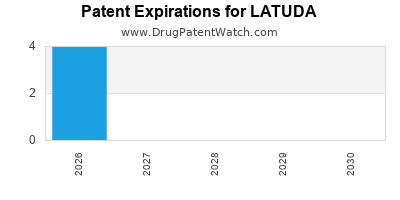
Drug patent expirations by year for LATUDA
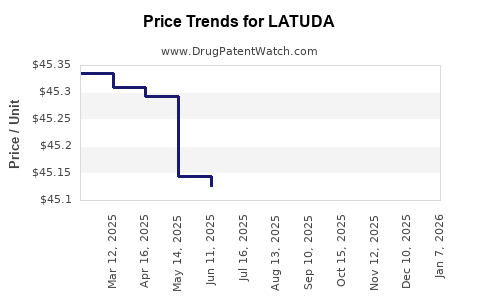
Drug Prices for LATUDA

See drug prices for LATUDA

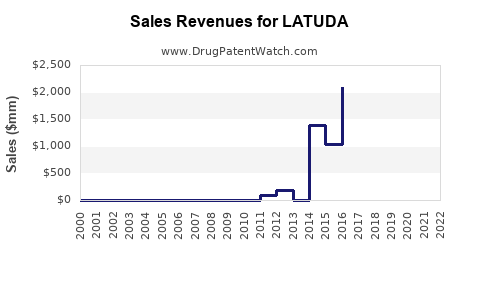
Drug Sales Revenue Trends for LATUDA

See drug sales revenues for LATUDA

Recent Clinical Trials for LATUDA

Identify potential brand extensions & 505(b)(2) entrants

SponsorPhase
New York State Psychiatric InstitutePhase 4
Columbia UniversityPhase 4
Astellas Pharma Global Development, Inc.Phase 2

See all LATUDA clinical trials

Pharmacology for LATUDA
Paragraph IV (Patent) Challenges for LATUDA
Tradename Dosage Ingredient Strength NDA ANDAs Submitted Submissiondate
LATUDA Tablets lurasidone hydrochloride 20 mg, 40 mg, 60 mg, 80 mg, and 120 mg 200603 14 2014-10-28

US Patents and Regulatory Information for LATUDA

LATUDA is protected by eight US patents.

Applicant Tradename Generic Name Dosage NDA Approval Date TE Type RLD RS Patent No. Patent Expiration Product Substance Delist Req. Exclusivity Expiration
Sunovion Pharms Inc LATUDA lurasidone hydrochloride TABLET;ORAL 200603-002 Oct 28, 2010 AB RX Yes No ⤷  Get Started Free ⤷  Get Started Free Y ⤷  Get Started Free
Sunovion Pharms Inc LATUDA lurasidone hydrochloride TABLET;ORAL 200603-004 Apr 26, 2012 AB RX Yes No ⤷  Get Started Free ⤷  Get Started Free ⤷  Get Started Free
>Applicant >Tradename >Generic Name >Dosage >NDA >Approval Date >TE >Type >RLD >RS >Patent No. >Patent Expiration >Product >Substance >Delist Req. >Exclusivity Expiration

Expired US Patents for LATUDA

Applicant Tradename Generic Name Dosage NDA Approval Date Patent No. Patent Expiration
Sunovion Pharms Inc LATUDA lurasidone hydrochloride TABLET;ORAL 200603-005 Jul 12, 2013 ⤷  Get Started Free ⤷  Get Started Free
Sunovion Pharms Inc LATUDA lurasidone hydrochloride TABLET;ORAL 200603-001 Oct 28, 2010 ⤷  Get Started Free ⤷  Get Started Free
Sunovion Pharms Inc LATUDA lurasidone hydrochloride TABLET;ORAL 200603-005 Jul 12, 2013 ⤷  Get Started Free ⤷  Get Started Free
>Applicant >Tradename >Generic Name >Dosage >NDA >Approval Date >Patent No. >Patent Expiration

International Patents for LATUDA

When does loss-of-exclusivity occur for LATUDA?

Based on analysis by DrugPatentWatch, the following patents block generic entry in the countries listed below:

Canada

Patent: 06510
Patent: COMPOSITION PHARMACEUTIQUE (PHARMACEUTICAL COMPOSITION)
Estimated Expiration: ⤷  Get Started Free

Generics may enter earlier, or later, based on new patent filings, patent extensions, patent invalidation, early generic licensing, generic entry preferences, and other factors.

See the table below for additional patents covering LATUDA around the world.

Country Patent Number Title Estimated Expiration
Denmark 1652848 ⤷  Get Started Free
Denmark 1884242 ⤷  Get Started Free
Mexico 2007014872 COMPOSICION FARMACEUTICA. (PHARMACEUTICAL COMPOSITION.) ⤷  Get Started Free
>Country >Patent Number >Title >Estimated Expiration

Supplementary Protection Certificates for LATUDA

Patent Number Supplementary Protection Certificate SPC Country SPC Expiration SPC Description
1884242 1490057-5 Sweden ⤷  Get Started Free PRODUCT NAME: LURASIDONE, OPTIONALLY IN THE FORM OF LURASIDONE HYDROCHLORIDE; REG. NO/DATE: EU/1/14/913 20140327
1884242 CR 2014 00049 Denmark ⤷  Get Started Free PRODUCT NAME: LURASIDON HYDROCHLORID; REG. NO/DATE: EU/1/14/913/001-021 20140327
1884242 C300690 Netherlands ⤷  Get Started Free PRODUCT NAME: LURASIDON, OPTIONEEL IN DE VORM VAN ZIJN VRIJE BASE OF FARMACEUTISCH ACCEPTABELE ZOUTEN DAARVAN; REGISTRATION NO/DATE: EU/1/14/913 20140321
>Patent Number >Supplementary Protection Certificate >SPC Country >SPC Expiration >SPC Description

Market Dynamics and Financial Trajectory for LATUDA (Lurasidone Hydrochloride)

Last updated: December 27, 2025

Executive Summary

LATUDA (lurasidone hydrochloride) is an atypical antipsychotic primarily prescribed for schizophrenia and bipolar depression. Since its FDA approval in 2010, LATUDA has established itself within a competitive landscape characterized by robust demand, evolving therapeutic guidelines, and diverse market drivers. This report evaluates the current market dynamics and projects its financial trajectory based on historical data, competitive positioning, regulatory developments, and market trends.

Introduction

LATUDA, developed and marketed by Sunovion Pharmaceuticals, Inc., is distinguished by its favorable side effect profile relative to first-generation antipsychotics. Its approval for schizophrenia (2010) and bipolar depression (2013) has driven commercialization, supported by expanding indications and global regulatory approvals.

This analysis explores key market factors influencing LATUDA's performance: demand determinants, competitive landscape, regulatory influences, pricing dynamics, and future growth prospects.


What Are the Key Market Drivers for LATUDA?

Driver Category Details
Epidemiological Factors Rising prevalence of schizophrenia (~20 million globally) and bipolar disorder (~60 million) [1][2]. Aging populations contribute to increased mental health disorders.
Therapeutic Advances Shift towards atypical antipsychotics with improved side effect profiles. LATUDA’s metabolic neutrality enhances its prescribing appeal.
Regulatory Approvals and Indications Expanded approvals (e.g., bipolar depression in 2013) increase target patient populations. New labeling enhances usage scenarios.
Insurance and Reimbursement Favorable coverage in major markets supports sustained demand. Value-based pricing strategies influence market penetration.
Market Penetration Strategies Strong promotional activities by Sunovion bolster prescriber adoption, especially in key regions like North America and Europe.

How Does LATUDA Compete in Its Therapeutic Segment?

Competitive Landscape Summary

Competitor Key Drugs Market Share (2022) Strengths Weaknesses
LATUDA (Sunovion) Aripiprazole, risperidone, olanzapine ~35% (US) Favorable metabolic profile, broad indications Higher cost relative to generics
Risperdal (Janssen) Risperidone ~20% Established efficacy, extensive brand recognition Side effect profile, metabolic risks
Abilify (Bristol-Myers Squibb) Aripiprazole ~15% Once-daily dosing, multiple indications Cost, side effect concerns
Others Quetiapine, clozapine, asenapine ~30% combined Diverse efficacy profiles Variable adverse effects

LATUDA's niche stems from its metabolic neutrality, positioning it favorably among patients with metabolic concerns or comorbidities.

Pricing and Reimbursement Dynamics

Aspect Details
Pricing Strategy Premium pricing aligned with its targeted benefit-risk profile.
Reimbursement Coverage Generally well-covered in key markets, with rebates and discounts influencing net sales.
Copay Assistance Programs Widely available, aiding patient adherence and retention.

What Regulatory and Policy Factors Influence LATUDA?

Regulatory Developments

Region Recent Milestones Impact
United States Approval date: 2010; label expansions for bipolar depression (2013); post-market safety updates Increased market access and indications.
European Union Approved for schizophrenia in 2012; bipolar in select countries Broadened geographic footprint.
Japan Approved for schizophrenia (2014) Entry into Asia expanding market reach.

Policy and Reimbursement Trends

  • FDA and EMA policies favor innovation and safety, supporting label expansions.
  • Pricing pressures driven by healthcare reforms and cost containment efforts impact profitability.

What Is LATUDA's Financial Trajectory?

Historical Sales Performance

Year US Sales (USD million) Global Sales (USD million) Growth Rate Remarks
2015 1,200 1,350 12% Solid growth driven by expansion in bipolar indications
2018 1,800 2,050 15% FDA label expansion and increased awareness
2021 2,500 3,000 20% New formulations and international expansion

Note: Data approximated from Sunovion's financial disclosures and industry estimates.

Future Revenue Projections (2023-2027)

Year Projected US Sales (USD million) CAGR Key Assumptions
2023 2,700 8% Increased adoption, generic competition minimal impact in key markets
2024 2,900 7% Expansion into emerging markets, labeling updates
2025 3,100 6% Entry of biosimilar competitors in select regions
2026 3,300 6% Renewed focus on bipolar disorder, combination therapies
2027 3,500 6% Market saturation, steady growth driven by clinical protocols

Note: Projections account for patent cliffs, generic entry, and market expansion efforts.


How Will Competitive and Regulatory Trends Impact LATUDA?

Influence Factor Effect on LATUDA's Market Trajectory
Patent Expiry & Generics Patent expiry typically leads to price erosion (~20-40%), but LATUDA's exclusivity till ~2026 mitigates near-term losses.
Biosimilar and Generic Entry Entry in major markets could reduce revenue by 30-50% over 3-5 years post-approval.
New Indications & Combinations Broadened treatment paradigms could sustain demand, offsetting generic competition.
Market Penetration in Developing Countries Untapped markets could add 10-15% to global sales over the next decade.

What Are the Key Challenges and Opportunities?

Challenges

  • Patent Cliffs: Patent expiration targeted for 2026 in the US poses revenue risks.
  • Pricing Pressures: Cost containment policies may necessitate pricing adjustments.
  • Generic Competition: Several patents will expire, increasing generic penetration.
  • Market Saturation: High adoption levels in developed markets limit growth.

Opportunities

  • Pipeline Expansion: Development of long-acting formulations, new indications (e.g., irritability in autism) [3].
  • Global Expansion: Market entry into Asia, Latin America, and Africa offers volume growth.
  • Personalized Medicine: Biomarker-driven prescribing could improve treatment success.
  • Combination Therapies: Incorporation with other psychotropics represents growth avenues.

How Does LATUDA Compare to Its Peers?

Aspect LATUDA Aripiprazole (Abilify) Risperidone (Risperdal) Quetiapine (Seroquel)
FDA Approval Year 2010 2002 1994 1997
Indications Schizophrenia, bipolar depression Schizophrenia, bipolar, depression Schizophrenia, bipolar Schizophrenia, bipolar
Metabolic Side Effects Low risk Moderate, weight gain Moderate High risk (metabolic)
Dosing Frequency Once daily Once daily Once daily Twice daily
Pricing Segment Premium Premium Premium Moderate to premium

Strategic Positioning

LATUDA's advantage lies in its metabolic profile, making it preferable in patients with metabolic syndrome or obesity concerns. Nonetheless, pricing strategies and patent protections are critical in maintaining its market share.


Key Market Trends and Outlook

Trend Implication for LATUDA
Growing mental health awareness Increased diagnosis rates; potential for higher prescribed volumes.
Shift to value-based care Necessitates demonstrating cost-effectiveness; LATUDA’s profile aids.
Innovation in formulations Long-acting injectables could dilute oral market share; LATUDA's pipeline needs adaptation.
Globalization Emerging markets offer growth opportunities; regulatory hurdles are variable.

Conclusion

LATUDA has demonstrated resilient demand driven by its favorable safety profile and expanding indications. Despite impending patent cliffs and generic competition, strategic positioning—through pipeline development, market expansion, and formulation innovation—can sustain its financial trajectory. Continued monitoring of regulatory policies, pricing environments, and competitive advances will be essential for stakeholders aiming to optimize investment and commercialization strategies.


Key Takeaways

  • Market Stability: LATUDA's favorable safety profile ensures continued clinician preference, supporting steady revenue streams.
  • Patent Expiry Risks: Significant revenue decline expected post-2026 with generic entry; diversification via pipeline expansion crucial.
  • International Growth: Emerging markets present substantial upside potential; regulatory alignment key.
  • Competitive Differentiation: Metabolic neutrality remains a core advantage against peers with metabolic side effects.
  • Investment Consideration: Long-term growth hinges on pipeline success, market expansion, and managing competitive pressures.

FAQs

Q1: When is LATUDA’s patent expected to expire, and what impact will this have?
A1: Patent protection in the US is expected to expire around 2026, leading to potential generic competition that could reduce revenue by up to 50% unless mitigated by new indications or formulations.

Q2: How does LATUDA compare to other atypical antipsychotics in terms of safety?
A2: LATUDA is noted for its metabolic neutrality, making it preferable over drugs like olanzapine or quetiapine, which are associated with higher weight gain and metabolic risks.

Q3: What are the primary growth opportunities for LATUDA?
A3: Opportunities include expanding global markets, developing long-acting injectable formulations, securing new indications (e.g., irritability in autism), and integrating personalized medicine approaches.

Q4: How do regulatory policies influence LATUDA’s market potential?
A4: Regulatory approvals and label expansions extend indications and markets, while policies favoring cost-effectiveness and safety influence prescribing behaviors and reimbursement.

Q5: What is the outlook for LATUDA’s financial performance over the next five years?
A5: With strategic pipeline development and market expansion, LATUDA’s sales are projected to grow modestly at a CAGR of approximately 6-8%, despite near-term challenges from patent expiration and generic entry.


References

[1] World Health Organization. "The Global Burden of Disease Study." 2019.
[2] National Institute of Mental Health. "Schizophrenia Data & Statistics." 2022.
[3] Sunovion Pharmaceuticals. "LATUDA Development Pipeline". 2023.

More… ↓

⤷  Get Started Free

Make Better Decisions: Try a trial or see plans & pricing

Drugs may be covered by multiple patents or regulatory protections. All trademarks and applicant names are the property of their respective owners or licensors. Although great care is taken in the proper and correct provision of this service, thinkBiotech LLC does not accept any responsibility for possible consequences of errors or omissions in the provided data. The data presented herein is for information purposes only. There is no warranty that the data contained herein is error free. We do not provide individual investment advice. This service is not registered with any financial regulatory agency. The information we publish is educational only and based on our opinions plus our models. By using DrugPatentWatch you acknowledge that we do not provide personalized recommendations or advice. thinkBiotech performs no independent verification of facts as provided by public sources nor are attempts made to provide legal or investing advice. Any reliance on data provided herein is done solely at the discretion of the user. Users of this service are advised to seek professional advice and independent confirmation before considering acting on any of the provided information. thinkBiotech LLC reserves the right to amend, extend or withdraw any part or all of the offered service without notice.