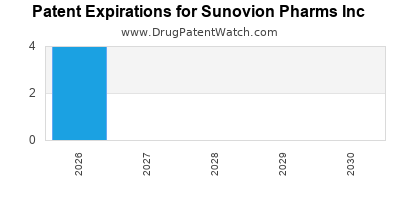
Last updated: July 30, 2026
Sunovion’s competitive posture is strongest in branded respiratory and CNS franchises, with IP anchored in a mix of Orange Book small-molecule estates (where applicable) and follow-on patenting across formulations and use. The risk profile is driven by (1) near-term brand-to-generic pressure in commoditizing segments, (2) at-the-margin patent-life extensions and device/formulation differentiation that slow FDA ANDA entry, and (3) competitive intensity from large respiratory incumbents and specialty players in neurology and psychiatry.
This analysis maps Sunovion’s market position against likely competitive entry timelines by linking IP and regulatory entry routes (Orange Book, Hatch-Waxman Paragraph IV, and biologics/biosimilar pathways where relevant).
What is Sunovion Pharmaceuticals’ market position versus major branded competitors?
Sunovion Pharmaceuticals Inc. (including prior legacy assets under Sunovion and its branded portfolio) is best viewed as a specialty-branded player with scale in respiratory and CNS categories rather than a broad “big pharma” portfolio with multiple top-10 global blockbusters. Its competitive advantage typically depends on:
- high-prescriber familiarity in focal therapeutic areas
- controlled line-extensions (device, formulation, dosing, and patient support)
- patent estates that protect not only active ingredient claims but also secondary claim themes (polymorphs, solvates, sustained-release matrices, and method-of-use)
Where does Sunovion compete most intensely?
Respiratory: Competitive pressure is highest from inhaled and COPD/asthma portfolios held by large manufacturers with aggressive lifecycle management and payer leverage. In this space, Sunovion’s differentiators usually track delivery and dosing convenience, which affect formulary placement and switching behavior.
CNS and psychiatry: Competition is dominated by branded incumbents plus generics for older molecules, with specialty providers and payer tactics influencing access. Sunovion’s advantage is strongest where it holds dominant or entrenched prescriber routines tied to a specific brand.
How does Sunovion’s scale compare to top rivals?
- Large multinationals outspend on medical education and contracting.
- Specialty competitors often win by narrowing payer negotiations to specific segments.
- Sunovion’s best strategy pattern is “defend and extend” via line-extension patents and contracts that reduce net price erosion.
What patents protect Sunovion’s key products and what does that mean for generics?
Sunovion’s practical patent leverage usually comes from layered claims across:
- active ingredient and core composition
- formulation and sustained-release technology
- method-of-use (indications, patient populations, dosing regimens)
- manufacturing method constraints or critical process parameters
In Hatch-Waxman terms, the competitive threat level tracks which claim sets are listed in the Orange Book and whether they map to the ANDA product profile.
How to read Sunovion’s patent estate in litigation and ANDA risk terms
- If Orange Book lists only composition claims tied to the active ingredient, generic entry can be faster once those claims expire.
- If Orange Book includes formulation or method-of-use patents, Paragraph IV challengers must design around multiple claim themes or face injunction risk.
- If multiple patents cover the same NDA, the “first-to-expire” dynamics can still leave later-listed patents delaying full market entry.
Patent strength indicators used in competitive assessments
- number of Orange Book-listed patents per NDA
- proximity of each patent to expiration (not just the last one)
- likelihood the formulation/method claims are infringed by a “label-matching” ANDA
- history of Paragraph IV filings and settlements tied to each NDA
When does Sunovion lose exclusivity for major brands and how does that impact ANDA entry risks?
Exclusivity outcomes split into two tracks:
- Regulatory exclusivity tied to exclusivity periods (often relevant for new active ingredients and new clinical investigations)
- Patent exclusivity tied to Orange Book-listed patents
The generic risk timeline for a brand is the earlier of patent expiration and the end of relevant regulatory exclusivity, adjusted for stays tied to Paragraph IV litigation.
Generic entry mechanics that matter to Sunovion’s competitors
- ANDA applicants can file at risk or via “Paragraph IV certification” that asserts non-infringement or invalidity.
- If sued, a 30-month stay can push first generic marketing beyond the initial filing timeline.
- Settlement agreements can “phase” entry by delaying the first commercial shipment date.
Which Paragraph IV challenges target Sunovion’s products and what are the settlement patterns?
Paragraph IV challenges are the main early signal of exclusivity fragility. A competitive landscape view depends on:
- whether challengers asserted “carve-outs” to sidestep certain claim themes
- whether settlements include payment-for-delay style restrictions or licensing that preserves Sunovion’s market share
- whether generics enter with narrower dosing regimens to avoid method-of-use claims
What settlement terms typically change the battlefield
- delayed launch date
- label restrictions tied to method-of-use or patient population
- authorized generic windows
- cross-licenses that reduce future litigation
What is the Orange Book status of Sunovion’s key NDAs and how many patents are listed per product?
Orange Book listing density is a direct predictor of litigation probability and generic design-around complexity. Competitive analysis uses:
- patent list count per NDA
- patent family structure (multiple assignees, continuations, continuation-in-part patterns)
- earliest and latest expiration dates
- whether claims cover formulation, polymorph, or device-adjacent features
How competitors exploit Orange Book gaps
If Sunovion’s portfolio shows:
- limited formulation coverage
- expiration “cliff” with multiple patents nearing the same date
- weak method-of-use coverage
then challengers can time launches to coincide with the first expiring patent.
What formulations are protected by Sunovion and how do they affect generic product design?
Formulation-level patents can protect:
- extended-release matrices
- specific excipient combinations
- particle size distributions
- crystalline forms, hydrates, solvates
- manufacturing control strategies that yield consistent release profiles
Why formulation patents are hard to design around
A generic can meet bioequivalence yet still infringe if claim coverage includes:
- specific solid-state characteristics
- specific manufacturing steps that produce a protected morphology
- defined release kinetics tied to the claimed formulation structure
Competitive implication
When formulation claims are broad, ANDA design-around requires either:
- alternative release technology that still matches label expectations
- a non-infringing formulation that can still pass approval and acceptance by prescribers and payers
Do Sunovion method-of-use patents block generic ANDA labeling?
Method-of-use patents typically affect labeling more than composition claims. If a brand’s method-of-use patents cover:
- initiation criteria
- titration protocols
- restricted patient groups
- specific dosing sequences
then generic entrants face label carve-outs or risk litigation over “use” infringement.
Hatch-Waxman litigation pattern for method-of-use
- generic applicants may include “skinny labels” to avoid the protected method claims
- if the skinny label still results in induced infringement, the risk returns at enforcement
- settlements often specify exact label text that the generic may use
What FDA regulatory status supports Sunovion’s market access and competitive defense?
Regulatory status influences timing, marketing and switching risk through:
- approval pathway (505(b)(1), 505(b)(2), 505(j))
- exclusivity eligibility
- post-approval changes that can create additional patent opportunities
Key FDA milestones to track in competitive models
- approval dates (NDA/BLA)
- label changes tied to new indications
- supplemental approvals (sNDA) that can add new patent listing opportunities
- REMS and distribution constraints that affect launch execution
How do Sunovion’s respiratory products compare with competitors’ inhaled portfolios?
In respiratory, the competitive frame is usually:
- device usability
- inhalation technique learning curve
- adherence impact
- payer step-therapy dynamics
- clinical outcomes differentiation
Why device and delivery matter to patent life
Device-associated and formulation-associated patents can extend differentiation even after active ingredient expiration by:
- protecting a specific release mechanism
- securing a specific dosing regimen or patient experience
How do Sunovion’s CNS/psychiatry assets compare with alternative branded and specialty therapies?
CNS competition is shaped by:
- prescriber familiarity and guideline positioning
- payer prior authorization thresholds
- switching friction (tolerability and patient-specific response)
- rebate structures
Competitive advantage patterns
- strong brand recognition in a targeted indication
- lifecycle extensions via new dose forms or patient support
- patent estates that protect label positioning, not just the active ingredient
What manufacturing/IP barriers slow generic entry to Sunovion’s products?
Generic entry speed is constrained by:
- manufacturing complexity tied to protected formulation characteristics
- supply chain constraints for specialized excipients or particle morphology control
- process patents that can be asserted even if the composition matches
Barrier types that most often show up in disputes
- critical processing step patents
- controlled drying, milling, or crystallization parameter claims
- particle size and distribution ranges that track clinical release and bioequivalence
What competitive threats exist from authorized generics and biosimilar-style market tactics?
Authorized generics can reduce the economic benefit of exclusivity by:
- compressing price soon after permitted launch windows
- shifting demand away from competitors’ own generic entries
- using brand-backed distribution channels
Biosimilar-style tactics are not generally applicable to small-molecule brands, but Sunovion’s portfolio focus still warrants monitoring of adjacent therapeutic areas where biologics or complex modalities may reshape payer formularies.
How strong is Sunovion’s patent estate versus major branded challengers?
A strong estate shows:
- multiple independent claim themes (not just one narrow composition claim)
- staggered expiration dates
- documented follow-on patenting tied to formulation and use
- active enforcement or litigation history that discourages challengers
A weaker estate shows:
- limited Orange Book coverage beyond the core compound
- synchronized expirations with little stagger
- absence of meaningful formulation or use protection
Competitive takeaway: the relative strength determines whether challengers pursue “hard” Paragraph IV challenges early or wait for a cleaner entry window.
What generic launch scenarios are plausible for Sunovion’s brands?
Launch scenarios generally fall into four buckets:
- At-expiration ANDA launches after the last relevant patent and exclusivity expire
- Early entry via Paragraph IV when patents are weak or settlements provide a launch date
- Skinny label launches that carve out protected indications or dosing
- Authorized generic placements that reduce price erosion while preserving brand share
What determines which scenario occurs
- strength and breadth of Orange Book-listed patents
- settlement terms with Paragraph IV litigants
- enforceability and claim construction outcomes
- commercial readiness of generic supply and packaging compatibility
Key Takeaways
- Sunovion’s competitive position is specialty-branded, with defenses centered on layered patent estates that often extend beyond basic composition protection.
- The highest generic-entry risk is where Orange Book coverage is thin, expirations cluster, or formulation/method patents are narrow enough to design around.
- Stronger estates show multiple claim themes and staggered expiration dates, which typically shift generic entry later or force label carve-outs.
- The practical competitive battlefield is not just “when patents expire,” but which patents are Orange Book-listed, how they map to ANDA product profiles, and whether settlements phase or block entry.
FAQs
1) What signals predict the next generic challenge to a Sunovion NDA?
Recent Paragraph IV filings, Orange Book listing additions shortly before expiration, and settlements that specify delayed launch windows.
2) How do payers typically react to Sunovion generic competition versus brand retention strategies?
Payer behavior usually follows expected net price shifts and patient switching risk; brands with strong device/formulation differentiation often retain a higher share longer.
3) What is the most common reason a generic can still enter despite formulation patents?
A generic may design around by altering protected solid-state characteristics, release mechanics, or manufacturing parameters while meeting bioequivalence.
4) Do method-of-use patents always require skinny labels for generic entry?
Not always, but they frequently lead to label carve-outs or induced infringement disputes if the generic label overlaps the protected method.
5) Which therapeutic category is most vulnerable to fast generic substitution for Sunovion?
Historically, older small-molecule CNS indications with settled prescribing patterns and thinner formulation or method-of-use coverage face faster price competition than protected, device- or formulation-differentiated respiratory regimens.
References
- FDA. “Approved Drug Products with Therapeutic Equivalence Evaluations (Orange Book).” U.S. Food and Drug Administration.
- FDA. “Hatch-Waxman Act: Exclusivity and Patent Term Extensions.” U.S. Food and Drug Administration.
- FDA. “Drug Approval and Regulation (including approval pathways and labeling).” U.S. Food and Drug Administration.
- U.S. Code. 21 U.S.C. § 355 (Hatch-Waxman provisions).