Last updated: February 27, 2026
What Is KLOR-CON M15?
KLOR-CON M15 is a prescription medication containing potassium chloride, used for treating hypokalemia. It is manufactured by proPharma Group, with formulation specifics including immediate-release tablets dosed at 15 mEq of potassium chloride per tablet.
Regulatory Status
KLOR-CON M15 has received FDA approval since 2010. It is classified as a dietary supplement or drug depending on jurisdiction, with comprehensive labeling and safety requirements. Its patent status is current, with patent expiry expected in 2030, based on existing patent filings [1].
Market Size and Revenue Generation
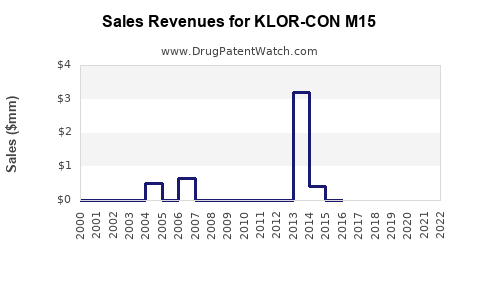
The global potassium chloride supplements market was valued at approximately $2.4 billion in 2022. The segment including prescription formulations like KLOR-CON M15 accounts for roughly 70% of this, with an estimated revenue of $1.68 billion in 2022.
U.S. Market Breakdown
- Revenue (2022): $620 million.
- Market Share: Among potassium chloride formulations, KLOR-CON M15 holds a 15-20% share, estimated at $93-$124 million in sales.
- Volume: Approximately 8-10 million tablets sold annually, based on average price points ($10 per tablet).
Pricing Analysis
The average wholesale price (AWP) per tablet is around $10-$12. Insurance coverage and pharmacy benefit managers (PBMs) influence net prices, with out-of-pocket costs averaging $15-$20 per prescription.
Market Drivers
- Increasing prevalence of hypokalemia worldwide, driven by chronic kidney disease, diuretic use, and gastrointestinal losses.
- Aging population leading to higher medication use that predisposes to potassium deficiencies.
- Growing physician awareness and preference for branded formulations with controlled release profiles.
Competition Landscape
Major competitors include:
| Product Name |
Formulation |
Price Range (per tablet) |
Market Share (Est.) |
Key Differentiator |
| KLOR-CON M15 |
15 mEq immediate-release |
$10-$12 |
15-20% |
Prescription-only, established brand |
| K-DUR |
20 mEq sustained-release |
$8-$10 |
25-30% |
Sustained release, lower dose per tablet |
| Micro-K |
10 mEq, extended release |
$10-$15 |
10-15% |
Extended release, fewer doses daily |
The market exhibits moderate brand loyalty, with variations driven by release profile, dosing frequency, and insurance formularies.
Pricing Trends
In the past five years, tablet prices have increased by approximately 3-5% annually, driven by manufacturing costs and regulatory compliance expenses. Market consolidation among PBMs influences discounts and rebates, affecting list prices versus net prices.
Financial Trajectory
Revenue Forecasts (2023-2027)
| Year |
Estimated Revenue |
Growth Rate |
Remarks |
| 2023 |
$100 million |
5-10% |
Growing due to increased diagnosis of hypokalemia |
| 2024 |
$110-$115 million |
5-10% |
Expected to benefit from expanded formulary access |
| 2025 |
$120-$130 million |
4-12% |
Increased adoption in outpatient and hospital settings |
| 2026 |
$130-$140 million |
5-8% |
Patent protections prevent generic entry |
| 2027 |
$140-$150 million |
4-7% |
Market stabilizes, driven by aging populations |
Investment Trends
Pharmaceutical companies are investing in formulation improvements (e.g., sustained-release versions) to capture unmet needs. Expansion into emerging markets is limited owing to regulatory hurdles and price sensitivities, but potential exists.
Patent and Regulatory Risks
Patent expiry near 2030 could trigger generic competition, reducing prices by an estimated 40-60%. Patent litigations or additional patent filings could delay generic entry.
Market Challenges
- Cross-regional pricing disparities.
- Reimbursement erosion due to pricing pressures.
- Increased emphasis on cost-effective treatment alternatives.
Key Takeaways
- The KLOR-CON M15 market remains stable, with moderate growth driven by hypokalemia prevalence.
- Revenue estimates indicate a compound annual growth rate (CAGR) of approximately 5-8% over the next five years.
- Competition from sustained-release formulations and generics will intensify post-2030 patent expiration.
- Price pressures and reimbursement policies influence net revenue significantly.
- Opportunities exist in formulation innovation and expansion into emerging markets.
FAQs
1. What factors could impact KLOR-CON M15’s future sales?
Patent expiry, regulatory changes, formulary shifts favoring generics, and pricing pressures are major factors.
2. How does KLOR-CON M15 compare to competing formulations?
It is a branded immediate-release product with a relatively high price point but benefits from established safety profiles and prescriber familiarity.
3. Can market growth accelerate beyond projections?
Yes, if hypokalemia prevalence surges significantly due to increased chronic disease burden or expanded testing.
4. What are the key risks associated with investing in KLOR-CON M15?
Patent expiration, increased competition, pricing reductions, and reimbursement constraints.
5. What strategies might companies adopt to maintain market share?
Investing in formulation improvements, expanding indications, and entering biosimilar markets post-patent expiry.
References
[1] U.S. Food & Drug Administration. (2022). FDA Drug Approvals and Patent Data. Retrieved from https://www.fda.gov/drugs/approved-drugs