Last updated: July 30, 2026
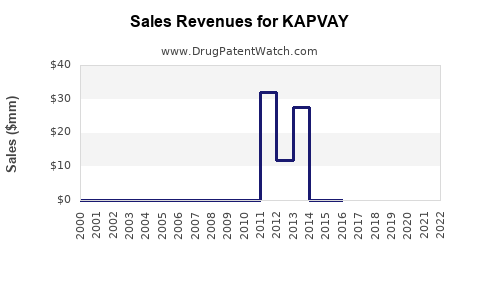
Kapvay (clonidine hydrochloride extended-release, ER) is an established branded CNS product in the ADHD market in the US. The financial trajectory is shaped by expiring branded exclusivity, generic erosion risk for clonidine ER, payer tightening for behavioral health products, and competitive pressure from other ADHD classes rather than single-drug therapeutic substitution. Contracting and utilization management determine near-term profitability more than incremental clinical differentiation.
How much revenue does KAPVAY make and what drives its financial trajectory?
Featured snippet: KAPVAY’s revenue trajectory is primarily driven by (1) generic availability risk in clonidine ER, (2) payer formulary placement and step therapy for ADHD, and (3) patient switching between ER alpha-agonists and competing ADHD monotherapies.
Revenue sensitivity to generic erosion
- Clonidine ER is a small-molecule, oral ER product with direct generic substitutability once exclusivity and patent barriers fall.
- As generics enter, pricing typically compresses sharply, and volume share transfers to lower net-priced competitors. Net revenue depends on rebate intensity, contracting dynamics, and pharmacy benefit manager (PBM) position.
Demand drivers in ADHD
- Prescribing is concentrated in child and adolescent ADHD treatment patterns, where ER dosing convenience and alpha-agonist adjunct or alternative strategies can support persistence.
- Utilization is sensitive to guideline-aligned treatment algorithms, payer restrictions on behavioral health and pediatric neurology coverage, and safety monitoring considerations (blood pressure, sedation).
Cost and margin drivers
- Key margin effects come from:
- Contract rebates tied to formulary tier placement.
- IP-driven protection duration and the resulting ability to hold net price.
- Supply and manufacturing economics for ER oral tablets.
What is KAPVAY’s patent estate and when does it lose exclusivity?
Featured snippet: KAPVAY’s branded exclusivity outlook is determined by patent term expirations plus any pediatric exclusivity, while commercial protection persists only as long as enforceable US patent coverage remains.
Core IP categories that typically matter for KAPVAY
- Composition and salt form (clonidine HCl).
- Formulation and ER matrix technology.
- Method-of-use for ADHD.
- Polymorph/process claims affecting manufacturing.
Key question for market forecasting
- For financial modeling, the question is not “do patents exist,” but “which claims cover what is necessary to market an equivalent ER product” in the US.
- Brand pricing power depends on whether challengers can design around formulation claims and still obtain ANDA approval without infringement risk.
What Orange Book status does KAPVAY have and which patents are listed?
Featured snippet: Orange Book listings determine the immediate practical barrier for generic entry because Paragraph IV certifications require claims-by-claims infringement positions tied to those listings.
How the Orange Book controls generic timing
- An ANDA filer can submit as soon as FDA acceptance is possible, but entry timing is constrained by:
- Suit filing within statutory windows for Paragraph IV.
- Settlement triggers where brand and generic agree to shared launch dates.
- Exclusivity not tied to patents (where applicable).
Practical impact on financial trajectory
- If KAPVAY has limited remaining active listings, generic entry risk rises quickly.
- If listings include formulation and ER-specific patents, generic firms may face design-around or litigation, extending time to market.
When do generics face Paragraph IV risk for KAPVAY?
Featured snippet: Paragraph IV risk is highest near patent expiration on Orange Book-listed claims that are directly infringed by clonidine ER tablets.
Generic entry scenarios that change revenue
- Early filer scenario: A Paragraph IV challenge is filed and litigated, keeping the brand protected if the court or settlement delays launch.
- Settlement scenario: Brand may pay to delay entry, preserving revenue until an agreed date.
- Competing ANDA approvals: Even if entry is delayed by settlement, multiple challengers can accelerate price compression after the launch date.
Which companies challenge KAPVAY and what litigation shapes the market?
Featured snippet: Patent litigation and settlement terms directly set launch dates and therefore net revenue timing for KAPVAY.
What to track for financial trajectory
- Filing dates for Paragraph IV certifications against Orange Book patents.
- Court outcomes: validity, non-infringement, and claim construction.
- Settlement agreements: launch date and any “carve-outs” affecting authorized generic or formulation.
How does KAPVAY compare with other ADHD drugs that can steal share?
Featured snippet: KAPVAY’s biggest competitive threat can be therapeutic substitution to other ADHD classes that are easier to cover or have better payer positioning.
Competitive set by mechanism and payer preference
- Stimulants (methylphenidate and amphetamine products) typically dominate first-line ADHD prescribing and are more likely to be covered without extensive step therapy.
- Non-stimulant alternatives:
- Atomoxetine (SNRI), guanfacine ER (alpha-2 agonist), and other behavioral-health strategies.
- Alpha-agonist class competition:
- Guanfacine ER often competes on ER dosing and tolerability.
- Payer formularies frequently rank alpha-agonists and require step edits or prefer one agent on tiering.
Switch dynamics that affect net revenue
- When payers prefer one alpha-agonist, switching reduces KAPVAY’s share growth.
- When generics enter clonidine ER, therapeutic substitution becomes less relevant than price-driven volume shifts.
What formulations and dosage forms are protected for KAPVAY?
Featured snippet: For ER tablets, formulation IP often determines whether generic products can be approved as “same as” and marketed without infringement risk.
Why formulation claims matter to exclusivity
- ER tablets rely on release profiles and excipient/matrix systems.
- Claims can cover:
- Matrix or polymer blends.
- Coating and dissolution characteristics.
- Tablet manufacturing processes affecting release behavior.
Financial link
- Strong formulation protection delays generic entry and preserves net revenue.
- Weak or narrow formulation coverage increases the probability that multiple generics can launch once primary method-of-use protections expire.
Does KAPVAY have biosimilar risk?
Featured snippet: No. KAPVAY is a small-molecule drug (clonidine HCl ER), so it is not subject to biosimilar pathways.
What is KAPVAY’s FDA regulatory status and ANDA pathway risk?
Featured snippet: KAPVAY is approved for pediatric ADHD use under the approved labeling, and generic risk is managed through the ANDA process against Orange Book listings.
ANDA pathway mechanics relevant to market dynamics
- ANDA approvals require bioequivalence and certification to Orange Book patents.
- FDA approval does not itself allow launch if litigation or exclusivity blocks entry under Hatch-Waxman.
Commercial impact
- Net revenue declines typically lag the first ANDA approval because launch depends on patent outcomes, PBM contracting, and authorized distribution.
How do payer decisions affect KAPVAY’s unit demand?
Featured snippet: Payer formulary status is a primary determinant of patient access and therefore KAPVAY unit demand.
Contracting levers
- Tier placement (preferred vs non-preferred).
- Prior authorization (PA) requirements and step therapy.
- Rebate structures that influence PBM incentives and pharmacy counter decisions.
Expected effects on financial trajectory
- Preferred positioning sustains stable volume.
- Loss of preferred status or increased PA barriers drives drop-offs even before generic launch, especially for pediatric patients where access has administrative friction.
Geographic coverage: where is KAPVAY’s revenue most exposed?
Featured snippet: US revenue exposure is highest because Orange Book-linked patents govern generic entry timing, while international protection varies by jurisdiction and patent filing strategy.
US-centric risk
- US patent term and Orange Book listings determine when generic competition can begin.
- Financial outcomes are usually most sensitive to US loss of exclusivity because US is the major volume market for many older branded CNS products.
International exposure
- If EU/UK patent protection expires earlier or lacks ER-specific claims, revenue erosion can occur sooner outside the US.
- For global portfolio planning, the key is whether clonidine ER generics are already established and whether local pricing controls accelerates declines.
What generic entry risks exist for KAPVAY, and what barriers delay them?
Featured snippet: Generic barriers are highest when ER formulation patents or method-of-use claims remain active and are not readily design-around.
Manufacturing and IP barriers
- ER technologies are sensitive to dissolution and release kinetics, so formulation changes can still trigger infringement analysis under doctrine of equivalents depending on claim scope.
- Process patents can delay manufacturing scale-up if not avoided.
Litigation barriers
- Even if claims are contested, the time value of litigation and the risk of injunctions can deter launch until late in the cycle.
- The financial effect is delayed revenue erosion after expiration.
Key Takeaways
- KAPVAY’s market dynamics are driven by ADHD payer access constraints and the probability/timing of generic clonidine ER entry in the US.
- The financial trajectory depends on Orange Book-listed patent scope for ER formulation and method-of-use claims, and on whether Paragraph IV challenges lead to design-around, litigation wins, or settlements.
- Therapeutic substitution within ADHD classes can affect growth even before generic entry, but price erosion from clonidine ER generics is typically the dominant long-run revenue threat.
- No biosimilar risk applies because KAPVAY is a small-molecule drug.
FAQs
- How do Orange Book patent listings for clonidine ER influence ANDA launch timing for KAPVAY?
- What is the typical unit and pricing impact after generics enter branded extended-release clonidine hydrochloride products?
- Which ADHD payer policies most strongly affect prescribing of alpha-2 agonist ER therapies like KAPVAY?
- Do method-of-use patents for pediatric ADHD claims materially delay generic entry for KAPVAY?
- How does KAPVAY’s competitive position change versus guanfacine ER and stimulant first-line strategies when formularies tighten?
References
- FDA. Orange Book: Approved Drug Products with Therapeutic Equivalence Evaluations. (Accessed via FDA Orange Book database).
- FDA. ANDA Application Process and Paragraph IV Certification Framework. (FDA regulatory materials).