JAKAFI Drug Patent Profile
✉ Email this page to a colleague
Which patents cover Jakafi, and what generic alternatives are available?
Jakafi is a drug marketed by Incyte Corp and is included in two NDAs. There are twenty-five patents protecting this drug and one Paragraph IV challenge.
This drug has two hundred and thirty-six patent family members in forty-six countries.
The generic ingredient in JAKAFI is ruxolitinib phosphate. There are two drug master file entries for this compound. One supplier is listed for this compound. Additional details are available on the ruxolitinib phosphate profile page.
DrugPatentWatch® Generic Entry Outlook for Jakafi
Jakafi was eligible for patent challenges on November 16, 2015.
By analyzing the patents and regulatory protections it appears that the earliest date
for generic entry will be December 12, 2028. This may change due to patent challenges or generic licensing.
There have been six patent litigation cases involving the patents protecting this drug, indicating strong interest in generic launch. Recent data indicate that 63% of patent challenges are decided in favor of the generic patent challenger and that 54% of successful patent challengers promptly launch generic drugs.
Indicators of Generic Entry
AI Deep Research
Questions you can ask:
- What is the 5 year forecast for JAKAFI?
- What are the global sales for JAKAFI?
- What is Average Wholesale Price for JAKAFI?
Summary for JAKAFI
| International Patents: | 236 |
| US Patents: | 8 |
| Applicants: | 1 |
| NDAs: | 2 |
| Finished Product Suppliers / Packagers: | 1 |
| Raw Ingredient (Bulk) Api Vendors: | 68 |
| Clinical Trials: | 81 |
| Patent Applications: | 1,634 |
| Drug Prices: | Drug price information for JAKAFI |
| Patent Litigation and PTAB cases: | See patent lawsuits and PTAB cases for JAKAFI |
| What excipients (inactive ingredients) are in JAKAFI? | JAKAFI excipients list |
| DailyMed Link: | JAKAFI at DailyMed |
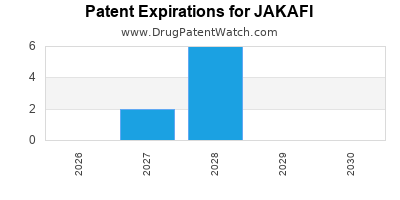

DrugPatentWatch® Estimated Loss of Exclusivity (LOE) Date for JAKAFI
Generic Entry Date for JAKAFI*:
Constraining patent/regulatory exclusivity:
NDA:
Dosage:
TABLET;ORAL |
*The generic entry opportunity date is the latter of the last compound-claiming patent and the last regulatory exclusivity protection. Many factors can influence early or later generic entry. This date is provided as a rough estimate of generic entry potential and should not be used as an independent source.
Recent Clinical Trials for JAKAFI
Identify potential brand extensions & 505(b)(2) entrants
| Sponsor | Phase |
|---|---|
| University of Pennsylvania | PHASE2 |
| National Heart, Lung, and Blood Institute (NHLBI) | PHASE2 |
| Incyte Corporation | PHASE2 |
Pharmacology for JAKAFI
| Drug Class | Janus Kinase Inhibitor Kinase Inhibitor |
| Mechanism of Action | Janus Kinase Inhibitors |
Paragraph IV (Patent) Challenges for JAKAFI
| Tradename | Dosage | Ingredient | Strength | NDA | ANDAs Submitted | Submissiondate |
|---|---|---|---|---|---|---|
| JAKAFI | Tablets | ruxolitinib phosphate | 5 mg, 10 mg, 15 mg, 20 mg, and 25 mg | 202192 | 1 | 2015-12-17 |
US Patents and Regulatory Information for JAKAFI
JAKAFI is protected by eight US patents and six FDA Regulatory Exclusivities.
Based on analysis by DrugPatentWatch, the earliest date for a generic version of JAKAFI is ⤷ Start Trial.
This potential generic entry date is based on patent ⤷ Start Trial.
Generics may enter earlier, or later, based on new patent filings, patent extensions, patent invalidation, early generic licensing, generic entry preferences, and other factors.
| Applicant | Tradename | Generic Name | Dosage | NDA | Approval Date | TE | Type | RLD | RS | Patent No. | Patent Expiration | Product | Substance | Delist Req. | Exclusivity Expiration |
|---|---|---|---|---|---|---|---|---|---|---|---|---|---|---|---|
| Incyte Corp | JAKAFI XR | ruxolitinib phosphate | TABLET, EXTENDED RELEASE;ORAL | 217180-005 | May 1, 2026 | RX | Yes | Yes | ⤷ Start Trial | ⤷ Start Trial | ⤷ Start Trial | ||||
| Incyte Corp | JAKAFI XR | ruxolitinib phosphate | TABLET, EXTENDED RELEASE;ORAL | 217180-001 | May 1, 2026 | RX | Yes | No | ⤷ Start Trial | ⤷ Start Trial | Y | ⤷ Start Trial | |||
| Incyte Corp | JAKAFI | ruxolitinib phosphate | TABLET;ORAL | 202192-003 | Nov 16, 2011 | RX | Yes | No | ⤷ Start Trial | ⤷ Start Trial | ⤷ Start Trial | ||||
| Incyte Corp | JAKAFI | ruxolitinib phosphate | TABLET;ORAL | 202192-003 | Nov 16, 2011 | RX | Yes | No | ⤷ Start Trial | ⤷ Start Trial | Y | ⤷ Start Trial | |||
| >Applicant | >Tradename | >Generic Name | >Dosage | >NDA | >Approval Date | >TE | >Type | >RLD | >RS | >Patent No. | >Patent Expiration | >Product | >Substance | >Delist Req. | >Exclusivity Expiration |
International Patents for JAKAFI
When does loss-of-exclusivity occur for JAKAFI?
Based on analysis by DrugPatentWatch, the following patents block generic entry in the countries listed below:
Australia
Patent: 08266183
Patent: Salts of the Janus kinase inhibitor (R)-3-(4-(7H-pyrrolo[2,3-d]pyrimidin-4-yl)-1H-pyrazol-1-yl)-3-cyclopentylpropanenitrile
Estimated Expiration: ⤷ Start Trial
Brazil
Patent: 0814254
Patent: SAIS DO INIBIDOR DE JANUS QUINASE(R)-3(-4(7H-PIRROLO[2,3-D]PIRIMIDIN-4-IL)-1H-PIRAZ OL-1-IL)-3-CICLOPENTILPROPANONITRILA
Estimated Expiration: ⤷ Start Trial
Canada
Patent: 89663
Patent: SELS DE L'INHIBITEUR (7H-PYRROLO[2,3-D]PYRIMIDIN-4-YL)-1H-PYRAZ OL-1-YL)-3-CYCLOPENTYLPROPANENITRILE DE LA JANUS KINASE (SALTS OF THE JANUS KINASE INHIBITOR (7H-PYRROLO[2,3-D]PYRIMIDIN -4-YL)-1H-PYRAZOL-1-YL)-3-CYCLOPENTYLPROPANENITRILE)
Estimated Expiration: ⤷ Start Trial
China
Patent: 1932582
Patent: Salts of the janus kinase inhibitor (r)-3-(4-(7h-pyrrolo[2,3-d]pyrimidin-4-yl)-1h-pyrazol-1-yl)-3-cyclopentylpropanenitrile
Estimated Expiration: ⤷ Start Trial
Patent: 3524509
Patent: Salts of the janus kinase inhibitor (r)-3-(4-(7h-pyrrolo[2,3-d]pyrimidin-4-yl)-1h-pyrazol-1-yl)-3-cyclopentylpropanenitrile
Estimated Expiration: ⤷ Start Trial
Colombia
Patent: 51256
Patent: SALES DEL INHIBIDOR DE JANUS CINASA (R)-3-(4-(7H-PIRROLO[2,3-D]PIRIMIDIN-4IL)1H-PIRAZOL-1-IL)-3-CICLOPENTILPROPANITRILO
Estimated Expiration: ⤷ Start Trial
Costa Rica
Patent: 151
Patent: SALES DEL INHIBIDOR DE JANUS CINASA (R)-3-(4-(7H-PIRROLO[2,3-CICLOPENTILPROPANITRILO
Estimated Expiration: ⤷ Start Trial
Croatia
Patent: 0140541
Estimated Expiration: ⤷ Start Trial
Patent: 0160717
Estimated Expiration: ⤷ Start Trial
Patent: 0190385
Estimated Expiration: ⤷ Start Trial
Cuba
Patent: 933
Patent: SALES DEL INHIBIDOR DE JANUS CINASA (R)-3-(4-(7H-PIRROLO[2,3-D]PIRIMIDIN-4-IL)-1H-PIRAZOL-1-IL)-3-CICLOPENTILPROPANITRILO
Estimated Expiration: ⤷ Start Trial
Patent: 179
Patent: SALES DE ÁCIDO MALEICO Y DE ÁCIDO SULFÚRICO DE (R)-3-(4-(7H-PIRROLO[2,3-d]PIRIMIDIN-4-IL)-1H-PIRAZOL-1-IL)-3-CICLOPENTILPROPANITRILO
Estimated Expiration: ⤷ Start Trial
Patent: 090213
Patent: SALES DEL INHIBIDOR DE JANUS CINASA (R)-3-(4-(7H-PIRROLO[2,3-D]PIRIMIDIN-4-IL)-1H-PIRAZOL-1-IL)-3-CICLOPENTILPROPANITRILO
Estimated Expiration: ⤷ Start Trial
Patent: 120155
Patent: SALES DE ÁCIDO MALEICO Y DE ÁCIDO SULFÚRICO DE (R)-3-(4-(7H-PIRROLO[2,3-d]PIRIMIDIN-4-IL)-1H-PIRAZOL-1-IL)-3-CICLOPENTILPROPANITRILO
Estimated Expiration: ⤷ Start Trial
Cyprus
Patent: 15145
Estimated Expiration: ⤷ Start Trial
Patent: 17693
Estimated Expiration: ⤷ Start Trial
Patent: 21338
Estimated Expiration: ⤷ Start Trial
Denmark
Patent: 73752
Estimated Expiration: ⤷ Start Trial
Patent: 40731
Estimated Expiration: ⤷ Start Trial
Patent: 70090
Estimated Expiration: ⤷ Start Trial
Dominican Republic
Patent: 009000280
Patent: SALES DEL INHIBIDOR DE JANUS CINASA (R)-3-(4-(7H-PIRROLO[2,3-D]PIRIMIDIN-4-IL)-1H-PIRAZOL-1-IL)-3-CICLOPENTILPROPANITRILO
Estimated Expiration: ⤷ Start Trial
Ecuador
Patent: 099802
Patent: SALES DEL INHIBIDOR DE JANUS CINASA (R)-3-(4-(7H-PIRROLO[2,3-d]PIRIMIDIN-4-IL)-1H-PIRAZOL-1-IL)-3- CICLOPENTILPROPANITRILO
Estimated Expiration: ⤷ Start Trial
Eurasian Patent Organization
Patent: 9784
Patent: СОЛИ ИНГИБИТОРА ЯНУС-КИНАЗЫ (R)-3-(4-(7H-ПИРРОЛО[2,3-d]ПИРИМИДИН-4-ИЛ)-1H-ПИРАЗОЛ-1-ИЛ)-3-ЦИКЛОПЕНТИЛПРОПАННИТРИЛА (SALTS OF THE JANUS KINASE INHIBITOR (R)-3-(4-(7H-PYRROLO[2,3-d]PYRIMIDIN-4-YL)-1H-PYRAZOL-1-YL)-3-CYCLOPENTYLPROPANENITRILE)
Estimated Expiration: ⤷ Start Trial
Patent: 1070013
Patent: СОЛИ ИНГИБИТОРА ЯНУС-КИНАЗЫ (R)-3-(4-(7H-ПИРРОЛО[2,3-d]ПИРИМИДИН-4-ИЛ)-1H-ПИРАЗОЛ-1-ИЛ)-3-ЦИКЛОПЕНТИЛПРОПАННИТРИЛА (SALTS OF THE JANUS KINASE INHIBITOR (R)-3-(4-(7H-PYRROLO[2,3-d]PYRIMIDIN-4-YL)-1H-PYRAZOL-1-YL)-3-CYCLOPENTYLPROPANENITRILE)
Estimated Expiration: ⤷ Start Trial
European Patent Office
Patent: 73752
Patent: SELS DE L'INHIBITEUR (R)-3-(4-(7H-PYRROLO(2,3-D)PYRIMIDIN-4-YL)-1H-PYRAZOL-1-YL)-3-CYCLOPENTYLPROPANENITRILE DE LA JANUS KINASE (SALTS OF THE JANUS KINASE INHIBITOR (R)-3-(4-(7H-PYRROLO(2,3-D)PYRIMIDIN-4-YL)-1H-PYRAZOL-1-YL)-3-CYCLOPENTYLPROPANENITRILE)
Estimated Expiration: ⤷ Start Trial
Patent: 40731
Patent: Sels cristallines de l'inhibiteur de janus kinase (r)-3-(4- (7h-pyrrolo [2,3-d] pyrimidin-4-yl)-1h-pyrazol-1-yl) -3-cyclopentylpropanenitrile (CRYSTALLINE SALTS OF THE JANUS KINASE INHIBITOR (R)-3-(4-(7H-PYRROLO[2,3-D]PYRIMIDIN-4-YL)-1H-PYRAZOL-1-YL)-3-CYCLOPENTYLPROPANENITRILE)
Estimated Expiration: ⤷ Start Trial
Patent: 70090
Patent: UTILISATION DES SELS DE L'INHIBITEUR DE JANUS KINASE (R)-3-(4- (7H-PYRROLO [2,3-D] PYRIMIDIN-4-YL)-1H-PYRAZOL-1-YL) -3-CYCLOPENTYLPROPANENITRILE (USE OF SALTS OF THE JANUS KINASE INHIBITOR (R)-3-(4-(7H-PYRROLO[2,3-D]PYRIMIDIN-4-YL)-1H- PYRAZOL-1-YL)-3- CYCLOPENTYLPROPANENITRILE)
Estimated Expiration: ⤷ Start Trial
Patent: 95369
Patent: UTILISATION DES SELS DE L'INHIBITEUR DE JANUS KINASE (R)-3-(4-(7H-PYRROLO [2,3-D]PYRIMIDIN-4-YL)-1H-PYRAZOL-1-YL)-3-CYCLOPENTYLPROPANENITRILE (USE OF SALTS OF THE JANUS KINASE INHIBITOR (R)-3-(4-(7H-PYRROLO[2,3-D]PYRIMIDIN-4-YL)-1H- PYRAZOL-1-YL)-3- CYCLOPENTYLPROPANENITRILE)
Estimated Expiration: ⤷ Start Trial
Patent: 11883
Patent: SELS DE L'INHIBITEUR DE JANUS KINASE (R)-3-(4-(7H-PYRROLO[2,3-D -1H-]PYRIMIDINE-4-YL) -1H-PYRAZOL-1-YL)-3-CYCLOPENTYLPROPANENITRILE (SALTS OF THE JANUS KINASE INHIBITOR (R)-3-(4-(7H-PYRROLO[2,3-D]PYRIMIDIN-4-YL)-1H- PYRAZOL-1-YL)-3-CYCLOPENTYLPROPANENITRILE)
Estimated Expiration: ⤷ Start Trial
Patent: 06378
Patent: SELS DE L'INHIBITEUR DE JANUS KINASE (R)-3-( 4-(7H-PYRROLO[2,3-D!PYRIMIDIN-4-YL)-1H-PYRAZOL-1-YL)-3-CYCLOPENTYLPROP AENITRILE (SALTS OF THE JANUS KINASE INHIBITOR (R)-3-( 4-(7H-PYRROLO[2,3-D]PYRIMIDIN-4-YL)-1H-PYRAZOL-1-YL)-3- CYCLOPENTYLPROP ANENITRILE)
Estimated Expiration: ⤷ Start Trial
Georgia, Republic of
Patent: 0125533
Patent: SALTS OF THE JANUS KINASE INHIBITOR (R)-3-(4-(7H-PYRROLO[2,3-D]PYRIMIDIN-4-YL)-1H-PYRAZOL-1-YL)-3-CYCLOPENTYL PROPANENITRILE
Estimated Expiration: ⤷ Start Trial
Guatemala
Patent: 0900314
Patent: SALES DEL INHIBIDOR DE JANUS CINASA (R)-3-(4-(7H-PIRROLO [2,3-D] PIRIMIDIN-4-IL)-1H-PIRAZOL-1-IL)-3-CICLOPENTILPROPANITRILO
Estimated Expiration: ⤷ Start Trial
Hong Kong
Patent: 43161
Patent: 激酶抑制劑 -吡咯 嘧啶- -基 -吡唑- -基 -環戊基丙腈的鹽 (SALTS OF THE JANUS KINASE INHIBITOR (R)-3-(4-(7H-PYRROLO[2,3-D]PYRIMIDIN-4- YL)-1H-PYRAZOL-1-YL)-3-CYCLOPENTYLPROPANENITRILE JANUS (R)-3-(4-(7H-[23-D]-4-)-1H--1-)-3-)
Estimated Expiration: ⤷ Start Trial
Patent: 98652
Patent: 激酶抑制劑 -吡咯 嘧啶- -基 -吡唑- -基 -環戊基丙腈的結晶鹽 (CRYSTALLINE SALTS OF THE JANUS KINASE INHIBITOR (R)-3-(4-(7H-PYRROLO[2,3- D]PYRIMIDIN-4-YL)-1H-PYRAZOL-1-YL)-3-CYCLOPENTYLPROPANENITRILE JANUS (R)-3-(4-(7H-[23-D]-4-)-1H--1-)-3-)
Estimated Expiration: ⤷ Start Trial
Hungary
Patent: 29236
Estimated Expiration: ⤷ Start Trial
Patent: 43732
Estimated Expiration: ⤷ Start Trial
Israel
Patent: 2524
Patent: מלחים של מדכא ג'אנוס קינאס (r)–3– (4–(7h–פירולו[d–3, 2]פירימידין –4–איל)–h 1–פיראזול–1–איל)–3–ציקלופנטילפרופאנאניטריל (Salts of the janus kinase inhibitor (r)-3-(4-(7 h-pyrrolo[2,3-d]pyrimidin-4-yl)-1h-pyrazol-1-yl)-3-cyclopentylpropanenitrile)
Estimated Expiration: ⤷ Start Trial
Patent: 4276
Patent: מלחים של מדכא ג'אנוס קינאס (r)– 3– (4–(h7–פירולו[d – 2,3]פירימידין–4–איל)–1h–פיראזול–1l–איל)–3–ציקלופנטילפרופאנאניטריל (Salts of the janus kinase inhibitor (r)-3-(4-(7h-pyrrolo[2,3-d]pyrimidin-4-yl)-1h-pyrazol-1-yl)-3-)
Estimated Expiration: ⤷ Start Trial
Patent: 0401
Patent: מלחים של מדכא ג'אנוס קינאס (r)- 3- (4-(h7-פירולו[d – 2,3]פירימידין-4-איל)-1h-פיראזול-1l-איל)-3-ציקלופנטילפרופאנאניטריל (Salts of the janus kinase inhibitor (r)-3-(4-(7h-pyrrolo[2,3-d]pyrimidin-4-yl)-1h-pyrazol-1-yl)-3-cyclopentylpropanenitrile)
Estimated Expiration: ⤷ Start Trial
Patent: 7708
Patent: מלחים של מדכא ג'אנוס קינאס (r)– 3– (4–(h7–פירולו[d – 2,3]פירימידין–4–איל)–1h–פיראזול–1l–איל)–3–ציקלופנטילפרופאנאניטריל (Salts of the janus kinase inhibitor (r)-3-(4-(7h-pyrrolo[2,3-d]pyrimidin-4-yl)-1h-pyrazol-1-yl)-3-cyclopentylpropanenitrile)
Estimated Expiration: ⤷ Start Trial
Japan
Patent: 75653
Estimated Expiration: ⤷ Start Trial
Patent: 10529209
Estimated Expiration: ⤷ Start Trial
Lithuania
Patent: 70090
Estimated Expiration: ⤷ Start Trial
Malaysia
Patent: 4969
Patent: SALTS OF THE JANUS KINASE INHIBITOR (R)-3-(4-(7H-PYRROLO[2,3-D]PYRIMIDIN-4-YL)-1H-PYRAZOL-1-YL)-3-CYCLOPENTYLPROPANENITRILE
Estimated Expiration: ⤷ Start Trial
Mexico
Patent: 2814
Patent: SALES DE INHIBIDOR DE JANUS CINASA (R)-3-(4-7H-PIRROLO[2,3-D]PIRIM IDIN-4-IL)-1H-PIRAZOL-1-IL)-3-CICLOPENTILPROPANITRILO. (SALTS OF THE JANUS KINASE INHIBITOR (R)-3-(4-(7H-PYRROLO[2,3-D]PY RIMIDIN-4-YL)-1H-PYRAZOL-1-YL)-3-CYCLOPENTYLPROPANENITRILE.)
Estimated Expiration: ⤷ Start Trial
Patent: 09013402
Patent: SALES DE INHIBIDOR DE JANUS CINASA (R)-3-(4-(7H-PIRROLO[2,3-D]PIRI MIDIN-4-IL)-1H-PIRAZOL-1-IL)-3-CICLOPENTILPROPANITRILO. (SALTS OF THE JANUS KINASE INHIBITOR (R)-3-(4-(7H-PYRROLO[2,3-D]PY RIMIDIN-4-YL)-1H-PYRAZOL-1-YL)-3-CYCLOPENTYLPROPANENITRILE.)
Estimated Expiration: ⤷ Start Trial
Montenegro
Patent: 960
Patent: SOLI INHIBITORA JANUS KINAZE, (R)-3-(4-(7H-PIROL[2,3-D]PIRIMIDIN-4-IL)-1H-PIRAZOL-1-IL)-3-CIKLOPENTILPROPANNITRILA (SALTS OF THE JANUS KINASE INHIBITOR (R)-3-(4-(7H-PYRROLO[2,3-D]PYRIMIDIN-4-YL)-1H-PYRAZOL-1-YL)-3-CYCLOPENTYLPROPANENITRILE)
Estimated Expiration: ⤷ Start Trial
Morocco
Patent: 517
Patent: املاح المثبط (r)-3-(4-(7h-البيرولو(3،2- d)بيرميدين-4- yl)- 1h-بيرازول-1- yl)-3_ سيكلوبينتيلبروباننيتريل من يانوس الكيناز.
Estimated Expiration: ⤷ Start Trial
New Zealand
Patent: 1803
Patent: SALTS OF THE JANUS KINASE INHIBITOR (R)-3-(4-(7H-PYRROLO[2,3-D]PYRIMIDIN-4-YL)-1H-PYRAZOL-1-YL)-3-CYCLOPENTYLPROPANENITRILE
Estimated Expiration: ⤷ Start Trial
Nicaragua
Patent: 0900216
Patent: SALES DE INHIBIDOR DE JANUS CINASA ( R ) - ( 3 ) - ( 4 - ( 7H - PIRROLO [ 2,3-D ] PIRIMIDIN - 4 - IL ) - 1H - PIRAZOL - 1 - IL) - 3 - CICLOPENTILPROPANENITRILO.
Estimated Expiration: ⤷ Start Trial
Norway
Patent: 19025
Estimated Expiration: ⤷ Start Trial
Poland
Patent: 73752
Estimated Expiration: ⤷ Start Trial
Patent: 40731
Estimated Expiration: ⤷ Start Trial
Patent: 70090
Estimated Expiration: ⤷ Start Trial
Portugal
Patent: 73752
Estimated Expiration: ⤷ Start Trial
Patent: 70090
Estimated Expiration: ⤷ Start Trial
San Marino
Patent: 201000002
Estimated Expiration: ⤷ Start Trial
Patent: 01000002
Estimated Expiration: ⤷ Start Trial
Serbia
Patent: 245
Estimated Expiration: ⤷ Start Trial
Patent: 878
Estimated Expiration: ⤷ Start Trial
Patent: 449
Estimated Expiration: ⤷ Start Trial
Singapore
Patent: 201509887U
Estimated Expiration: ⤷ Start Trial
Patent: 201912675V
Estimated Expiration: ⤷ Start Trial
Patent: 2198
Estimated Expiration: ⤷ Start Trial
Slovenia
Patent: 73752
Estimated Expiration: ⤷ Start Trial
Patent: 40731
Estimated Expiration: ⤷ Start Trial
Patent: 70090
Estimated Expiration: ⤷ Start Trial
South Africa
Patent: 0908826
Estimated Expiration: ⤷ Start Trial
South Korea
Patent: 1549876
Estimated Expiration: ⤷ Start Trial
Patent: 100049010
Patent: 야누스 키나제 억제제(R)―3―(4―(7H―피롤로[2,3-d]피리미딘―4―일)―1H―피라졸―1―일)―3―사이클로펜틸프로판니트릴의 염 (SALTS OF THE JANUS KINASE INHIBITOR (R)-3-(4-(7H-PYRROLO[2,3-D]PYRIMIDIN-4-YL)-1H-PYRAZOL-1-YL)-3-CYCLOPENTYLPROPANENITRILE)
Estimated Expiration: ⤷ Start Trial
Patent: 150036210
Patent: 야누스 키나제 억제제(R)―3―(4―(7H―피롤로[2,3-d]피리미딘―4―일)―1H―피라졸―1―일)―3―사이클로펜틸프로판니트릴의 염 (Salts of the Janus kinase inhibitor (R)-3-(4-(7H-pyrrolo[2,3-d]pyrimidin-4-yl)-1H-pyrazol-1-yl)-3-cyclopentylpropanenitrile)
Estimated Expiration: ⤷ Start Trial
Spain
Patent: 67665
Estimated Expiration: ⤷ Start Trial
Patent: 75797
Estimated Expiration: ⤷ Start Trial
Patent: 14092
Estimated Expiration: ⤷ Start Trial
Patent: 03444
Estimated Expiration: ⤷ Start Trial
Tunisia
Patent: 09000514
Estimated Expiration: ⤷ Start Trial
Turkey
Patent: 1903488
Estimated Expiration: ⤷ Start Trial
Ukraine
Patent: 467
Estimated Expiration: ⤷ Start Trial
Generics may enter earlier, or later, based on new patent filings, patent extensions, patent invalidation, early generic licensing, generic entry preferences, and other factors.
See the table below for additional patents covering JAKAFI around the world.
| Country | Patent Number | Title | Estimated Expiration |
|---|---|---|---|
| Australia | 2008266183 | ⤷ Start Trial | |
| Brazil | PI0814254 | ⤷ Start Trial | |
| Canada | 2689663 | ⤷ Start Trial | |
| China | 101932582 | ⤷ Start Trial | |
| >Country | >Patent Number | >Title | >Estimated Expiration |
Supplementary Protection Certificates for JAKAFI
| Patent Number | Supplementary Protection Certificate | SPC Country | SPC Expiration | SPC Description |
|---|---|---|---|---|
| 1966202 | C300574 | Netherlands | ⤷ Start Trial | PRODUCT NAME: RUXOLITINIB OF EEN FARMACEUTISCH AANVAARDBAAR ZOUT DAARVAN; REGISTRATION NO/DATE: EU/1/12/773/001-003 20120823 |
| 1966202 | PA2013002 | Lithuania | ⤷ Start Trial | |
| 1966202 | CA 2013 00005 | Denmark | ⤷ Start Trial | |
| 1966202 | C20130003 00072 | Estonia | ⤷ Start Trial | PRODUCT NAME: RUKSOLITINIIB;REG NO/DATE: K(2012)6018 LOPLIK 23.08.2012 |
| >Patent Number | >Supplementary Protection Certificate | >SPC Country | >SPC Expiration | >SPC Description |
Jakafi (ruxolitinib) market dynamics and financial trajectory: exclusivity, competitive pressure, and revenue outlook
More… ↓
Make Better Decisions: Try a trial or see plans & pricing
Drugs may be covered by multiple patents or regulatory protections. All trademarks and applicant names are the property of their respective owners or licensors. Although great care is taken in the proper and correct provision of this service, thinkBiotech LLC does not accept any responsibility for possible consequences of errors or omissions in the provided data. The data presented herein is for information purposes only. There is no warranty that the data contained herein is error free. We do not provide individual investment advice. This service is not registered with any financial regulatory agency. The information we publish is educational only and based on our opinions plus our models. By using DrugPatentWatch you acknowledge that we do not provide personalized recommendations or advice. thinkBiotech performs no independent verification of facts as provided by public sources nor are attempts made to provide legal or investing advice. Any reliance on data provided herein is done solely at the discretion of the user. Users of this service are advised to seek professional advice and independent confirmation before considering acting on any of the provided information. thinkBiotech LLC reserves the right to amend, extend or withdraw any part or all of the offered service without notice.
ISSN: 2162-2639

Privacy and Cookies
Terms & Conditions
Site Map
DrugPatentWatch Alternatives
LOE / Major Patent Expirations 2026 - 2027
NCE-1 Patent Challenge Dates 2026 - 2027
Friedman, Yali. "DrugPatentWatch" DrugPatentWatch, thinkBiotech, 2026, www.DrugPatentWatch.com.
See Primary Research Papers Citing DrugPatentWatch