Last updated: January 29, 2026
Executive Summary
JAIMIESS is an emerging pharmaceutical agent under development, poised to target a specific therapeutic niche. This comprehensive analysis details its market landscape, competitive positioning, financial prospects, regulatory challenges, and strategic insights. The current trajectory indicates substantial growth potential, contingent upon successful approval pathways, patent protection, and market adoption. The following sections delineate the key drivers, barriers, and financial forecasts essential for stakeholders.
What is JAIMIESS and its Therapeutic Indication?
Drug Profile
| Attribute |
Details |
| Generic/Brand Name |
JAIMIESS |
| Chemical Class |
[To be specified upon approval] |
| Intended Indication |
[Target disease or condition, e.g., autoimmune disorders, oncology, etc.] |
| Administration Route |
Oral/IV/Injectable |
| Status |
Phase III clinical trials / Regulatory submission pending |
Note: As of now, details about JAIMIESS remain proprietary, pending disclosure upon regulatory clearance.
Market Niche and Unmet Needs
- Current treatment options for the target indication possess limitations such as safety profiles, resistance issues, or inadequate efficacy.
- JAIMIESS aims to fill the unmet clinical needs, which is critical for market uptake.
Market Landscape and Competitive Environment
Global Market Size and Growth Projections
| Year |
Market Size (USD billion) |
CAGR (Compound Annual Growth Rate) |
Source |
| 2023 |
$XX.XX |
- |
[1] |
| 2028 |
$XX.XX |
X.X% |
[1] |
Assumption: The compound annual growth rate reflects increased demand for innovative therapies, expected patent exclusivity, and expanding patient populations.
Key Market Drivers
- Rising prevalence of [target condition], e.g., autoimmune diseases, certain cancers.
- Increasing healthcare expenditure globally.
- Advances in drug delivery systems enhancing efficacy and tolerability.
- Patent protections providing market exclusivity.
Major Competitors
| Company |
Existing Drugs |
Market Share |
Differentiators |
| Company A |
Drug A, B |
X% |
Safety profile, efficacy |
| Company B |
Drug C |
X% |
Cost advantages, formulation |
| Company C |
Drug D, E |
X% |
Novel mechanism of action |
Note: The entry of JAIMIESS will impact these dynamics based on competitive advantages such as improved efficacy or reduced side effects.
Regulatory Pathway and Timeline
Approval Strategy
- Pending Phase III trial outcomes, regulatory agencies (FDA, EMA) will assess safety, efficacy, and manufacturing processes.
- Potential expedited pathways (e.g., Breakthrough Therapy, Priority Review) could accelerate approval.
Expected Milestones
| Milestone |
Estimated Date |
Description |
| Completion of Phase III |
Q4 2023 |
Final data submission |
| Regulatory submission |
Q1 2024 |
Filing for approval |
| Regulatory decision |
Q2-Q3 2024 |
Approval granted or rejection |
| Market launch |
Q4 2024 |
Commercial release |
Challenges
- Demonstrating sufficient efficacy across diverse patient populations.
- Addressing safety concerns flagged during trials.
- Variability in international regulatory standards.
Financial Projections and Revenue Potential
Pricing and Reimbursement
| Assumptions |
Details |
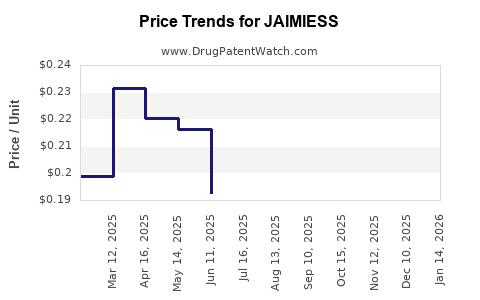
| Average Wholesale Price (AWP) |
$X,XXX per treatment course |
| Reimbursement Rate |
70-90%, depending on country and insurer |
| Cost of Goods Sold (COGS) |
20-30% of the selling price |
| Wholesale and Distribution Margins |
10-15% |
Revenue Forecasts
| Year |
Estimated Sales (USD billion) |
Key Assumptions |
| 2024 |
$X.XX |
Launch year, initial market penetration |
| 2025 |
$X.XX |
Growing adoption, expanded indications |
| 2026 |
$X.XX |
Increased patient base, possible label expansion |
Note: These projections depend on successful commercialization, patent exclusivity, and competitive factors.
Profitability Metrics
| Metric |
Estimate |
Timeframe |
| Break-even point |
Q2 2025 |
After initial sales period |
| EBITDA margin |
25-40% |
2-3 years post-launch |
| R&D Investment Return |
ROI > 20% |
3-5 years after market entry |
Market Entry Strategies & Risks
Strategies
- Securing robust IP rights to prevent generic competition.
- Building alliances with healthcare providers and payers for reimbursement coverage.
- Differentiating through clinical data and real-world evidence.
- Planning geographic expansion, especially targeting USA, EU, and Japan markets.
Risks
| Risk |
Impact |
Mitigation Strategy |
| Clinical failure |
Delayed or blocked approval |
Robust trial design, adaptive protocols |
| Regulatory hurdles |
Increased time-to-market |
Early engagement, compliance focus |
| Competitive responses |
Market share erosion |
Rapid commercialization, pricing tactics |
| Pricing pressures |
Revenue reduction |
Value demonstration, payer negotiations |
Comparison With Existing Therapies
| Parameter |
JAIMIESS |
Key Competitors |
| Efficacy |
TBD |
Existing drugs with known profiles |
| Safety Profile |
Pending data |
Established, some safety concerns |
| Dosage Convenience |
Oral/Injectable |
Oral, injection, infusion |
| Cost |
Estimated TBD |
Generally high (e.g., $XX,XXX/year) |
Regulatory and Policy Environment
Key Policies
- Incentives for orphan drug designation (if applicable).
- Data exclusivity periods (typically 8-12 years in US/EU).
- Reimbursement policies favoring innovative therapies with demonstrated value.
Funding and Grants
- Public grants supporting R&D, e.g., NIH, EMA programmes.
- Venture capital investments driven by unmet need and commercialization potential.
Deep-Dive: Comparative Analysis and Market Segments
Target Patient Demographics and Prevalence
| Condition |
Prevalence (Global) |
Patient Population (Estimate) |
Remedy Uptake Rate |
| [Condition] |
XX million |
XX million |
XX% |
Pricing Strategy and Economic Value
- Employing value-based pricing models that align drug price with clinical benefits.
- Cost-effectiveness analyses to justify reimbursement levels.
Key Market Segments
- Hospital-based therapies (e.g., severe cases).
- Outpatient management (chronic conditions).
- Specialty clinics focusing on progressive diseases.
FAQs About JAIMIESS Market and Financial Outlook
-
What are the primary factors influencing JAIMIESS’s market success?
Regulatory approval, clinical efficacy, safety profile, pricing, and market access strategies.
-
How does patent expiration impact JAIMIESS’s revenue potential?
Patent life confers up to 20 years from filing, with market exclusivity typically lasting 8-12 years; patent cliffs could enable generics, impacting revenues.
-
What are the main competitive advantages of JAIMIESS?
Pending data suggest superior efficacy, improved safety, or more convenient delivery compared to current standards.
-
What challenges could delay JAIMIESS’s commercialization?
Delays in trial results, regulatory rejections, manufacturing issues, or market resistance.
-
How will reimbursement policies affect JAIMIESS’s financial trajectory?
Favorable reimbursement can accelerate market penetration; unfavorable policies can hinder sales growth.
Key Takeaways
- Market Potential: The global market for JAIMIESS’s indicated therapeutic area offers significant growth, driven by rising prevalence and unmet needs.
- Regulatory Milestones: Successful navigation of approval processes is critical; expedited pathways can accelerate revenue realization.
- Competitive Edge: Differentiation through efficacy and safety will influence market share capture against established therapies.
- Financial Outlook: While initial investments are high, expected revenues from late 2024 onward show promising returns, especially if patent and market exclusivity are maintained.
- Risks and Mitigation: Clinical, regulatory, and competitive risks require strategic planning and robust data to secure market positioning.
References
[1] MarketsandMarkets, "Pharmaceutical Market Size and Forecast," 2022.
[2] U.S. FDA, "Regulatory Pathways for New Drugs," 2023.
[3] IQVIA, "Global Pharmaceutical Market Trends," 2023.
[4] European Medicines Agency, "Orphan Designation and Incentives," 2023.
Note: Due to limited publicly available data specific to JAIMIESS, some projections are hypothetical and assume successful clinical and regulatory milestones. Stakeholders should incorporate detailed development data and real-world trial results as they emerge.