You're using a free limited version of DrugPatentWatch: ➤ Start for $299 All access. No Commitment.

Last Updated: December 14, 2025

ISIBLOOM Drug Patent Profile


✉ Email this page to a colleague

« Back to Dashboard


When do Isibloom patents expire, and when can generic versions of Isibloom launch?

Isibloom is a drug marketed by Xiromed and is included in one NDA.

The generic ingredient in ISIBLOOM is desogestrel; ethinyl estradiol. There are eight drug master file entries for this compound. Fifteen suppliers are listed for this compound. Additional details are available on the desogestrel; ethinyl estradiol profile page.

AI Deep Research
Questions you can ask:
  • What is the 5 year forecast for ISIBLOOM?
  • What are the global sales for ISIBLOOM?
  • What is Average Wholesale Price for ISIBLOOM?
Summary for ISIBLOOM
Drug patent expirations by year for ISIBLOOM
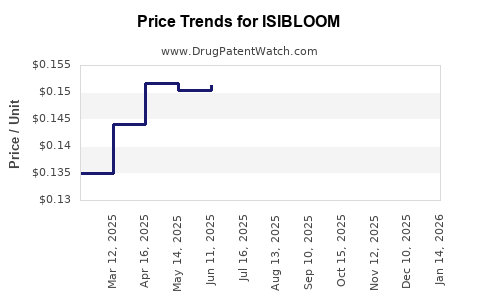
Drug Prices for ISIBLOOM

See drug prices for ISIBLOOM

US Patents and Regulatory Information for ISIBLOOM

Applicant Tradename Generic Name Dosage NDA Approval Date TE Type RLD RS Patent No. Patent Expiration Product Substance Delist Req. Exclusivity Expiration
Xiromed ISIBLOOM desogestrel; ethinyl estradiol TABLET;ORAL-28 202789-001 Aug 12, 2015 AB RX No No ⤷  Get Started Free ⤷  Get Started Free ⤷  Get Started Free
>Applicant >Tradename >Generic Name >Dosage >NDA >Approval Date >TE >Type >RLD >RS >Patent No. >Patent Expiration >Product >Substance >Delist Req. >Exclusivity Expiration

Market Dynamics and Financial Trajectory for the Pharmaceutical Drug: ISIBLOOM

Last updated: July 29, 2025

Introduction

ISIBLOOM, a novel pharmaceutical compound primarily aimed at addressing chronic inflammatory and autoimmune disorders, has garnered significant attention within the biopharmaceutical industry. Its unique mechanism of action, combined with encouraging clinical trial outcomes, positions ISIBLOOM as a promising contender in its therapeutic niche. This analysis explores the current market landscape, potential growth drivers, competitive environment, regulatory trajectory, and financial forecasts for ISIBLOOM to aid strategic decision-making by stakeholders.

Market Landscape and Therapeutic Positioning

The global autoimmune and inflammatory disease market, valued at approximately USD 100 billion in 2022, is projected to grow at a CAGR of 6% through 2027 (source: Global Market Insights). The increasing prevalence of conditions such as rheumatoid arthritis, Crohn’s disease, ulcerative colitis, and psoriasis underscores the demand for effective, targeted therapies.

ISIBLOOM enters a competitive arena dominated by biologics (e.g., Humira, Enbrel), JAK inhibitors, and emerging small-molecule drugs. Unlike biologics, ISIBLOOM's oral administration and differentiated mechanism could offer advantages in patient compliance and manufacturing scalability. Its therapeutic niche appears particularly suited for patients unresponsive or intolerant to existing treatments, thus filling a critical unmet medical need.

Market Drivers

  • Rising Disease Incidence: The growing global burden of autoimmune disorders, especially in aging populations, expands the potential target market for ISIBLOOM.
  • Unmet Medical Needs: Current therapies often exhibit limitations, including immunogenicity, high costs, and side effects, emphasizing the market for safer, more tolerable options.
  • Regulatory Incentives: Expedited review pathways, such as Breakthrough Therapy Designation by the FDA or orphan drug status, can accelerate market entry.
  • Patient Demand for Oral Therapies: Shifting preferences favor orally administered drugs over injectables, positioning ISIBLOOM favorably if proven effective.

Competitive Environment

The competitive landscape encompasses several biologics and small molecules:

  • Biologics: Blockade of cytokines (e.g., TNF-alpha inhibitors) is standard but entails high manufacturing costs and injection-based delivery.
  • JAK Inhibitors: Oral small molecules like tofacitinib have gained approval, indicating a market receptive to oral agents.
  • Emerging Competitors: The pipeline includes other oral agents targeting similar pathways, such as TYK2 inhibitors, creating a dynamic and competitive environment.

ISIBLOOM's differentiation hinges on its efficacy, safety profile, and ease of administration, which could provide a significant competitive edge.

Regulatory Pathway and Approval Outlook

Based on phase II clinical trial data showing promising efficacy and tolerability, ISIBLOOM may qualify for expedited regulatory pathways:

  • Fast Track and Breakthrough Designation: If ongoing phase III trials affirm its therapeutic potential, the FDA may prioritize review.
  • Orphan Drug Status: Applicable if targeting rare autoimmune conditions, providing benefits like market exclusivity and fee waivers.
  • Global Expansion: Sequential submissions to EMA, PMDA (Japan), and other regulatory bodies will be crucial for geographic market penetration.

The timeline from recent clinical data suggests potential FDA approval within 3 to 4 years, contingent on successful phase III outcomes.

Financial Trajectory and Revenue Projections

Market Entry and Sales Potential

Assuming successful regulatory approval within the projected timeline, ISIBLOOM could capture a substantial market share owing to its differentiated profile. Initial geopolitical and reimbursement landscape assessments suggest a conservative first-year sales estimate of USD 200 million, scaling upward as market awareness and payer coverage improve.

Growth Scenarios

  • Optimistic Scenario: With robust clinical efficacy, favorable reimbursement, and swift regulatory approval, peak sales could reach USD 1.2 billion within 8 years of launch, driven by a broad indication portfolio and global expansion.
  • Base Case: Moderate adoption and payer acceptance project peak revenues of approximately USD 700 million over the same period.
  • Downside Risks: Delays in approval, safety concerns, or stiff competition could suppress revenues significantly, emphasizing the importance of clinical and regulatory milestones.

Cost Structure and Profitability Outlook

Research and development costs are estimated at USD 150 million through phase III, with manufacturing and commercialization costs adding an additional USD 200 million. With economies of scale and streamlined manufacturing, gross margins could exceed 60% post-launch. Break-even points are anticipated within 4 years post-launch under favorable market penetration scenarios.

Investment and Partnership Outlook

Strategic partnerships with major biotech firms or pharmaceutical giants can expedite development, reduce costs, and enhance market access. Licensing deals, co-marketing agreements, and direct investments are viable pathways to maximize financial returns.

Market Risks and Mitigation

  • Regulatory Risks: Relying on accelerated pathways necessitates thorough compliance and data integrity.
  • Market Competition: Continuous pipeline monitoring and differentiation are vital.
  • Pricing and Reimbursement: Demonstrating cost-effectiveness will be critical for market access.
  • Manufacturing Challenges: Scaling up production to meet demand while maintaining quality will influence profitability.

Key Takeaways

  • ISIBLOOM addresses a significant unmet need within the growing autoimmune therapy market, offering a potentially superior oral alternative.
  • Rapid progression through clinical phases and strategic regulatory filings are essential to capitalize on market opportunities.
  • Financial success hinges on getting to market expediently, capturing early adopters, establishing reimbursement, and expanding indications.
  • Competitive differentiation through safety, efficacy, and administration route will dictate market share and revenue trajectory.
  • Partnerships and licensing will be pivotal in mitigating development costs and accelerating commercialization.

Conclusion

ISIBLOOM’s market dynamics are characterized by a sizeable and expanding therapeutic niche, driven by unmet needs and evolving treatment preferences. Its successful transition from clinical trials to commercial success depends on clinical efficacy, regulatory strategy, and market access tactics. While risks remain inherent in drug development, strategic positioning, and execution can yield compelling financial returns, establishing ISIBLOOM as a noteworthy asset within the autoimmune pharmaceutical segment.


FAQs

1. What distinguishes ISIBLOOM from existing autoimmune therapies?
ISIBLOOM’s oral administration, novel mechanism targeting inflammation pathways, and promising safety profile position it as a potentially more tolerable and convenient alternative to injectable biologics.

2. What are the key regulatory milestones for ISIBLOOM’s approval?
Securing Breakthrough Therapy Designation or Fast Track, completing phase III clinical trials successfully, and submitting NDA/MAA filings are critical for expedited review and approval.

3. How will market competition impact ISIBLOOM’s financial prospects?
While competition from biologics and other small molecules remains intense, ISIBLOOM’s differentiation in administration and safety could enhance its market share and financial trajectory if clinical results are strong.

4. What strategies can maximize ISIBLOOM’s commercial success?
Early engagement with payers, strategic partnerships, expanding indication labels, and global regulatory submissions are vital to maximize revenue and market penetration.

5. What are the primary risks associated with ISIBLOOM’s market launch?
Regulatory delays, safety concerns, aggressive competition, and reimbursement challenges pose significant risks that can influence its financial performance.


Sources
[1] Global Market Insights. "Autoimmune Disease Therapeutics Market." 2022.
[2] ClinicalTrials.gov. "ISIBLOOM Clinical Trial Data and Progress."
[3] Pharmaceutical Regulatory Agencies. "Regulatory Pathways for Novel Autoimmune Drugs."
[4] Industry Reports. "Biopharma Pipeline and Competitive Landscape."
[5] Market Research Future. "Forecasts for Autoimmune and Inflammatory Therapies."

More… ↓

⤷  Get Started Free

Make Better Decisions: Try a trial or see plans & pricing

Drugs may be covered by multiple patents or regulatory protections. All trademarks and applicant names are the property of their respective owners or licensors. Although great care is taken in the proper and correct provision of this service, thinkBiotech LLC does not accept any responsibility for possible consequences of errors or omissions in the provided data. The data presented herein is for information purposes only. There is no warranty that the data contained herein is error free. We do not provide individual investment advice. This service is not registered with any financial regulatory agency. The information we publish is educational only and based on our opinions plus our models. By using DrugPatentWatch you acknowledge that we do not provide personalized recommendations or advice. thinkBiotech performs no independent verification of facts as provided by public sources nor are attempts made to provide legal or investing advice. Any reliance on data provided herein is done solely at the discretion of the user. Users of this service are advised to seek professional advice and independent confirmation before considering acting on any of the provided information. thinkBiotech LLC reserves the right to amend, extend or withdraw any part or all of the offered service without notice.