Last updated: August 4, 2026
INVEGA HAFYERA is a long-acting injectable formulation of paliperidone palmitate administered once every six months for adults with schizophrenia who have been adequately treated with a one-month or three-month paliperidone palmitate product. Its commercial value is tied to longer dosing intervals, lower administration frequency, and retention of patients within Johnson & Johnson’s INVEGA franchise. J&J does not publicly report HAFYERA revenue separately, so product-level sales and profitability cannot be isolated from the company’s reported INVEGA SUSTENNA and INVEGA TRINZA results.
HAFYERA has a favorable commercial position through the second half of the 2020s. The main risks are slower conversion from monthly and quarterly injections, payer pressure, competing long-acting antipsychotics, and eventual generic challenges to the paliperidone palmitate franchise.
What is INVEGA HAFYERA and how does it work?
INVEGA HAFYERA is an extended-release injectable suspension containing paliperidone palmitate, the active metabolite of risperidone. It is marketed by Janssen Pharmaceuticals, a Johnson & Johnson company.
The FDA approved HAFYERA in July 2021 for the treatment of schizophrenia in adults after stabilization on a one-month paliperidone palmitate product or adequate treatment with a three-month paliperidone palmitate product.[1]
INVEGA HAFYERA dosing and administration
| Attribute |
INVEGA HAFYERA |
| Active ingredient |
Paliperidone palmitate |
| Dosage form |
Extended-release injectable suspension |
| Administration interval |
Every six months |
| Approved population |
Adults with schizophrenia |
| Available strengths |
1,092 mg and 1,560 mg |
| Administration sites |
Gluteal or deltoid muscle |
| Required prior treatment |
Stabilization with INVEGA SUSTENNA or INVEGA TRINZA |
| Manufacturer |
Janssen Pharmaceuticals, Johnson & Johnson |
| FDA approval |
July 2021 |
HAFYERA is not an initiation product. Patients must first demonstrate tolerability and clinical stability on monthly or three-month paliperidone palmitate. This requirement reduces immediate conversion opportunities but supports a sequential franchise strategy: patients can move from monthly SUSTENNA to quarterly TRINZA and then to six-month HAFYERA.
How large is the market for long-acting injectable antipsychotics?
The long-acting injectable antipsychotic market is driven by adherence management, relapse prevention, and reduced treatment-monitoring burden. The relevant population is adults with schizophrenia who have difficulty maintaining adherence to oral medication or who benefit from supervised administration.
HAFYERA competes in a narrower segment than oral antipsychotics because it is limited to patients already stabilized on paliperidone palmitate. The product’s addressable market expands as J&J increases conversion from SUSTENNA and TRINZA.
Key market drivers include:
- Lower injection frequency compared with monthly or quarterly products.
- Reduced risk of missed daily oral doses.
- Greater persistence for patients who remain in care.
- Lower administration burden for stable patients and providers.
- Potential reductions in hospitalization and relapse-related costs.
- Use in public-sector, Medicaid, community mental-health, and specialty psychiatric settings.
The principal commercial constraint is that the six-month interval does not remove the need for clinical follow-up, injection-site administration, or payer authorization. Patients also must remain clinically suitable for a long-duration formulation.
How does INVEGA HAFYERA compare with competing long-acting antipsychotics?
HAFYERA has the longest approved dosing interval among the major paliperidone and aripiprazole long-acting injectable products. Its competitive advantage is strongest in patients who are already stable and prefer fewer injections.
| Product |
Active ingredient |
Typical dosing interval |
Manufacturer |
Competitive position |
| INVEGA HAFYERA |
Paliperidone palmitate |
Six months |
Johnson & Johnson |
Longest interval in the paliperidone franchise |
| INVEGA TRINZA |
Paliperidone palmitate |
Three months |
Johnson & Johnson |
Established step before HAFYERA |
| INVEGA SUSTENNA |
Paliperidone palmitate |
One month |
Johnson & Johnson |
Broadest entry point in the franchise |
| ABILIFY MAINTENA |
Aripiprazole monohydrate |
Monthly or longer with approved regimen options |
Otsuka/Lundbeck |
Major branded competitor |
| ARISTADA |
Aripiprazole lauroxil |
Monthly to six months, depending on regimen |
Alkermes |
Competes on dosing flexibility |
| RYKINDO |
Risperidone |
Every two weeks |
Luye Pharma |
Shorter dosing interval |
| PERSERIS |
Risperidone |
Monthly |
Indivior |
Subcutaneous monthly option |
Aripiprazole products compete directly for long-acting treatment decisions but have different pharmacology, tolerability, dosing, and initiation requirements. HAFYERA’s primary competitive advantage is convenience after stabilization, while aripiprazole products can have advantages in patients for whom prolactin elevation, weight gain, or other paliperidone-related risks are concerns.
What is the financial trajectory for INVEGA HAFYERA?
J&J does not disclose HAFYERA revenue as a standalone line item. The company reports INVEGA products within broader Innovative Medicine sales disclosures, generally combining SUSTENNA, TRINZA, and HAFYERA. As a result, public filings support analysis of the franchise but not a verified HAFYERA-only revenue figure, gross margin, or operating profit.
Revenue trajectory
HAFYERA’s revenue trajectory has three phases:
-
Launch and access expansion, 2021-2023.
Commercial growth depended on payer adoption, physician familiarity, and conversion of stable patients from monthly and quarterly injections.
-
Franchise migration, 2024-2027.
Growth is expected to come primarily from switching eligible SUSTENNA and TRINZA patients to HAFYERA rather than from new schizophrenia diagnoses. This creates a mix-shift opportunity within J&J’s own franchise.
-
Maturity and exclusivity pressure, 2028 onward.
Growth should become more dependent on market expansion, retention, pricing, and the timing of generic or patent-driven competition affecting paliperidone palmitate products.
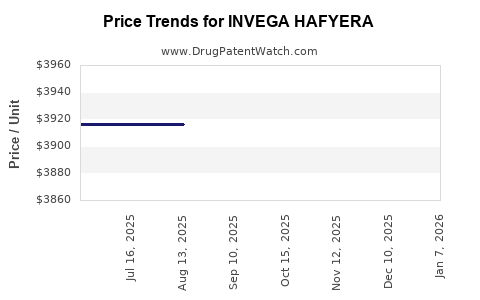
HAFYERA can increase revenue per stabilized patient relative to monthly products if the product maintains premium pricing and payer coverage. The six-month formulation also helps J&J defend patients against switching to competing long-acting injectables.
Why HAFYERA revenue is strategically important to J&J
The product extends the life cycle of paliperidone palmitate. It gives J&J a newer formulation after the monthly and three-month products reach later stages of their commercial cycles. This can delay franchise erosion by offering a differentiated dosing schedule rather than relying solely on price or sales-force promotion.
The commercial value is therefore greater than the product’s separately reported sales. HAFYERA supports:
- Patient retention within the INVEGA family.
- Higher treatment convenience.
- A premium formulation position.
- A longer runway for branded injection revenue.
- Reduced dependence on the monthly product alone.
When does INVEGA HAFYERA lose exclusivity?
HAFYERA does not have a single publicly reported “loss of exclusivity” date that determines all generic-entry risk. Exclusivity must be assessed across FDA regulatory exclusivity, Orange Book-listed patents, formulation claims, manufacturing claims, and litigation outcomes.
The active ingredient, paliperidone, is not a new molecular entity. HAFYERA therefore does not receive the five-year new chemical entity exclusivity associated with a newly approved active ingredient. Its protection depends primarily on patents and any formulation-specific regulatory protections.
FDA regulatory exclusivity
The FDA approval of HAFYERA created a new product approval but did not create a new active-ingredient exclusivity period. The principal barrier to competition is the injectable formulation and its associated patents, not NCE exclusivity.
Orange Book status
The FDA Orange Book is the controlling public source for patents submitted for approved drug products. Orange Book review should distinguish between:
- Patents listed specifically for HAFYERA.
- Patents covering paliperidone palmitate formulations generally.
- Patents covering injection devices or administration.
- Patents listed for SUSTENNA or TRINZA but not necessarily applicable to HAFYERA.
- Patents with expiration dates that may be subject to pediatric extensions, terminal disclaimers, or patent-term adjustments.
A generic applicant seeking approval before relevant listed patent expiry may file a Paragraph IV certification. The brand holder can then sue within 45 days, triggering a potential 30-month stay of approval under the Hatch-Waxman framework.[2]
What patents protect INVEGA HAFYERA?
HAFYERA’s protection is expected to center on formulation and delivery characteristics rather than the underlying paliperidone molecule. Relevant patent categories include:
Extended-release paliperidone palmitate formulations
These claims may cover particle size, crystalline form, aqueous suspension characteristics, release profile, concentration, or the composition of the injectable suspension.
Six-month dosing methods
Method-of-use claims may cover administration of a specific paliperidone palmitate dose at six-month intervals in patients stabilized on earlier paliperidone products. These claims can create a separate challenge for generic applicants because a product may be chemically equivalent while the branded dosing method remains patented.
Manufacturing and particle-engineering processes
Long-acting injectable products are difficult to replicate consistently. Manufacturing claims may cover precipitation, particle formation, suspension preparation, sterilization, filling, and control of release characteristics. These patents can create practical barriers even when a generic sponsor has designed around composition claims.
Patent-strength assessment
HAFYERA’s patent estate is commercially meaningful but technically vulnerable to design-around strategies. Composition claims are generally stronger when they cover narrowly defined physicochemical properties that are necessary to reproduce the clinical release profile. Method-of-use claims may be narrower because generic sponsors can seek approval for non-infringing uses or rely on prescribing behavior.
The most important strength is the combination of formulation, dosing, and manufacturing coverage. The main weakness is that the product uses an established active ingredient with a substantial prior-art record.
Which companies are challenging INVEGA HAFYERA?
No publicly established, product-specific Paragraph IV challenger should be treated as confirmed without an ANDA filing, FDA litigation record, or court docket identifying HAFYERA. Generic paliperidone palmitate competition is more likely to emerge first around earlier monthly or three-month formulations because those products have larger installed patient bases and earlier commercial histories.
Potential challengers would include generic injectable manufacturers with experience in complex suspensions, sterile manufacturing, and abbreviated new drug applications. The technical burden is higher than for a conventional tablet because an applicant must demonstrate pharmaceutical equivalence and bioequivalence for a long-acting injectable suspension.
What generic entry risks exist for INVEGA HAFYERA?
Generic entry risk is lower in the near term than the risk from internal franchise substitution or competing branded long-acting injectables. The main barriers are:
- Complex sterile injectable manufacturing.
- Long release duration and difficult bioequivalence testing.
- Multiple formulation and process patents.
- Need to establish equivalent drug product characteristics.
- Physician and payer reluctance to switch stable patients.
- Limited volume relative to oral generic markets.
A generic applicant may still challenge patents before expiry. A Paragraph IV filing would create litigation risk even if approval and commercial launch occur years later. The most likely launch scenarios are:
| Scenario |
Commercial effect |
| No early generic challenge |
Continued premium pricing and gradual conversion from TRINZA |
| Patent settlement with delayed entry |
Predictable erosion after an agreed date |
| Successful Paragraph IV challenge |
Accelerated price pressure and rapid payer substitution |
| At-risk launch |
Immediate litigation exposure and possible damages |
| Competing branded LAI expansion |
Share pressure without direct generic substitution |
Because HAFYERA is administered only twice annually, switching economics may differ from monthly products. Payers may value fewer administrations but may also negotiate aggressively because treatment costs are concentrated into larger individual claims.
Does INVEGA HAFYERA face biosimilar risk?
No. HAFYERA is a chemically synthesized small-molecule drug, not a biologic. It is not subject to biosimilar competition under the Biologics Price Competition and Innovation Act. Any future competitors would be generic or follow-on versions evaluated under the Hatch-Waxman framework, not biosimilars.
What patent litigation and settlement issues affect HAFYERA?
The key litigation risk is a Paragraph IV challenge to patents covering paliperidone palmitate formulations, dosing schedules, or manufacturing methods. A litigation settlement could establish a licensed generic-entry date before the latest asserted patent expiry.
A complete HAFYERA litigation assessment requires matching each ANDA, patent number, court complaint, settlement, and FDA approval event to the exact product strength and dosing regimen. Public financial reporting by J&J does not provide this product-level litigation detail. The commercially relevant question is whether a challenger can obtain approval for a monthly or quarterly paliperidone product and use that position to pressure HAFYERA pricing or conversion.
What licensing deals affect INVEGA HAFYERA?
HAFYERA is an internally developed Janssen product and is not generally identified as a separately licensed asset in J&J’s public product disclosures. The commercial rights are associated with Johnson & Johnson’s Innovative Medicine business and Janssen operating entities.
The principal external commercial relationships are more relevant to competing products. Otsuka and Lundbeck commercialize aripiprazole products, while Alkermes commercializes ARISTADA. These companies shape the competitive environment but do not hold reported HAFYERA rights.
How strong is the INVEGA HAFYERA commercial position?
HAFYERA has a strong product-level value proposition but a narrower eligible population than its predecessor products. Its strongest attributes are:
- Six-month dosing.
- Established paliperidone clinical history.
- Franchise continuity from SUSTENNA and TRINZA.
- Reduced administration frequency.
- High technical barriers to generic replication.
Its main constraints are:
- Requirement for prior stabilization.
- Limited ability to capture untreated patients directly.
- Competition from aripiprazole long-acting injectables.
- Paliperidone-related tolerability considerations.
- Lack of separately disclosed financial performance.
- Eventual exposure to complex-generic development.
What is the FDA regulatory status of INVEGA HAFYERA?
HAFYERA is FDA-approved for adult schizophrenia. It is not approved as an initiation therapy, and its label requires prior stabilization with a one-month or three-month paliperidone palmitate regimen. The product is administered by a healthcare professional and is not an oral or self-administered formulation.[1]
Key Takeaways
- INVEGA HAFYERA is a six-month paliperidone palmitate injection approved by the FDA in July 2021.
- Its commercial strategy is based on converting stable patients from SUSTENNA and TRINZA.
- J&J does not disclose HAFYERA revenue separately, so product-specific financial estimates are not verifiable from company filings.
- HAFYERA has no biosimilar risk because paliperidone palmitate is a small-molecule drug.
- Generic risk depends on formulation, method-of-use, manufacturing, and Orange Book-listed patents.
- The strongest commercial defense is the combination of six-month convenience and technical complexity.
- The main long-term risks are branded competition, payer pricing, internal franchise migration, and complex-generic entry.
FAQs About INVEGA HAFYERA
Is INVEGA HAFYERA more profitable than INVEGA SUSTENNA?
J&J does not report product-level profit or margin data. HAFYERA may support higher value per stabilized patient because it is a differentiated six-month formulation, but profitability depends on manufacturing cost, rebates, administration economics, and payer contracts.
Can a patient start treatment directly with INVEGA HAFYERA?
No. Patients must first be adequately treated with a one-month or three-month paliperidone palmitate product and demonstrate tolerability and clinical stability.
Is HAFYERA covered by Medicare and Medicaid?
Coverage varies by plan, state, medical-benefit classification, prior-authorization rules, and provider reimbursement. Long-acting injectables are often reimbursed through medical or pharmacy benefit structures depending on the payer.
What drug is the closest competitor to INVEGA HAFYERA?
The closest direct competitors are long-acting aripiprazole products, particularly ABILIFY MAINTENA and ARISTADA. INVEGA TRINZA is the closest internal alternative because it contains the same active ingredient and is administered every three months.
Could generic SUSTENNA reduce HAFYERA sales?
Yes. A lower-cost monthly or quarterly paliperidone product could pressure HAFYERA indirectly by weakening the overall INVEGA franchise and reducing J&J’s ability to control the treatment sequence. Direct substitution would depend on the patient’s clinical status, payer policy, and physician preference.
References
-
U.S. Food and Drug Administration. (2021). INVEGA HAFYERA (paliperidone palmitate) extended-release injectable suspension prescribing information. Janssen Pharmaceuticals.
-
U.S. Food and Drug Administration. (2023). Approved drug products with therapeutic equivalence evaluations: Orange Book. U.S. Department of Health and Human Services.
-
Johnson & Johnson. (2024). 2023 annual report. Johnson & Johnson.
-
Johnson & Johnson. (2025). 2024 annual report. Johnson & Johnson.
-
U.S. Congress. (1984). Drug Price Competition and Patent Term Restoration Act of 1984, Pub. L. No. 98-417.