Last updated: August 1, 2026
INCRUSE ELLIPTA is GSK's once-daily umeclidinium bromide inhaler for maintenance treatment of chronic obstructive pulmonary disease. The product has a mature commercial profile, limited standalone revenue disclosure, and declining strategic importance relative to GSK's higher-growth Trelegy Ellipta franchise.
The main commercial risks are generic entry, pricing pressure in COPD, formulary substitution, and the expiration of device and formulation protections. Its principal defense is the technical complexity of dry-powder inhaler development rather than a broad, durable composition-of-matter moat.
What is INCRUSE ELLIPTA and how does it compete in COPD?
INCRUSE ELLIPTA contains umeclidinium bromide, a long-acting muscarinic antagonist, or LAMA. It is administered once daily through GSK's Ellipta dry-powder inhaler.
The FDA approved INCRUSE ELLIPTA in April 2014 for the long-term, once-daily maintenance treatment of airflow obstruction in patients with COPD. It is not indicated for acute bronchospasm or asthma rescue treatment. The labeled dose is one inhalation of 62.5 micrograms once daily. [1]
How does umeclidinium compare with competing LAMA products?
The principal competing LAMA products are Spiriva HandiHaler and Spiriva Respimat, marketed by Boehringer Ingelheim, and Tudorza Pressair, marketed by AstraZeneca in the United States.
| Product |
Active ingredient |
Device |
Dosing |
Competitive position |
| INCRUSE ELLIPTA |
Umeclidinium |
Ellipta dry-powder inhaler |
Once daily |
GSK monotherapy LAMA |
| Spiriva HandiHaler |
Tiotropium |
Capsule-based dry-powder inhaler |
Once daily |
Established LAMA with broad physician familiarity |
| Spiriva Respimat |
Tiotropium |
Soft-mist inhaler |
Once daily |
Alternative delivery system |
| Tudorza Pressair |
Aclidinium |
Multidose dry-powder inhaler |
Twice daily |
Smaller COPD franchise |
| Seebri Breezhaler |
Glycopyrronium |
Capsule-based inhaler |
Once daily |
Primarily non-U.S. exposure |
| ANORO ELLIPTA |
Umeclidinium/vilanterol |
Ellipta dry-powder inhaler |
Once daily |
Direct GSK dual-bronchodilator alternative |
| TRELEGY ELLIPTA |
Fluticasone furoate/umeclidinium/vilanterol |
Ellipta dry-powder inhaler |
Once daily |
GSK's higher-value triple-therapy product |
INCRUSE competes primarily on once-daily dosing, the Ellipta device, and integration with GSK's broader respiratory portfolio. Its commercial position is weaker than that of ANORO and TRELEGY because monotherapy LAMA treatment has lower revenue per patient and more direct generic substitution risk.
What is the FDA regulatory status of INCRUSE ELLIPTA?
INCRUSE ELLIPTA is an FDA-approved inhaled maintenance therapy for COPD. It is a small-molecule inhalation product, not a biologic. Biosimilar regulation therefore does not apply.
The product's regulatory profile is summarized below.
| Regulatory item |
Status |
| U.S. approval |
Approved |
| Original U.S. approval date |
April 30, 2014 |
| Active ingredient |
Umeclidinium bromide |
| Dosage form |
Inhalation powder |
| Device |
Ellipta |
| Indication |
Maintenance treatment of COPD |
| Rescue use |
Not indicated |
| Biosimilar pathway |
Not applicable |
| Generic pathway |
ANDA or other applicable abbreviated pathway, subject to FDA requirements |
| Combination products using umeclidinium |
ANORO ELLIPTA and TRELEGY ELLIPTA |
The product label warns against use in acute bronchospasm and identifies anticholinergic-related risks, including paradoxical bronchospasm, cardiovascular effects, narrow-angle glaucoma, and urinary retention. [1]
How has the INCRUSE ELLIPTA market developed?
The product entered a crowded maintenance-COPD market in 2014. Its initial commercial rationale was to give GSK a once-daily LAMA that could compete with Spiriva while also supporting a broader Ellipta platform.
Market development followed three stages:
- Early adoption after U.S. launch, supported by the Ellipta device and GSK's respiratory sales infrastructure.
- Maturity as LAMA and long-acting bronchodilator classes became increasingly commoditized.
- Portfolio migration toward ANORO and TRELEGY, which generate higher value per treated patient and align with the movement toward dual and triple therapy.
GSK's respiratory strategy increasingly centers on TRELEGY, NUCALA, and newer respiratory assets. INCRUSE remains commercially relevant as a component of the Ellipta platform, but it is not one of GSK's principal growth drivers.
What factors determine INCRUSE demand?
Demand is shaped by:
- COPD diagnosis and treatment rates.
- Guideline movement toward long-acting bronchodilator therapy.
- Payer preference for lower-cost LAMA products.
- Physician familiarity with Ellipta.
- Patient ability to use the device correctly.
- Switching between single, dual, and triple therapy.
- Availability of generic or authorized-generic alternatives.
- Reimbursement restrictions and step-edit requirements.
- GSK's contracting strategy across respiratory products.
The main structural constraint is that many patients who begin with a LAMA may later be escalated to dual or triple therapy. That limits the long-term revenue pool for a standalone LAMA.
What are the financial results and revenue trajectory for INCRUSE ELLIPTA?
GSK does not consistently disclose INCRUSE ELLIPTA as a separate, recurring revenue line in its public financial reporting. The company reports major respiratory products separately when they are material, but smaller brands may be grouped within broader respiratory or established-products categories.
That reporting structure prevents a clean, independently verified annual sales series for INCRUSE from GSK's consolidated filings. The available financial conclusion is directional:
- INCRUSE is a mature product rather than a major growth asset.
- Its revenue is materially below TRELEGY's sales.
- Its economic value is partly indirect because umeclidinium also supports ANORO and TRELEGY.
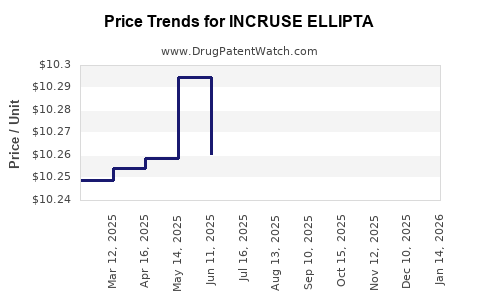
- Product-level sales are exposed to price erosion before complete generic substitution.
- GSK's respiratory growth has shifted toward triple therapy and biologic products.
GSK reported strong growth for TRELEGY in recent years, driven by increased use of single-inhaler triple therapy and market expansion. That growth can reduce the strategic emphasis placed on INCRUSE monotherapy even when umeclidinium demand remains stable within the overall portfolio. [2][3]
How does INCRUSE compare financially with TRELEGY and ANORO?
| Metric |
INCRUSE ELLIPTA |
ANORO ELLIPTA |
TRELEGY ELLIPTA |
| Therapy |
LAMA |
LAMA/LABA |
ICS/LAMA/LABA |
| Revenue potential per patient |
Lower |
Medium |
Higher |
| Growth profile |
Mature |
Mature to pressured |
Growth-oriented |
| Generic exposure |
High as monotherapy |
Combination-product exposure |
More complex combination protection |
| Strategic role |
Standalone LAMA and platform product |
Dual-bronchodilator product |
Core respiratory growth brand |
| Likely payer pressure |
High |
High |
Increasing but more differentiated |
The financial trajectory for INCRUSE is therefore best understood as a mature-brand decline or stabilization profile, not as an independent growth story. Its value persists through brand recognition, formulary access, physician familiarity, and the broader Ellipta ecosystem.
When does INCRUSE ELLIPTA lose exclusivity?
INCRUSE's exclusivity position depends on several separate rights:
- Patent protection for umeclidinium or its pharmaceutical form.
- Patents covering the inhalation formulation.
- Patents covering the Ellipta device or dose-delivery system.
- Regulatory exclusivity associated with the original approval.
- Potential pediatric extensions or patent-term adjustments.
- Country-specific supplementary protection certificates and regulatory extensions.
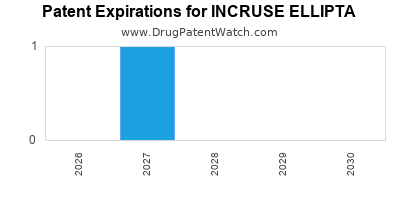
The earliest composition and active-ingredient protections are materially less important now than they were at launch. The commercial protection period for the original product has largely matured, while remaining risk is concentrated in formulation, device, and combination-product patents.
What is the Orange Book status of INCRUSE ELLIPTA?
INCRUSE ELLIPTA is listed in the FDA Orange Book as a prescription inhalation product. Orange Book listings can include patents directed to the active ingredient, formulation, method of use, device, or product configuration. The relevant listings and expiration dates may change through patent-listing updates, delistings, terminal disclaimers, patent-term adjustments, and pediatric extensions. [4]
A practical Orange Book assessment should distinguish between:
- Patents that directly cover umeclidinium bromide.
- Patents covering the dry-powder formulation.
- Patents covering the Ellipta inhaler.
- Method-of-use patents for COPD maintenance treatment.
- Patents listed against ANORO or TRELEGY rather than INCRUSE.
A patent covering the Ellipta device may not block an alternative inhaler design. Conversely, an ANDA applicant may need to address multiple listed patents even where the active ingredient itself has limited remaining protection.
What patents protect INCRUSE ELLIPTA?
The INCRUSE patent estate is likely layered rather than dependent on one broad, long-lived patent. The principal protection categories are:
Active-ingredient and chemical patents
These cover umeclidinium, its salts, stereochemical forms, or related chemical intermediates. Their value declines sharply after expiry because an ANDA applicant can seek approval using the same active ingredient.
Formulation patents
Formulation patents may cover:
- Umeclidinium particle size.
- Lactose-based carrier systems.
- Powder blends.
- Dose uniformity.
- Stability characteristics.
- Moisture control.
- Delivered-dose performance.
These patents can delay or complicate generic development, but they are often narrower than composition-of-matter claims.
Ellipta device patents
Ellipta-related rights may cover:
- Blister-strip configuration.
- Dose indexing.
- Mouthpiece structure.
- Airflow pathways.
- Piercing or opening mechanisms.
- Dose loading and dispensing.
- Inhaler housing and operating features.
Device patents are commercially significant because an inhaled generic must demonstrate comparable performance and user operation without necessarily copying the branded device.
Method-of-use patents
Method patents can cover once-daily administration for COPD or treatment of airflow obstruction with umeclidinium. Their practical blocking value depends on claim scope, statutory patent status, and whether the generic applicant makes a valid section viii statement or uses a restricted label.
Which companies are challenging INCRUSE ELLIPTA?
The public competitive threat comes from generic manufacturers and established respiratory companies rather than biosimilar developers.
Potential generic competitors include companies with inhalation-development capabilities, such as:
- Teva Pharmaceutical Industries.
- Viatris.
- Cipla.
- Lupin.
- Glenmark.
- Hikma.
- Sun Pharmaceutical Industries.
- Respiratory-specialist manufacturers developing dry-powder inhalers.
The existence of a potential competitor does not establish that an ANDA has been filed or approved. FDA approval requires pharmaceutical equivalence, bioequivalence or equivalent performance, device comparability where applicable, manufacturing controls, and labeling compliance.
What Paragraph IV risks exist for INCRUSE ELLIPTA?
A Paragraph IV certification would assert that a listed patent is invalid, unenforceable, or not infringed. For a branded inhaler, an ANDA applicant may challenge patents covering the drug, formulation, method of use, or device.
The principal litigation scenarios are:
| Scenario |
Effect on GSK |
Commercial implication |
| No ANDA challenge |
Brand retains practical control |
Continued price and formulary pressure |
| Paragraph IV notice |
GSK may file patent litigation |
Potential 30-month stay under applicable law |
| Settlement with delayed entry |
Predictable erosion date |
Reduced litigation uncertainty |
| Early court victory for generic |
Accelerated launch risk |
Rapid price erosion |
| GSK patent victory |
Delayed entry |
Extended brand protection |
| Non-infringement design-around |
Generic may avoid key device claims |
Device competition without direct copying |
No definitive public conclusion should be drawn about a current Paragraph IV challenge without reviewing the FDA listing, litigation docket, and company disclosures for the relevant period. The economic risk remains credible because mature inhaled products are attractive targets when the market is large and the active ingredient is well established.
How strong is the INCRUSE ELLIPTA patent estate?
The patent estate is moderate rather than exceptionally strong.
Its strengths are:
- Established Ellipta device platform.
- Multiple potential layers of formulation and device protection.
- Technical barriers to reproducing inhaled dose performance.
- GSK's experience defending respiratory products.
- Portfolio-level leverage through ANORO and TRELEGY.
Its weaknesses are:
- Mature U.S. regulatory and commercial exclusivity.
- Limited differentiation for a standalone LAMA.
- Potentially narrow formulation and device claims.
- Availability of alternative inhaler designs.
- High payer sensitivity to COPD maintenance costs.
- No biologic exclusivity or biosimilar barrier.
- Substitution toward competing LAMA/LABA and triple-therapy products.
The strongest remaining barrier is likely product-development complexity, not a single broad patent. A generic competitor that successfully solves device, powder-performance, and regulatory requirements could create material erosion even if some secondary patents remain enforceable.
What generic launch scenarios exist for INCRUSE ELLIPTA?
Scenario 1: Delayed generic entry
GSK retains market share through remaining patents, settlements, or regulatory delays. Net price erosion occurs through payer contracting, but unit volume remains relatively stable.
Scenario 2: Single generic launch
The first approved generic receives substantial commercial leverage. Inhaled products often experience slower substitution than oral tablets because prescribers and patients must use a new device, but payer mandates can accelerate switching.
Scenario 3: Multiple generic entrants
Price declines become more severe once several manufacturers enter. Gross-to-net discounts increase, rebate competition intensifies, and the branded product may retain only a smaller premium segment.
Scenario 4: Device-led partial substitution
A competitor launches a different inhaler rather than a close Ellipta copy. This can produce gradual erosion because formulary conversion and patient training take time.
Scenario 5: Portfolio substitution
GSK shifts patients from INCRUSE to ANORO or TRELEGY where clinically appropriate. This may protect some umeclidinium-related revenue but does not fully preserve INCRUSE sales.
What licensing deals affect INCRUSE ELLIPTA?
INCRUSE is primarily associated with GSK's internally developed respiratory portfolio and the Ellipta platform. Public commercial disclosures do not identify a major standalone licensing transaction that is central to the product's current value.
The more important licensing and collaboration question concerns the broader respiratory portfolio, including co-development, regional commercialization, and rights associated with inhaled medicines. Those arrangements may affect geographic sales and royalties, but they do not change the core U.S. assessment: GSK controls the branded INCRUSE franchise, while generic manufacturers represent the principal future competitive threat.
What geographic markets are important for INCRUSE?
INCRUSE has been commercialized in multiple markets under GSK's respiratory franchise, but exclusivity differs by jurisdiction.
| Region |
Key issue |
| United States |
Orange Book patents, ANDA litigation, payer substitution |
| European Union |
National and regional patent rights, SPC status, tender pricing |
| United Kingdom |
UK patent rights, NHS formulary decisions, generic inhaler adoption |
| Japan |
Local regulatory and reimbursement requirements |
| Emerging markets |
Lower pricing, local manufacturing, tender competition |
European and emerging-market sales can face earlier price compression because national health systems use tenders, reference pricing, and centralized reimbursement controls. U.S. economics are more dependent on patent litigation, PBM contracting, Medicare coverage, and formulary placement.
What manufacturing and intellectual-property barriers affect generic INCRUSE?
Generic development requires more than reproducing the active ingredient. A competitor must establish:
- Consistent particle-size distribution.
- Delivered-dose uniformity.
- Aerodynamic particle performance.
- Moisture and stability control.
- Reliable blister or dose-container production.
- Device metering accuracy.
- Human-factor performance.
- Manufacturing scale and quality-system compliance.
- FDA acceptance of the abbreviated application.
These requirements create a higher development barrier than for conventional tablets. They also raise the probability that initial competition will be limited to technically capable respiratory manufacturers.
The barrier does not guarantee long-term protection. Once a competitor completes development and secures approval, the same complexity can support a durable, differentiated inhaler franchise for the entrant.
What patent litigation and settlement issues affect INCRUSE?
The relevant litigation questions are whether:
- GSK has sued an ANDA applicant within the statutory period.
- A 30-month stay applies.
- The challenged patents cover the approved product.
- A generic applicant has made a Paragraph IV or section viii certification.
- A settlement permits an agreed launch date.
- The settlement includes licensing, supply, or non-compete terms.
- Antitrust scrutiny applies to the agreement.
A settlement can preserve branded revenue until a defined date while removing binary litigation risk. For INCRUSE, the commercial value of settlement protection declines as the product ages and as competing LAMA/LABA and triple therapies gain share.
How does INCRUSE compare with other GSK respiratory assets?
| Attribute |
INCRUSE |
ANORO |
TRELEGY |
| Molecules |
Umeclidinium |
Umeclidinium/vilanterol |
Fluticasone furoate/umeclidinium/vilanterol |
| COPD role |
LAMA maintenance |
Dual bronchodilation |
Triple therapy |
| Commercial maturity |
Mature |
Mature |
Growth and expansion |
| Strategic importance |
Supporting asset |
Secondary respiratory asset |
Core respiratory asset |
| Patent complexity |
Moderate |
Higher due to combination |
Higher due to combination and formulation |
| Generic risk |
Direct active-ingredient and device risk |
Combination and device risk |
Greater formulation, combination, and device complexity |
| Revenue outlook |
Flat to declining |
Pressure from competition |
Stronger relative growth |
Key Takeaways
- INCRUSE ELLIPTA is a mature once-daily umeclidinium inhaler for COPD.
- GSK does not consistently disclose standalone INCRUSE revenue, so its financial trajectory must be assessed through portfolio reporting and market positioning.
- The product has lower strategic value than TRELEGY and lower revenue potential than combination therapies.
- Its patent estate relies on chemical, formulation, device, and method-of-use layers.
- The principal long-term threat is generic inhaler entry, not biosimilar competition.
- Device complexity may delay entry, but it is not a permanent barrier.
- U.S. risk depends on Orange Book listings, Paragraph IV activity, patent litigation, and settlement terms.
- Pricing pressure and payer substitution can erode value before full generic entry.
- GSK may protect part of the underlying umeclidinium franchise by shifting patients toward ANORO or TRELEGY.
- Geographic exclusivity and commercial erosion will vary substantially between the United States, Europe, the United Kingdom, Japan, and tender-driven emerging markets.
FAQs
Is INCRUSE ELLIPTA still protected by patents?
Some product, formulation, method-of-use, or Ellipta device protections may remain relevant depending on jurisdiction and the current FDA listing. The original launch-era exclusivity has largely matured, making secondary patents and regulatory status more important.
Does INCRUSE ELLIPTA have a biosimilar competitor?
No. INCRUSE contains a small-molecule active ingredient, so competition would arise through generic or abbreviated applications rather than the biosimilar pathway.
Is umeclidinium available as a generic?
Generic availability depends on jurisdiction, approval status, patent certifications, and device requirements. The existence of an active ingredient does not by itself establish that an approved generic umeclidinium inhaler is commercially available.
What is the biggest commercial threat to INCRUSE ELLIPTA?
The largest threat is a combination of generic inhaler entry, payer-mandated substitution, and movement from standalone LAMA treatment to lower-cost or clinically preferred combination therapies.
Does TRELEGY replace INCRUSE?
TRELEGY does not replace INCRUSE for every patient because it contains an inhaled corticosteroid, a LAMA, and a LABA. It can capture patients who require escalation to triple therapy, reducing the growth potential of standalone INCRUSE.
References
-
U.S. Food and Drug Administration. (2023). INCRUSE ELLIPTA prescribing information. GlaxoSmithKline LLC.
-
GSK plc. (2023). Annual report 2023. GSK plc.
-
GSK plc. (2024). Full-year 2023 results and investor materials. GSK plc.
-
U.S. Food and Drug Administration. (2024). Approved drug products with therapeutic equivalence evaluations: Orange Book. FDA.