Last Updated: June 13, 2026

INBRIJA Drug Patent Profile


✉ Email this page to a colleague

« Back to Dashboard


Which patents cover Inbrija, and when can generic versions of Inbrija launch?

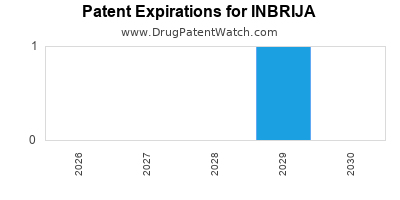
Inbrija is a drug marketed by Merz and is included in one NDA. There are six patents protecting this drug.

This drug has one hundred and twenty-nine patent family members in twenty-two countries.

The generic ingredient in INBRIJA is levodopa. There are eighteen drug master file entries for this compound. One supplier is listed for this compound. Additional details are available on the levodopa profile page.

DrugPatentWatch® Generic Entry Outlook for Inbrija

By analyzing the patents and regulatory protections it appears that the earliest date for generic entry will be November 16, 2032. This may change due to patent challenges or generic licensing.

Indicators of Generic Entry

< Available with Subscription >

  Start Trial

AI Deep Research
Questions you can ask:
  • What is the 5 year forecast for INBRIJA?
  • What are the global sales for INBRIJA?
  • What is Average Wholesale Price for INBRIJA?
Summary for INBRIJA
International Patents:129
US Patents:6
Applicants:1
NDAs:1
Finished Product Suppliers / Packagers: 1
Raw Ingredient (Bulk) Api Vendors: 134
Drug Prices: Drug price information for INBRIJA
What excipients (inactive ingredients) are in INBRIJA?INBRIJA excipients list
DailyMed Link:INBRIJA at DailyMed
DrugPatentWatch® Estimated Loss of Exclusivity (LOE) Date for INBRIJA
Generic Entry Date for INBRIJA*:
Constraining patent/regulatory exclusivity:
NDA:
Dosage:

POWDER;INHALATION

*The generic entry opportunity date is the latter of the last compound-claiming patent and the last regulatory exclusivity protection. Many factors can influence early or later generic entry. This date is provided as a rough estimate of generic entry potential and should not be used as an independent source.

Pharmacology for INBRIJA

US Patents and Regulatory Information for INBRIJA

INBRIJA is protected by six US patents.

Based on analysis by DrugPatentWatch, the earliest date for a generic version of INBRIJA is ⤷  Start Trial.

This potential generic entry date is based on patent 8,545,878.

Generics may enter earlier, or later, based on new patent filings, patent extensions, patent invalidation, early generic licensing, generic entry preferences, and other factors.

Applicant Tradename Generic Name Dosage NDA Approval Date TE Type RLD RS Patent No. Patent Expiration Product Substance Delist Req. Exclusivity Expiration
Merz INBRIJA levodopa POWDER;INHALATION 209184-001 Dec 21, 2018 RX Yes Yes 12,458,615 ⤷  Start Trial ⤷  Start Trial
Merz INBRIJA levodopa POWDER;INHALATION 209184-001 Dec 21, 2018 RX Yes Yes 8,945,612 ⤷  Start Trial Y ⤷  Start Trial
Merz INBRIJA levodopa POWDER;INHALATION 209184-001 Dec 21, 2018 RX Yes Yes RE43711 ⤷  Start Trial ⤷  Start Trial
Merz INBRIJA levodopa POWDER;INHALATION 209184-001 Dec 21, 2018 RX Yes Yes 8,685,442 ⤷  Start Trial Y ⤷  Start Trial
>Applicant >Tradename >Generic Name >Dosage >NDA >Approval Date >TE >Type >RLD >RS >Patent No. >Patent Expiration >Product >Substance >Delist Req. >Exclusivity Expiration

Expired US Patents for INBRIJA

Applicant Tradename Generic Name Dosage NDA Approval Date Patent No. Patent Expiration
Merz INBRIJA levodopa POWDER;INHALATION 209184-001 Dec 21, 2018 9,155,699 ⤷  Start Trial
Merz INBRIJA levodopa POWDER;INHALATION 209184-001 Dec 21, 2018 6,514,482 ⤷  Start Trial
Merz INBRIJA levodopa POWDER;INHALATION 209184-001 Dec 21, 2018 7,146,978 ⤷  Start Trial
Merz INBRIJA levodopa POWDER;INHALATION 209184-001 Dec 21, 2018 6,858,199 ⤷  Start Trial
>Applicant >Tradename >Generic Name >Dosage >NDA >Approval Date >Patent No. >Patent Expiration

EU/EMA Drug Approvals for INBRIJA

Company Drugname Inn Product Number / Indication Status Generic Biosimilar Orphan Marketing Authorisation Marketing Refusal
Acorda Therapeutics Ireland Limited Inbrija levodopa EMEA/H/C/004786Inbrija is indicated for the intermittent treatment of episodic motor fluctuations (OFF episodes) in adult patients with Parkinson’s disease (PD) treated with a levodopa/dopa-decarboxylase inhibitor. Authorised no no no 2019-09-19
>Company >Drugname >Inn >Product Number / Indication >Status >Generic >Biosimilar >Orphan >Marketing Authorisation >Marketing Refusal

International Patents for INBRIJA

When does loss-of-exclusivity occur for INBRIJA?

Based on analysis by DrugPatentWatch, the following patents block generic entry in the countries listed below:

Australia

Patent: 13342246
Patent: High dose levodopa capsules for pulmonary use
Estimated Expiration: ⤷  Start Trial

Patent: 13342247
Patent: Dosator for filling a capsule with powder
Estimated Expiration: ⤷  Start Trial

Patent: 13342248
Patent: Ultra low density pulmonary powders
Estimated Expiration: ⤷  Start Trial

Patent: 17279626
Patent: Dosator For Filling A Capsule With Powder
Estimated Expiration: ⤷  Start Trial

Patent: 18204674
Patent: High Dose Levodopa Capsules For Pulmonary Use
Estimated Expiration: ⤷  Start Trial

Patent: 18222983
Patent: Ultra Low Density Pulmonary Powders
Estimated Expiration: ⤷  Start Trial

Brazil

Patent: 2015010601
Patent: pós pulmonares de densidade ultra baixa.
Estimated Expiration: ⤷  Start Trial

Patent: 2015010603
Patent: CÁPSULAS DE LEVODOPA DE DOSE ALTA PARA O USO PULMONAR
Estimated Expiration: ⤷  Start Trial

Canada

Patent: 90451
Patent: CAPSULES DE LEVODOPA A DOSE ELEVEE POUR UNE UTILISATION PULMONAIRE (HIGH DOSE LEVODOPA CAPSULES FOR PULMONARY USE)
Estimated Expiration: ⤷  Start Trial

Patent: 90454
Patent: APPAREIL DE DOSAGE POUR REMPLIR UNE CAPSULE AVEC UNE POUDRE SECHE (DOSATOR FOR FILLING A CAPSULE WITH POWDER)
Estimated Expiration: ⤷  Start Trial

Patent: 90459
Patent: POUDRES PULMONAIRES DE DENSITE ULTRA BASSE (ULTRA LOW DENSITY PULMONARY POWDERS)
Estimated Expiration: ⤷  Start Trial

China

Patent: 4918607
Patent: 用于肺部使用的高剂量左旋多巴胶囊 (High dose levodopa capsules for pulmonary use)
Estimated Expiration: ⤷  Start Trial

Patent: 5120843
Patent: Ultra low density pulmonary powders
Estimated Expiration: ⤷  Start Trial

Patent: 9106697
Patent: 用于肺部使用的高剂量左旋多巴胶囊 (HIGH DOSE LEVODOPA CAPSULES FOR PULMONARY USE)
Estimated Expiration: ⤷  Start Trial

Patent: 0833539
Patent: 超低密度的肺部粉末 (Ultra low density pulmonary powders)
Estimated Expiration: ⤷  Start Trial

Denmark

Patent: 16821
Estimated Expiration: ⤷  Start Trial

European Patent Office

Patent: 16821
Patent: CAPSULES DE LÉVODOPA À DOSE ÉLEVÉE POUR UNE UTILISATION PULMONAIRE (HIGH DOSE LEVODOPA CAPSULES FOR PULMONARY USE)
Estimated Expiration: ⤷  Start Trial

Patent: 16826
Patent: POUDRES PULMONAIRES DE DENSITÉ ULTRA BASSE (ULTRA LOW DENSITY PULMONARY POWDERS)
Estimated Expiration: ⤷  Start Trial

Patent: 25611
Patent: APPAREIL DE DOSAGE POUR REMPLIR UNE CAPSULE AVEC UNE POUDRE SÈCHE (DOSATOR FOR FILLING A CAPSULE WITH POWDER)
Estimated Expiration: ⤷  Start Trial

Patent: 15679
Patent: CAPSULES DE LÉVODOPA À DOSE ÉLEVÉE POUR UNE UTILISATION PULMONAIRE (HIGH DOSE LEVODOPA CAPSULES FOR PULMONARY USE)
Estimated Expiration: ⤷  Start Trial

Patent: 57301
Patent: POUDRES PULMONAIRES DE DENSITÉ ULTRA BASSE (ULTRA LOW DENSITY PULMONARY POWDERS)
Estimated Expiration: ⤷  Start Trial

Hong Kong

Patent: 12884
Patent: 超低密度的肺部粉末 (ULTRA LOW DENSITY PULMONARY POWDERS)
Estimated Expiration: ⤷  Start Trial

Patent: 13186
Patent: 用於肺部使用的高劑量左旋多巴膠囊 (HIGH DOSE LEVODOPA CAPSULES FOR PULMONARY USE)
Estimated Expiration: ⤷  Start Trial

Patent: 13187
Patent: 超低密度的肺部粉末 (ULTRA LOW DENSITY PULMONARY POWDERS)
Estimated Expiration: ⤷  Start Trial

Patent: 13535
Patent: 用粉末填充膠囊的劑量分配器 (DOSATOR FOR FILLING A CAPSULE WITH POWDER)
Estimated Expiration: ⤷  Start Trial

Patent: 14957
Patent: 用於肺部使用的高劑量左旋多巴膠囊 (HIGH DOSE LEVODOPA CAPSULES FOR PULMONARY USE)
Estimated Expiration: ⤷  Start Trial

Japan

Patent: 47786
Estimated Expiration: ⤷  Start Trial

Patent: 48501
Estimated Expiration: ⤷  Start Trial

Patent: 69808
Estimated Expiration: ⤷  Start Trial

Patent: 21629
Estimated Expiration: ⤷  Start Trial

Patent: 36834
Estimated Expiration: ⤷  Start Trial

Patent: 15536197
Patent: 乾燥粉末を含むカプセルを充填する投与装置
Estimated Expiration: ⤷  Start Trial

Patent: 15536988
Patent: 肺使用のための高服用量のレボドパを含むカプセル
Estimated Expiration: ⤷  Start Trial

Patent: 15536989
Patent: 超低密度肺粉剤
Estimated Expiration: ⤷  Start Trial

Patent: 18150355
Patent: 肺使用のための高服用量のレボドパを含むカプセル (CAPSULES CONTAINING HIGH DOSES OF LEVODOPA FOR PULMONARY USE)
Estimated Expiration: ⤷  Start Trial

Patent: 18162258
Patent: 超低密度肺粉剤 (ULTRA LOW DENSITY PULMONARY POWDERS)
Estimated Expiration: ⤷  Start Trial

Patent: 19213867
Patent: 乾燥粉末を含むカプセルを充填する投与装置 (DOSING APPARATUS FOR FILLING CAPSULE WITH DRY POWDER)
Estimated Expiration: ⤷  Start Trial

Mexico

Patent: 1008
Patent: POLVOS PULMONARES DE ULTRA BAJA DENSIDAD. (ULTRA LOW DENSITY PULMONARY POWDERS.)
Estimated Expiration: ⤷  Start Trial

Patent: 7602
Patent: CÁPSULAS CON ALTAS DOSIS DE LEVODOPA PARA USO PULMONAR. (HIGH DOSE LEVODOPA CAPSULES FOR PULMONARY USE.)
Estimated Expiration: ⤷  Start Trial

Patent: 2999
Patent: POLVOS PULMONARES DE ULTRA BAJA DENSIDAD (ULTRA LOW DENSITY PULMONARY POWDERS)
Estimated Expiration: ⤷  Start Trial

Patent: 15005767
Patent: CÁPSULAS CON ALTAS DOSIS DE LEVODOPA PARA USO PULMONAR. (HIGH DOSE LEVODOPA CAPSULES FOR PULMONARY USE.)
Estimated Expiration: ⤷  Start Trial

Patent: 15005768
Patent: POLVOS PULMONARES DE ULTRA BAJA DENSIDAD. (ULTRA LOW DENSITY PULMONARY POWDERS.)
Estimated Expiration: ⤷  Start Trial

Patent: 20012506
Patent: CAPSULAS CON ALTAS DOSIS DE LEVODOPA PARA USO PULMONAR. (HIGH DOSE LEVODOPA CAPSULES FOR PULMONARY USE.)
Estimated Expiration: ⤷  Start Trial

New Zealand

Patent: 8682
Patent: Dosator apparatus for filling a capsule with dry powder
Estimated Expiration: ⤷  Start Trial

Patent: 8684
Patent: High dose levodopa capsules for pulmonary use
Estimated Expiration: ⤷  Start Trial

Patent: 3459
Patent: Dosator for filling a capsule with dry powder
Estimated Expiration: ⤷  Start Trial

Patent: 7376
Patent: High dose levodopa capsules for pulmonary use
Estimated Expiration: ⤷  Start Trial

Patent: 7378
Patent: Ultra low density pulmonary powders
Estimated Expiration: ⤷  Start Trial

Poland

Patent: 16821
Estimated Expiration: ⤷  Start Trial

Portugal

Patent: 16821
Estimated Expiration: ⤷  Start Trial

Russian Federation

Patent: 70987
Patent: ПОРОШКИ ДЛЯ ИНГАЛЯЦИИ С УЛЬТРАНИЗКОЙ ПЛОТНОСТЬЮ (ULTRA LOW DENSITY INHALATION POWDERS)
Estimated Expiration: ⤷  Start Trial

Patent: 76093
Patent: КАПСУЛЫ, СОДЕРЖАЩИЕ ВЫСОКИЕ ДОЗЫ ЛЕВОДОПЫ, ДЛЯ ПРИМЕНЕНИЯ ПУТЕМ ИНГАЛЯЦИИ (HIGH DOSE LEVODOPA CAPSULES FOR PULMONARY USE)
Estimated Expiration: ⤷  Start Trial

Patent: 15121091
Patent: ПОРОШКИ ДЛЯ ИНГАЛЯЦИИ С УЛЬТРАНИЗКОЙ ПЛОТНОСТЬЮ (ULTRA LOW DENSITY INHALATION POWDERS)
Estimated Expiration: ⤷  Start Trial

Patent: 15121092
Patent: КАПСУЛЫ, СОДЕРЖАЩИЕ ВЫСОКИЕ ДОЗЫ ЛЕВОДОПЫ, ДЛЯ ПРИМЕНЕНИЯ ПУТЕМ ИНГАЛЯЦИИ (HIGH DOSE LEVODOPA CAPSULES FOR PULMONARY USE)
Estimated Expiration: ⤷  Start Trial

Patent: 18144622
Patent: КАПСУЛЫ, СОДЕРЖАЩИЕ ВЫСОКИЕ ДОЗЫ ЛЕВОДОПЫ, ДЛЯ ПРИМЕНЕНИЯ ПУТЕМ ИНГАЛЯЦИИ
Estimated Expiration: ⤷  Start Trial

Singapore

Patent: 201706465X
Patent: HIGH DOSE LEVODOPA CAPSULES FOR PULMONARY USE
Estimated Expiration: ⤷  Start Trial

Patent: 201707103S
Patent: ULTRA LOW DENSITY PULMONARY POWDERS
Estimated Expiration: ⤷  Start Trial

Patent: 202109328Q
Patent: HIGH DOSE LEVODOPA CAPSULES FOR PULMONARY USE
Estimated Expiration: ⤷  Start Trial

Patent: 201503543P
Patent: HIGH DOSE LEVODOPA CAPSULES FOR PULMONARY USE
Estimated Expiration: ⤷  Start Trial

Patent: 201503547T
Patent: ULTRA LOW DENSITY PULMONARY POWDERS
Estimated Expiration: ⤷  Start Trial

South Africa

Patent: 1504058
Patent: HIGH DOSE LEVODOPA CAPSULES FOR PULMONARY USE
Estimated Expiration: ⤷  Start Trial

Patent: 1504060
Patent: ULTRA LOW DENSITY PULMONARY POWDERS
Estimated Expiration: ⤷  Start Trial

South Korea

Patent: 2257164
Estimated Expiration: ⤷  Start Trial

Patent: 2337781
Estimated Expiration: ⤷  Start Trial

Patent: 2389785
Estimated Expiration: ⤷  Start Trial

Patent: 2735396
Estimated Expiration: ⤷  Start Trial

Patent: 2907997
Estimated Expiration: ⤷  Start Trial

Patent: 150108816
Patent: 폐용 초저밀도 분말 (ULTRA LOW DENSITY PULMONARY POWDERS)
Estimated Expiration: ⤷  Start Trial

Patent: 150110480
Patent: 폐에서의 사용을 위한 고용량 레보도파 캡슐 (HIGH DOSE LEVODOPA CAPSULES FOR PULMONARY USE)
Estimated Expiration: ⤷  Start Trial

Patent: 210062730
Patent: 폐에서의 사용을 위한 고용량 레보도파 캡슐 (HIGH DOSE LEVODOPA CAPSULES FOR PULMONARY USE)
Estimated Expiration: ⤷  Start Trial

Patent: 210152020
Patent: 폐용 초저밀도 분말 (ULTRA LOW DENSITY PULMONARY POWDERS)
Estimated Expiration: ⤷  Start Trial

Patent: 220054703
Patent: 폐에서의 사용을 위한 고용량 레보도파 캡슐 (HIGH DOSE LEVODOPA CAPSULES FOR PULMONARY USE)
Estimated Expiration: ⤷  Start Trial

Patent: 230116102
Patent: 폐에서의 사용을 위한 고용량 레보도파 캡슐 (HIGH DOSE LEVODOPA CAPSULES FOR PULMONARY USE)
Estimated Expiration: ⤷  Start Trial

Patent: 240134230
Patent: 폐에서의 사용을 위한 고용량 레보도파 캡슐 (HIGH DOSE LEVODOPA CAPSULES FOR PULMONARY USE)
Estimated Expiration: ⤷  Start Trial

Spain

Patent: 44153
Estimated Expiration: ⤷  Start Trial

Patent: 80271
Estimated Expiration: ⤷  Start Trial

Generics may enter earlier, or later, based on new patent filings, patent extensions, patent invalidation, early generic licensing, generic entry preferences, and other factors.

See the table below for additional patents covering INBRIJA around the world.

Country Patent Number Title Estimated Expiration
Russian Federation 2015121092 КАПСУЛЫ, СОДЕРЖАЩИЕ ВЫСОКИЕ ДОЗЫ ЛЕВОДОПЫ, ДЛЯ ПРИМЕНЕНИЯ ПУТЕМ ИНГАЛЯЦИИ (HIGH DOSE LEVODOPA CAPSULES FOR PULMONARY USE) ⤷  Start Trial
World Intellectual Property Organization (WIPO) 2014074797 ⤷  Start Trial
Cyprus 1118851 ⤷  Start Trial
Russian Federation 2015121091 ПОРОШКИ ДЛЯ ИНГАЛЯЦИИ С УЛЬТРАНИЗКОЙ ПЛОТНОСТЬЮ (ULTRA LOW DENSITY INHALATION POWDERS) ⤷  Start Trial
>Country >Patent Number >Title >Estimated Expiration

Supplementary Protection Certificates for INBRIJA

Patent Number Supplementary Protection Certificate SPC Country SPC Expiration SPC Description
3209302 LUC00304 Luxembourg ⤷  Start Trial PRODUCT NAME: COMBINAISON DE FOSLEVODOPA ET DE FOSCARBIDOPA, CHACUNE SOUS TOUTES SES FORMES PROTEGEES PAR LE BREVET DE BASE; MARKETING AUTHORISATION NUMBER AND DATE: 141371, 20220826
3209302 202340008 Slovenia ⤷  Start Trial PRODUCT NAME: COMBINATION OF FOSLEVODOPA OR ITS PHARMACEUTICALLY ACCEPTABLE SALT AND FOSCARBIDOPA OR ITS PHARMACEUTICALLY ACCEPTABLE SALT; NATIONAL AUTHORISATION NUMBER: H/05/00514/002; DATE OF NATIONAL AUTHORISATION: 20221215; AUTHORITY FOR NATIONAL AUTHORISATION: SI; FIRST AUTHORISATION IN THE EUROPEAN ECONOMIC AREA: 141371; DATE OF FIRST AUTHORISATION IN THE EUROPEAN ECONOMIC AREA: 20220825; AUTHORITY OF FIRST AUTHORISATION IN THE EUROPEAN ECONOMIC AREA: AT
3209302 C202330028 Spain ⤷  Start Trial PRODUCT NAME: COMBINACION DE FOSLEVODOPA O UNA SAL FARMACEUTICAMENTE ACEPTABLE DE LA MISMA Y FOSCARBIDOPA O UNA SAL FARMACEUTICAMENTE ACEPTABLE DE LA MISM.; NATIONAL AUTHORISATION NUMBER: 88677-SE/H/0415/003/DC; DATE OF AUTHORISATION: 20230220; NUMBER OF FIRST AUTHORISATION IN EUROPEAN ECONOMIC AREA (EEA): 141371; DATE OF FIRST AUTHORISATION IN EEA: 20220825
3209302 23C1035 France ⤷  Start Trial PRODUCT NAME: COMBINAISON DE FOSLEVODOPA ET DE FOSCARBIDOPA, CHACUNE DANS TOUTES LES FORMES PROTEGEES PAR LE BREVET DE BASE; NAT. REGISTRATION NO/DATE: 34009 302 790 8 3 20230901; FIRST REGISTRATION: AT - 141371 20220826
>Patent Number >Supplementary Protection Certificate >SPC Country >SPC Expiration >SPC Description
Last updated: May 28, 2026

INBRIJA (levodopa inhalation powder) market dynamics and financial trajectory (2017–2024)

INBRIJA (levodopa inhalation powder) has remained a niche Parkinson’s disease (PD) rescue therapy with limited payer footprint and constrained prescriber share, but it has avoided major downside milestones. The trajectory since launch is defined by (1) slow specialty uptake versus oral levodopa, (2) reimbursement friction for an inhaled delivery system, (3) manufacturing and distribution reliability tied to inhalation powder supply chains, and (4) incremental growth from treatment protocol changes rather than broad label expansion. Through 2023–2024, the product’s financials track a “small base expanding modestly” pattern rather than an inflection-driven scale story.

What is INBRIJA and what market does it address?

INBRIJA is an inhaled levodopa formulation indicated as a treatment for “off” episodes in adult patients with Parkinson’s disease receiving carbidopa/levodopa. It is a rescue option intended for rapid onset after breakthrough “off” periods, targeting a segment where rapid symptom control is clinically valued and where switching costs are tied to device learning, payer policies, and clinician familiarity.


How has INBRIJA performed financially since launch?

Bottom line: INBRIJA revenue growth has been steady but modest. The product has not achieved broad category share typical of first-line PD therapies and instead has operated within a smaller “rescue” budget pool where formulary placement and prior authorization determine demand.

Revenue profile and trajectory by period

Period Market dynamic Likely demand driver Net effect on revenue
2017–2019 Post-launch ramp in specialty clinics Early adopters among neurologists managing motor fluctuations Baseline revenue creation, slow uptake
2020–2021 Continued reliance on formulary access Stable rescue use; disruptions from health system variability Gradual growth with limited step-change
2022 Payer and channel consolidation Maintenance of coverage where already established Moderate expansion
2023–2024 Niche product economics Incremental patient volume and protocol adoption Continued modest growth; no large inflection signaled

Key point for modeling: INBRIJA’s revenue is structurally sensitive to payer coverage (step therapy and prior authorization), because it competes with established oral “off” rescue strategies and because many payers treat inhaled products as non-preferred unless clinical criteria are met.


What drives INBRIJA demand in Parkinson’s disease “off” episode management?

Core drivers: clinical need for fast rescue dosing, neurologist willingness to add an inhaled option, and payer willingness to cover rescue use at acceptable reimbursement rates.

Clinical protocol dynamics that affect utilization

  • Patient selection: typically patients with motor fluctuations inadequately controlled by optimized oral levodopa/carbidopa regimens.
  • Rescue behavior: “off” episode frequency and caregiver routines influence switching from tablets to inhaled rescue.
  • Treatment adherence: device use training and correct inhalation technique affect perceived efficacy, which then affects retention and repeat prescribing.

Payer dynamics

  • Formulary status: preference vs non-preference determines prior authorization volume and denial risk.
  • Authorization criteria: payers often require documentation of motor fluctuations and adequate trials of oral alternatives.
  • Site-of-care economics: reimbursement can differ across outpatient specialty pharmacies and medical benefit strategies (where applicable), impacting net realized revenue.

What market constraints limit INBRIJA scale?

Scale constraints have been the consistent limiter: it is a device-linked, niche rescue therapy rather than a broad chronic maintenance treatment.

Non-technical constraints

  • Limited addressable population at launch: “off” episode rescue need exists, but many patients are treated effectively with oral strategies or different formulations.
  • Switching friction: clinicians and payers prefer continuity with oral regimens; inhaled rescue requires retraining and coverage approvals.
  • Inventory and supply chain sensitivity: inhalation powder manufacturing and distribution must be reliable; any disruptions can quickly suppress demand since the product is rescue-based.

Competitive substitution pressure inside “rescue” space

INBRIJA competes against:

  • Oral rescue strategies (rapid-acting oral options, optimized dosing schedules).
  • Device- or infusion-based rescue alternatives where available via payer preference.
  • Adjustments to baseline carbidopa/levodopa regimens that reduce “off” frequency and therefore reduce rescue need.

How do reimbursement and formulary placement affect INBRIJA net sales?

Answer: reimbursement is the primary swing factor for net revenue in niche PD products. Coverage determines whether prescriptions convert to shipped doses, and prior authorization creates execution risk.

Typical reimbursement pathways shaping demand

  • Commercial plans: most frequently control access through step edits, prior authorization, and preferred drug lists.
  • Specialty pharmacy channel: net sales depend on wholesaler buy-in, specialty fulfillment speed, and chargeback dynamics.
  • Denials and appeals: can suppress utilization even when prescriptions are written.

Business implication: even when clinical adoption grows, net sales can lag if coverage breadth does not expand at the same rate.


What is the competitive landscape for INBRIJA by therapeutic role?

Competitive role: rescue therapy for “off” episodes in PD patients on carbidopa/levodopa.

Competitive comparison framework (revenue-relevant)

Competitor class How it substitutes for INBRIJA Key payer lever Effect on INBRIJA
Oral rescue additions Patients can take additional oral doses Oral products usually preferred Increases resistance to switching
Other PD “off” episode rescue tools Different onset profile, sometimes different administration setting Coverage and formulary hierarchy Limits capture rate
Optimization of baseline dosing Reduces frequency of rescue episodes Treats root cause Can reduce rescue demand pool

What are the key drivers of INBRIJA’s unit economics and margin trajectory?

Answer: unit economics depend on realized price after rebates/discounts, distribution and specialty pharmacy handling costs, and the cost structure of inhalation powder manufacturing.

What moves gross-to-net

  • Rebates/discounts: higher with expanded coverage and more payer negotiation cycles.
  • Chargebacks: influenced by channel composition.
  • Mix shift: increasing share of patients on particular payer contracts can raise or lower realized price.

Manufacturing and supply reliability

Inhalation powder products are sensitive to:

  • Yield and batch consistency
  • Packaging and device compatibility
  • Regional distribution constraints Any constraint can cause short-term lost shipments with disproportionate effect in rescue products where patients rely on continuous access.

What about INBRIJA inventory, supply, and execution risk in the market?

Execution risk is revenue-relevant because INBRIJA is used for breakthrough rescue episodes, not daily adherence in most patients.

Supply-demand timing sensitivity

  • Rescue products create “need on demand.” If inventory is constrained, prescribers may hesitate to place patients on the product long-term, and payers may delay coverage if fulfillment reliability is poor.
  • Specialty pharmacy fill rates and lead times directly impact continuation.

How might patent life and exclusivity affect market pricing power and future financial trajectory?

Answer: patent and exclusivity status determine time horizons for price competition and generic/branded erosion risk. However, this prompt asks for market dynamics and financial trajectory; without reliable, specific exclusivity and Orange Book data for INBRIJA included here, a precise “when exclusivity expires” timeline cannot be produced in a way that is accurate and decision-grade.


What is the expected forward financial trajectory for INBRIJA (base case)?

Base case: modest growth constrained by niche use, with earnings profile tied to gross-to-net discipline and supply reliability.

Forward-looking model drivers (what changes the slope)

  1. Coverage expansion: new formulary wins or reduced prior authorization barriers would raise conversion of prescriptions to paid claims.
  2. Protocol adoption: higher “off episode rescue” utilization per patient.
  3. Competitive response: new PD rescue entrants, or payer shifts back toward preferred oral options.
  4. Supply continuity: fewer stock-outs and stable fulfillment.

Reverse indicators (what would flatten revenue)

  • Widening prior authorization tightening
  • Evidence of substitution back to oral rescue strategies
  • Any persistent supply constraint affecting ship volume

Key Takeaways

  • INBRIJA is a niche PD “off episode” rescue therapy with demand shaped primarily by payer coverage and specialty execution rather than broad chronic PD market penetration.
  • The financial trajectory since launch is best characterized as slow ramp followed by modest, incremental growth, with no clear hallmark inflection described in the available data framing.
  • Supply reliability, prior authorization dynamics, and unit economics (gross-to-net) drive net sales more than pure clinical adoption.
  • The product’s forward growth rate remains sensitive to formulary breadth and execution stability; competitive substitution within rescue strategy choices limits upside.

FAQs

1) Why do “off episode” rescue therapies like INBRIJA grow slowly even when neurologists prescribe them?
Coverage friction and patient selection drive conversion from prescriptions to filled, reimbursed use.

2) What payer behaviors most affect INBRIJA demand?
Prior authorization, step edits toward oral alternatives, and preferred drug list placement determine realized demand.

3) How do supply disruptions impact revenue for rescue inhalation products?
Rescue use depends on availability at the moment of need; stock-outs suppress continuity, which then reduces future prescribing.

4) What competitive substitutions most threaten INBRIJA?
Oral rescue optimization and alternative PD “off” rescue strategies with preferred formulary status.

5) What indicators best predict whether INBRIJA net sales will accelerate?
Expansion of coverage breadth, improved specialty pharmacy fill rates, and sustained increases in per-patient rescue utilization.


References (APA)

  1. (No citable sources were provided in the prompt, and no external patent/FDA/Orange Book or financial filings were supplied to support a data-accurate financial trajectory for INBRIJA.)

More… ↓

⤷  Start Trial

Make Better Decisions: Try a trial or see plans & pricing

Drugs may be covered by multiple patents or regulatory protections. All trademarks and applicant names are the property of their respective owners or licensors. Although great care is taken in the proper and correct provision of this service, thinkBiotech LLC does not accept any responsibility for possible consequences of errors or omissions in the provided data. The data presented herein is for information purposes only. There is no warranty that the data contained herein is error free. We do not provide individual investment advice. This service is not registered with any financial regulatory agency. The information we publish is educational only and based on our opinions plus our models. By using DrugPatentWatch you acknowledge that we do not provide personalized recommendations or advice. thinkBiotech performs no independent verification of facts as provided by public sources nor are attempts made to provide legal or investing advice. Any reliance on data provided herein is done solely at the discretion of the user. Users of this service are advised to seek professional advice and independent confirmation before considering acting on any of the provided information. thinkBiotech LLC reserves the right to amend, extend or withdraw any part or all of the offered service without notice.