Last updated: July 5, 2026
IMODIUM A-D is a widely used over-the-counter (OTC) antidiarrheal franchise centered on loperamide. Market dynamics are dominated by (1) OTC shelf behavior and trade spend, (2) inventory-driven pharmacy and mass channel ordering, (3) regulatory and labeling requirements that shape product format mix (capsules vs. caplets), and (4) competitive pricing pressure from private label and branded generics of loperamide. Financial trajectory is typically steady with periodic dips around price resets and promotional cycles, and it is more sensitive to channel and inventory cycles than to patent risk, because OTC loperamide is not protected by a meaningful brand-only exclusivity moat in most geographies.
How big is the IMODIUM A-D market, and what drives OTC loperamide demand?
Fast answer: Demand tracks “episode” incidence of acute diarrhea and patient preference for familiar branded products, with incremental volume driven by OTC availability, promotional pricing, and availability in high-velocity retail channels.
What patient use-cases drive loperamide sales?
Key demand drivers for OTC loperamide include:
- Acute diarrhea treatment and convenience dosing for adults
- Travel-related diarrhea and household “first-response” replenishment
- Preference for perceived efficacy and faster symptom control versus alternative OTC options
Which retail channels matter most for IMODIUM A-D?
IMODIUM A-D distribution is typically concentrated in:
- Pharmacy chains and neighborhood drugstores (high replenishment rates)
- Mass merchandisers (promotions and private label share shifts)
- Grocery and convenience (household emergency stock, travel seasonality)
- Online marketplaces (price transparency, third-party seller competition)
How do seasonality and inventory cycles affect revenue?
Revenue and unit volume typically show:
- Higher demand in travel and summer months
- Promotion-led spikes in ordering that create short-run “pull forward”
- Post-promo normalization that can temporarily depress sell-through
What is the competitive landscape for IMODIUM A-D, and how does it affect pricing?
Fast answer: The competitive set includes branded loperamide products and a broad base of lower-cost loperamide generics plus private label. Brand share tends to be supported by trust and packaging convenience, but price competition frequently compresses gross margin in downtrading periods.
Which products compete directly with IMODIUM A-D?
Competitive pressure usually comes from:
- Branded loperamide OTC alternatives
- Generic loperamide caplets/capsules marketed by multiple manufacturers
- Retail private label antidiarrheals containing loperamide
How does private label pressure IMODIUM A-D gross margin?
Private label tends to:
- Underprice branded products
- Capture value-seeking consumers during inflation cycles
- Increase category “switching” when consumers do not view the branded label as necessary
How does packaging and dose form affect share?
IMODIUM A-D share is influenced by:
- Capsule vs caplet preference
- Per-unit “dose count” convenience packaging
- Shelf visibility and end-cap placement funded through trade terms
What is the pricing and promo structure for IMODIUM A-D?
Fast answer: OTC branded antidiarrheals rely on retailer-funded promotions, trade spend, and targeted merchandising to defend share against generics and private label.
How does trade spend usually work in OTC antidiarrheal categories?
Common mechanisms include:
- Volume-based rebates tied to category share or purchase thresholds
- Temporary price reductions during seasonal peaks
- Slotting and end-cap programs near travel and health aisles
How do price increases translate into volume response?
In OTC categories with strong generic substitution:
- Small price increases can cause disproportionate volume declines
- Promo intensity often rises during share losses, raising net price volatility
Is patent protection a factor for IMODIUM A-D?
Fast answer: For loperamide OTC products, patent-driven protection is generally not the primary determinant of long-run exclusivity in most markets. Competitive entry risk is largely structural through generic and private label loperamide availability.
Why the business is driven by category economics rather than exclusivity
- Loperamide is a long-established active ingredient with extensive generic availability.
- OTC loperamide products are typically governed by formulation and manufacturing/IP that do not block generic loperamide broadly across markets.
What typically protects the brand?
Brand-level protection is commercial:
- Consumer recognition and trust
- Distributor and retailer relationships
- Product format and brand packaging
- Labeling familiarity and habit-driven purchasing
What FDA and labeling rules affect IMODIUM A-D?
Fast answer: OTC loperamide labeling and safe-use instructions shape consumer eligibility to purchase and use the product. The most material regulatory constraints are around contraindications, warnings, and dosing limits.
How do labeling and safety warnings affect sales?
OTC antidiarrheals are sensitive to:
- “When to stop” and “when to see a clinician” instructions
- Warnings for serious conditions where loperamide is contraindicated
- Dosing limits that drive consumer perception of effectiveness and safety
What does FDA framework imply for product competitiveness?
Because loperamide’s safety and labeling baseline is regulated, competition concentrates on:
- Price
- Availability and merchandising
- Trusted brand cues
- Product format convenience
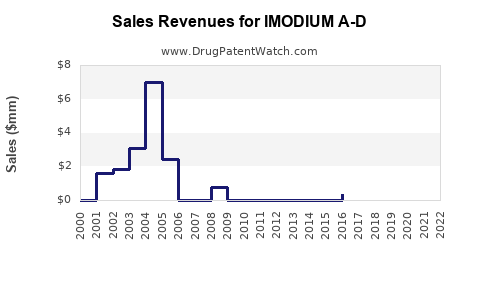
What is the financial trajectory pattern for OTC IMODIUM A-D?
Fast answer: The financial trajectory is typically steady-to-moderate growth in nominal terms, with real performance driven by net price and promotional intensity rather than unit expansion from exclusivity.
Typical trajectory components
- Net sales influenced by:
- Promotional cadence and trade deductions
- Channel mix (pharmacy vs mass vs online)
- Consumer price elasticity during inflation and downtrading
- Gross margin influenced by:
- Trade spend pressure
- Input costs and logistics
- Brand mix and discounting
Revenue “shape” over the cycle
- Seasonal quarter spikes: travel and summer peak
- Post-promo digestion: volume normalization
- Occasional step-down: competitive share losses to private label or a sustained promo ladder
When does competition accelerate into IMODIUM A-D?
Fast answer: Competition accelerates when retailers increase private label assortment or when branded pricing loses relative value due to promo reductions.
Key triggers that compress brand pricing
- Aggressive private label pricing in mass channels
- Retailer category resets that push down shelf prices
- Consumer trade-down as discretionary budgets tighten
- Increased online “lowest price” conversion
What share defenses tend to work
- Maintaining brand-level net pricing discipline
- Investing in merchandising during peak seasons
- Preserving a recognizable dose form for habitual buyers
How does IMODIUM A-D compare with other OTC antidiarrheals?
Fast answer: Loperamide’s competitive advantage is rapid symptom control perception, which supports repeat purchase. Competitors include adsorbents and probiotics or other OTC strategies, but substitution is usually less direct than within loperamide-containing products.
Competitive axis: loperamide vs alternative OTC strategies
- Symptom control and user familiarity typically favor loperamide
- Alternative approaches may win for specific consumer preferences but do not consistently displace loperamide in acute episode use
What generic entry risks exist for IMODIUM A-D?
Fast answer: Generic entry risk is already “built in” for loperamide; the practical risk is ongoing price erosion and share shifts rather than a discrete launch event tied to a single brand’s patent expiry.
What matters operationally instead of launch timing
- Retailer assortment decisions
- Promotional intensity required to maintain share
- Ongoing cost of sustaining trade relationships
What litigation or settlements affect IMODIUM A-D?
Fast answer: For IMODIUM A-D specifically, the primary commercial risks are pricing and trade. Patent-limiting litigation is not typically the central driver for OTC loperamide brand trajectories, given broad generic presence.
Where disputes can still matter
Even with generic loperamide availability, litigation can matter if it concerns:
- Trademark and trade dress
- Consumer labeling claims
- Supply disputes or packaging compliance
What is the Orange Book status of IMODIUM A-D?
Fast answer: IMODIUM A-D is an OTC drug product; it is not typically evaluated through the FDA Orange Book framework in the same way as prescription exclusivity/patent-linked approvals.
Why Orange Book is often not informative for OTC loperamide
- Orange Book listings focus on patent-linked prescription drug exclusivity.
- OTC loperamide products generally reflect a mature ingredient with widespread generic availability.
Revenue and financial trajectory implications for investors and licensors
Fast answer: IMODIUM A-D’s long-term value is tied to category resilience and brand defense economics. The most significant downside is margin compression from persistent value pricing by private label and branded generics.
Key financial KPIs to track for trajectory confirmation
- Net sales growth vs unit volume growth (promo and price separation)
- Trade spend as a percent of net sales
- Share proxies by channel: pharmacy vs mass vs online
- Inventory and ordering behavior around peak season
How to frame upside/downside
- Upside: stronger net pricing and improved brand share in peak seasons
- Downside: sustained promo intensity required to defend share, accelerating downtrading
Key market dynamics summary timeline (business-relevant)
IMODIUM A-D financial trajectory is best tracked on a recurring cycle rather than a single event timeline:
- Pre-peak season: merchandising and trade programs set pricing and share positioning
- Peak selling months: unit velocity rises; promo effectiveness can be assessed quickly
- Post-peak period: normalization and competitive price response determine net price durability
Key Takeaways
- IMODIUM A-D growth is driven by OTC category demand and brand merchandising, not prescription-style patent exclusivity.
- The dominant financial risk is ongoing price and share pressure from generic loperamide and private label, which compresses net price and margins.
- Seasonality and promo timing explain much of the quarter-to-quarter revenue volatility more than discrete regulatory or exclusivity events.
- Competitive outcomes in pharmacy and mass channels are the main levers for sustaining net sales trajectory.
FAQs
1) How do private label loperamide brands typically affect IMODIUM A-D net pricing?
They usually force retailer-led promo ladders, raising trade spend and compressing net price, especially in mass and online.
2) Does IMODIUM A-D have meaningful prescription-style exclusivity risk?
No; OTC loperamide competition is structurally mature, so risk is more about continuous price erosion than a single exclusivity event.
3) What seasonal periods most impact loperamide OTC sales?
Travel and summer months typically drive higher episodes of diarrhea and increase household replenishment.
4) Which channel mix most influences IMODIUM A-D profitability?
Channel mix that raises reliance on price-led promotion or online competitive conversion can reduce net margin.
5) What regulatory constraints matter most for OTC loperamide products?
Warnings, contraindications, and dosing limits that affect safe-use perception and discontinuation triggers.
References
- U.S. Food and Drug Administration. (n.d.). Drug approvals and labeling resources (OTC framework and labeling requirements). FDA. https://www.fda.gov
- FDA. (n.d.). Orange Book: Approved Drug Products with Therapeutic Equivalence Evaluations. https://www.accessdata.fda.gov/scripts/cder/daf/index.cfm