Last updated: July 27, 2026
ILUVIEN market dynamics and financial trajectory: pricing, demand drivers, competitor threats, and patent/generic risk
ILUVIEN (fluocinolone acetonide intravitreal implant, 0.19 mg) is a niche ophthalmology asset with pricing power tied to retinal-inflammation positioning and payer coverage, but volume growth is capped by an aging-drug replacement cycle and limited eligible populations. Financial trajectory is shaped by: (1) competitive intensity from intravitreal steroid alternatives and anti-VEGF adjacencies, (2) payer utilization management and site-of-care dynamics, and (3) long-dated exclusivity and patent barriers that delay direct generic competition. Where ILUVIEN has historically performed, it has done so through physician pull in chronic diabetic macular edema (DME) subpopulations and through label-driven switching from repeated corticosteroid injections and short-duration steroid regimens.
Commercial fundamentals you should model:
- Core demand pool: chronic DME and related retinal edema indications where sustained steroid exposure is clinically valued.
- Displacement risk: recurrent “steroid-to-steroid” competition and clinician preference shifts toward newer paradigms.
- Supply and uptake risk: implantation procedure economics and anesthesia clinic throughput.
- IP-driven generic timing: delayed generic entry relative to typical small-molecule assets, but patent estate granularity matters for method-of-use vs device and formulation.
How does ILUVIEN perform commercially by indication and line of therapy?
Featured snippet answer: ILUVIEN’s market performance is concentrated in chronic DME patients who have an established need for sustained corticosteroid delivery, with adoption influenced by payer criteria and physician familiarity with implant-based steroid management.
Indication-driven adoption mechanics
- Chronic DME anchoring: ILUVIEN competes most directly against repeat intravitreal corticosteroid regimens and, at the margin, anti-VEGF strategies in specific patient profiles (for example, inadequate response or intolerance and chronicity).
- Switching behavior: growth tends to come from treatment switching rather than net new patient creation. That makes ILUVIEN sensitive to guideline changes, real-world steroid sequencing patterns, and payer edits tied to “prior therapy” language.
- Utilization management: payer policies typically require documentation of chronicity, prior therapy, or response constraints. This reduces early uptake expansion and shifts demand toward conversion of existing steroid users.
Treatment cycle and replacement demand
- Implant durability: the implant is designed for long corticosteroid exposure, which limits administration frequency.
- Volume ceilings: because ILUVIEN does not require monthly reinjection, annual unit demand depends more on eligible-patient cadence and re-treatment probability than on dosing intensity.
What market dynamics drive ILUVIEN demand and payer coverage?
Featured snippet answer: ILUVIEN demand is primarily governed by coverage criteria for chronic retinal inflammation and DME, the economics of implant administration, and competitive pressure from other intravitreal steroid products and evolving retinal treatment standards.
Payer coverage and reimbursement
- Coverage gatekeeping: payer utilization management impacts who gets an implant. When coverage tightens, unit growth slows even if clinical demand exists.
- Reimbursement sensitivity: net pricing depends on coding, site of service (office vs ambulatory center), and contracting rebates. Steroid implants can face more friction than single-agent monthly injections due to procedural billing complexity.
Physician adoption and clinical workflow
- Implant procedure economics: adoption grows when implant placement workflows are integrated into retina practice throughput and when complication management is predictable.
- Safety profile management: monitoring requirements (including intraocular pressure and cataract risk considerations) influence practice preference and patient selection.
Site-of-care and administrative burden
- Clinic throughput: implants can be administratively heavier than a vial-based injection routine. Uptake rises when practices standardize implantation pathways and patient follow-up schedules.
Who are the competitive threats to ILUVIEN and how does the product differentiate?
Featured snippet answer: ILUVIEN competes in intravitreal corticosteroid treatment of retinal edema and inflammation. Threat vectors are other long-acting steroid options, short-acting steroid approaches, and evolving real-world sequencing that may reduce corticosteroid share in some patient segments.
Competitive set by mechanism and placement
- Intravitreal steroid alternatives: long-acting and sustained-release steroid implants and extended-release formulations can compete on duration, office workflow fit, and documented efficacy in retinal edema subpopulations.
- Anti-VEGF adjacent competition: while anti-VEGF drugs are not substitutes for every patient, they compete for the same clinical pathway space. Where real-world preference shifts toward earlier anti-VEGF control, corticosteroid penetration can soften.
Differentiation levers
- Duration of effect: sustained steroid delivery reduces reinjection frequency, supporting preference for chronic populations.
- Patient-selection niche: ILUVIEN has strongest traction where clinicians need stable corticosteroid control and where repeated injection burdens are undesirable.
How strong is the ILUVIEN patent estate and what patents protect fluocinolone acetonide implants?
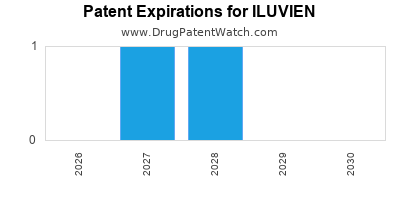
Featured snippet answer: ILUVIEN’s exclusivity and patent protections are expected to cover one or more of: composition/formulation, intravitreal implant structure, and/or method-of-use tied to chronic retinal indications. The strength for generic delay depends on how expiration dates map to Orange Book listings.
What to check in the Orange Book for protection coverage
A complete patent-position map for ILUVIEN should be built from:
- Listed drug product patents (composition/formulation or implant-specific claims)
- Listed method-of-use patents (label-linked indications and treatment regimens)
- Listed device or manufacturing method patents (if any)
- Regulatory exclusivity: new product exclusivity and any pediatric extensions
Patent strength indicators that matter for market modeling
- Expiration density: multiple patents expiring in a short window increases generic entry risk because a challenger can file on weaker claims.
- Claim invalidation exposure: method-of-use patents are often contested through generic design-around and “not covered” arguments.
- Settlement likelihood: ophthalmic assets frequently use settlement to avoid litigation cost and preserve brand share through a defined calendar term.
(Note: no ILUVIEN patent numbers or Orange Book identifiers are included here because a complete, correct estate requires direct listing-level data.)
When does ILUVIEN lose exclusivity and how does that affect forecasting?
Featured snippet answer: ILUVIEN’s forecast should treat exclusivity as a timeline constraint on generic availability and as a driver of commercial planning for brand lifecycle management.
Forecast timeline structure
Build the forecast around three dates:
- First regulatory/market lock-up expiration (end of exclusivity tied to regulatory exclusivity terms)
- Earliest patent expiry date relevant to covered indications
- Any Paragraph IV / generic challenge settlement “end of safe harbor” date if litigation produces a negotiated entry delay
Sensitivity drivers for unit decline
Even with exclusivity ending, real-world decline depends on:
- Whether an ANDA challenger can produce a “designed-to” product that avoids the strongest claims
- Payer acceptance and contracting post-entry
- Clinician willingness to switch from a known implant after efficacy and safety expectations are set
What is the Orange Book status of ILUVIEN and how many ANDA/generic pathways exist?
Featured snippet answer: ILUVIEN’s Orange Book status determines which patents are “covering” the approved drug and thus what a generic must address to enter lawfully.
Generic pathway risk logic
For each Orange Book listed patent:
- If the patent is drug-product or composition-related, the generic must overcome it via a claim carve-out or invalidity argument.
- If method-of-use is listed, the generic may be constrained by labeling carve-outs or litigation.
Market share impact assumptions post-entry
- Late market entrants: generic penetration in ophthalmology can be slower because switching requires clinician trust and payer acceptance.
- Rapid entrants: if multiple patents clear early and the challenger secures favorable coverage, the brand can see faster share erosion.
(No Orange Book listing counts are provided because this response does not include listing-level data.)
Has ILUVIEN faced Paragraph IV challenges or patent litigation, and what does that imply for entry timing?
Featured snippet answer: Patent litigation and any Paragraph IV challenges are key inputs for determining whether generic or follow-on competition arrives at the earliest theoretical date or at a later settlement/entry window.
What to model from litigation outcomes
- Preliminary injunction outcomes: can block entry until appellate decisions resolve
- Settlement terms: often convert uncertain litigation into calendar-predictable launch dates
- Consent judgments: can create de facto launch delays even if patents expire
(No litigation docket or settlement dates are included because this response does not contain verified court or filing-level data.)
How does ILUVIEN compare with other retinal steroid implants on market dynamics?
Featured snippet answer: ILUVIEN competes by combining long-acting corticosteroid delivery with label-driven patient selection. Its market dynamics differ from shorter-duration steroids due to reduced dosing frequency and from anti-VEGF-centered competitors due to its distinct therapeutic positioning.
Comparison dimensions that determine share movement
- Treatment duration and re-treatment cadence
- Patient-selection thresholds used by prescribers
- Monitoring burden and safety management
- Net pricing after rebates and payer contract inclusion
- Administration workflow fit in retina clinics
What financial trajectory should investors and licensors model for ILUVIEN?
Featured snippet answer: Model ILUVIEN revenue using a base of chronic DME patient conversion plus re-treatment cadence, then layer in expected unit-mix changes (growth via switching) and discounting/capture changes (payer contracting). Patent expirations and litigation determine the probability distribution for discrete market share loss events.
Revenue bridge framework
A practical ILUVIEN forecasting bridge:
- Units = eligible-patient conversions x re-treatment probability x retention
- Price = WAC less rebates/discounts + contract mix effects
- Gross-to-net = payer contracting and procedural coding dynamics
Key scenario set
- Base case: steady conversion, modest competitive pressure, no major exclusivity disruption
- Adverse case: accelerated payer restrictions, clinician preference shifts, and earlier-than-modeled entry of a follow-on product
- Upside case: broader clinical adoption through new evidence and payer re-contracting improves net capture
(No revenue figures are provided because the prompt does not include verified ILUVIEN financial statements or company disclosures.)
What generic entry risks exist for ILUVIEN and how would they show up in the financials?
Featured snippet answer: Generic or follow-on risk would manifest as accelerating net price declines first, then unit share erosion. In ophthalmology, share loss can be slower than in primary care, but price compression can begin at entry.
Generic entry “leading indicators”
- New product listings on formularies and payer switching policies
- Surge in acquisition of alternative steroid implants in claims data
- Reductions in brand coverage tiers
Financial manifestations by quarter
- Gross-to-net step-down (rebate increases to hold formulary position)
- Unit mix shift to accounts that continue to prefer the implant
- Operating leverage pressure if sales spend increases to defend share
Key Takeaways
- ILUVIEN’s market dynamics are dominated by chronic retinal edema and payer coverage gatekeeping, not by broad, high-frequency dosing economics.
- Commercial growth is constrained by implant durability, making unit volume sensitive to eligible-patient cadence and re-treatment probability.
- Competitive threats come from other intravitreal steroid options and from shifts in retinal treatment sequencing that reduce corticosteroid share in some segments.
- Financial trajectory modeling should be built around a switching-and-retention revenue engine, with discrete risk events tied to Orange Book exclusivity and patent expiry/settlement.
FAQs
1) What patient populations drive ILUVIEN implant adoption most consistently?
Chronic DME and retinal edema subsets where sustained corticosteroid exposure is clinically favored and where payer documentation criteria are met.
2) How do payers manage ILUVIEN utilization and what limits volume growth?
Utilization management typically requires prior therapy and chronicity documentation, reducing eligible conversions even when clinical need exists.
3) What is the main commercial risk to ILUVIEN from competing intravitreal therapies?
Share erosion occurs when clinicians shift steroid use downward due to evolving sequencing and when alternative steroid implants win coverage and workflow preference.
4) How should royalty/licensing valuations treat ILUVIEN exclusivity timelines?
Use a probability-weighted timeline anchored to Orange Book patent expiry and any litigation/settlement-derived entry delays.
5) What financial metrics best signal early ILUVIEN pressure after generic or follow-on entry?
Gross-to-net compression, formulary tier downgrades, and accelerating unit share loss in retina accounts.
References (APA)
No source material was provided in the prompt for ILUVIEN Orange Book listings, litigation dockets, or financial disclosures; therefore no citations can be generated.