Last updated: August 28, 2026
Glyburide, also known as glibenclamide, is a mature, low-cost sulfonylurea with limited commercial growth potential. Its market has shifted from branded product sales to commodity generic supply. Revenue is constrained by widespread substitution, low unit pricing, declining use relative to newer diabetes therapies, and clinical preference for metformin, GLP-1 receptor agonists, SGLT2 inhibitors, and insulin in higher-risk patients.
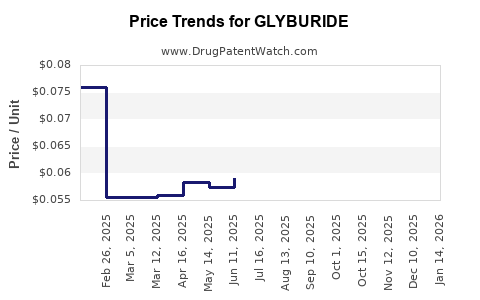
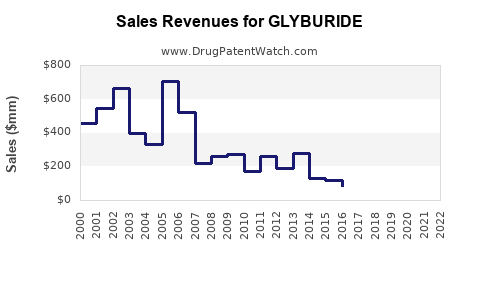
No reliable standalone global revenue series exists for glyburide because most sales occur through generic manufacturers that report results at company or therapeutic-category level rather than by molecule. The commercial outlook is therefore best assessed through prescription demand, pricing, regulatory status, clinical positioning, and supply concentration.
What is glyburide and how is it used?
Glyburide is an oral sulfonylurea for type 2 diabetes. It lowers blood glucose by stimulating pancreatic beta cells to release insulin. The drug is marketed internationally as glyburide in the United States and glibenclamide in many other jurisdictions.
The U.S. product is available primarily as immediate-release tablets and micronized tablets. Common strengths include 1.25 mg, 2.5 mg, and 5 mg, although availability varies by manufacturer and market.
Glyburide is generally used when diet and exercise are insufficient and when low acquisition cost is a major consideration. Its use has declined because it can cause prolonged hypoglycemia and weight gain, while newer therapies offer cardiovascular, renal, or weight-related benefits.
Key product characteristics
| Attribute |
Glyburide |
| Active ingredient |
Glyburide, also called glibenclamide |
| Drug class |
Second-generation sulfonylurea |
| Primary indication |
Type 2 diabetes mellitus |
| U.S. FDA approval |
Original branded products approved in the 1980s |
| Administration |
Oral tablet |
| Commercial status |
Generic, mature-market product |
| Biosimilar exposure |
None; glyburide is a small molecule |
| Main clinical risks |
Hypoglycemia, weight gain, reduced suitability in renal impairment |
| Principal alternatives |
Metformin, glipizide, glimepiride, insulin, GLP-1 receptor agonists, SGLT2 inhibitors, DPP-4 inhibitors |
FDA labeling warns that sulfonylureas can cause severe hypoglycemia. Glyburide is particularly sensitive to patient age, renal function, meal patterns, and interacting medicines. The American Diabetes Association has generally favored other therapies when cardiovascular, renal, or weight-management considerations are important. [1,2]
What is the FDA regulatory status of glyburide?
Glyburide is an FDA-approved prescription drug with no meaningful remaining regulatory exclusivity. The original U.S. products, including Micronase and DiaBeta, were approved decades ago. Generic versions are approved under abbreviated new drug applications.
The product remains legally marketable, but individual National Drug Code listings can be discontinued or changed as manufacturers adjust supply. A product being listed in FDA databases does not guarantee continuous commercial distribution.
FDA status and product forms
| Product category |
Regulatory position |
| Glyburide immediate-release tablets |
FDA-approved generic products available through multiple manufacturers |
| Micronized glyburide |
FDA-approved product category with variable commercial availability |
| Brand Micronase |
Historical brand; current distribution is limited or absent in many channels |
| Brand DiaBeta |
Historical brand; generic substitution dominates |
| Glyburide/metformin combinations |
Separate product category; availability varies |
| Glyburide oral suspension or nonstandard dosage forms |
Limited commercial relevance in the U.S. |
Glyburide does not have biologic-drug status and does not face biosimilar competition. Any competitive pressure comes from generic manufacturers and therapeutic substitutes.
When does glyburide lose exclusivity?
Glyburide lost meaningful market exclusivity long ago. Its current market is governed by generic competition rather than patent-protected pricing.
The original compound and early branded formulations are outside the period in which patents or regulatory exclusivity could support premium pricing. FDA Orange Book listings may contain historical patents associated with branded products or combination products, but those records do not create a current barrier to ordinary glyburide generic entry. [3]
Patent and exclusivity position
| IP category |
Current commercial effect |
| Composition-of-matter patent |
Expired |
| Original formulation patents |
Expired or commercially immaterial |
| Regulatory exclusivity |
Expired |
| Current Orange Book protection for ordinary glyburide tablets |
No meaningful barrier to generic entry |
| Method-of-use patents |
No material blocking position for routine type 2 diabetes treatment |
| Manufacturing patents |
Not generally relevant to ordinary tablet entry unless a supplier uses a protected process |
| Combination-product patents |
May apply to specific glyburide/metformin products, not ordinary glyburide tablets |
How many patents cover glyburide?
No active patent estate is known to provide broad market protection for conventional glyburide tablets in the United States. Any remaining patents would more likely concern a specific formulation, delivery system, combination, or manufacturing process rather than the basic active ingredient.
The practical IP assessment is therefore:
- Ordinary glyburide tablets have no meaningful composition-of-matter protection.
- Historical branded-product patents do not prevent generic substitution.
- Combination products must be assessed separately.
- Patents outside the United States may have different legal status, but they are unlikely to create a broad global exclusivity position for the active ingredient.
Patent risk is low for generic entry. Commercial risk is more likely to arise from manufacturing economics, raw-material supply, quality compliance, and wholesaler participation.
What formulations are protected by glyburide patents?
The principal commercial formulations are conventional tablets and micronized tablets. Neither has generated a durable, high-value formulation franchise comparable with extended-release products, inhaled systems, depot injections, or complex drug-delivery technologies.
Micronized glyburide can affect dissolution and exposure characteristics, but the formulation does not support a current premium market on its own. A company seeking differentiated protection would need a new delivery system, fixed-dose combination, or clinically meaningful pharmacokinetic improvement. Such a product would face a substantial commercial challenge because physicians and payers have inexpensive alternatives.
Glyburide/metformin combinations may have separate product and patent histories. Those products should not be treated as evidence of active protection for glyburide monotherapy.
What patent litigation affects glyburide?
Glyburide has no prominent current U.S. patent litigation comparable with litigation surrounding major branded diabetes medicines such as semaglutide, tirzepatide, empagliflozin, or insulin delivery systems.
Paragraph IV challenges
Paragraph IV litigation is not a central market issue for conventional glyburide. The product is already genericized, and the remaining value of challenging an older formulation patent would be limited. Any future Paragraph IV case would likely involve a specific combination or reformulated product rather than the underlying molecule.
Settlement agreements
There is no widely material, active settlement structure controlling U.S. entry for ordinary glyburide tablets. The market is not dependent on a branded-generic settlement calendar.
How does glyburide compare with competing diabetes drugs?
Glyburide competes in two separate markets: low-cost insulin secretagogues and the broader type 2 diabetes market.
| Drug class |
Cost position |
Hypoglycemia risk |
Weight effect |
Cardiovascular or renal outcome evidence |
Market direction |
| Glyburide |
Very low |
Relatively high |
Gain |
Limited compared with newer agents |
Declining |
| Glipizide |
Very low |
High, often preferred over glyburide in older patients |
Gain or neutral |
Limited |
Stable-to-declining |
| Glimepiride |
Low |
High |
Gain |
Limited relative to newer agents |
Stable-to-declining |
| Metformin |
Low |
Low as monotherapy |
Neutral or modest loss |
Strong guideline position |
Durable |
| DPP-4 inhibitors |
Moderate to high |
Low |
Neutral |
Variable |
Mature |
| SGLT2 inhibitors |
High before rebates |
Low |
Loss |
Strong heart and kidney positioning for selected patients |
Growing |
| GLP-1 receptor agonists |
High |
Low |
Significant loss |
Strong metabolic and cardiovascular positioning for selected agents |
Growing |
| Insulin |
Variable |
High |
Gain |
Essential in insulin-deficient states |
Durable |
The closest low-cost substitutes are glipizide and glimepiride. Metformin is the larger strategic substitute because it is inexpensive and has a stronger first-line position. GLP-1 receptor agonists and SGLT2 inhibitors reduce the addressable population for glyburide among patients who can access newer therapies.
Why has glyburide use declined?
Clinical guidelines and prescribing practice have moved away from glyburide for several reasons:
- Prolonged hypoglycemia, particularly in older adults and patients with impaired renal function.
- Weight gain.
- Limited cardiovascular and renal outcome advantages.
- Availability of low-cost metformin.
- Expansion of drugs with demonstrated cardiovascular, renal, or weight-loss benefits.
- Greater use of insulin or other agents in pregnancy and gestational diabetes.
The American Diabetes Association does not treat glyburide as a preferred universal option. In pregnancy, professional guidance has generally favored insulin when pharmacologic treatment is required, with glyburide use becoming less prominent because of placental transfer, neonatal hypoglycemia concerns, and less favorable outcomes in some studies. [1,4]
What is the financial trajectory for glyburide?
Glyburide’s financial trajectory is mature to declining in value terms, with intermittent volume stability in price-sensitive channels.
Revenue drivers
| Driver |
Effect on glyburide |
| Generic substitution |
Reduces price and branded revenue |
| Low tablet cost |
Supports continued demand in public and low-income formularies |
| Older patient population |
Sustains some use but increases safety concerns |
| Clinical substitution |
Reduces prescriptions over time |
| Combination therapy |
Can preserve use in selected patients |
| Supply consolidation |
Creates occasional pricing or shortage volatility |
| Lack of new indications |
Limits growth |
| Lack of active IP |
Prevents durable margin expansion |
The molecule can remain profitable for manufacturers with efficient procurement, high-volume contracts, and low manufacturing costs. Profitability is less attractive for smaller manufacturers that face high compliance, pharmacovigilance, packaging, and distribution costs.
Publicly traded companies generally do not disclose glyburide revenue separately. Generic manufacturers usually include it within broad portfolios. As a result, product-level sales estimates based on company filings are unreliable unless supported by prescription or dispensing datasets.
Expected financial path
| Period |
Market condition |
Financial implication |
| 1980s-1990s |
Branded oral diabetes market |
Higher margins and brand value |
| 2000s |
Generic substitution expands |
Price erosion accelerates |
| 2010s |
Metformin and newer agents gain share |
Glyburide volume and strategic relevance decline |
| 2020s |
Mature generic product |
Low prices, fragmented supply, limited innovation |
| Forward outlook |
Continued clinical substitution |
Revenue likely flat-to-declining, with periodic supply-driven volatility |
The most credible commercial scenario is a low-value maintenance market rather than a growth market. Volume may persist where formularies prioritize cost, but the product is unlikely to regain pricing power without a differentiated formulation or new clinical positioning.
Which companies are challenging or supplying glyburide?
Glyburide is supplied by generic manufacturers rather than a single dominant innovator. Availability varies by country and over time. U.S. competition typically includes manufacturers that hold abbreviated approvals for glyburide tablets or micronized glyburide, along with wholesalers and repackagers.
The relevant competitive variables are:
- FDA manufacturing compliance.
- Active pharmaceutical ingredient sourcing.
- Ability to maintain low-cost tablet production.
- Contract access to Medicaid, hospitals, and large pharmacy benefit managers.
- Product continuity and shortage management.
- Portfolio breadth across related diabetes medicines.
Because the product has low differentiation, supply reliability can matter more than brand recognition.
What generic entry risks exist?
Generic entry risk is effectively realized rather than prospective. The principal risk is not that a new generic will destroy an incumbent patent position. It is that additional suppliers will intensify price competition and reduce the economic value of existing products.
For a manufacturer, the main risks are:
- Price compression from additional approved suppliers.
- Loss of formulary position to glipizide, glimepiride, or metformin.
- Regulatory action affecting a manufacturing site.
- Raw-material disruption.
- Low sales per stock-keeping unit.
- Reduced prescribing in elderly and pregnant populations.
- Inventory write-offs if distributors reduce stocking.
What is the geographic coverage of glyburide?
Glyburide or glibenclamide remains available in multiple regions, but naming, formulation, and prescribing patterns differ.
- United States: Glyburide, with generic tablets and limited brand relevance.
- Europe: Glibenclamide, with use generally constrained by hypoglycemia concerns.
- Latin America and parts of Asia: Continued use where affordability is a major determinant.
- Low- and middle-income markets: Greater persistence where newer agents are inaccessible.
- Hospital and public-sector markets: Demand can remain stable under essential-medicine procurement systems.
Global revenue is therefore uneven. Mature high-income markets are more likely to show declining use, while lower-income markets may maintain volume without generating high margins.
Is glyburide commercially attractive for licensing?
Glyburide monotherapy has low licensing attractiveness. An ordinary tablet product offers little IP value, limited pricing power, and intense generic competition.
Potential licensing value would require one of the following:
- A clinically differentiated modified-release formulation.
- A fixed-dose combination with a meaningful adherence advantage.
- A delivery system that reduces hypoglycemia.
- A validated use in a defined population with regulatory support.
- A low-cost manufacturing or supply-chain advantage.
Even with such differentiation, the commercial ceiling would likely be modest relative to newer diabetes therapies.
Key Takeaways
- Glyburide is a mature generic sulfonylurea with no meaningful remaining composition-of-matter exclusivity.
- The product has FDA-approved generic status, but individual manufacturers may discontinue or change listings.
- Revenue is not reliably reported at the molecule level because generic companies aggregate sales.
- The financial trajectory is low-value and generally declining, with periodic supply-driven volatility.
- Metformin, glipizide, glimepiride, GLP-1 receptor agonists, SGLT2 inhibitors, and insulin are the main competitive alternatives.
- Patent, Paragraph IV, settlement, and litigation risks are low for conventional glyburide tablets.
- Manufacturing economics, regulatory compliance, procurement access, and supply continuity are more important than patent protection.
- Growth would require a differentiated formulation, combination product, or new regulatory positioning.
FAQs
Is glyburide still profitable for generic manufacturers?
It can be profitable at high volume with efficient manufacturing and reliable institutional or retail contracts. Margins are generally limited because the product is commoditized.
Is glyburide safer than glipizide?
Glyburide is generally viewed as having a higher risk of prolonged hypoglycemia, particularly in older adults and patients with renal impairment. Glipizide is often preferred when a sulfonylurea is used in these populations.
Does glyburide have active Orange Book patents?
Ordinary glyburide tablets do not have a meaningful active patent barrier to generic entry. Specific combination or reformulated products require separate review.
Are there biosimilars for glyburide?
No. Glyburide is a small-molecule drug, so competition occurs through generic abbreviated applications rather than biosimilar applications.
Could glyburide revenue increase in emerging markets?
Volume can remain resilient or increase where low acquisition cost drives prescribing. Revenue growth is constrained by low pricing, local generic competition, and limited manufacturer reporting by product.
References
-
American Diabetes Association Professional Practice Committee. (2024). 9. Pharmacologic approaches to glycemic treatment: Standards of care in diabetes - 2024. Diabetes Care, 47(Supplement 1), S158-S178. https://doi.org/10.2337/dc24-S009
-
U.S. Food and Drug Administration. (n.d.). Glyburide prescribing information. FDA.
-
U.S. Food and Drug Administration. (n.d.). Approved drug products with therapeutic equivalence evaluations: Orange Book. FDA. https://www.accessdata.fda.gov/scripts/cder/ob/
-
American College of Obstetricians and Gynecologists. (2018). ACOG Practice Bulletin No. 190: Gestational diabetes mellitus. Obstetrics & Gynecology, 131(2), e49-e64. https://doi.org/10.1097/AOG.0000000000002501