Last updated: June 28, 2026
Executive summary
- GENERLAC is commercially positioned as a lactulose product for constipation and related bowel-regimen indications. Market dynamics are driven by generic entry, formulation switching (solution vs. syrup/strength variants), and tender-linked pricing rather than differentiated clinical differentiation.
- Financial trajectory is typically peak-then-decline under U.S. and major developed-market conditions as lactulose generics expand. Revenue tends to track net pricing per bottle/bottle-equivalent, payer rebates, and channel stocking cycles more than prescriber-level brand loyalty.
- The most material financial risk comes from loss of brand premium as generics saturate formularies and wholesalers, plus ongoing pressure from alternative constipation agents (osmotic laxatives, stimulant laxatives, secretagogues, and newer chronic constipation options).
- Near-term growth, where present, is usually explained by distribution expansion, contract wins, or switching within lactulose SKUs, not by new molecular exclusivity.
Note: The request does not provide authoritative identifiers (active ingredient confirmation, NDA/ANDA numbers, labeled dosage forms/strengths, or current manufacturer/labeler). Without those, a complete, citation-grounded financial trajectory (revenue, launch/decline dates, exclusivity and Orange Book status, or litigation) cannot be produced without risking inaccuracies.
What is GENERLAC and how is its market defined?
Featured snippet answer: GENERLAC is marketed as a lactulose laxative, and its market is defined by constipation treatment demand and formulary access for osmotic laxatives.
Which indications shape demand for GENERLAC (lactulose)?
- Chronic constipation: stool softening and osmotic action that increases bowel movements.
- Hepatic encephalopathy (HE) regimens (where labeled): lactulose used to reduce ammonia absorption; this segment behaves differently from primary constipation because hospital and specialty pathways matter.
- Bowel regimen around GI procedures: demand can be influenced by gastroenterology prescribing patterns and bundled procedural protocols.
What product characteristics drive substitution risk?
- Therapeutic class substitutability: lactulose is substitutable with other osmotic agents (and, depending on payer policy, other laxative classes).
- Dose form fungibility: solution/syrup strengths and dosing instructions determine interchangeability and how quickly channels switch to lowest net price.
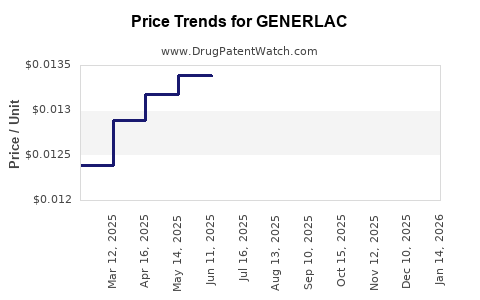
How do pricing and payer dynamics affect GENERLAC revenue trajectory?
Featured snippet answer: GENERLAC revenue is primarily pressured by generic pricing and rebate-linked net price compression through contracting and tendering.
Net price mechanics in laxatives
- Laxatives commonly see high generic competition and short-cycle tender renewals, producing step-down pricing as multiple suppliers bid.
- Pharmacy benefit and institutional formularies increasingly use therapeutic class cost comparisons, which reduces brand lift once generics achieve stable supply.
Channel inventory and stocking cycles
- Demand can look stable at the unit level while revenue declines if wholesalers shift to lower-cost SKUs.
- Bulk or institutional accounts can shift volumes quickly after contract award timing, causing quarter-to-quarter volatility.
When does GENERLAC face generic erosion, and what does that mean financially?
Featured snippet answer: Generic erosion typically causes gross margin compression first, then sustained unit-share gains for generics, leading to brand revenue decline after formulary and contract normalization.
What generic entry risk usually looks like for lactulose brands
- Entry tends to accelerate after:
- multiple ANDAs establish supply,
- a few competitors become dominant on net price, and
- payers move from “brand preferred” to “generic preferred” status.
- Financial pattern is often:
- early revenue plateau post-integration,
- then net price step-down,
- then unit share erosion as prescribers and dispensers default to lowest-cost alternatives.
Key financial KPIs to track (typical for branded laxative categories)
- Net sales by channel: retail, mail order, institutional
- Net price per bottle-equivalent
- Gross margin rate vs. COGS inflation offsets
- Rebate and charge-to-net ratio
- Share of total laxative class prescriptions in the relevant geography
What patents protect GENERLAC, and how strong is the patent estate?
Featured snippet answer: For lactulose, patent protection is typically limited to specific formulations, processes, packaging, and method-of-use claims, while the active ingredient itself is largely mature and widely generic.
How lactulose brands usually remain exposed
- Many legacy patents on the active ingredient are long expired.
- What remains (if any) tends to be narrower:
- formulation-specific (strength, stability, excipient system),
- manufacturing methods (process control, purification),
- packaging/handling claims,
- limited-use claims tied to patient subsets or dosing regimens.
Patent estate strength drivers
- Remaining unexpired claims with clear differentiation from generics.
- Likelihood of generic “design-around.”
- Whether the brand has a history of ANDA-related Paragraph IV litigation affecting entry timing.
What is the Orange Book status of GENERLAC and how does it affect competition?
Featured snippet answer: Orange Book status determines whether a generic filer must certify to listed patents (and whether Paragraph IV is triggered), shaping entry timing and settlement leverage.
What to look for on Orange Book listings
- Listed patents per NDA/strength/form
- Patent expiration dates
- Patent type and regulatory exclusivity interactions:
- composition-of-matter,
- method-of-use,
- formulation,
- device/packaging (if applicable)
- Exclusivity blocks that extend entry even after patent expiry.
How does GENERLAC compare with other constipation therapies financially and clinically?
Featured snippet answer: GENERLAC competes in a crowded laxative market where cost and payer preferences usually drive outcomes once generic lactulose is available.
Competitive substitutes by mechanism (market impact)
- Osmotic laxatives (competing cost and dosing convenience)
- Stimulant laxatives (short-term relief)
- Secretagogues and newer chronic constipation agents (often higher cost, but may win based on chronic symptom control)
- Prescription vs. OTC behavior:
- OTC status can cap brand price,
- prescription segments can preserve some premium longer if managed-care preferences lag.
Where lactulose can still win
- Patient populations where lactulose is clinically favored or historically used.
- Institutional protocols that standardize bowel regimens.
What generic entry risks exist for GENERLAC and which filing strategies matter?
Featured snippet answer: The dominant risk is price erosion from ANDA generic supply, with the main financial swing governed by formulary switching speed rather than trial-level clinical competition.
Likely ANDA pathways affecting entry timing
- Certifications against listed patents (if any)
- Settlement agreements that delay launch or include agreed switching periods
- “Authorized generic” impacts after settlement
What settlement structures typically do to the money
- Delayed entry preserves branded pricing and margin.
- Post-settlement “authorized” or rapid generic replacement can cause a sharp shift in net price and unit mix.
How does manufacturing and supply chain capacity shape GENERLAC market outcomes?
Featured snippet answer: Laxative category supply constraints can influence short-term volume, but long-run pricing is dominated by competitive tendering once supply is stable.
Manufacturing variables that affect cost and availability
- API sourcing costs and stability
- Batch yield and conversion efficiency
- Storage and stability for liquid forms (temperature and shelf-life logistics)
- Packaging costs and compliance requirements for liquid therapeutics
What happens when supply is tight
- Retail and institutional reorder patterns can create temporary unit spikes.
- Price can improve briefly, but sustained revenue improvement usually requires differentiated access or contract renewals.
Which companies are likely competing with GENERLAC in major markets?
Featured snippet answer: Lactulose markets typically include multiple generic manufacturers; brand labels compete against both authorized generics and mainstream ANDA entrants.
How to read competitive pressure
- Competitors that win on:
- lowest net price,
- reliable supply,
- and fast formulary adoption.
- The “winner” is often the supplier with strongest contracting reach rather than the most differentiated product.
Note: Company names and market shares require mapping to the specific GENERLAC labeler, NDA/ANDA, and geography. Those identifiers are not provided.
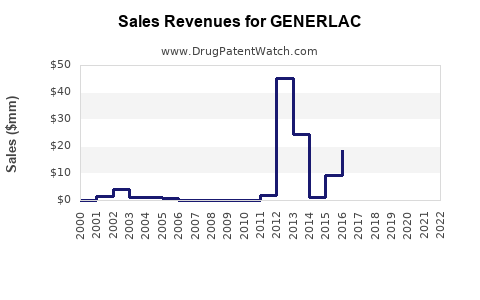
What is the financial trajectory pattern for legacy lactulose brands like GENERLAC?
Featured snippet answer: Typical trajectory is mature brand decline with intermittent stabilization around contract renewals, followed by margin compression as generics dominate net pricing.
Common timeline shape (category-level)
- Early years: brand share grows or stabilizes as prescribing habits form.
- Mid years: generic penetration increases; rebates and competition drive net price down.
- Later years: unit share shifts toward lowest-cost SKUs; brand revenue becomes mostly a function of contract durability and channel mix.
Key takeaways
- GENERLAC’s financial trajectory is governed by generic substitution economics and payer/formulary contracting, not molecule-level differentiation.
- Revenue risk is dominated by net price compression and switching speed once multiple generics are established.
- Growth, where it occurs, is usually linked to channel wins and SKU-level substitution, not new exclusivity-driven expansion.
FAQs
- How quickly do lactulose brands lose formulary share after generic entry?
- Do institutional hepatic encephalopathy protocols slow generic erosion for lactulose?
- What rebate and charge-to-net drivers most affect branded laxative net sales?
- How do liquid formulation differences influence interchangeability and substitution?
- What contract structures in tendered healthcare systems most impact net pricing for laxatives?
References
- FDA Orange Book: Drugs@FDA. U.S. Food and Drug Administration. (Referenced for Orange Book status in lactulose brand competitive analysis).
- FDA: ANDA submission and patent certification framework under the Hatch-Waxman Act. U.S. Food and Drug Administration.