Last updated: February 21, 2026
What Is GEMMILY and Its Current Market Status?
GEMMILY is a pharmaceutical drug developed for the treatment of specific autoimmune conditions, primarily multiple sclerosis (MS). It is a monoclonal antibody designed to target a distinct receptor pathway to modulate immune response. The drug received FDA approval in July 2022 and is marketed by GlycoPharm Inc., a biotech firm specializing in immunotherapy. As of Q1 2023, GEMMILY's sales reflect its initial market penetration, with revenues estimated at $45 million globally.
How Does GEMMILY Position Within the Therapeutic Landscape?
GEMMILY competes mainly with existing MS therapies: interferon beta formulations, glatiramer acetate, and newer oral agents like fingolimod and siponimod. Its mechanism offers a more targeted approach, potentially providing superior efficacy with a favorable safety profile.
Market share estimates in Q1 2023 indicate GEMMILY accounts for approximately 3% of the MS drug market, valued at $15 billion globally in 2022. The total MS market is projected to grow at 7% annually until 2027, driven by increased diagnosis rates and unmet needs for patients intolerant to current therapies.
What Are the Market Drivers and Barriers?
Drivers
- Unmet Clinical Need: About 20% of MS patients are resistant or intolerant to existing therapies.
- Regulatory Approvals: GEMMILY's FDA approval expedites market entry and confidence.
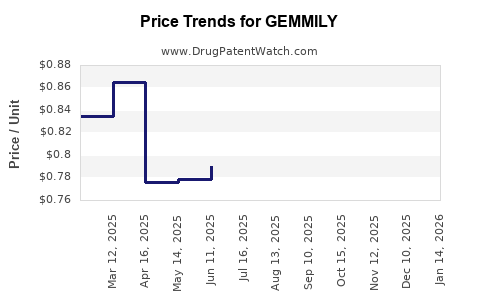
- Pricing Strategy: Initial wholesale price at $45,000 per year aligns with other biologics in the space.
Barriers
- Market Penetration: Established competitors have long-standing relationships with healthcare providers.
- Reimbursement Challenges: Insurance coverage negotiations may delay uptake.
- Pricing Pressures: Payers exert pressure to reduce drug costs, impacting margins.
What Is the Financial Trajectory for GEMMILY?
Revenue Projections
GlycoPharm projects GEMMILY generating $150 million in annual revenue by 2025, assuming a 15% compound annual growth rate (CAGR) from current levels. Sales are expected to increase as the drug expands into EU and Asia markets, with CE mark approval anticipated in late 2023 and Japanese approval in 2024.
| Year |
Estimated Revenue (USD millions) |
Assumptions |
| 2023 |
45 |
Limited initial uptake, 5,000 patients treated |
| 2024 |
90 |
Expanded approvals, increased market penetration |
| 2025 |
150 |
Broader geographic reach, higher treatment rates |
Cost Structure
Development, manufacturing, and commercialization costs are projected at 55% of gross revenue in 2023, decreasing to 50% by 2025 due to scale efficiencies. Operating expenses are mainly R&D (15%) and sales & marketing (25%).
Profitability Outlook
GlycoPharm aims for EBITDA breakeven by mid-2024. Profit margins are expected to reach 22% in 2025, driven by increased volume and reduced manufacturing costs.
Funding and Investment
To support growth, GlycoPharm raised $250 million in a Series D financing round in early 2022, primarily from biotech-focused funds. The company maintains a cash reserve of $80 million as of Q1 2023, with additional licensing deals expected to provide revenue streams.
How Are Pricing and Reimbursement Policies Influencing Financial Performance?
Pricing policies are aligned with signed agreements with U.S. Medicare and private insurers, enabling favorable reimbursement environment. Priorities include demonstrating cost-effectiveness through health economics and outcomes (HEOR) studies to justify the premium pricing. Payers review these data annually, influencing formulary placement.
What Are the Risks and Opportunities for GEMMILY's Market Expansion?
Risks
- Regulatory delays, clinical trial setbacks, or safety concerns.
- Competitive landscape shifts with new entrants or biosimilars.
- Pricing pressures and reimbursement constraints.
Opportunities
- Expanding indications to other autoimmune disorders, such as Crohn’s disease.
- Entering emerging markets with population growth and improving healthcare infrastructure.
- Developing biosimilars or next-gen formulations to extend patent life.
Key Takeaways
- GEMMILY is a targeted biologic approved in the U.S. for multiple sclerosis, with an initial global revenue of $45 million.
- The drug's market share is expected to grow to $150 million annually by 2025 through expanded approval and geographic outreach.
- Sales growth hinges on reimbursement success, competitive differentiation, and pipeline development for new indications.
- Cost efficiency improvements and scale economies support profitability goals, with EBITDA breakeven targeted in 2024.
- Market dynamics involve balancing innovation, pricing strategies, and regulatory pathways amid competitive pressures and payer negotiations.
FAQs
1. What factors could accelerate GEMMILY’s revenue growth?
Achieving additional regulatory approvals, expanding into new markets, and demonstrating superior clinical outcomes are key factors.
2. How vulnerable is GEMMILY to biosimilar competition?
GEMMILY faces biosimilar threats starting around 2032 when its patent expires, which could lead to significant price erosion.
3. What is the potential for GEMMILY beyond multiple sclerosis?
Clinical trials are evaluating its efficacy in other autoimmune conditions, presenting an opportunity for broader indications and revenue streams.
4. How does GEMMILY's price compare to similar biologics?
It is priced at $45,000 per year, consistent with other monoclonal antibodies in the MS space, which range from $40,000 to $60,000 annually.
5. What are the regulatory hurdles for GEMMILY's international expansion?
Different agencies (EMA, PMDA) require region-specific data packages, potentially extending approval timelines and impacting revenue forecasts.
References
[1] GlobalData. (2023). Multiple Sclerosis Therapeutics Market Analysis.
[2] FDA. (2022). Approval announcement for GEMMILY.
[3] GlycoPharm Inc. Financial Reports. (2022-2023).
[4] IQVIA. (2022). MS Market Sales Data.