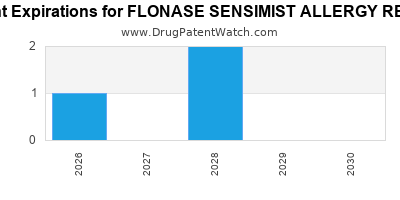
Last updated: October 21, 2026
Flonase Sensimist Allergy Relief is an over-the-counter nasal corticosteroid containing fluticasone furoate, 27.5 mcg per spray. Haleon owns and markets the consumer brand after the 2019 separation of GSK’s consumer-health business and the 2022 formation of Haleon. The product competes in the U.S. intranasal allergy market against Flonase Allergy Relief, Nasacort Allergy 24HR, Rhinocort Allergy Spray, generic fluticasone propionate, and other steroid nasal sprays.
The commercial outlook is stable but mature. Flonase Sensimist benefits from strong brand recognition, an OTC distribution model, and product differentiation based on scent, spray feel, and device design. Its main constraints are generic competition, seasonal demand, retailer bargaining power, and the absence of separately reported brand revenue from Haleon.
What is Flonase Sensimist Allergy Relief?
Flonase Sensimist is an OTC nasal spray for temporary relief of symptoms associated with seasonal and year-round allergic rhinitis. Its active ingredient is fluticasone furoate, a synthetic corticosteroid.
| Product attribute |
Detail |
| Brand |
Flonase Sensimist Allergy Relief |
| Active ingredient |
Fluticasone furoate |
| Strength |
27.5 mcg per spray |
| Dosage form |
Metered-dose nasal spray |
| Route |
Intranasal |
| U.S. regulatory status |
OTC product marketed under an FDA-approved NDA |
| Primary manufacturer and marketer |
Haleon |
| Original developer |
GlaxoSmithKline |
| Main indication |
Allergic rhinitis |
| Primary market |
United States consumer health market |
| Principal competitors |
Flonase Allergy Relief, Nasacort, Rhinocort, generic nasal corticosteroids |
Flonase Sensimist differs from standard Flonase Allergy Relief primarily through its active ingredient and delivery experience. Standard Flonase contains fluticasone propionate. Sensimist uses fluticasone furoate and is marketed as having a lighter, gentler mist with no added scent.
When did Flonase Sensimist receive FDA approval and lose prescription status?
The FDA approved fluticasone furoate nasal spray under the Veramyst prescription brand before the product moved into the OTC market. Flonase Sensimist was introduced as an OTC allergy product in the United States in 2016 following FDA approval of the nonprescription formulation and labeling.
| Milestone |
Timing |
| Veramyst prescription approval |
2007 |
| Flonase Sensimist OTC launch |
2016 |
| GSK consumer-health separation from parent company |
2019 |
| Haleon public listing and operating launch |
2022 |
| Current commercial status |
OTC brand marketed by Haleon |
The OTC switch expanded access and moved the product from physician-prescribed treatment into self-care retail channels. The change also increased exposure to private-label substitution and promotional competition.
FDA labeling permits use in adults and children subject to age restrictions stated on the package. The product is intended for regular use during allergy seasons rather than immediate relief from acute nasal congestion.
What is the financial trajectory for Flonase Sensimist?
Haleon does not publicly report Flonase Sensimist revenue as a standalone line item. Public filings generally aggregate consumer-health brands by geographic region, category, or larger brand portfolio. A precise product-level revenue series therefore cannot be established from public company disclosures.
The financial trajectory can be assessed through five commercial drivers:
- OTC category expansion and seasonal allergy prevalence.
- Brand pricing and premium positioning.
- Retail distribution and shelf placement.
- Cannibalization within the Flonase franchise.
- Generic and private-label substitution.
Flonase Sensimist likely operates as a mature, cash-generating OTC brand rather than a high-growth prescription asset. Its financial profile is supported by recurring seasonal demand, low refill friction, and broad retail availability. Growth is more likely to come from price, household penetration, and channel execution than from major increases in treated-patient volume.
How does Flonase Sensimist generate revenue?
Revenue comes primarily from U.S. retail sales through pharmacies, mass merchants, grocery stores, club stores, and e-commerce platforms. The commercial model includes:
- Direct retail sales to consumers.
- Pharmacy and retailer wholesale purchases.
- Seasonal promotional campaigns.
- Multipack and family-size packaging.
- E-commerce search placement.
- Cross-selling within the broader Flonase portfolio.
The brand is exposed to retailer trade spending, couponing, temporary price reductions, and changes in private-label shelf allocation. A premium price depends on consumer recognition of the Sensimist delivery system and perceived tolerability advantages.
What is the likely financial trajectory through the next several years?
The expected trajectory is mature and defensively positioned:
| Period |
Expected commercial pattern |
| Near term |
Stable demand with seasonal volatility and continued promotional pressure |
| Medium term |
Low single-digit nominal growth potential from pricing, e-commerce, and distribution |
| Longer term |
Margin pressure from generics, retailer concentration, and product-line substitution |
The product’s revenue may rise in nominal terms even if unit volume is flat, provided Haleon maintains pricing and distribution. Volume pressure would increase if consumers switch to generic fluticasone products or lower-priced store brands.
The strongest periods typically coincide with high pollen counts, longer allergy seasons, and effective spring retail campaigns. Demand can weaken when allergy seasons are mild or when consumers substitute oral antihistamines, generic nasal corticosteroids, or combination allergy products.
How large is the Flonase Sensimist market opportunity?
The addressable market is the U.S. allergic-rhinitis and nasal-allergy category. Demand is broad because allergic rhinitis affects a significant share of the population and often requires repeated treatment across multiple months.
The most commercially relevant customer groups are:
- Adults with seasonal allergic rhinitis.
- Parents purchasing pediatric allergy products.
- Consumers seeking non-drowsy allergy treatment.
- Patients dissatisfied with the spray feel of older nasal products.
- Existing Flonase users trading up to Sensimist.
- Consumers moving from prescription treatment to OTC self-care.
Sensimist has a narrower differentiation than the broader Flonase name. The Flonase brand creates awareness, while Sensimist provides an upgraded delivery proposition. That positioning can support premium pricing but can also shift sales away from standard Flonase rather than expand the total franchise.
How does Flonase Sensimist compare with competing allergy drugs?
| Product |
Active ingredient |
Market position |
Principal competitive issue |
| Flonase Sensimist |
Fluticasone furoate |
Premium Flonase nasal steroid |
Higher price and generic substitution |
| Flonase Allergy Relief |
Fluticasone propionate |
Mainstream Flonase brand |
Direct internal cannibalization |
| Nasacort Allergy 24HR |
Triamcinolone acetonide |
Major OTC nasal steroid |
Strong brand and retailer competition |
| Rhinocort Allergy Spray |
Budesonide |
Established nasal steroid |
Retail and generic alternatives |
| Generic fluticasone propionate |
Fluticasone propionate |
Value alternative |
Price-based substitution |
| Oral antihistamines |
Various |
Non-nasal alternative |
Different administration and symptom profile |
Sensimist’s competitive advantage is not a fundamentally new therapeutic class. It is the combination of fluticasone furoate, brand trust, consumer advertising, and spray experience. Its defensibility is therefore more commercial than technological.
What patents protect Flonase Sensimist?
The original fluticasone furoate nasal-spray program was protected by patents covering the active compound, pharmaceutical compositions, aqueous nasal formulations, and manufacturing or delivery characteristics. The earliest foundational rights associated with fluticasone furoate and the prescription Veramyst product have generally reached or approached the end of their enforceable lives.
The commercial product’s current protection is better understood as a layered brand and regulatory position:
| Protection layer |
Current relevance |
| Active-ingredient patents |
Limited for a mature molecule |
| Nasal-formulation patents |
Potentially relevant, but dependent on claim scope and expiration |
| Device and spray-delivery rights |
May protect specific components or performance characteristics |
| FDA regulatory exclusivity |
Expired for the original prescription product |
| Trademark protection |
Material for the Flonase and Sensimist names |
| Trade dress and packaging |
Commercially relevant but narrower than patent protection |
| Advertising and consumer recognition |
Important practical barrier to substitution |
A complete current patent list, including claim status and expiration dates for each jurisdiction, cannot be established reliably from the brand name alone. Patent rights may attach to the active ingredient, formulation, device, manufacturing process, or a related prescription product rather than to the Sensimist trade name.
What is the Orange Book status of Flonase Sensimist?
Flonase Sensimist is an OTC product rather than a currently marketed prescription product. Orange Book protections are most relevant to prescription drug products approved through an NDA. The historic Veramyst approval and related prescription-drug listings do not provide the same commercial barrier as an active prescription-only product.
OTC status changes the competitive pathway:
- A competing product may enter through an FDA-approved OTC NDA.
- A product may rely on an applicable OTC regulatory framework where available.
- Generic substitution is less dependent on pharmacy-level prescription substitution.
- Retail price and shelf placement become more important than Orange Book exclusivity.
The practical result is that brand equity, advertising, product quality, retailer relationships, and manufacturing scale carry more weight than active prescription exclusivity.
When does Flonase Sensimist lose exclusivity?
Flonase Sensimist has already lost the protection associated with prescription-market exclusivity for fluticasone furoate nasal therapy. The core commercial issue is no longer a single patent cliff. It is the gradual erosion of branded OTC pricing as competing nasal corticosteroids become available.
The relevant loss-of-exclusivity events are:
- Expiration of foundational compound and formulation patents.
- Entry of competing fluticasone furoate nasal products, if approved.
- Expansion of generic fluticasone propionate and other nasal-steroid alternatives.
- Retailer replacement of branded facings with private-label products.
- Consumer switching caused by price gaps.
A generic competitor does not need to duplicate every Sensimist product attribute to pressure the brand. A lower-priced product with the same therapeutic class and acceptable delivery performance can capture price-sensitive consumers.
Are there Paragraph IV challenges involving Flonase Sensimist?
Paragraph IV litigation is principally associated with abbreviated new drug applications that challenge patents listed for an approved prescription drug. Because Flonase Sensimist is marketed OTC, the conventional Paragraph IV framework is less central than it was for prescription Veramyst.
Potential challenges could still arise if a manufacturer seeks approval for a prescription or OTC fluticasone furoate nasal product and relies on patents listed against a relevant NDA. The commercial effect would depend on:
- The specific reference listed drug.
- The patents identified in FDA records.
- The applicant’s certification.
- Whether the patent holder files litigation within the statutory period.
- Whether the applicant receives 180-day generic exclusivity.
- Whether a settlement delays entry.
No current, material Paragraph IV settlement or active litigation can be reliably attributed to the Sensimist brand itself based solely on public brand information.
What formulation patents protect the Sensimist delivery system?
Sensimist’s formulation and device proposition is commercially important because the product is sold partly on user experience. Potential protection areas include:
- Suspension stability of fluticasone furoate.
- Particle-size distribution.
- Preservative and excipient selection.
- Spray-force characteristics.
- Metered-dose accuracy.
- Nasal deposition.
- Container-closure and pump design.
These rights may be separate from the trademark and may cover a specific formulation or device rather than all fluticasone furoate nasal sprays. Even when formulation patents remain enforceable, competitors can attempt design-arounds using different excipients, devices, particle characteristics, or manufacturing processes.
What manufacturing and intellectual-property barriers affect generic entry?
Manufacturing a consistent nasal suspension is more complex than producing a simple oral tablet. A competitor must control:
- Uniform drug dispersion.
- Dose delivery across the container life.
- Pump reproducibility.
- Particle-size distribution.
- Microbial quality.
- Container compatibility.
- Stability under transport and storage conditions.
- Human-factor performance.
These requirements can delay commercial entry even after basic patent barriers weaken. They do not create permanent exclusivity. A well-funded generic manufacturer with nasal-delivery capabilities can reproduce the required performance or design around protected features.
Which companies are challenging Flonase Sensimist?
Competition is likely to come from three groups rather than from a single challenger:
Generic manufacturers
Large generic companies can compete through fluticasone propionate, triamcinolone acetonide, budesonide, and potentially fluticasone furoate products. Their principal advantage is price.
Consumer-health companies
Kenvue, Bayer, Perrigo, and other consumer-health businesses compete in OTC allergy products through brands, private-label supply, and retail partnerships. Their products can take share without directly duplicating the Sensimist formulation.
Retail private labels
Store brands create the greatest price pressure. Retailers can offer lower-priced nasal corticosteroids while using the same shelf category, seasonal displays, and search placement.
What litigation and settlement risks affect the brand?
The principal legal risks are likely to involve product liability, advertising, trademark, manufacturing, and regulatory compliance rather than a single active patent dispute.
Potential disputes include:
- Allegations that advertising overstates speed or duration of relief.
- Trademark conflicts involving the Sensimist name.
- Consumer claims involving product labeling or spray performance.
- Patent litigation concerning nasal formulations or devices.
- Contract or manufacturing disputes in the supply chain.
- Regulatory action relating to OTC labeling or promotional claims.
No active settlement agreement should be assumed for the brand without a case-specific docket or company disclosure. OTC brands can face commercial erosion without litigation if competing products achieve FDA clearance and retail distribution.
How strong is the Flonase Sensimist patent estate?
The patent estate is likely moderate to weak as a standalone long-term barrier, while the brand estate remains stronger.
| Protection category |
Assessment |
| Compound exclusivity |
Weak for a mature active ingredient |
| Prescription regulatory exclusivity |
Expired |
| Formulation protection |
Potentially meaningful but claim-specific |
| Device protection |
May support differentiation, not necessarily block all entry |
| Trademark |
Stronger commercial asset |
| Consumer awareness |
Strong |
| Retail distribution |
Important and difficult for smaller entrants |
| Manufacturing know-how |
Moderate operational barrier |
| Long-term generic barrier |
Limited |
The strategic value lies in the combined commercial system: brand recognition, advertising, retail access, product reviews, packaging, and manufacturing scale. These factors can preserve price premiums after formal exclusivity ends.
What generic launch scenarios exist for Flonase Sensimist?
Three launch scenarios are commercially plausible.
Scenario one: no direct fluticasone furoate entrant
The brand retains a premium position while competing against other nasal steroids. Haleon protects margins through advertising, packaging, and retail execution.
Scenario two: one approved direct competitor
A direct fluticasone furoate nasal spray enters with a lower price. Haleon may respond through coupons, pack-size changes, retailer promotions, and clearer differentiation around spray comfort.
Scenario three: multiple direct and private-label entrants
The category shifts toward price competition. Sensimist remains viable as a premium brand but experiences unit and margin pressure. Retailer negotiation becomes more important, and marketing spending may rise to protect shelf position.
What is the geographic coverage of Flonase Sensimist?
The brand’s strongest commercial relevance is in the United States, where Flonase Sensimist was developed for the OTC allergy market. Fluticasone furoate nasal spray has also been marketed internationally under different brand names and regulatory classifications, but product names, sponsors, indications, and patent positions vary by country.
Patent and regulatory analysis must therefore be conducted by jurisdiction. U.S. OTC status does not establish equivalent status in Canada, Europe, Japan, Australia, or emerging markets. Haleon’s distribution rights, local registrations, and third-party arrangements may also differ by territory.
What does Flonase Sensimist mean for Haleon investors?
Flonase Sensimist is strategically valuable as part of Haleon’s respiratory and allergy portfolio, but it is unlikely to determine Haleon’s overall financial performance independently. The product contributes to:
- Recurring seasonal consumer-health revenue.
- Brand-level pricing power.
- Pharmacy and mass-retail presence.
- Cross-selling within allergy and respiratory categories.
- Portfolio diversification beyond analgesics and oral health.
The main investor risks are private-label substitution, promotional inflation, weaker allergy seasons, product recalls, supply interruptions, and the inability to sustain a price premium over generic nasal steroids.
Key Takeaways
- Flonase Sensimist contains fluticasone furoate and is an OTC nasal corticosteroid.
- Haleon owns the consumer-health brand after the GSK separation.
- Standalone revenue is not publicly disclosed.
- The product is a mature OTC asset with stable seasonal demand rather than a high-growth prescription product.
- Its strongest defenses are brand equity, spray experience, advertising, distribution, and manufacturing scale.
- Prescription exclusivity has expired, and conventional Orange Book protection is no longer the primary barrier.
- Generic and private-label competition represent the principal long-term risks.
- Direct Paragraph IV litigation is less central because Sensimist is marketed OTC.
- The financial trajectory depends more on pricing, retail execution, and brand retention than on patent extension.
- Formulation and device rights may slow entry but are unlikely to provide permanent protection against well-funded competitors.
FAQs About Flonase Sensimist Allergy Relief
Is Flonase Sensimist the same as generic fluticasone?
No. Flonase Sensimist contains fluticasone furoate, while many generic Flonase products contain fluticasone propionate. Both are intranasal corticosteroids, but they are different active ingredients and products.
Who manufactures Flonase Sensimist?
Haleon markets Flonase Sensimist. The brand originated within GlaxoSmithKline’s consumer-health business before that business became part of Haleon.
Does Flonase Sensimist have a patent cliff?
The product has passed the principal prescription exclusivity period associated with fluticasone furoate nasal therapy. Its remaining commercial exposure comes from formulation, device, trademark, and brand protections rather than a single decisive patent cliff.
Can pharmacies automatically substitute a generic for Flonase Sensimist?
OTC substitution generally operates through consumer and retailer purchasing decisions rather than prescription-level automatic substitution. The exact regulatory treatment depends on the competing product and its approval pathway.
Is Flonase Sensimist a biologic requiring biosimilar competition?
No. Fluticasone furoate is a small-molecule corticosteroid. Biosimilar regulation does not apply. Competition comes from generic or alternative nasal corticosteroid products.
References
-
Haleon plc. (2024). Annual report and financial statements 2023. Haleon.
-
U.S. Food and Drug Administration. (2007). Veramyst prescribing information. FDA.
-
U.S. Food and Drug Administration. (2016). Flonase Sensimist Allergy Relief labeling and regulatory information. FDA.
-
U.S. Food and Drug Administration. (2024). Approved drug products with therapeutic equivalence evaluations. FDA.
-
GlaxoSmithKline plc. (2019). GSK consumer healthcare business separation materials. GSK.
-
Haleon plc. (2022). Haleon listing and investor materials. Haleon.