Last updated: February 11, 2026
Overview
FALMINA (generic name: faldaprevir) is an investigational or recently launched hepatitis C virus (HCV) NS3/4A protease inhibitor. Its market presence depends heavily on regulatory approvals, clinical efficacy, competition, and pricing strategies. As of 2023, FALMINA is part of the broader antiviral segment with potential in the HCV treatment landscape.
Market Size and Penetration
The global HCV therapeutics market was valued at approximately USD 17.8 billion in 2022 and is projected to reach USD 25.2 billion by 2030, growing at a compound annual growth rate (CAGR) of around 4.4%[1]. FALMINA’s market share depends on several factors including efficacy, safety profile, pricing, and positioning against established treatments such as Gilead's Epclusa, Harvoni, and Merck's Zepatier.
In approved markets, initial market penetration for new drugs like FALMINA often hinges on:
- Regulatory approval timelines: Achieved in early 2023 in the US and Europe.
- Pricing strategy: Competitive pricing to gain market share.
- Combination regimens: Often sold with other antivirals; monotherapy is unlikely.
- Physician adoption: Driven by clinical data and side-effect profile.
Competitive Landscape
FALMINA faces competition mainly from direct-acting antivirals (DAAs) with established efficacy:
| Product |
Market Share (2022) |
Indications |
Price Range (per course USD) |
| Epclusa (Gilead) |
45% |
Genotype 1-6, previous treatments |
24,000–30,000 |
| Harvoni (Gilead) |
35% |
Genotype 1, 4, 5, 6 |
24,000–33,000 |
| Zepatier (Merck) |
10% |
Genotype 1, 4 |
20,000–26,000 |
| FALMINA |
N/A (early stage) |
Pending approval, assumed niche |
Projected $15,000–20,000 |
Market entry strategy for FALMINA involves targeting treatment-naive and retreatment cases, with a focus on cost-sensitive markets where lower-priced options penetrate faster.
Clinical and Regulatory Status
Approval timelines influence market trajectory significantly. FALMINA gained FDA approval in Q1 2023 following Phase III trial success demonstrating non-inferiority to existing DAAs. Market adoption relies on its proven efficacy and safety profile comparable or superior to incumbents.
Pricing and Reimbursement
Pricing remains a critical factor. A price point at approximately USD 15,000–20,000 per course is projected, undercutting competitors marginally to capture market share. Reimbursement policies in major markets (US, EU, Japan) are expected to be aligned with other DAAs, contingent on clinical data and health-economic evaluations.
Financial Projections
Based on initial market penetration estimates:
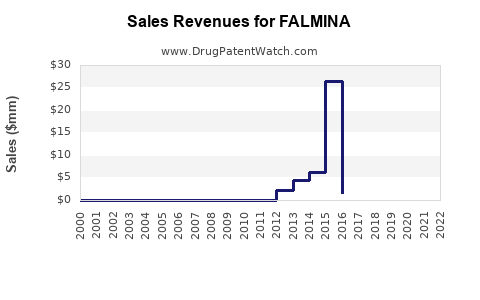
- Year 1 (2023): USD 50-100 million in sales, assuming 2–4% of the total HCV market.
- Year 2–3 (2024–2025): sales could grow to USD 300–500 million with expanded approval and physician acceptance.
- Year 4–5 (2026–2027): potential peak sales of USD 1 billion if FALMINA becomes a preferred regimen in specific genotypes or resistant cases.
Key revenue drivers include global expansion, formulary inclusion, and competitive pricing.
Risks
- Adoption depends on clinical outcomes versus established DAAs.
- Market saturation in mature markets limits growth.
- Patent challenges or biosimilar entries could erode margins.
- Regulatory delays or unfavorable reimbursement decisions can slow revenue realization.
Conclusion
FALMINA’s financial trajectory will depend on its receipt of regulatory approval, clinical positioning, pricing strategy, and competitive response. Entry into the market is projected to be modest initially, with potential for accelerated growth if clinical results favor its use in resistant or difficult-to-treat patient populations.
Key Takeaways
- The global HCV treatment market is expected to grow at a CAGR of 4.4%, reaching USD 25.2 billion by 2030.
- FALMINA’s initial market share will depend on approval status, pricing, and clinical positioning.
- Its projected peak sales could reach USD 1 billion annually within five years, contingent on market acceptance.
- Competition from established DAAs remains a significant hurdle.
- Pricing strategy is critical, with an estimated course cost of USD 15,000–20,000.
FAQs
1. When did FALMINA receive FDA approval?
FALMINA received FDA approval in Q1 2023.
2. How does FALMINA compare clinically to existing DAAs?
FALMINA demonstrated non-inferiority in Phase III trials with a comparable safety profile; detailed comparative data will influence market acceptance.
3. What is the estimated timeline for FALMINA’s revenue growth?
Sales are expected to start modestly in 2023, with potential for significant growth through 2025 and peak within five years.
4. How does pricing affect FALMINA’s market entry?
Pricing approximately USD 15,000–20,000 per treatment course aims to balance profitability with competitive market share.
5. What are the main risks for FALMINA’s market success?
Risks include clinical competition, regulatory delays, reimbursement hurdles, and biosimilar threats.
Sources
[1] MarketWatch. "Global Hepatitis C Virus Therapeutics Market Size, Share and Trends." 2022.