Last updated: July 29, 2026
EXALGO (hydromorphone hydrochloride) Market Dynamics and Financial Trajectory: Sales Trends, Exclusivity Timelines, and Competitive Risks
EXALGO (hydromorphone hydrochloride) is a prescription extended-release (ER) opioid brand. The market’s financial trajectory is dominated by (1) opioid risk management and payer restrictions, (2) generic ER hydromorphone erosion, and (3) label, formulation, and REMS dynamics affecting demand and utilization.
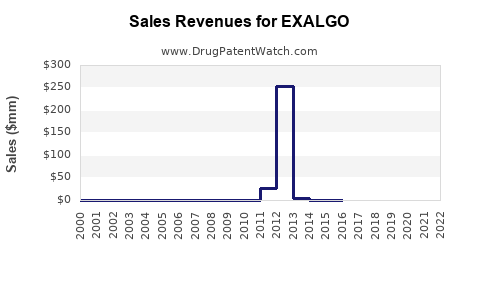
What is the financial trajectory of EXALGO (hydromorphone ER) sales?
Featured snippet answer: EXALGO’s financial trajectory has been shaped by generic competition to ER hydromorphone and broader opioid market tightening, with brand sales constrained over time by substitution and payer controls.
Where sales typically sit in the opioid ER segment
- The opioid ER market has shifted toward fewer reimbursed products and tighter criteria for initiation and continuation.
- ER opioids with available generic substitutes generally see faster erosion than products protected by meaningful formulation and use patents plus 180-day exclusivity leverage (when applicable).
Drivers that change near-term and mid-term brand revenue
- Formulary access: Payer tiering, prior authorization, quantity limits, and step therapy reduce addressable demand.
- Dose/discontinuation patterns: Opioid stewardship programs lower long-duration ER use in some cohorts.
- Litigation and policy: Opioid settlement dynamics and corporate risk management influence contracting decisions and marketing spend.
- Generic substitution timing: When AB-rated generics are available at parity or near-parity price points, brand ASP compression accelerates.
Implication for investors and licensors
- For brand endurance, the key variable is not “total class growth,” but the ability to retain formulary status against AB-rated generics and to avoid label restrictions that narrow patient segments.
How do opioid REMS, prescriber restrictions, and payer controls affect EXALGO market dynamics?
Featured snippet answer: EXALGO demand is strongly influenced by REMS-adjacent risk management, payer controls, and prescriber behavior that reduce ER opioid initiation and increase monitoring.
REMS and risk-control channels affecting utilization
- ER opioid prescribing requires alignment with risk mitigation frameworks, including careful patient selection, titration, and monitoring.
- Many payers apply opioid-specific utilization management that targets new starts, high-dose regimens, and long-term continuations.
Payer behaviors that reduce ER opioid brand sales
- Prior authorization for ER opioids.
- “Fail-first” requirements (short-acting opioid stabilization before ER).
- Coverage carveouts for specific diagnoses or non-cancer pain categories.
- Limits tied to morphine milligram equivalents (MME) thresholds.
Formulary position outcomes
- Once generics gain broad coverage, brand retention depends on:
- differentiated clinical positioning within the label,
- contracting arrangements,
- and any remaining patent or exclusivity advantages.
What patents protect EXALGO and how strong is the patent estate?
Featured snippet answer: The defensibility of EXALGO historically depends on hydromorphone ER formulation and method-of-use patent coverage in addition to any associated FDA exclusivities. Patent strength determines whether generics can launch without Paragraph IV litigation risk.
Key patent estate categories that matter for ER opioids
- Formulation patents: ER matrix, coating, dose dumping prevention, particle engineering, and excipient systems.
- Method-of-use patents: dosing regimens, titration methods, specific patient populations, and clinical outcome claims.
- Manufacturing/process patents: controlled release mechanisms and manufacturing parameters.
- Polymorph/crystal form patents: if present for the active or key intermediates.
How estate strength ties to financial trajectory
- A robust patent barrier slows generic entry and preserves brand ASP and volume.
- Once meaningful barriers fall, brand revenue generally declines rapidly due to AB substitution and payer switching.
When does EXALGO lose exclusivity and what are the generic launch risks?
Featured snippet answer: EXALGO’s exclusivity end points determine when generic ER hydromorphone can fully erode brand share. The practical launch risk depends on (1) patent expiration timing and (2) whether ANDA approvals are blocked by Paragraph IV litigation.
Generic entry risk mechanics
- Generics can enter at launch if:
- patents listed in the Orange Book are not asserted,
- or are found invalid/not infringed,
- or litigation settles allowing an agreed design-around or launch date.
- Brand revenue is most exposed when:
- the last meaningful patent or exclusivity listed for the ER product expires, and
- the generic is AB-rated with formulary access.
Financial read-through
- Expect stepwise revenue drops around:
- first generic availability (partial switch),
- broader payer adoption of generics,
- and subsequent price compression in ER hydromorphone.
What is the Orange Book status of EXALGO (hydromorphone ER)?
Featured snippet answer: Orange Book status governs patent listings tied to ANDA launch timing. EXALGO’s brand value is highest when Orange Book-listed patents remain enforceable against generic applicants.
How to interpret Orange Book listings for ER opioids
- Identify:
- Drug product (brand strength and dosage form),
- Patent numbers,
- Patent expiry dates,
- Exclusivities (if any),
- Listed exclusivities tied to NCE, 505(b)(2), or changes (where applicable).
Why this matters commercially
- Orange Book listings determine whether a generic must file Paragraph IV certifications and trigger 30-month stays, or whether launch can proceed with fewer legal constraints.
How do competitors and generics affect EXALGO pricing, volume, and revenue?
Featured snippet answer: Generic ER hydromorphone substitutes pressure EXALGO’s ASP and volume through AB switching and payer contracting.
Competitive landscape dynamics
- ER hydromorphone is a therapeutic and dosing substitute with multiple generic manufacturers once patents are cleared.
- Competition typically produces:
- ASP compression across the category,
- increased rebate pressure,
- and reduced brand market share.
What to track for market trajectory
- Brand vs. total category sales by quarter.
- Generic share metrics in ER hydromorphone.
- Contracting patterns (net-to-gross decline, rebate rate changes).
- Patient switching events post-coverage updates.
Commercial consequence
- Once generic penetration reaches broad formulary status, revenue tends to follow:
- declining unit share,
- declining ASP,
- and reduced marketing effectiveness relative to generic price points.
What patent litigation affects EXALGO and what settlement outcomes matter for launch timing?
Featured snippet answer: Patent litigation and settlement outcomes can shift generic launch timing and determine whether the market sees early or delayed AB substitution.
Litigation pathways relevant to EXALGO
- ANDA Paragraph IV litigation over Orange Book-listed patents.
- Court-managed stays (including 30-month automatic stays linked to timely filings).
- Settlements that:
- license branded supply to generics,
- agree on modified launch dates,
- or allow launch after specified patent expiry.
Financial consequence of settlement terms
- Launch date delays typically preserve brand revenue but rarely stop erosion long-term once multiple patents and exclusivities clear.
- Licensing terms can create a “soft” revenue floor if branded royalties replace lost sales, but ER opioids generally don’t sustain brand economics without meaningful exclusivity.
How does EXALGO compare with other ER opioids in market performance and formulary access?
Featured snippet answer: ER opioids face similar utilization management pressures, but relative performance depends on generic availability, payer tiering, and any remaining product-specific defensibility.
Relative positioning variables
- Patent defensibility and time-to-generic substitution.
- Label breadth (indications, contraindications, dosing limitations).
- REMS-related compliance burden.
- Payer preferred drug lists and contracting history.
- Safety communications history affecting switching to alternative ER opioids.
Where EXALGO sits in practice
- If AB-rated generic ER hydromorphone products are widely available, EXALGO’s relative formulary position typically weakens versus alternatives that retain exclusivity or have better payer standing.
Which formulations of EXALGO (strengths, dose forms) face the highest erosion risk?
Featured snippet answer: Strengths and dosage forms that have broader generic coverage, easier dosing equivalency, and fewer product-specific design-around barriers face the fastest erosion.
Erosion risk factors
- Generic applicants choose strengths that maximize clinical and commercial overlap.
- Payer tiering often moves all strengths together after the first generic achieves formulary inclusion.
- Manufacturing scale and supply reliability can accelerate substitution.
Commercial impact
- When initial generics launch for select strengths, erosion can start unevenly, then becomes broad once payers harmonize formularies across strengths.
What manufacturing and IP barriers could slow generic entry for EXALGO?
Featured snippet answer: Generic entry barriers are primarily legal (patents listed in the Orange Book) and regulatory (bioequivalence requirements), with manufacturing barriers secondary once generic design-around is viable.
Primary barriers
- Patent coverage in ER formulation and method-of-use.
- Ability to meet dissolution and release-profile targets for ER hydromorphone.
Secondary barriers
- Manufacturing validation for consistent release characteristics.
- Supply chain reliability and lot-to-lot consistency for ER products.
Why the barrier profile matters financially
- If design-around is straightforward, erosion accelerates.
- If only limited generic designs can meet the ER release requirements, erosion may be slower or more staggered.
What revenue exposure does EXALGO have in the next generic substitution cycle?
Featured snippet answer: Revenue exposure is concentrated around the remaining life of enforceable patents and any litigation-driven delays that postpone AB substitution.
Exposure map (commercial)
- High exposure: markets where EXALGO is already non-preferred and where payer policies allow immediate generic substitution.
- Medium exposure: markets with active prior authorization rules or continuing brand-preferred contracts.
- Lower exposure: markets where brand contracting persists until the final patent or exclusivity barrier clears.
Risk indicators that forecast a revenue step-down
- Orange Book changes and patent expiry approaching for listed patents.
- Court rulings favoring generic entrants.
- Settlements with agreed “at-risk” launches.
- Rapid generic adoption on pharmacy benefit manager (PBM) preferred lists.
Key Takeaways
- EXALGO’s market dynamics are dominated by opioid risk management, payer utilization controls, and AB-rated substitution pressures from generic ER hydromorphone products.
- Financial trajectory is typically stepwise: preserved performance while enforceable exclusivity/patent barriers exist, followed by rapid erosion once generic entry becomes formulary-wide.
- Patent estate strength and Orange Book status determine the timing of generic substitution and thus the timing of revenue decline.
- Litigation and settlement outcomes can shift launch timing, but they usually delay rather than prevent long-term category substitution.
FAQs
1) What drives EXALGO (hydromorphone ER) net price compression after generic launch?
AB substitution plus formulary re-tiering compresses ASP and increases rebate pressure for brand-only access.
2) How do prior authorization and step therapy policies affect EXALGO patient starts?
They reduce new initiations and shift prescribers toward already-preferred ER alternatives or generics.
3) What is the biggest commercial difference between EXALGO and other ER hydromorphone competitors?
The presence or absence of enforceable patent barriers and how quickly generics achieve broad formulary inclusion.
4) Do settlements in ER opioid ANDA litigation typically delay generic erosion?
They can delay launch and reduce immediate share loss, but broad payer adoption usually drives longer-run erosion.
5) What product attributes most influence ER opioid generic bioequivalence acceptance?
Release-profile matching and dissolution behavior aligned with ER design requirements determine approval speed and substitution likelihood.
References
- FDA Orange Book: Approved Drug Products with Therapeutic Equivalence Evaluations (accessed via FDA database).
- FDA. Guidance for Industry: Bioavailability and Bioequivalence Studies for Nasal Spray and Regul. (for bioequivalence framework applicable to ER products).