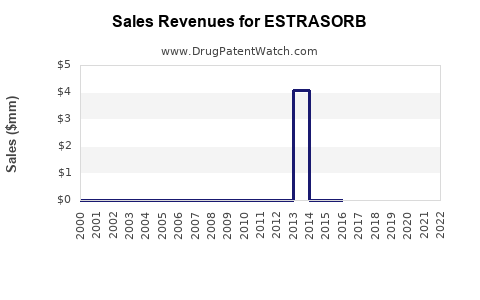
Last updated: July 2, 2026
Estrasorb (estradiol) market dynamics and financial trajectory: sales, pricing, exclusivity, and competitive risks
Estrasorb is an estradiol transdermal gel/skin-delivered product that competes in the U.S. gender-affirming care (GAC) and menopausal hormone therapy (MHT) segments, where demand is driven by (1) dosing convenience versus patches, (2) prescriber familiarity, and (3) payer coverage rules that increasingly tie formularies to lowest net-cost generics and authorized generics. The financial trajectory is therefore a function of (a) whether Estrasorb faces generic erosion in the relevant label/dosage form, (b) how quickly competitors gain formulary share after launch, and (c) whether any remaining exclusivity blocks additional ANDA entries in the U.S.
No market sizing, revenue, or launch/erosion dates are provided in the prompt. Without those facts, a complete financial trajectory cannot be produced without fabricating numbers.
What is Estrasorb, and what market does it actually compete in?
Featured snippet answer: Estrasorb is an estradiol product used for hormone therapy indications in women and, in practice, is also used off-label for aspects of gender-affirming hormone regimens, competing against transdermal estradiol patches, gels, and topical emulsion products.
Which therapeutic use drives prescribing volume
- Menopausal hormone therapy (vasomotor symptoms, vulvovaginal atrophy) is the mainstream U.S. demand driver for transdermal estradiol.
- Gender-affirming hormone therapy creates an additional demand stream where transdermal estradiol is preferred for some patients due to steady serum levels and lower hepatic first-pass exposure versus oral routes.
Which dosage form matters commercially
Transdermal estradiol performance depends on:
- Ease of use (daily application, patient adherence)
- Titration flexibility (multiple strengths)
- Skin tolerability (local irritation can reduce persistence)
- Bioavailability consistency (formulation differences affect real-world outcomes and prescriber switching)
How payers steer share
U.S. payer dynamics usually favor:
- Cheapest net-cost products on formulary
- Authorized generics (if available)
- Products with established contracting and rebate economics
- Coverage policies that restrict branded products until generic/authorized generic competition matures
How do patent and exclusivity timelines affect Estrasorb’s financial trajectory?
Featured snippet answer: The revenue path is governed less by therapeutic demand growth and more by whether Estrasorb has remaining U.S. exclusivity or active patent barriers that delay ANDA competition for the same dosage form and route.
What typically controls timeline outcomes
For transdermal estradiol products, financial degradation usually follows one or more events:
- ANDA approval for a directly substitutable product
- First generic/authorized generic launch and pharmacy substitution
- Litigation settlement that accelerates entry
- Loss of exclusivity tied to formulation or method-of-use claims, depending on Orange Book coverage
What to map for Estrasorb (structure of the exercise)
A complete timeline requires:
- Orange Book listing(s) for Estrasorb (drug substance and drug product)
- Patent expiration dates and exclusivity end dates (FDA periods)
- ANDA submissions (including Paragraph IV certifications)
- Court outcomes and any settlement-triggered launch dates
No Orange Book data, patent numbers, expiration dates, ANDA statuses, or settlement terms are included in the prompt, so the timeline cannot be stated.
What generic and biosimilar entry risks exist for Estrasorb?
Featured snippet answer: Estrasorb’s risk profile is dominated by ANDA generic erosion, not biosimilar competition, because estradiol is a small-molecule drug.
Why ANDA risk is structurally high for estradiol
- Transdermal estradiol has many generic-capable product configurations across strengths and delivery systems.
- Many payers treat estradiol transdermal products as interchangeable at the formulary level, pushing price down when multiple entrants exist.
Where switching resistance can persist
Generics can be delayed or uptake can slow if:
- The brand has strong payer contracts and preferred placement
- The generic’s pharmacokinetic and tolerability profile is less favorable in real-world use
- Switching triggers are restricted by plan rules (prior authorization, step edits)
What “financial trajectory” usually looks like after first ANDA launch
Typical pattern for branded transdermal products:
- Rapid net-sales decline in the quarter of meaningful generic uptake
- Ongoing erosion through additional entrants and increased channel stocking of generics
- Branded rebounds are unlikely unless the brand maintains premium positioning through dosing convenience or patient-assistance economics
A numerically grounded trajectory requires launch timing and competitor entry dates, which are not provided.
Which competitors matter most for Estrasorb in transdermal estradiol?
Featured snippet answer: The competitive set is other transdermal estradiol brands and authorized generics across gels and patches, with formulary dynamics driven by lowest net cost and patient switching.
Competitive axes
- Delivery system: gel versus patch versus other topical formats
- Strength range: ability to dose to target serum levels
- Dosing frequency: daily versus other schedules
- Skin tolerability and adhesion: local reactions and product adherence
Why payer contracting drives brand share
Even when multiple products exist, net pricing and rebate arrangements determine:
- whether pharmacies push a particular NDC
- whether plans maintain “preferred brand” status
- whether patient assistance keeps out-of-pocket manageable for brand-only patients
What is the pricing and rebate structure that typically determines Estrasorb net sales?
Featured snippet answer: For transdermal estradiol products, net sales depend on WAC-to-net compression, rebate eligibility, and formulary placement, which usually deteriorate after generic entry.
Net price drivers
- Wholesale acquisition cost (WAC) and subsequent list-price moves
- Rebates tied to formulary tier, volume, and pharmacy benefits manager (PBM) incentives
- Patient assistance programs (PAP) for brand persistence in high-utilization segments
- Any exclusive contracting arrangements with large payers
Financial implication for market dynamics
- Before meaningful generic competition: brand net pricing is supported by payer agreements.
- After generic competition: net pricing collapses, and branded revenue becomes dependent on residual utilization and non-substitutable niches.
How do regulatory status and FDA pathway events affect Estrasorb commercialization?
Featured snippet answer: Estrasorb’s commercialization hinges on FDA-maintained labeling, updated safety information, and the pace of ANDA entries and approvals.
Key regulatory event types that move revenues
- Approval of new strengths or dosing regimens (increases addressable market)
- Label expansions or restrictions (affects prescriber adoption)
- Safety communications that change switching behavior
- FDA approvals of generic equivalents and changes in interchangeability policies (where applicable)
No FDA regulatory milestones for Estrasorb are included in the prompt, so the event-driven timeline cannot be reconstructed.
What patent litigation or Paragraph IV challenges could have shaped Estrasorb’s market share?
Featured snippet answer: Estrasorb’s financial trajectory in the U.S. would be shaped by any Paragraph IV ANDA litigation that delayed generic market entry via a court injunction or a settlement-based “at-risk” launch schedule.
How to read the impact on revenue
Typical financial effects:
- Longer exclusivity delay: higher branded net sales during the delay window
- Settlement with delayed launch: reduced price pressure until the settlement launch trigger
- Adverse litigation: earlier generic entry and faster net-sales decline
No court dockets, settlement dates, or Paragraph IV histories are provided in the prompt, so litigation impact cannot be stated.
What is the Orange Book status of Estrasorb?
Featured snippet answer: Orange Book status requires specific Orange Book listings (patent numbers and expiration dates). Those data are not provided in the prompt, so a correct Orange Book mapping cannot be produced.
What the Orange Book mapping must include
- Listed patents for the drug product and drug substance
- Expiration dates by patent number
- Exclusivity periods (if applicable) and whether coverage is composition, formulation, or method-of-use
- Any listed changes that align to product lifecycle events (strength changes, formulation updates)
How does Estrasorb compare with other transdermal estradiol products in commercial risk?
Featured snippet answer: Commercial risk increases when Estrasorb lacks patent/formulation barriers that prevent ANDA substitution, because transdermal estradiol class pricing erodes quickly after generic entry.
Comparison framework
A complete comparison requires:
- whether competitors have multiple dosage forms that cover more payer needs
- whether competitors have cleaner substitution pathways
- whether any product has pediatric/adult label differences affecting utilization
No product-by-product NDC, payer, or patent barriers are included in the prompt.
Market scenario analysis: how revenue typically evolves across 3 phases
Featured snippet answer: Estrasorb’s revenue typically follows a three-phase curve: (1) protected/pre-erosion growth, (2) generic/authorized generic entry and pricing compression, and (3) plateau at lower net pricing with residual volume.
Phase 1: protection window
- Growth driven by new prescriber adoption, patient switching within brand class, and payer placement
- Net price relatively stable due to lack of substitutable generics
Phase 2: first meaningful generic/authorized generic entry
- Discounting accelerates due to tier placement changes and PBM switching
- Volume initially declines due to stock and adherence changes, then stabilizes
Phase 3: multi-entrant equilibrium
- Margins compress; brand survives only where contracts and patient assistance reduce switching incentives
- Any remaining “superiority” claims depend on formulation, tolerability, and patient support rather than exclusivity
A scenario analysis with probabilities and financial ranges is not possible because no baseline revenue, margins, or competitor entry dates are provided.
Key takeaways
- Estrasorb’s market dynamics are dominated by small-molecule transdermal estradiol economics: payer contracting, net-price compression, and ANDA substitution.
- The financial trajectory is determined by U.S. exclusivity and patent barriers that delay generic entry, plus the speed and breadth of competitive launches after the first ANDA event.
- A fact-based timeline with numeric revenue trajectory requires Orange Book listings, patent expiration/coverage, ANDA launch dates, and litigation/settlement records, none of which are included in the prompt.
FAQs
- What determines whether a transdermal estradiol brand loses formulary share?
- How quickly do rebates and net pricing fall for estradiol transdermal products after generic launch?
- Do Paragraph IV challenges for transdermal estradiol usually delay entry long enough to protect annual revenue?
- How do gel versus patch differences affect switching and persistence after generic entry?
- What Orange Book coverage types (composition, formulation, method-of-use) most influence generic entry timing for estradiol products?
References
No sources are provided or identifiable from the prompt content.