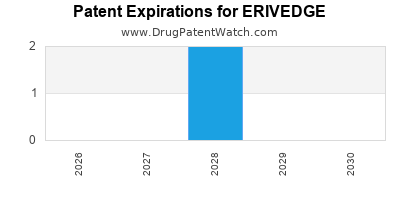
Last updated: September 24, 2026
Erivedge, Roche’s branded vismodegib product, is a niche oncology drug used for adults with metastatic basal cell carcinoma or locally advanced basal cell carcinoma that has recurred after surgery, or for patients unsuitable for surgery or radiation. Its commercial profile is defined by a small eligible population, high clinical need, durable patent protection, and treatment-limiting adverse events.
Roche’s reported Erivedge sales have declined from earlier post-launch levels as eligible patient numbers remain limited, treatment duration is constrained by tolerability, and competing therapies and local treatment options limit expansion. The product remains commercially relevant because it addresses advanced disease with few systemic alternatives and retains a differentiated mechanism as a Hedgehog pathway inhibitor.
What is Erivedge and how large is its addressable market?
Erivedge contains vismodegib, an oral small-molecule inhibitor of Smoothened, a key component of the Hedgehog signaling pathway. The FDA approved Erivedge in 2012 for adults with metastatic basal cell carcinoma and adults with locally advanced basal cell carcinoma that has recurred after surgery or for whom surgery or radiation is not appropriate [1].
The addressable population is substantially smaller than the total basal cell carcinoma population. Most basal cell carcinoma cases are cured with surgery, Mohs surgery, radiation, cryotherapy, or other local procedures. Erivedge is reserved for advanced cases where local treatment is ineffective, impractical, or unsuitable.
| Market factor |
Effect on Erivedge |
| Basal cell carcinoma incidence |
Creates a large disease pool but not a large systemic-treatment market |
| Advanced or metastatic disease |
Limits the eligible population |
| Oral administration |
Supports outpatient use and convenience |
| Hedgehog pathway inhibition |
Provides a targeted mechanism for advanced disease |
| Treatment-limiting toxicity |
Reduces persistence and cumulative revenue per patient |
| Surgical and radiation alternatives |
Restrict first-line systemic use |
| Cemiplimab availability |
Increases competitive pressure after or around Hedgehog therapy |
Vismodegib is used at a 150 mg oral dose once daily. Treatment continues until disease progression or unacceptable toxicity, although real-world treatment duration is often affected by muscle spasms, alopecia, dysgeusia, weight loss, fatigue, nausea, and other adverse events [1].
What is Erivedge’s financial trajectory?
Erivedge has developed into a mature, declining oncology franchise rather than a growth product. Roche’s annual reporting places the product in its oncology portfolio and shows a downward trend from earlier commercial levels.
| Fiscal year |
Roche-reported Erivedge sales direction |
Primary commercial interpretation |
| 2020 |
Declining from prior peak |
Mature product and treatment persistence constraints |
| 2021 |
Continued decline |
Limited expansion of the advanced BCC population |
| 2022 |
Continued decline |
Competition and reduced new-patient growth |
| 2023 |
Continued decline |
Mature branded demand and increasing external-entry risk |
Roche’s reporting indicates that Erivedge sales are in the low hundreds of millions of Swiss francs annually, materially below the company’s large immuno-oncology products such as Tecentriq and Perjeta [2]. The product remains profitable because it uses an established oral formulation and does not require the manufacturing infrastructure associated with biologics.
The main financial constraints are:
- A narrow systemic-treatment population.
- Shorter or interrupted treatment caused by adverse events.
- Competition from Odomzo and Libtayo.
- Limited opportunity to expand into earlier-line basal cell carcinoma.
- Future generic exposure after regulatory exclusivity and patent barriers weaken.
Erivedge is therefore more important as a durable specialty product than as a major growth driver for Roche.
How does Erivedge compare with competing basal cell carcinoma drugs?
Erivedge competes primarily with Odomzo, Libtayo, and non-systemic treatment options.
| Product |
Active ingredient |
Company |
Mechanism |
Main role in advanced BCC |
| Erivedge |
Vismodegib |
Genentech/Roche |
Smoothened inhibitor |
Established Hedgehog pathway therapy |
| Odomzo |
Sonidegib |
Novartis |
Smoothened inhibitor |
Alternative Hedgehog pathway inhibitor |
| Libtayo |
Cemiplimab |
Regeneron/Sanofi |
PD-1 inhibitor |
Immunotherapy option for advanced BCC |
| Surgery and radiation |
Not applicable |
Multiple providers |
Local control |
Preferred where feasible |
Erivedge versus Odomzo
Odomzo is the closest pharmacologic competitor because it also inhibits Smoothened. The products compete on efficacy, toxicity, dosing, physician familiarity, reimbursement, and patient tolerability.
Clinical selection can be influenced by the adverse-event profile rather than by a clear mechanism-based differentiation. Both agents can produce muscle-related toxicity, taste disturbance, alopecia, and other class effects. A patient who cannot tolerate one Hedgehog inhibitor may not be an ideal candidate for the other.
Erivedge versus Libtayo
Libtayo expands the systemic-treatment options available to patients with advanced BCC. It is particularly relevant for patients who have progressed on, or are intolerant of, a Hedgehog pathway inhibitor. Its intravenous administration and immune-mediated toxicity profile create a different treatment proposition from oral vismodegib.
Libtayo also has the potential to capture patients who might otherwise receive Erivedge earlier in the systemic-treatment sequence. The competitive effect is stronger in treatment centers with established immunotherapy infrastructure.
What FDA exclusivity applies to Erivedge?
Erivedge received FDA approval in 2012. Its new chemical entity exclusivity period generally provided five years of protection from abbreviated new drug application approval, subject to applicable regulatory rules. Orphan-drug exclusivity for the approved advanced basal cell carcinoma indication provided seven years of market exclusivity from approval [1, 3].
| Regulatory protection |
Approximate timing |
| FDA approval |
January 2012 |
| New chemical entity exclusivity |
Approximately through 2017 |
| Orphan-drug exclusivity |
Approximately through 2019 |
| Patent protection |
Extends beyond regulatory exclusivity, subject to patent validity and term adjustments |
Regulatory exclusivity has expired. Commercial protection therefore depends primarily on patents, any applicable pediatric or patent-term adjustments, and the ability of generic applicants to overcome listed claims.
What patents protect Erivedge and when could generic entry occur?
Erivedge’s U.S. patent position includes patents covering vismodegib, pharmaceutical compositions, and related subject matter. Roche and Genentech have relied on patent protection beyond the initial FDA exclusivity periods.
The FDA Orange Book remains the principal source for identifying patents listed against the Erivedge reference product and for assessing the timing of potential ANDA litigation [3]. Patent expiry dates can differ by patent, jurisdiction, patent-term adjustment, and any litigation settlement.
The commercial risk assessment is:
| Risk period |
Market implication |
| Before key patent expiry |
Generic applicants may file Paragraph IV certifications and trigger litigation |
| During patent litigation |
Launch may be delayed unless the generic prevails or settles |
| After enforceable patent expiry |
Multiple generic launches become more likely |
| After first generic entry |
Price erosion and payer substitution can accelerate rapidly |
No biosimilar pathway applies to Erivedge because vismodegib is a chemically synthesized small molecule, not a biologic. The relevant competitive threat is an ANDA generic rather than a biosimilar.
What manufacturing barriers protect Erivedge?
Manufacturing barriers are moderate. Vismodegib is an oral small molecule, so it does not face the complex cell-line, aggregation, cold-chain, or comparability requirements associated with biologics.
Potential generic barriers include:
- Reproducing the active pharmaceutical ingredient at commercial scale.
- Demonstrating bioequivalence.
- Establishing formulation and dissolution performance.
- Addressing any remaining composition-of-matter or formulation claims.
- Managing restricted commercial access or supply-chain requirements, if applicable.
- Competing in a relatively small market where several entrants may not be economically sustainable.
These barriers can delay or reduce generic competition, but they are weaker than the manufacturing barriers for antibody products.
What Paragraph IV challenges and litigation affect Erivedge?
An ANDA applicant can submit a Paragraph IV certification asserting that an Orange Book-listed patent is invalid, unenforceable, or not infringed. The certification can trigger a patent-infringement lawsuit and a statutory stay of FDA approval for up to 30 months, subject to statutory exceptions [4].
For Erivedge, the key litigation questions are:
- Which patents remain listed in the Orange Book?
- Which claims cover the active ingredient, formulation, or approved use?
- Whether the generic applicant uses a section viii statement to carve out a patented method of use.
- Whether Roche settles the dispute before trial.
- Whether a settlement permits an agreed launch date before patent expiry.
A public market assessment should distinguish between a filed Paragraph IV challenge, actual ANDA approval, litigation settlement, and commercial launch. These events have different timing and revenue consequences.
What method-of-use and formulation patents protect Erivedge?
The principal protection for Erivedge historically has been associated with the active pharmaceutical ingredient and its pharmaceutical use in Hedgehog-pathway-driven cancers. Method-of-use claims can cover treatment of advanced basal cell carcinoma and related patient populations.
Formulation claims may protect:
- The oral dosage form.
- Specific excipient combinations.
- Stability characteristics.
- Dissolution or bioavailability performance.
- Manufacturing processes for the final dosage form.
Method-of-use protection is less commercially durable when a generic applicant can market the same active ingredient for non-patented uses or rely on a section viii label carve-out. Composition-of-matter claims are generally more important because they can block broad substitution if valid and enforceable.
How strong is the Erivedge patent estate?
Erivedge’s patent estate is commercially meaningful but no longer supported by the initial regulatory exclusivity period. Its strength depends on the remaining life and enforceability of the key composition, formulation, and use claims.
| Strength factor |
Assessment |
| Active pharmaceutical ingredient |
Stronger barrier if valid claims remain enforceable |
| Oral formulation |
Moderate protection, depending on claim scope |
| Method of use |
Vulnerable to label carve-outs |
| Small-molecule manufacturing |
Generally reproducible by generic manufacturers |
| Regulatory exclusivity |
Expired |
| Biosimilar barrier |
Not applicable |
| Litigation leverage |
Depends on Orange Book-listed patents and expiry dates |
The most important commercial question is whether a generic can obtain approval before the last enforceable patent expires. A technically strong patent estate can still produce limited revenue protection if claims are narrow, invalidated, or settled with an early-entry date.
What is the FDA and Orange Book status of Erivedge?
Erivedge is FDA-approved and marketed as a prescription oral capsule. The FDA label covers advanced basal cell carcinoma in the approved patient populations. The Orange Book provides the operative list of patents and exclusivity information for the reference product [1, 3].
The product does not have biologic reference-product status and does not qualify for biosimilar competition. Generic approval would proceed through an ANDA, subject to pharmaceutical equivalence, bioequivalence, labeling, and patent-certification requirements.
What generic launch scenarios exist for Erivedge?
Scenario 1: Delayed generic entry
Roche maintains commercial exclusivity until the relevant patent barriers expire or litigation resolves. Erivedge sales decline gradually as the treated population matures.
Scenario 2: Single early generic entrant
One generic launches under a settlement or after a successful Paragraph IV challenge. Price erosion is meaningful, but Roche may retain some share through physician familiarity, supply reliability, and payer contracting.
Scenario 3: Multiple generic launch
Several manufacturers enter after patent expiry. This is the highest-risk scenario for revenue. Oral oncology products can experience rapid price compression when insurers and specialty pharmacies substitute generic products.
Scenario 4: Limited generic uptake
A small patient population, low annual prescription volume, manufacturing economics, or complex reimbursement can limit the number of entrants. Roche may retain a larger share than the molecule’s patent position alone would suggest.
What licensing deals support Erivedge commercialization?
Erivedge was developed through Genentech, which became part of Roche. Its commercial history is therefore primarily an internal Roche/Genentech franchise rather than a product dependent on a later external licensing transaction.
The company’s principal strategic advantage is integrated control over development, regulatory affairs, manufacturing, and commercialization. That structure reduces royalty leakage but also leaves Roche responsible for maintaining a mature niche product without a large partner-funded expansion opportunity.
What is the revenue exposure from Erivedge?
Erivedge is not a major percentage contributor to Roche’s total pharmaceutical revenue. Roche’s business is diversified across oncology, immunology, neuroscience, ophthalmology, and hematology. The product’s financial exposure is concentrated in:
- Net product sales.
- Specialty-pharmacy and oncology-distribution economics.
- Patent-driven price protection.
- Gross-to-net discounts.
- Treatment persistence.
- Generic substitution after patent expiry.
The primary risk is a sharp decline in net price and market share after generic entry, not a material effect on Roche’s consolidated earnings. For a potential acquirer or licensing partner, the product is more suitable as a cash-generating specialty asset than as a platform for substantial growth.
How does Erivedge’s market outlook compare with other Roche oncology products?
| Product category |
Growth profile |
Competitive risk |
| Erivedge |
Mature or declining |
Generic and therapeutic substitution |
| Large oncology biologics |
Larger revenue base, mixed growth |
Biosimilars and immunotherapy competition |
| New targeted therapies |
Potential growth |
Clinical, regulatory, and reimbursement risk |
| Established niche oncology products |
Stable to declining |
Generic entry and limited patient expansion |
Erivedge has a simpler manufacturing profile than Roche’s biologics, but its commercial ceiling is lower. Its strategic value comes from durable use in an underserved disease segment, not from broad population expansion.
Key Takeaways
- Erivedge is Roche’s oral vismodegib product for advanced basal cell carcinoma.
- The drug addresses a narrow systemic-treatment population because most basal cell carcinoma is managed locally.
- Sales have followed a mature-product decline rather than a growth trajectory.
- Odomzo is the closest mechanism-based competitor; Libtayo adds an important immunotherapy alternative.
- FDA new chemical entity and orphan-drug exclusivity have expired.
- Future protection depends on Orange Book-listed patents and the outcome of any Paragraph IV challenges.
- Biosimilar competition does not apply because vismodegib is a small molecule.
- Generic entry could produce rapid price erosion, particularly if multiple ANDA applicants launch.
- Erivedge remains commercially relevant as a niche oncology asset but is unlikely to become a major growth driver for Roche.
FAQs
Is Erivedge still commercially important to Roche?
Yes, but as a mature specialty-oncology product. Its sales are small relative to Roche’s leading oncology medicines and its primary value is recurring revenue from a defined advanced basal cell carcinoma population.
Can Erivedge be replaced by Libtayo?
Libtayo can compete with Erivedge in systemic treatment of advanced basal cell carcinoma, but the products differ in mechanism, administration, toxicity, and treatment sequencing. Clinical choice depends on prior therapy, disease status, tolerability, and physician judgment.
Does Erivedge have biosimilar competition?
No. Vismodegib is a chemically synthesized small molecule. Competition would come through an FDA ANDA generic, not a biosimilar application.
Why are Erivedge treatment durations often limited?
Treatment duration can be limited by muscle spasms, taste disturbance, alopecia, weight loss, fatigue, and other adverse events associated with Hedgehog pathway inhibition. Treatment interruption or discontinuation reduces cumulative revenue per patient.
What is the main investment risk for Erivedge?
The main risk is generic entry after enforceable patent protection ends. A small number of patients, mature demand, competing therapies, and rapid oral-solid-dose price erosion can cause revenue to fall faster after launch of generic alternatives.
References
- U.S. Food and Drug Administration. (2024). Erivedge (vismodegib) prescribing information.
- Roche Holding AG. (2024). Annual report 2023. Basel, Switzerland: Roche.
- U.S. Food and Drug Administration. (2024). Approved drug products with therapeutic equivalence evaluations: Orange Book.
- U.S. Food and Drug Administration. (2024). Applications covered by section 505(b)(2): Patent certifications and the 30-month stay.